Статья 19Регламент № 648/2004 Европейского парламента и Совета Европейского Союза
Актуально на 04.11.2026.
Как цитировать: Статья 19. Регламент N 648/2004 Европейского парламента и Совета Европейского Союза. 648/2004. https://bukva.ai/docs/reglament-6482004/statya-19
Настоящий Регламент вступает в силу 8 октября 2005 г.
Настоящий Регламент обязателен во всей своей полноте и подлежит непосредственному применению во всех государствах-членах ЕС.
Совершено в Страсбурге, 31 марта 2004 г.
СТАНДАРТЫ АККРЕДИТАЦИИ, НАДЛЕЖАЩЕЙ ЛАБОРАТОРНОЙ ПРАКТИКИ И ЗАЩИТЫ ЖИВОТНЫХ, ПРИМЕНЯЕМЫЕ К ЛАБОРАТОРИЯМ, КОТОРЫЕ ЯВЛЯЮТСЯ КОМПЕТЕНТНЫМИ И УПОЛНОМОЧЕННЫМИ ПРЕДОСТАВЛЯТЬ НЕОБХОДИМЫЕ УСЛУГИ ПО ПРОВЕРКЕ СООТВЕТСТВИЯ ДЕТЕРГЕНТОВ ТРЕБОВАНИЯМ НАСТОЯЩЕГО РЕГЛАМЕНТА И ПРИЛОЖЕНИЙ К НЕМУ
1. Стандарты, применяемые на уровне лабораторий:
- EN ISO/IEC 17025, Общие требования к компетенции лабораторий, осуществляющих калибрование и испытание;
- Директива 2004/10/ЕС;
- Директива 86/609/ЕЭС Совета ЕС.
2. Стандарты, применяемые на уровне органов по аккредитации и органов, осуществляющих контроль за соблюдением надлежащей лабораторной практики:
- EN 45003, Система аккредитации лабораторий, осуществляющих калибрование и испытание, общие требования к эксплуатации и признанию;
- Директива 2004/9/ЕС.
МЕТОДЫ ИСПЫТАНИЙ СПОСОБНОСТИ К ПЕРВИЧНОЙ БИОДЕГРАДАЦИИ ПОВЕРХНОСТНО-АКТИВНЫХ ВЕЩЕСТВ В ДЕТЕРГЕНТАХ
Способность к первичной биодеградации измеряется путем определения оставшегося уровня исходных поверхностно-активных веществ в биодеградировавших жидкостях. Настоящее Приложение начинается с перечня методов испытаний, общих для всех классов поверхностно-активных веществ, после чего под заголовками A - D перечисляются аналитические процедуры испытаний, специфичных для каждого класса поверхностно-активных веществ.
Критерием успешного прохождения испытания на способность к первичной биодеградации является достижение уровня, составляющего как минимум 80%, который измеряется в соответствии с нижеуказанными методами испытаний.
Эталонный метод лабораторного испытания поверхностно-активных веществ в настоящем Регламенте основан на «процедуре контрольного испытания» в методе Организации экономического сотрудничества и развития (OECD), изложенном в Приложении VIII.1. Изменения в процедуре контрольного испытания допускаются при том условии, что они соответствуют стандарту EN ISO 11733.
(1) Метод OECD, опубликованный в техническом отчете OECD от 11 июня 1976 г. под названием «Предлагаемый метод определения способности к биодеградации поверхностно-активных веществ в синтетических детергентах».
(2) Метод, используемый во Франции, который утвержден « arrêté du 24 décembre 1987», опубликованным в Journal officiel de la République française от 30 декабря 1987 г., стр. 15385, и стандартом NF 73-260 от июня 1981 г., опубликованным Association française de normalisation (AFNOR).
(3) Метод, используемый в Германии, установленный «Verordnung über die Abbaubarkeit anionischer und nichtionischer grenzflächenaktiver Stoffe in Wasch- und Reinigungsmitteln» от 30 января 1977 г., опубликованный в Bundesgesetzblatt от 1977 г., Часть I, стр. 244, изложенный в Регламенте о внесении изменений в указанный Регламент от 4 июня 1986 г., опубликованный в Bundesgesetzblatt 1986 г., Часть I, стр. 851.
(4) Метод, используемый в Соединенном Королевстве, под названием «Porous Pot Test» и описанный в техническом отчете № 70 (1978) Water Research Centre.
(5) «Процедура контрольного испытания» в методе OECD, описанном в Приложении VIII.1 (включая возможные изменения в условиях проведения испытания, предложенные в EN ISO 11733). Настоящий метод также является эталонным методом, используемым для урегулирования спорных вопросов.
Определение анионных поверхностно-активных веществ в испытаниях проводится анализом активного вещества метилена голубого (Methylene Blue Active Substance — MBAS) в соответствии с критериями, установленными Приложением VIII.2. В отношении тех анионных поверхностно-активных веществ, которые не реагируют на вышеуказанный метод (MBAS), или если это необходимо в целях обеспечения большей эффективности или точности, должен применяться соответствующий специфический инструментальный анализ, такой как высокоэффективная жидкостная хроматография (HPLC) или газовая хроматография (GC). Производитель по требованию должен предоставить компетентным органам государств-членов ЕС образцы чистого поверхностно-активного вещества, необходимого для проведения испытаний.
Определение неионогенных поверхностно-активных веществ в испытаниях проводится методом активного вещества висмута (Bismuth Active Substance — BiAS) в соответствии аналитической процедурой, установленной Приложением VIII.3.
В отношении тех неионогенных поверхностно-активных веществ, которые не реагируют на вышеуказанный метод (BiAS), или если это необходимо в целях обеспечения большей эффективности или точности, должен применяться соответствующий специфический инструментальный анализ, такой как высокоэффективная жидкостная хроматография (HPLC) или газовая хроматография (GC). Производитель по требованию должен предоставить компетентным органам государств-членов ЕС образцы чистого поверхностно-активного вещества, необходимого для проведения испытаний.
Определение катионных поверхностно-активных веществ в испытаниях проводится анализом активного вещества дисульфина голубого (Disulfine Blue Active Substance — DBAS) в соответствии со следующими DBAS процедурами:
Метод, используемый в Федеративной Республике Германии, (1989) DIN 38 409 — Ausgabe: 1989-07.
В отношении тех катионных поверхностно-активных веществ, которые не реагируют на вышеуказанный метод испытания, или если это необходимо в целях обеспечения большей эффективности или точности (что должно быть надлежащим образом обосновано), должен применяться соответствующий специфический инструментальный анализ, такой как высокоэффективная жидкостная хроматография (HPLC) или газовая хроматография (GC). Производитель по требованию должен предоставить компетентным национальным органам государств-членов ЕС образцы чистого поверхностно-активного вещества, необходимого для проведения испытаний.
Определение амфотерных поверхностно-активных веществ в испытаниях проводится посредством анализа после процедур, перечисленных ниже:
1. При отсутствии катионных поверхностно-активных веществ:
Метод, используемый в Федеративной Республике Германии, (1989) DIN 38 409-Teil 20.
Метод Orange II (Boiteux, 1984).
В отношении тех катионных поверхностно-активных веществ, которые не реагируют на вышеуказанные методы испытания, или если это необходимо в целях обеспечения большей эффективности или точности (что должно быть надлежащим образом обосновано), должен применяться соответствующий специфический инструментальный анализ, такой как высокоэффективная жидкостная хроматография (HPLC) или газовая хроматография (GC). Производитель по требованию должен предоставить компетентным органам государств-членов ЕС образцы чистого поверхностно-активного вещества, необходимого для проведения испытаний.
МЕТОДЫ ИСПЫТАНИЙ СПОСОБНОСТИ К ОКОНЧАТЕЛЬНОЙ БИОДЕГРАДАЦИИ (МИНЕРАЛИЗАЦИИ) ПОВЕРХНОСТНО-АКТИВНЫХ ВЕЩЕСТВ В ДЕТЕРГЕНТАХ
A. Эталонный метод лабораторного испытания способности к окончательной биодеградации поверхностно-активного вещества в настоящем Регламенте основан на стандарте EN ISO 14593:1999 (испытание с CO2 в свободном пространстве над продуктом).
Поверхностно-активные вещества, содержащиеся в детергентах, считаются биодеградируемыми, если уровень способности к биодеградации (минерализации), измеряемый в соответствии с одним из нижеследующих испытаний <*>, составляет как минимум 60% в течение 28 дней:
<*> Данные испытания определены в качестве наиболее подходящих для поверхностно-активных веществ.
1. стандарт EN ISO 14593:1999 — Качество воды — Оценка способности к окончательной аэробной биодеградации органических соединений в водной среде — Метод анализа неорганического углерода в герметизированных сосудах (испытание с CO2 в свободном пространстве над продуктом). Преадаптация не проводится. Принцип 10-дневного «окна» не применяется (эталонный метод).
2. Метод, изложенный в Приложении V.C.4-C к Директиве 67/548/ЕЭС (освобождение диоксида углерода (CO2), модифицированное испытание тип Sturm): преадаптация не проводится. Принцип 10-дневного «окна» не применяется.
3. Метод, изложенный в Приложении V.C.4-E к Директиве 67/548/ЕЭС (закрытая колба): преадаптация не проводится. Принцип 10-дневного «окна» не применяется.
4. Метод, изложенный в Приложении V.C.4-D к Директиве 67/548/ЕЭС (манометрическая респирометрия): преадаптация не проводится. Принцип 10-дневного «окна» не применяется.
5. Метод, изложенный в Приложении V.C.4-F к Директиве 67/548/ЕЭС (MITI: Министерство международной торговли и промышленности, Япония): преадаптация не проводится. Принцип 10-дневного «окна» не применяется.
6. Стандарт ISO 10708:1997 — Качество воды — Оценка способности к окончательной аэробной биодеградации органических соединений в водной среде — Определение биохимической потребности в кислороде посредством двухфазного испытания в закрытом сосуде. Преадаптация не проводится. Принцип 10-дневного «окна» не применяется.
B. В зависимости от физических свойств поверхностно-активного вещества может быть использован один из нижеуказанных методов, если это надлежащим образом обосновано <*>. Следует отметить, что критерий успешного прохождения испытания в соответствии с данными методами, составляющий как минимум 70%, должен считаться эквивалентным критерию успешного прохождения испытания, составляющему как минимум 60%, указанному в методах, перечисленных в пункте A. Эквивалентность выбора нижеуказанных методов должна оцениваться на основании подтверждения в каждом конкретном случае в соответствии со Статьей 5 настоящего Регламента.
<*> Методы растворенного органического углерода (DOC) могут дать результаты в отношении степени удаления, а не окончательной биодеградации. Манометрическая респирометрия, метод Министерства внешней торговли и промышленности (MITI) и метод определения биохимического потребления кислорода в двухфазном закрытом сосуде (BOD) не будут подходящими в некоторых случаях, поскольку высокая начальная концентрация в испытании может приводить к возникновению ингибиторного эффекта.
1. Метод, изложенный в Приложении V.C.4-A к Директиве 67/548/ЕЭС (аннигиляция растворенного органического углерода (DOC)): преадаптация не проводится. Принцип 10-дневного «окна» не применяется. Критерий успешного прохождения испытания на способность к биодеградации, определяемой посредством испытания, должен составлять как минимум 70% в течение 28 дней.
2. Метод, изложенный в Приложении V.C.4-B к Директиве 67/548/ЕЭС (модифицированное скрининговое исследование OECD — аннигиляция растворенного органического углерода (DOC)): преадаптация не проводится. Принцип 10-дневного «окна» не применяется. Критерий успешного прохождения испытания на способность к биодеградации, определяемой посредством испытания, должен составлять как минимум 70% в течение 28 дней.
NB: те из вышеуказанных методов, которые были взяты из Директивы 67/548/ЕЭС Совета ЕС, могут быть также найдены в публикации «Классификация, упаковка и маркировка опасных веществ в Европейском Союзе», Часть 2: «Методы испытания». Европейская Комиссия 1997, ISBN 92-828-0076-8.
ДОПОЛНИТЕЛЬНАЯ ОЦЕНКА РИСКОВ В ОТНОШЕНИИ ПОВЕРХНОСТНО-АКТИВНЫХ ВЕЩЕСТВ, СОДЕРЖАЩИХСЯ В ДЕТЕРГЕНТАХ
Для тех поверхностно-активных веществ, в отношении которых предусмотрена оценка экологических рисков в контексте Директивы 93/67/ЕЭС или Регламента (ЕЭС) 793/93, Регламента (ЕС) 1488/94 и Технических руководств, данная оценка рисков должна рассматриваться вместе с дополнительной оценкой рисков, проводимой в рамках сферы применения настоящего Регламента.
В тех случаях, когда существует высокая вероятность образования стойких метаболитов, дополнительная оценка рисков, проводимая в рамках сферы применения настоящего Регламента, должна рассматриваться в контексте оценок, проводимых в рамках Директивы 93/67/ЕЭС или Регламента (ЕЭС) 793/93. Указанная оценка должна проводиться в каждом конкретном случае и, в частности, на основе результатов испытаний, указанных в Части 3.
Исследование должно охватывать водный составляющий компонент окружающей среды. Указанный в Статье 12(2) Комитет в каждом конкретном случае имеет право затребовать дополнительную информацию, касающуюся специфических вопросов оценки рисков. Дополнительная информация может включать в себя и другие составляющие компоненты окружающей среды, например, осадки сточных вод и почву. В отношении дополнительной информации, которая должна быть включена в технический файл, указанный в Статьях 5 и 9, применяется ярусный подход. Файл должен содержать как минимум информацию, указанную в пунктах 1, 2 и 3, изложенных ниже.
Тем не менее с целью минимизации испытаний и, в особенности, во избежание излишних испытаний на животных дополнительные исследования, указанные в пункте 4.2.2, требуются только в тех случаях, когда такая информация является необходимой и соразмерной. В случае возникновения спора относительно объема требуемой дополнительной информации решение может быть принято в соответствии с процедурой, изложенной в Статье 12(2).
Как указано в Статье 13, включенное в настоящее Приложение руководство в отношении принятия решений о предоставлении частичного отступления может быть при необходимости адаптировано в свете накопленного опыта.
1. Идентичность поверхностно-активного вещества (в соответствии с положениями, изложенными в Приложении VII.A к Директиве 67/548/ЕЭС).
1.1.1 Название по номенклатуре IUPAC
1.1.2 Другие названия
1.1.3 Номер CAS и название CAS (при наличии)
1.1.4 Номера EINECS <*> или Elincs <**> (при наличии)
<*> Европейский инвентаризационный список существующих коммерческих химических веществ.
<**> Европейский перечень зарегистрированных химических веществ.
2.2. Информация о способах использования, приведенная в настоящем разделе, является достаточной для того, чтобы обеспечить приблизительную, но в то же время реалистичную оценку функции и экологического воздействия поверхностно-активного вещества, которые связаны с его использованием в составе детергентов. Данная информация должна включать следующее:
- важность применения (общественная польза);
- условия применения (сценарий выпуска);
- объем использования;
- наличие и пригодность альтернатив (соображения функционального и экономического характера);
- оценку соответствующей экологической информации.
Должна предоставляться информация о токсичности жидкостей, полученных при проведении испытания. Если отсутствуют данные об идентичности остатка, может быть затребована информация, указанная в пункте 4.2.1., в зависимости от потенциального риска, важности и количества поверхностно-активного вещества, используемого в составе детергентов. В случае возникновения спора в отношении данной информации решение может быть принято в соответствии с процедурой, изложенной в Статье 12(2).
4.1.1 Предварительно адаптированный инокулят
Любое из испытаний, указанных в Приложении III, может проводиться с использованием предварительно подготовленного инокулята с целью представления доказательств важности преадаптации поверхностно-активного вещества.
4.1.2 Испытания изначальной способности к биодеградации.
Как минимум одно из нижеуказанных испытаний должно быть предусмотрено:
- метод, изложенный в Приложении V.C.12 к Директиве 67/548/ЕЭС (модифицированное испытание SCAS);
- метод, изложенный в Приложении V.C.9 к Директиве 67/548/ЕЭС (Zahn-Wellens).
Отрицательный результат, полученный при проведении испытания изначальной способности к биодеградации, будет являться показателем потенциальной стойкости, который в принципе может считаться основанием, достаточным для запрета размещения на рынке данного поверхностно-активного вещества, за исключением тех случаев, когда критерии, указанные в Статье 6, показывают, что отсутствуют основания для отказа в предоставлении частичного отступления.
4.1.3. Испытания симулирования способности к биодеградации активированного ила.
Следующие испытания, указанные ниже, должны быть предусмотрены:
- метод, изложенный в Приложении V.C.10 к Директиве 67/548/ЕЭС (включая возможные изменения в условиях проведения испытания, предложенные в EN ISO 11733).
Отрицательный результат, полученный при проведении испытания симулирования способности к биодеградации активированного ила, будет являться показателем потенциальной возможности высвобождения метаболитов при очистке сточных вод, который в принципе может рассматриваться как доказательство необходимости проведения более полной оценки риска.
Должна предоставляться следующая информация о токсичности жидкостей, полученных при проведении испытания:
4.2.1 Физико-химические данные, в том числе:
- идентичность метаболита (и способы анализа, посредством которых она была получена);
- основные физико-химические свойства (растворимость в воде, коэффициент распределения октанол/вода (Log Po/w, и т.д.).
4.2.2. Воздействие на организмы. Испытания, которые должны проводиться в соответствии с принципами надлежащей лабораторной практики.
Рыба: рекомендуемым испытанием является испытание, указанное в Приложении V.C.1 к Директиве 67/548/ЕЭС.
Дафния: рекомендуемым испытанием является испытание, указанное в Приложении V.C.2 к Директиве 67/548/ЕЭС.
Водоросли: рекомендуемым испытанием является испытание, указанное в Приложении V.C.3 к Директиве 67/548/ЕЭС.
Бактерии: рекомендуемым испытанием является испытание, указанное в Приложении V.C.11 к Директиве 67/548/ЕЭС.
4.2.3 Деградация.
Биотическая: рекомендуемым испытанием является испытание, указанное в Приложении V.C.5 к Директиве 67/548/ЕЭС.
Абиотическая: рекомендуемым испытанием является испытание, указанное в Приложении V.C.7 к Директиве 67/548/ЕЭС. Предоставляемая информация должна учитывать потенциал метаболитов к биоконцентрации, а также их потенциал к распределению на фазе отложения осадка.
Кроме того, если возникают подозрения, что некоторые метаболиты вызывают нарушения в функционировании эндокринной системы, рекомендуется определить, способны ли они оказать негативное воздействие, как только будут доступны валидные схемы испытаний, позволяющие провести оценку такого негативного воздействия.
NB: все вышеуказанные методы могут быть также найдены в публикации «Классификация, упаковка и маркировка опасных веществ в Европейском Союзе», Часть 2: «Методы испытания». Европейская Комиссия 1997. ISBN 92-828-0076-8.
СПИСОК ПОВЕРХНОСТНО-АКТИВНЫХ ВЕЩЕСТВ, В ОТНОШЕНИИ КОТОРЫХ РАЗРЕШЕНО ЧАСТИЧНОЕ ОТСТУПЛЕНИЕ
Путем предоставления частичного отступления в соответствии со Статьями 4 - 6 и в соответствии с процедурой, изложенной в Статье 12(2), следующие поверхностно-активные вещества, содержащиеся в детергентах, которые проходят испытания, предусмотренные Приложением II, но при этом не проходят испытания, предусмотренные Приложением III, могут размещаться на рынке и использоваться при условии соблюдения ограничений, указанных ниже.
«EC номер» означает Einecs-, ELINCS- или NLP-номер и является официальным номером вещества в Европейском Союзе.
«Einecs» означает Европейский инвентаризационный список существующих коммерческих химических веществ. Данный список содержит точный перечень всех веществ, которые, как считается, были размещены на рынке Сообщества по состоянию на 18 сентября 1981 г. Einecs-номер может быть получен из Европейского инвентаризационного списка существующих коммерческих химических веществ <*>.
<*> ОЖ № C 146 A, 15.6.1990, стр. 1.
«ELINCS» означает Европейский перечень зарегистрированных химических веществ. ELINCS номер может быть получен из Европейского перечня зарегистрированных веществ (в последней редакции) <*>.
<*> Бюро официальных публикаций Европейских Сообществ, 2006, ISSN 1018-5593 EUR 22543 EN.
«NLP» означает No-Longer Polymer (вещество, которое больше не считается полимером). Определение термина «полимер» содержится в Статье 3(5) Регламента (ЕС) 1907/2006 Европейского Парламента и Совета ЕС <*>. NLP номер может быть получен из списка веществ, которые больше не считаются полимерами (в последней редакции) <**>.
<*> ОЖ № L 396, 30.12.2006, стр. 1, с изменениями, внесенными ОЖ № L 136, 29.5.2007, стр. 3.
<**> Бюро официальных публикаций Европейских Сообществ, 2007, ISSN 1018-5593 EUR 20853 EN/3.
СПИСОК ПОВЕРХНОСТНО-АКТИВНЫХ ВЕЩЕСТВ, ИСПОЛЬЗОВАНИЕ КОТОРЫХ В СОСТАВЕ ДЕТЕРГЕНТОВ ЗАПРЕЩЕНО ИЛИ ОГРАНИЧЕНО
Следующие поверхностно-активные вещества, входящие в состав детергентов, определены как не соответствующие требованиям настоящего Регламента:
| Название по номенклатуре IUPAC | EC номер | CAS номер | Ограничения |
|---|---|---|---|
«EC номер» означает Einecs-, ELINCS- или NLP-номер и является официальным номером вещества в Европейском Союзе.
ОГРАНИЧЕНИЯ В ОТНОШЕНИИ СОДЕРЖАНИЯ ФОСФАТОВ И ДРУГИХ СОЕДИНЕНИЙ ФОСФОРА
| Детергент | Ограничения | Дата, начиная с которой применяется ограничение |
|---|---|---|
| 1. Бытовые детергенты для стирки | Не должны размещаться на рынке, если общее содержание фосфора является равным или большим 0,5 г в рекомендуемом количестве детергента, используемого в основном цикле процесса стирки в стиральных машинах со стандартной загрузкой, указанной в Разделе B Приложения VII для жесткой воды: - для «нормально загрязненных» тканей при использовании детергентов для грубой стирки; - для «легко загрязненных» тканей при использовании детергентов для стирки деликатных тканей. |
30 июня 2013 г. |
| 2. Бытовые детергенты для автоматических посудомоечных машин | Не должны размещаться на рынке, если общее содержание фосфора является равным или большим 0,3 г в стандартной дозировке, указанной в Разделе B Приложения VII. | 1 января 2017 г. |
МАРКИРОВКА И СПЕЦИФИКАЦИЯ ИНГРЕДИЕНТОВ <*>
<*> Часть пунктов Приложения удалена актами, вносящими изменения — прим. перев.
К упаковке детергентов, предназначенных для продажи широкому кругу лиц, применяются следующие положения.
Используются нижеследующие диапазоны, выраженные в процентах по весу:
для указания содержания перечисленных ниже составляющих компонентов, если они добавляются в концентрации, превышающей 0,2% по весу:
- фосфаты;
- фосфонаты;
- анионные поверхностно-активные вещества;
- катионные поверхностно-активные вещества;
- амфотерные поверхностно-активные вещества;
- неионогенные поверхностно-активные вещества;
- кислородосодержащие отбеливающие вещества;
- хлорсодержащие отбеливающие вещества;
- EDTA (этилендиаминтетрауксусная кислота) и ее соли;
- NTA (нитрилотриуксусная кислота) и ее соли;
- фенолы и галогенированные фенолы;
- парадихлорбензол;
- ароматические углеводороды;
- алифатические углеводороды;
- галогенированные углеводороды;
- мыло;
- цеолиты;
- поликарбоксилаты.
Следующие классы составляющих компонентов, если они добавляются в состав детергентов, должны указываться независимо от их концентрации:
Если добавляются консерванты, то они должны быть указаны независимо от их концентрации с использованием по возможности общей номенклатуры, установленной в соответствии со Статьей 8 Директивы 76/768/ЕЭС Совета ЕС от 27 июля 1976 г. о сближении законодательства государств-членов ЕС в отношении косметической продукции <*>.
<*> ОЖ № L 262, 27.9.1976, стр. 169. Текст в редакции Директивы 2005/80/ЕС Европейской Комиссии (ОЖ № L 303, 22.11.2005, стр. 32).
Если в концентрациях, превышающих 0,01% по весу, добавляются аллергенные ароматические вещества, которые введены в список веществ, указанный в Части 1 Приложения III к Директиве 76/768/ЕЭС, в результате внесения в него изменений Директивой 2003/15/ЕС Европейского Парламента и Совета <*> с целью включения ингредиентов аллергенных ароматических веществ из списка, первоначально одобренного Научным комитетом по вопросам косметических и непищевых продуктов (SCCNFP) в его Заключении SCCNFP/0017/98, то рассматриваемые аллергенные ароматические вещества должны указываться с использованием номенклатуры, предусмотренной настоящей Директивой, равно как и любые другие аллергенные ароматические вещества, которые впоследствии включаются в Часть 1 Приложения III к Директиве 76/768/ЕЭС посредством адаптации данного Приложения в соответствии с уровнем научно-технического прогресса.
<*> ОЖ № L 66, 11.3.2003, стр. 26.
На упаковке должен указываться адрес веб-сайта, на котором можно получить информацию о списке ингредиентов, указанных в Разделе D Приложения VII.
В отношении детергентов, которые предназначены для использования только в промышленном и институциональном секторе и недоступны для использования широким кругом лиц, соблюдение вышеуказанных требований не является обязательным, если эквивалентная информация предоставлена посредством технических спецификаций, сертификатов безопасности продукта или любым другим соответствующим образом.
В соответствии со Статьей 11(4) настоящего Регламента к упаковке детергентов, предназначенных для продажи широкому кругу лиц, применяются следующие положения.
Упаковка детергентов, которые продаются широкому кругу лиц и предназначены для использования в качестве детергентов для стирки, должна содержать следующую информацию:
- рекомендуемые количества и/или инструкции по дозировке, выраженные в миллилитрах или граммах, соответствующие стандартной загрузке стиральной машины, для мягкой воды, воды средней жесткости и жесткой воды, а также указания в отношении одного или двух циклов процесса стирки;
- в отношении детергентов для грубой стирки, — количество стандартных загрузок стиральной машины при стирке «нормально загрязненных» тканей, а в отношении детергентов, предназначенных для деликатных тканей, — количество стандартных загрузок стиральной машины при стирке «легко загрязненных» тканей, которое может быть постирано с помощью содержимого одной упаковки при использовании воды средней жесткости, соответствующей 2,5 ммоль CaCO3/л;
- вместимость любой мерной чаши (если таковая предоставляется) должна быть указана в миллилитрах или граммах, а также должны быть предусмотрены метки для указания дозы детергента, соответствующей стандартной загрузке стиральной машины, при использовании мягкой воды, воды средней жесткости и жесткой воды.
Стандартная загрузка стиральной машины составляет 4,5 кг сухой ткани при использовании детергентов для грубой стирки и 2,5 кг сухой ткани при использовании детергентов для легкой стирки в соответствии с определениями, содержащимися в Решении 1999/476/ЕС Европейской Комиссии от 10 июня 1999 г. об установлении экологических критериев присвоения экологической маркировки Сообщества детергентам для стирки <*>. Детергент должен считаться предназначенным для грубой стирки за исключением тех случаев, когда требования производителя предусматривают преимущественно уход за тканью, то есть стирку при низкой температуре, деликатные и цветные ткани.
<*> ОЖ № L 187, 20.7.1999, стр. 52. Текст в редакции Решения 2011/264/ЕС (ОЖ № L 111, 30.4.2011, стр. 34).
Бытовые детергенты для автоматических посудомоечных машин.
Упаковка детергентов, которые продаются широкому кругу лиц и предназначены для использования в качестве детергентов для автоматических посудомоечных машин, должна содержать следующую информацию:
- стандартную дозировку, выраженную в граммах или миллилитрах, или количество таблеток для основного цикла стирки нормально грязной посуды в полностью загруженной посудомоечной машине комплекта посуды на 12 персон с указанием при необходимости условий применения для мягкой воды, воды средней жесткости и жесткой воды.
При составлении спецификации ингредиентов, указанной в Статье 9(3), применяются следующие положения.
Спецификация должна содержать название детергента и наименование производителя.
Все ингредиенты должны быть указаны в порядке убывания процентного содержания по весу; список должен быть подразделен на следующие диапазоны значений, выраженные в процентах от веса:
Примеси не должны считаться ингредиентами.
«Ингредиент» означает любое химическое вещество синтетического или естественного происхождения, намеренно включенное в состав детергента. Для целей настоящего Приложения ароматизирующие вещества, эфирные масла или красители должны рассматриваться как один ингредиент, и ни одно из веществ, которое они содержат, не должно указываться, за исключением тех аллергенных ароматических веществ, которые включены в список веществ, изложенный в Части 1 Приложения III к Директиве 76/768/ЕЭС, если общая концентрация аллергенного ароматического вещества в детергенте превышает предельное значение, указанное в Разделе A настоящего Приложения.
В отношении каждого ингредиента должно быть указано общепринятое химическое название или название по номенклатуре IUPAC <*> и, при наличии, название по номенклатуре INCI <**>, CAS-номер, а также название согласно Европейской фармакопее.
<*> Международный союз теоретической и прикладной химии.
<**> Международная номенклатура косметических ингредиентов.
Производители должны опубликовать на веб-сайте вышеуказанную спецификацию ингредиентов, за исключением следующей информации:
- не требуется информация в отношении диапазонов, выраженных в процентах по весу;
- не требуются CAS-номера;
- названия ингредиентов должны указываться в соответствии с номенклатурой INCI или Европейской фармакопеей (если название по номенклатуре INCI отсутствует). Если отсутствуют оба вышеуказанных названия, должно использоваться общепринятое химическое название или название по номенклатуре IUPAC. Для обозначения ароматизирующего вещества должно использоваться слово «ароматизатор», а для красителя — слово «краситель». Ароматизирующие вещества, эфирные масла или красители должны рассматриваться как один ингредиент, и ни одно из веществ, которое они содержат, не должно указываться, за исключением тех аллергенных ароматических веществ, которые включены в список веществ, изложенный в Части 1 Приложения III к Директиве 76/768/ЕЭС, если общая концентрация аллергенного ароматического вещества в детергенте превышает предельное значение, указанное в Разделе A настоящего Приложения.
Не допускается установление каких-либо ограничений или условий доступа к веб-сайту, а содержание веб-сайта должно поддерживаться в обновленном состоянии. Рассматриваемый веб-сайт должен включать ссылку на веб-сайт Европейской Комиссии Pharmacos или другой подходящий веб-сайт, содержащий таблицу соответствия между названиями по номенклатуре INCI, названиями согласно Европейской фармакопее и CAS-номерами.
Вышеуказанное требование не применяется к промышленным или институциональным детергентам или поверхностно-активным веществам для промышленных или институциональных детергентов, которые имеют технические спецификации или сертификаты безопасности продукта.
МЕТОДЫ ИСПЫТАНИЯ И АНАЛИТИЧЕСКИЕ МЕТОДЫ
Нижеследующие методы испытания и аналитические методы применяются к процедурам, осуществляемым государствами-членами ЕС с целью контроля детергентов, размещенных на рынке.
Настоящий метод описывает лабораторную модель «активированный ил + дополнительный отстойник», которая предназначена для симулирования системы очистки муниципальных сточных вод. Условия проведения испытания указаны в Директивах, предшествующих настоящему Регламенту. В рассматриваемом методе испытания могут использоваться улучшенные современные условия проведения испытания, указанные в EN ISO 11733.
Метод измерения использует небольшую установку для аэрации сточных вод активированным илом, представленную схематично на Рисунке 1 и более подробно — на Рисунке 2. Оборудование состоит из сосуда для сточных вод A, предназначенного для синтетических сточных вод, насоса-дозатора B, сосуда для аэрации C, осадочной камеры D, пневматического насоса E для рециркуляции активированного ила и сосуда F для сбора очищенных сточных вод.
Сосуды A и F должны быть изготовлены из стекла или подходящего пластика и должны вмещать как минимум двадцать четыре литра. Насос B должен обеспечивать постоянную подачу синтетических сточных вод в сосуд для аэрации; данный сосуд во время нормальной работы содержит три литра смешанной жидкости. Металлокерамический куб для аэрации G прикреплен к верхушке конуса сосуда C. Количество воздуха, продуваемого через аэратор, контролируется с помощью расходомера H.
Синтетические сточные воды используются для проведения испытания. Растворить в каждом литре водопроводной воды:
- 160 мг пептона;
- 110 мг экстракта мяса;
- 30 мг мочевины, CO (NH2)2;
- 7 мг хлорида натрия, NaCl;
- 4 мг хлорида кальция, CaCl2.2H2O;
- 2 мг сульфата магния, MgSO4.7H2O;
- 28 мг вторичного кислого фосфата калия, K2HPO4;
- и 10 +/- 1 мг поверхностно-активного вещества.
Свежие синтетические сточные воды должны приготавливаться ежедневно.
Несмешанные поверхностно-активные вещества должны исследоваться в исходном состоянии. Активное содержимое образцов поверхностно-активных веществ должно быть определено, чтобы подготовить синтетические сточные воды (1.3).
В исходном положении заполнить сосуд для аэрации C и осадочную камеру D синтетическими сточными водами. Высота сосуда D должна быть установлена таким образом, чтобы объем содержимого в сосуде для аэрации C составлял три литра. Инокуляция производится путем введения 3 мл сточных вод высокого качества, которые прошли вторичную очистку и являются свежеотобранными с очистной установки, осуществляющей преимущественно очистку бытовых сточных вод. Сточные воды должны храниться в аэробных условиях в течение всего времени между отбором и применением. Затем ввести в действие аэратор G, пневматический насос E и дозирующее устройство B. Синтетические сточные воды должны проходить через сосуд для аэрации C со скоростью один литр в час; это дает среднюю длительность отстаивания, равную трем часам.
Скорость аэрации должна быть отрегулирована таким образом, чтобы содержимое сосуда C постоянно находилось в состоянии суспензии, а содержание растворенного кислорода составляло как минимум, 2 мг/л. Образование пены должно предотвращаться путем применения подходящих средств. Не должны применяться противопенные добавки, которые подавляют активированный ил или содержат поверхностно-активные вещества. Пневматический насос E должен быть установлен таким образом, чтобы активированный ил с осадочной камеры постоянно и регулярно возвращался в сосуд для аэрации C. Ил, накопившийся вокруг верхней части сосуда для аэрации C, внизу осадочной камеры D или в контуре циркуляции должен возвращаться в циркуляцию как минимум один раз в день посредством очистки щеткой или другими подходящими способами. Если ил не оседает, его способность к оседанию может быть увеличена путем добавления порций объемом 2 мл 5% раствора хлорида железа; при необходимости данная операция может осуществляться несколько раз.
Сточные воды с осадочной камеры D накапливаются в сосуде F в течение двадцати четырех часов, а затем после тщательного перемешивания отбирается их образец. После отбора образца сосуд F должен быть тщательно очищен.
Содержание поверхностно-активного вещества (в мг/л) в синтетических сточных водах определяется непосредственно перед использованием.
Содержание поверхностно-активного вещества (в мг/л) в сточных водах, которые собрались в течение двадцати четырех часов в сосуде F, должно определяться аналитически тем же методом сразу же после отбора: в противном случае образцы должны быть сохранены, предпочтительно путем замораживания. Концентрация поверхностно-активного вещества должна определяться с точностью до 0,1 мг/л.
В целях проверки эффективности процесса химическая потребность в кислороде (COD) или содержание растворенного органического углерода (DOC) в сточных водах, профильтрованных через стекловолокно, накопленных в сосуде F, и профильтрованных синтетических сточных водах в сосуде A, измеряется как минимум два раза в неделю.
Уменьшение химической потребности в кислороде (COD) или растворенном органическом углероде (DOC) должно выравниваться, когда ежедневная деградация поверхностно-активного вещества становится приблизительно равномерной в конце пускового периода, показанного на Рисунке 3.
Содержание сухого вещества в активированном иле, собранном в сосуде для аэрации, должно определяться два раза в неделю в г/л. Если содержание сухого вещества в активированном иле превышает 2,5 г/л, его избыток должен быть отобран.
Испытание деградации проводится при комнатной температуре; данная температура должна быть постоянной и должна поддерживаться в интервале между 19 — 24 °C.
Процент деградации поверхностно-активного вещества должен рассчитываться ежедневно на основе содержания поверхностно-активного вещества в мг/л синтетических сточных вод и соответствующих сточных вод, собранных в сосуде F.
Полученные таким образом значения способности к деградации должны быть представлены в графическом виде, как показано на Рисунке 3.
Способность поверхностно-активного вещества к деградации рассчитывается как среднее арифметическое значений, полученных в течение двадцати одного дня, которые следуют за пусковым периодом и периодом акклиматизации, в течение которых деградация была регулярной и работа установки была бесперебойной. В любом случае продолжительность пускового периода не должна превышать шести недель.
Ежедневные значения деградации исчисляются с точностью до 0,1%, а конечный результат определяется путем округления до ближайшего целого числа.
В некоторых случаях может допускаться уменьшение частоты отбора образцов, но для исчисления среднего значения должны использоваться результаты как минимум 14 образцов, отобранных в течение двадцати одного дня, которые следуют за пусковым периодом.
Метод основывается на факте, что катионный краситель метиленовый голубой образует синие соли с анионными поверхностно-активными веществами (MBAS), которые могут быть экстрагированы при помощи хлороформа. Во избежание интерференции экстракция сначала осуществляется из щелочного раствора, а затем экстракт взбалтывается с кислым раствором метиленового голубого. Поглощательная способность отделенной органической фазы измеряется посредством фотометрии при длине волны максимального поглощения, равной 650 нм.
2.2.1 Буферный раствор pH 10.
Растворить 24 г бикарбоната натрия, NaHCO3 AR, и 27 г безводного карбоната натрия (Na2CO3) AR в деионизированной воде и разбавить до 1000 мл;
2.2.2. нейтральный раствор метиленового голубого.
Растворить 0,35 г метиленового голубого AR в деионизированной воде и разбавить до 1000 мл. Подготовить раствор как минимум за двадцать четыре часа до использования. Поглощательная способность хлороформовой фазы слепого опыта, измеряемая по отношению к хлороформу, не должна превышать 0,015 на 1 см толщины слоя при 650 нм;
2.2.3. кислый раствор метиленового голубого.
Растворить 0,35 г метиленового голубого AR в 500 мл деионизированной воды и перемешать с 6,5 мл H2SO4 (d = 1,84 г/мл). Разбавить до 1000 мл деионизированной водой. Подготовить раствор как минимум за двадцать четыре часа до использования. Поглощательная способность хлороформовой фазы слепого опыта, измеряемая по отношению к хлороформу, не должна превышать 0,015 на 1 см толщины слоя при 650 нм;
2.2.4. хлороформ (трихлорметан) AR свежедистиллированный;
2.2.5. метиловый эфир додецилбензолсульфокислоты;
2.2.6. спиртовой раствор гидроксида калия, KOH 0,1 M;
2.2.8. серная кислота, H2SO4 0,5 M;
Растворить 1 г фенолфталеина в 50 мл этанола и добавить 50 мл деионизированной воды, непрерывно помешивая. Отфильтровать любой полученный осадок;
2.2.10. метанольный раствор соляной кислоты: 250 мл соляной кислоты AR и 750 мл метанола;
2.2.11. сепарационная лейка, 250 мл;
2.2.14. мерная колба, 1000 мл;
2.2.15. круглодонная колба с притертой стеклянной пробкой и дефлегматором, 250 мл; гранулы для облегчения кипения;
2.2.17. фотометр для измерений на 650 нм, с делениями от 1 до 5 см;
2.2.18. фильтровальная бумага для качественного анализа.
Образцы для анализа не должны отбираться через слой пены.
После тщательной очистки водой оборудование, используемое для анализа, необходимо тщательно промыть метанольным раствором соляной кислотой (2.2.10), а затем деионизированной водой перед началом его использования.
Профильтровать сточные воды, поступающие на очистку в установку для аэрации сточных вод активированным илом, и очищенные сточные воды, которые должны быть исследованы непосредственно при отборе образцов. Отбросить первые 100 мл фильтратов.
Поместить измеренный объем образца (при необходимости нейтрализованного) в сепарационную лейку объемом 250 мл (2.2.11). Объем образца должен содержать от 20 до 150 г MBAS. При низком содержании MBAS может быть использовано до 100 мл образца. При использовании менее 100 мл довести объем образца до 100 мл посредством разбавления деионизированной водой. Добавить в образец 10 мл буферного раствора (2.2.1), 5 мл нейтрального раствора метиленового голубого (2.2.2) и 15 мл хлороформа (2.2.4). Взболтать смесь равномерно и не слишком энергично в течение одной минуты. После разделения фаз слить слой хлороформа во вторую сепарационную лейку, содержащую 110 мл деионизированной воды и 5 мл кислого раствора метиленового голубого (2.2.3). Взболтать смесь в течение одной минуты. Слить слой хлороформа в мерную колбу (2.2.12) через ватный фильтр, предварительно очищенный и пропитанный хлороформом.
Экстрагировать щелочной и кислотный растворы три раза, используя по 10 мл хлороформа для второй и третьей экстракций. Отфильтровать комбинированные экстракты хлороформа через тот же ватный фильтр и разбавить до метки в мерной колбе объемом 50 мл (2.2.12) хлороформом, используемым для повторной промывки ваты. Измерить поглощательную способность раствора хлороформа по отношению к хлороформу фотометром на 650 нм с делениями от 1 до 5 см. Проводить слепое определение в течение всей процедуры.
Изготовить калибровочный раствор из стандартного вещества метилового эфира додецилбензолсульфокислоты (тип тетрапропилена с молекулярной массой 340) после омыления в калийной соли. MBAS рассчитывается как натриевая соль додецилбензолсульфокислоты (молекулярная масса 348).
С помощью мерной пипетки поместить 400 — 450 мг метилового эфира додецилбензолсульфокислоты (2.2.5) с точностью до 0,1 мг в круглодонную колбу и добавить 50 мл спиртового раствора гидроксида калия (2.2.6) и несколько гранул для облегчения кипения. После установки дефлегматора прокипятить в течение одного часа. После охлаждения промыть дефлегматор и притертый стеклянный шлиф с использованием приблизительно 30 мл этанола и добавить эти промывки в содержимое колбы. Титровать раствор серной кислотой по отношению к фенолфталеину до тех пор, пока он не станет бесцветным. Перелить данный раствор в мерную колбу объемом 1000 мл (2.2.14), разбавить до метки деионизированной водой и перемешать.
Часть данного концентрированного раствора поверхностно-активного вещества затем дополнительно разбавляется. Отобрать 25 мл и перелить в мерную колбу объемом 500 мл, разбавить до метки деионизированной водой и перемешать.
Данный стандартный раствор содержит:
\frac{E \times 1,023mgMBASperml}{20000}
Для установления калибровочной кривой взять порции соответственно 1, 2, 4, 6, 8 мл стандартного раствора и разбавить каждую до 100 мл деионизированной водой. Затем провести процедуру, указанную в пункте 2.3, включая слепое определение.
Калибровочная кривая (2.4) показывает количество анионного поверхностно-активного вещества (MBAS), содержащегося в образце. Содержание MBAS в образце определяется по формуле:
\frac{mgMBAS \times 1000}{V} = MBASmg/l
где: V = объем используемого образца в мл.
Результаты выражаются в виде натриевой соли додецилбензолсульфокислоты (молекулярная масса 348).
Результаты выражаются в MBAS мг/л с точностью до 0,1.
Поверхностно-активные вещества концентрируются и выделяются посредством газопоглощения. Количество неионогенного поверхностно-активного вещества в используемом образце должно быть в диапазоне 250 — 800 г.
Извлеченное поверхностно-активное вещество растворяется в этилацетате.
После разделения фаз и испарения растворителя неионогенное поверхностно-активное вещество осаждается в водном растворе модифицированным реактивом Dragendorff (KBiI4 + BaCl2 + ледяная уксусная кислота).
Осадок фильтруется, промывается ледяной уксусной кислотой и растворяется в растворе тартрата аммония. Висмут в растворе титруется потенциометрически раствором пирролидиндитиокарбамата при pH 4 — 5 с использованием яркого платинового индикаторного электрода и каломели или серебряного/хлорсеребряного стандартного электрода. Метод применяется к неионогенным поверхностно-активным веществам, содержащим 6 — 30 алкиленоксидных групп.
Результат титрования умножается на эмпирический коэффициент 54 для преобразования в стандартное вещество нонилфенола, конденсированного 10 молями оксида этилена (NP 10).
Реактивы должны приготовляться в деионизированной воде.
3.2.1 Чистый этилацетат, свежедистиллированный;
3.2.2. бикарбонат натрия, NaHCO3 AR;
3.2.3. разбавленная соляная кислота (20 мл концентрированной кислоты (HCl), разбавленной до 1000 мл водой);
3.2.4. свежедистиллированный метанол AR, хранящийся в стеклянной колбе;
3.2.5. бромкрезоловый пурпурный, 0,1 г в 100 мл метанола;
3.2.6. осаждающее вещество: осаждающее вещество представляет собой смесь двух объемов раствора A и одного объема раствора B. Смесь хранится в коричневой колбе и может быть использована в течение одной недели после смешивания;
Растворить 1,7 г нитрата висмута, BiONO3.H2O AR, в 20 мл ледяной уксусной кислоты и довести до 100 мл посредством разбавления водой. Затем растворить 65 г йодида калия AR в 200 мл воды. Смешать эти два раствора в измерительной колбе объемом 1000 мл, добавить 200 мл ледяной уксусной кислоты (3.2.7) и довести до 1000 мл посредством разбавления водой;
3.2.6.2 Раствор B.
растворить 290 г хлорида бария, BaCl2.2H2O AR, в 1000 мл воды;
3.2.7. ледяная уксусная кислота 99 — 100% (более низкие концентрации не являются подходящими);
3.2.8. раствор тартрата аммония: смешать 12,4 г винной кислоты AR и 12,4 мл раствора аммиака AR (d = 0,910 г/мл) и довести до 1000 мл путем разбавления водой (или использовать эквивалентное количество тартрата аммония AR);
3.2.9. разбавленный раствор аммиака: 40 мл раствора аммиака AR (d = 0,910 г/мл) разбавить до 1000 мл водой;
3.2.10. стандартный ацетатный буфер: растворить 40 г твердого гидроксида натрия AR в 500 мл воды в мензурке и дать ему остыть. Добавить 120 мл ледяной уксусной кислоты (3.2.7). Тщательно перемешать, охладить и перелить в мерную лабораторную колбу объемом 1000 мл. Разбавить водой до метки;
3.2.11. раствор пирролидиндитиокарбамата (известный как «карбаматный раствор»): растворить 103 мг пирролидиндитиокарбамата натрия, C5H8NNaS2.2H2O, в приблизительно 500 мл воды, добавить 10 мл n-амилового спирта AR и 0,5 г NaHCO3 AR и довести до 1000 мл путем разбавления водой;
3.2.12. раствор сульфата меди (для стандартизации 3.2.11).
Смешать 1,249 г сульфата меди, CuSO4.5H2O AR, с 50 мл 0,5 M серной кислоты и довести до 1000 мл путем разбавления водой.
Смешать 50 мл стокового раствора с 10 мл 0,5 M H2SO4 и довести до 1000 мл путем разбавления водой;
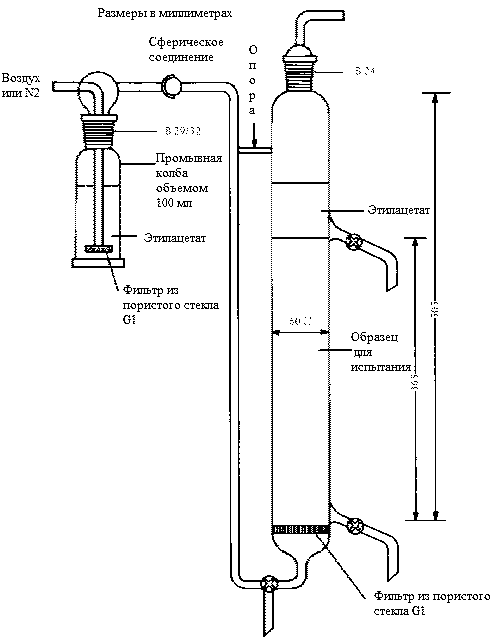
3.2.14. газопоглотительный аппарат (см. Рисунок 5).
Диаметр металлокерамического диска должен быть таким же, как и внутренний диаметр цилиндра;
3.2.15. сепарационная лейка, 250 мл;
3.2.16. магнитная мешалка с магнитом 25 — 30 мм;
3.2.17. тигель Гуча, диаметр перфорированного основания = 25 мм, типа G4;
3.2.18. круглые стекловолоконные фильтры с диаметром 27 мм; диаметр волокна 0,3 — 1,5 м;
3.2.19. две фильтровальные колбы с переходниками и резиновыми манжетами, 250 и 500 мл соответственно;
3.2.20. регистрирующий электронный потенциометр, оснащенный ярким платиновым индикаторным электродом и каломелью или серебряным/хлорсеребряным стандартным электродом с диапазоном 250 мВ, с автоматической бюреткой емкостью 20 — 25 мл, или альтернативное неавтоматизированное оборудование.
3.3.1 Концентрация и отделение поверхностно-активного вещества
Отфильтровать водный образец через качественную фильтровальную бумагу. Отбросить первые 100 мл фильтрата.
В газопоглотительный аппарат, предварительно промытый этилацетатом, поместить измеренное количество образца, таким образом, чтобы он содержал 250 — 800 г неионогенного поверхностно-активного вещества.
Для улучшения эффективности процесса отделения добавить 100 г хлорида натрия и 5 г бикарбоната натрия.
Если объем образца превышает 500 мл, добавить эти соли в газопоглотительный аппарат в твердом виде и растворить, пропустив через него азот или воздух.
Если используется образец меньшего объема, растворить соли в 400 мл воды и затем добавить в газопоглотительный аппарат.
Добавить воду таким образом, чтобы довести уровень до верхнего запорного крана.
Осторожно добавить 100 мл этилацетата на поверхность воды.
Заполнить промывную колбу в газовой линии (азот или воздух) на две трети этилацетатом.
Пропустить через аппарат поток газа со скоростью 30 — 60 л/ч; рекомендуется использовать расходомер. С момента начала скорость аэрации должна быть постепенно увеличена. Скорость газа должна регулироваться таким образом, чтобы фазы оставались заметно раздельными в целях минимизации смешивания фаз и раствора этилацетата в воде. Остановить поток газа через пять минут.
Если происходит уменьшение объема органической фазы более чем на 20% посредством растворения в воде, операция должна повторяться, при этом нужно обращать особое внимание на скорость потока газа.
Слить органическую фазу в сепарационную лейку. Перелить обратно в газопоглотительный аппарат всю воду с водной фазы, которая оказалась в сепарационной лейке (воды должно быть всего несколько мл). Отфильтровать фазу этилацетата через сухую качественную фильтровальную бумагу в мензурку объемом 250 мл.
Добавить еще 100 мл этилацетата в газопоглотительный аппарат и снова пропустить азот или воздух в течение пяти минут. Перелить органическую фазу в сепарационную лейку, использованную для первого разделения, слить водную фазу и пропустить органическую фазу через тот же фильтр, как и первую порцию этилацетата. Промыть сепарационную лейку и фильтр посредством использования приблизительно 20 мл этилацетата.
Выпарить экстракт этилацетата до сухости на водяной бане (в вытяжном шкафу). Направить легкий поток воздуха на поверхность раствора с целью ускорения процесса испарения.
3.3.2 Осаждение и фильтрация
Растворить сухой остаток, полученный в пункте 3.3.1, в 5 мл метанола, добавить 40 мл воды и 0,5 мл разбавленной HCl (3.2.3) и перемешать смесь магнитной мешалкой.
Добавить в указанный раствор 30 мл осаждающего вещества (3.2.6) с помощью измерительного цилиндра. После повторного перемешивания образуется осадок. После перемешивания в течение десяти минут дать смеси отстояться как минимум в течение пяти минут.
Отфильтровать смесь через тигель Гуча, основание которого покрыто стекловолоконной фильтровальной бумагой. Сначала промыть фильтр посредством всасывания приблизительно 2 мл ледяной уксусной кислоты. Затем тщательно промыть мензурку, магнит и тигель в ледяной уксусной кислоте (приблизительно 40 — 50 мл). Нет необходимости переносить все количество осадка, налипшего на стенки мензурки, в фильтр, потому что раствор осадка для титрования возвращается в мензурку, используемую для осаждения, и оставшийся осадок затем растворяется.
3.3.3 Растворение осадка
Растворить осадок в фильтровальном тигле посредством добавления горячего раствора тартрата аммония (температура приблизительно 80 °C) (3.2.8) тремя порциями по 10 мл. Дать каждой порции отстояться в тигле в течение нескольких минут перед процеживанием через фильтр в колбу.
Поместить содержимое фильтровальной колбы в мензурку, используемую для осаждения. Промыть стенки мензурки еще 20 мл раствора тартрата, чтобы растворить оставшуюся часть осадка.
Тщательно промыть тигель, переходник и фильтровальную колбу 150 — 200 мл воды и перелить обратно промывную воду в мензурку, используемую для осаждения.
3.3.4 Титрование
Перемешать раствор с помощью магнитной мешалки (3.2.16), добавить несколько капель бромкрезолового пурпурного (3.2.5), а затем добавлять разбавленный раствор аммиака (3.2.9) до тех пор, пока цвет не станет фиолетовым (раствор изначально является слабокислотным из-за остатка уксусной кислоты, которая использовалась для промывки).
Затем добавить 10 мл стандартного ацетатного буфера (3.2.10), погрузить электроды в раствор и титровать потенциометрически стандартным «карбаматным раствором» (3.2.11), при этом кончик бюретки должен быть погружен в раствор.
Скорость титрования не должна превышать 2 мл/мин.
Конечная точка — это пересечение касательных к двум ветвям потенциальной кривой.
Время от времени будет наблюдаться, что изгиб потенциальной кривой выравнивается; это может быть устранено посредством тщательной очистки платинового электрода (путем полировки наждачной бумагой).
3.3.5 Слепое определение
Одновременно необходимо проводить слепое определение в течение всей процедуры, используя 5 мл метанола и 40 мл воды, согласно инструкциям, изложенным в пункте 3.3.2. Доза слепого титрования должна быть менее 1 мл, в противном случае чистота реактивов (3.2.3, 3.2.7, 3.2.8, 3.2.9, 3.2.10) является сомнительной (особенно в отношении содержания тяжелых металлов), и указанные реактивы должны быть заменены. Слепое определение должно учитываться при расчете результатов.
3.3.6 Контроль коэффициента «карбаматного раствора»
Определить коэффициент для «карбаматного раствора» в день использования. Для этого необходимо титрировать 10 мл раствора сульфата меди (3.2.12) «карбаматным раствором» после добавления 100 мл воды и 10 мл стандартного ацетатного буфера (3.2.10). Если используемое количество равно «a» мл, коэффициент «f» определяется по следующей формуле:
и все результаты титрования умножаются на указанный коэффициент.
Каждое неионогенное поверхностно-активное вещество имеет свой собственный коэффициент, в зависимости от его состава и, в частности, от длины цепи оксида алкена. Концентрация неионогенного поверхностно-активного вещества выражается по отношению к стандартному веществу — нонилфенолу с десятью единицами оксида этилена (NP 10), для которых коэффициент преобразования равен 0,054.
С помощью указанного коэффициента определяется количество поверхностно-активного вещества, содержащегося в образце, выраженное в мг в виде NP 10 по следующей формуле:
(b — c) x f x 0,054 = мг неионогенного поверхностно-активного вещества, выраженного в мг в виде NP 10,
b = объем «карбаматного раствора», используемого в образце (мл);
c = объем «карбаматного раствора», используемого в слепом определении (мл);
f = коэффициент «карбаматного раствора».
Результаты выражаются в мг/л в виде NP 10 с точностью до 0,1 мг.
4. Предварительная обработка анионных поверхностно-активных веществ, предназначенных для испытания.
4.1.1 Обработка образцов
Перед началом проведения контрольного испытания, определяющего способность к первичной биодеградации, должна осуществляться следующая обработка анионных поверхностно-активных веществ и готовых детергентов:
Целью экстрагирования спиртом является устранение нерастворимых и неорганических ингредиентов в коммерческом продукте, которые при определенных обстоятельствах могут сорвать испытание способности к биодеградации.
4.1.2 Процедура ионного обмена
Для целей точности испытания способности к биодеградации необходимо выделить и отделить анионные поверхностно-активные вещества от мыла и от неионогенных и катионных поверхностно-активных веществ.
Это достигается посредством применения метода ионного обмена с использованием макропористой ионообменной смолы и подходящих элюентов для фракционного элюирования. Таким образом, мыло, анионные и неионогенные поверхностно-активные вещества могут быть выделены посредством одной процедуры.
4.1.3 Аналитический контроль
После гомогенизации концентрация анионных поверхностно-активных веществ в синтетическом детергенте определяется посредством метода анализа MBAS. Содержание мыла определяется посредством подходящего аналитического метода.
Данный анализ продукции является обязательным для расчета количества, необходимого для подготовки фракций для проведения испытания способности к биодеградации.
Количественное экстрагирование не является обязательным; однако как минимум 80% анионных поверхностно-активных веществ должно быть экстрагировано. Как правило результат экстрагирования составляет 90% или более.
Из гомогенного образца (порошки, осушенные пасты и осушенные жидкости) извлекается экстракт этанола, который содержит поверхностно-активные вещества, мыло и другие спирторастворимые составляющие компоненты образца синтетического детергента.
Экстракт этанола выпаривается до сухости, растворяется в смеси вода/изопропанол, а полученный раствор пропускается через комбинацию сильнокислотного катионного обмена/макропористого анионного обмена, нагретую до 50 °C. Данная температура является необходимой для предотвращения осаждения любых жирных кислот, которые могут присутствовать в кислой среде.
Любые неионогенные поверхностно-активные вещества остаются в сточных водах.
Мыльные жирные кислоты отделяются посредством экстракции этанолом, содержащим CO2. Затем извлекаются анионные поверхностно-активные вещества в виде солей аммония посредством элюирования водным изопропаноловым раствором бикарбоната аммония. Полученные соли аммония используются при проведении испытания деградации.
Катионные поверхностно-активные вещества, которые могут сорвать испытание способности к биодеградации и аналитическим процедурам, устраняются при помощи катионообменника, размещенного над анионообменником.
4.3.1 Деионизированная вода;
4.3.2. этанол, 95% (объемное соотношение) C2H5OH (допустимый денатурат: метилэтилкетон или метанол);
4.3.3. смесь вода/изопропанол (объемное соотношение 50/50):
- 50 частей по объему изопропанола, CH3 CHOH.CH3; и
- 50 частей по объему воды (4.3.1);
4.3.4. раствор углекислого газа в этаноле (приблизительно 0,1% CO2): с помощью нагнетательной трубки со встроенным агломератом пропустить диоксид углерода, CO2, через этанол (4.3.2) в течение десяти минут. Использовать только свежие растворы;
4.3.5. раствор бикарбоната аммония (объемное соотношение 60/40): 0,3 моль NH4HCO3 в 1000 мл смеси изопропанол/вода, состоящей из 60 частей по объему изопропанола и 40 частей по объему воды (4.3.1);
4.3.6. катионообменник (KAT), сильнокислотный, стойкий к спирту (50 — 100 меш);
4.3.7. анионообменник (AAT), макропористый, Merck Lewatit MP 7080 (70 — 150 меш) или эквивалентный;
4.3.8. соляная кислота, 10% HCl (весовое соотношение);
4.3.9. круглодонная колба объемом 2000 мл с притертой стеклянной пробкой и дефлегматором;
4.3.10. всасывающий фильтр диаметром 90 мм (который можно нагревать) для фильтровальной бумаги;
4.3.11. фильтровальная колба объемом 2000 мл;
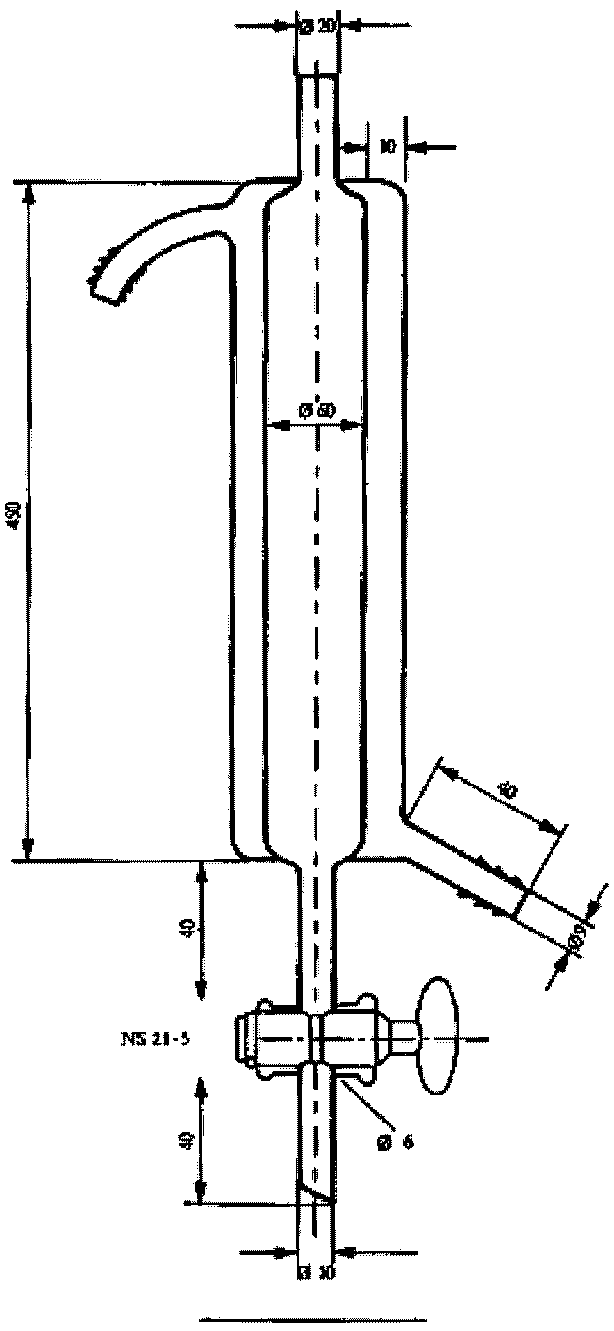
4.3.12. обменные колонны с нагревательной рубашкой и краном: внутренняя труба 60 мм в диаметре и 450 мм в высоту (см. Рисунок 4);
4.3.14. вакуумный сушильный шкаф;
4.4.1 Подготовка экстракта
Количество поверхностно-активных веществ, необходимых для проведения испытания биодеградации, составляет приблизительно 50 г MBAS.
Как правило, количество экстрагируемого продукта не должно превышать 1000 г, но может возникнуть необходимость экстрагирования дополнительного количества образца. По практическим соображениям в большинстве случаев количество используемого продукта должно ограничиваться 5000 г при подготовке экстрактов для проведения испытания биодеградации.
Опыт показал, что существуют преимущества в использовании нескольких малых экстракций, нежели одной большой. Соответствующие обменники предназначены для работы с количеством 600 — 700 ммоль поверхностно-активных веществ и мыла.
4.4.2 Выделение спирторастворимых составляющих компонентов
Добавить 250 г синтетического детергента, являющегося предметом анализа, в 1250 мл этанола, нагреть смесь до точки кипения, затем дефлегмировать в течение одного часа, помешивая. Пропустить горячий спиртовой раствор через крупнопористый всасывающий фильтр, нагретый до 50 °C, и быстро отфильтровать. Промыть колбу и всасывающий фильтр, используя приблизительно 200 мл горячего этанола. Фильтрат и промывку от фильтрата собрать в фильтровальную колбу.
В том случае, когда предметом анализа являются детергенты в форме пасты или жидких продуктов, необходимо убедиться, что образец содержит не более 55 г анионных поверхностно-активных веществ и не более 35 г мыла. Выпарить данный взвешенный образец до сухости. Растворить остаток в 2000 мл этанола и продолжить процедуру, указанную выше. В том случае, когда предметом анализа являются детергенты в форме порошков низкой объемной плотности (< 300 г/л), рекомендуется увеличивать пропорцию этанола до соотношения 20:1. Выпарить этанольный фильтрат до сухости, предпочтительно посредством роторного испарителя. Повторить операцию, если требуется большее количество экстракта. Растворить остаток в 5000 мл смеси вода/изопропанол.
Подготовка ионообменных колонн
4.4.3 КАТИОНООБМЕННАЯ КОЛОННА.
Поместить 600 мл катионообменной смолы (4.3.6) в мензурку объемом 3000 мл и полностью покрыть жидкостью посредством добавления 2000 мл соляной кислоты (4.3.8). Дать отстояться как минимум в течение двух часов, периодически помешивая.
Слить кислоту и поместить смолу в колонну (4.3.12) посредством деионизированной воды. Колонна должна содержать пробку из стекловаты.
Промыть колонну деионизированной водой со скоростью 10 — 30 мл/мин до тех пор, пока элюат не будет свободным от хлорида.
Заместить воду 2000 мл смеси вода/изопропанол (4.3.3) со скоростью 10 — 30 мл/мин. Обменная колонна теперь готова для использования.
Поместить 600 мл анионообменной смолы (4.3.7) в мензурку объемом 3000 мл и полностью покрыть жидкостью посредством добавления 2000 мл деионизированной воды.
Дать смоле набухнуть как минимум в течение двух часов.
Поместить смолу в колонну посредством деионизированной воды. Колонна должна содержать пробку из стекловаты.
Промыть колонну 0,3 M раствора бикарбоната аммония (4.3.5) до полного освобождения от хлорида. Для этого потребуется приблизительно 5000 мл раствора. Промыть снова 2000 мл деионизированной воды. Заместить воду 2000 мл смеси вода/изопропанол (4.3.3) со скоростью 10 — 30 мл/мин. Обменная колонна теперь в OH-форме и готова для использования.
4.4.4. Соединить обменные колонны таким образом, чтобы катионообменная колонна была помещена над анионообменной колонной.
Нагреть обменные колонны до 50 °C, используя термостат.
Нагреть 5000 мл полученного в пункте 4.4.2 раствора до 60 °C и пропустить раствор через комбинацию обменников со скоростью 20 мл/мин. Промыть колонны 1000 мл горячей смеси изопропанол/вода (4.3.3).
Для получения анионных поверхностно-активных веществ (MBAS) отсоединить колонну KAT. Элюировать мыльные жирные кислоты из колонны KAT с помощью 5000 мл раствора этанол/CO2 при температуре 50 °C (4.3.4). Отделить элюат.
Затем элюировать MBAS из колонны AAT при помощи 5000 мл раствора бикарбоната аммония (4.3.5). Выпарить элюат до сухости с помощью паровой бани или роторного испарителя.
Остаток содержит MBAS (в виде соли аммония) и, возможно, поверхностно-неактивные анионные вещества, которые не оказывают негативного воздействия на испытание биодеградации. Добавить в остаток деионизированную воду до получения необходимого объема и определить содержание MBAS в аликвоте. Раствор используется в качестве стандартного раствора анионных синтетических детергентов для проведения испытания биодеградации. Раствор должен храниться при температуре ниже 5 °C.
4.4.5 Катионообменник отсоединяется после использования.
С целью регенерации анионообменной смолы пропустить дополнительное количество раствора бикарбоната аммония (4.3.5) через колонну со скоростью потока приблизительно 10 мл/мин до тех пор, пока элюат не будет свободен от анионных поверхностно-активных веществ (испытание анализом активного вещества метилена голубого).
Затем пропустить 2000 мл смеси вода/изопропанол (4.3.3) через анионообменник для промывки. Анионообменник снова готов для использования.
Предварительная обработка неионогенных поверхностно-активных веществ, предназначенных для испытания
5.1.1. Перед началом проведения контрольного испытания, определяющего способность к первичной биодеградации, должна осуществляться следующая обработка неионогенных поверхностно-активных веществ и готовых детергентов:
Целью экстрагирования спиртом является устранение нерастворимых и неорганических ингредиентов в коммерческом продукте, которые при определенных обстоятельствах могут сорвать испытание способности к биодеградации.
5.1.2. Для целей точности испытания способности к биодеградации необходимо выделить и отделить неионогенные поверхностно-активные вещества от мыла и от анионных и катионных поверхностно-активных веществ.
Это достигается посредством применения метода ионного обмена с использованием макропористой ионообменной смолы и подходящих элюентов для фракционного элюирования. Таким образом, мыло, анионные и неионогенные поверхностно-активные вещества могут быть выделены посредством одной процедуры.
5.1.3. После гомогенизации концентрация анионных и неионогенных поверхностно-активных веществ в детергенте определяется посредством метода анализа MBAS и BiAS. Содержание мыла определяется посредством подходящего аналитического метода.
Данный анализ продукта является обязательным для расчета количества, необходимого для подготовки фракций для проведения испытания способности к биодеградации.
Количественное экстрагирование не является обязательным; однако как минимум 80% неионогенных поверхностно-активных веществ должно быть экстрагировано. Как правило, результат экстрагирования составляет 90% или более.
5.2. Из гомогенного образца (порошки, осушенная паста и осушенные жидкости) извлекается экстракт этанола, который содержит поверхностно-активные вещества, мыло и другие спирторастворимые составляющие компоненты образца детергента.
Экстракт этанола выпаривается до сухости, растворяется в смеси вода/изопропанол, а полученный раствор пропускается через комбинацию сильнокислотного катионного обмена/макропористого анионного обмена, нагретую до 50 °C. Данная температура является необходимой для предотвращения осаждения любых жирных кислот, которые могут присутствовать в кислой среде. Неионогенные поверхностно-активные вещества извлекаются из сточных вод путем выпаривания.
Катионные поверхностно-активные вещества, которые могут сорвать испытание деградации и аналитических процедур, устраняются при помощи катионообменника, размещенного над анионообменником.
<*> Вероятно, в оригинале опечатка в нумерации — прим. перев.
5.3.1 Деионизированная вода;
5.3.2. этанол, 95% (объемное соотношение) C2H5OH (допустимый денатурат: метилэтилкетон или метанол);
5.3.3. смесь вода/изопропанол (объемное соотношение 50/50):
- 50 частей по объему изопропанола, CH3 CHOH. CH3, и
- 50 частей по объему воды (5.3.1);
5.3.4. раствор бикарбоната аммония (объемное соотношение 60/40):
0,3 моль NH4HCO3 в 1000 мл смеси изопропанол/вода, состоящей из 60 частей по объему изопропанола и 40 частей по объему воды (5.3.1);
5.3.5. катионообменник (KAT), сильнокислотный, стойкий к спирту (50 — 100 меш);
5.3.6. анионообменник (AAT), макропористый, Merck Lewatit MP 7080 (70 — 150 меш) или эквивалентный;
5.3.7. соляная кислота, 10% HCl (весовое соотношение);
5.3.8. круглодонная колба объемом 2000 мл с притертой стеклянной пробкой и дефлегматором;
5.3.9. всасывающий фильтр диаметром 90 мм (который можно нагревать) для фильтровальной бумаги;
5.3.10. фильтровальная колба объемом 2000 мл;
5.3.11. обменные колонны с нагревательной рубашкой и краном: внутренняя труба 60 мм в диаметре и 450 мм в высоту (см Рисунок 4);
5.3.13. вакуумный сушильный шкаф;
5.4.1 Подготовка экстракта
Количество поверхностно-активных веществ, необходимых для проведения испытания биодеградации, составляет приблизительно 50 г BiAS.
При подготовке экстрактов для испытаний деградации максимальное количество используемого продукта не должно превышать 2000 г. В этой связи может возникнуть необходимость неоднократного/повторного проведения процедуры с целью получения достаточного количества испытаний деградации.
Опыт показал, что существуют преимущества в использовании нескольких малых экстракций, нежели одной большой.
Выделение спирторастворимых составляющих компонентов
5.4.2. Добавить 250 г синтетического детергента, являющегося предметом анализа, в 1250 мл этанола, нагреть смесь до точки кипения, затем дефлегмировать в течение одного часа, помешивая. Пропустить горячий спиртовой раствор через крупнопористый всасывающий фильтр, нагретый до 50 °C и быстро отфильтровать. Промыть колбу и всасывающий фильтр, используя приблизительно 200 мл горячего этанола. Фильтрат и промывку от фильтрата собрать в фильтровальную колбу.
В том случае, когда предметом анализа являются детергенты в форме пасты или жидких продуктов, необходимо убедиться, что образец содержит не более 25 г анионных поверхностно-активных веществ и не более 35 г мыла. Выпарить данный взвешенный образец до сухости. Растворить остаток в 500 мл этанола и продолжить процедуру, указанную выше.
В том случае, когда предметом анализа являются детергенты в форме порошков низкой объемной плотности (< 300 г/л), рекомендуется увеличивать пропорцию этанола до соотношения 20:1.
Выпарить этанольный фильтрат до полной сухости, предпочтительно посредством роторного испарителя. Повторить операцию, если требуется большее количество экстракта. Растворить остаток в 5000 мл смеси вода/изопропанол.
Подготовка ионообменных колонн
5.4.3 КАТИОНООБМЕННАЯ КОЛОННА.
Поместить 600 мл катионообменной смолы (5.3.5) в мензурку объемом 3000 мл и полностью покрыть жидкостью посредством добавления 2000 мл соляной кислоты (5.3.7). Дать отстояться как минимум в течение двух часов, периодически помешивая.
Слить кислоту и поместить смолу в колонну (5.3.11) посредством деионизированной воды. Колонна должна содержать пробку из стекловаты. Промыть колонну деионизированной водой со скоростью 10 — 30 мл/мин до тех пор, пока элюат не будет свободным от хлорида.
Заместить воду 2000 мл смеси вода/изопропанол (5.3.3) со скоростью 10 — 30 мл/мин. Обменная колонна теперь готова для использования.
Поместить 600 мл анионообменной смолы (5.3.6) в мензурку и полностью покрыть жидкостью посредством добавления 2000 мл деионизированной воды. Дать смоле набухнуть как минимум в течение двух часов. Поместить смолу в колонну посредством деионизированной воды. Колонна должна содержать пробку из стекловаты.
Промыть колонну 0,3 M раствора бикарбоната аммония (5.3.4) до полного освобождения от хлорида. Для этого потребуется приблизительно 5000 мл раствора. Промыть снова 2000 мл деионизированной воды.
Заместить воду 2000 мл смеси вода/изопропанол (5.3.3) со скоростью 10 — 30 мл/мин. Обменная колонна теперь в OH-форме и готова для использования.
5.4.4 Процедура ионного обмена
Соединить обменные колонны таким образом, чтобы катионообменная колонна была помещена над анионообменной колонной. Нагреть обменные колонны до 50 °C, используя термостат. Нагреть 5000 мл раствора, полученного в пункте 5.4.2, до 60 °C и пропустить раствор через комбинацию обменников со скоростью 20 мл/мин. Промыть колонны 1000 мл горячей смеси изопропанол/вода (5.3.3).
Для извлечения неионогенных поверхностно-активных веществ необходимо собрать фильтрат и промывку от фильтрата и выпарить до сухости, предпочтительно посредством роторного испарителя. Остаток содержит BiAS. Добавить деионизированную воду до получения необходимого объема и определить содержание BiAS в аликвоте. Раствор используется в качестве стандартного раствора неионогенных поверхностно-активных веществ для проведения испытания деградации. Раствор должен храниться при температуре ниже 5 °C.
5.4.5 Регенерация ионообменных смол
Катионообменник отсоединяется после использования.
С целью регенерации анионообменной смолы пропустить 5000 — 6000 мл раствора бикарбоната аммония (5.3.4) через колонну со скоростью потока приблизительно 10 мл/мин до тех пор, пока элюат не будет свободен от анионных поверхностно-активных веществ (испытание анализом активного вещества метилена голубого). Затем пропустить 2000 мл смеси вода/изопропанол (5.3.3) через анионообменник для промывки. Анионообменник снова готов для использования.
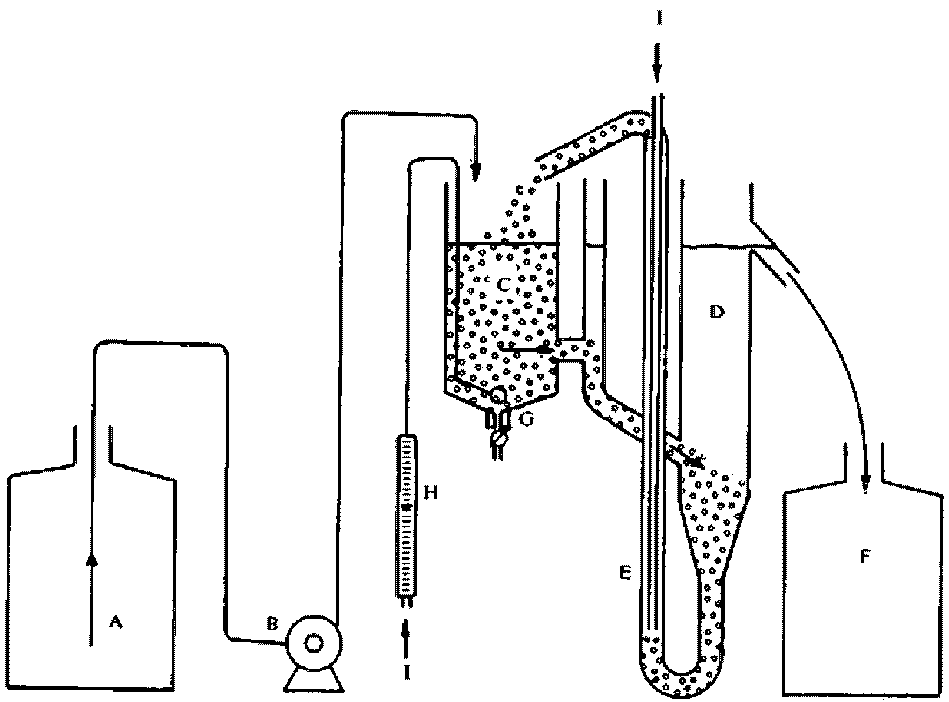
A Сосуд для хранения сточных вод
C Сосуд для аэрации (вместимость: три литра)
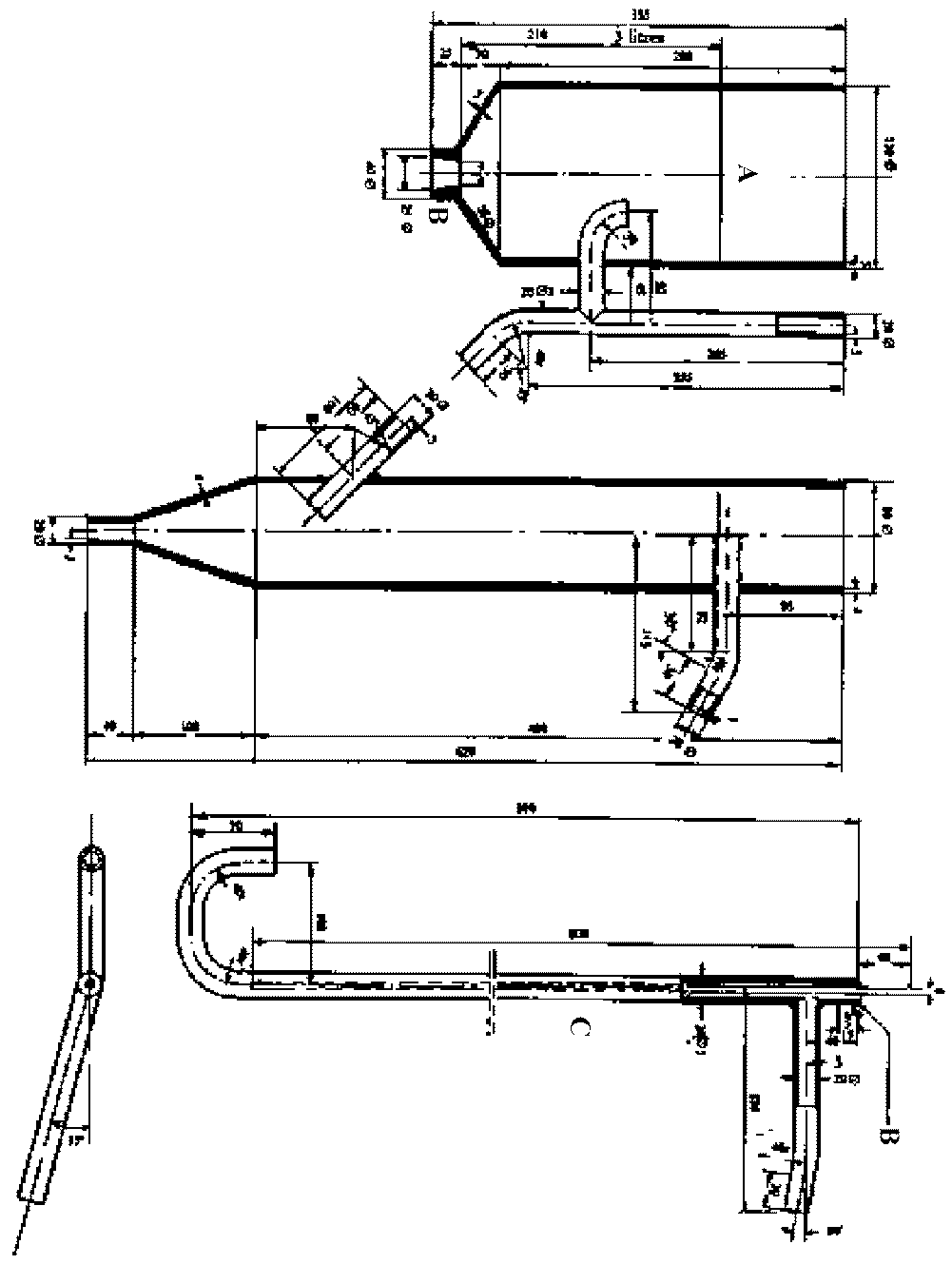
B Твердый поливинилхлорид (ПВХ)
C Стекло или водонепроницаемый пластик (твердый ПВХ)
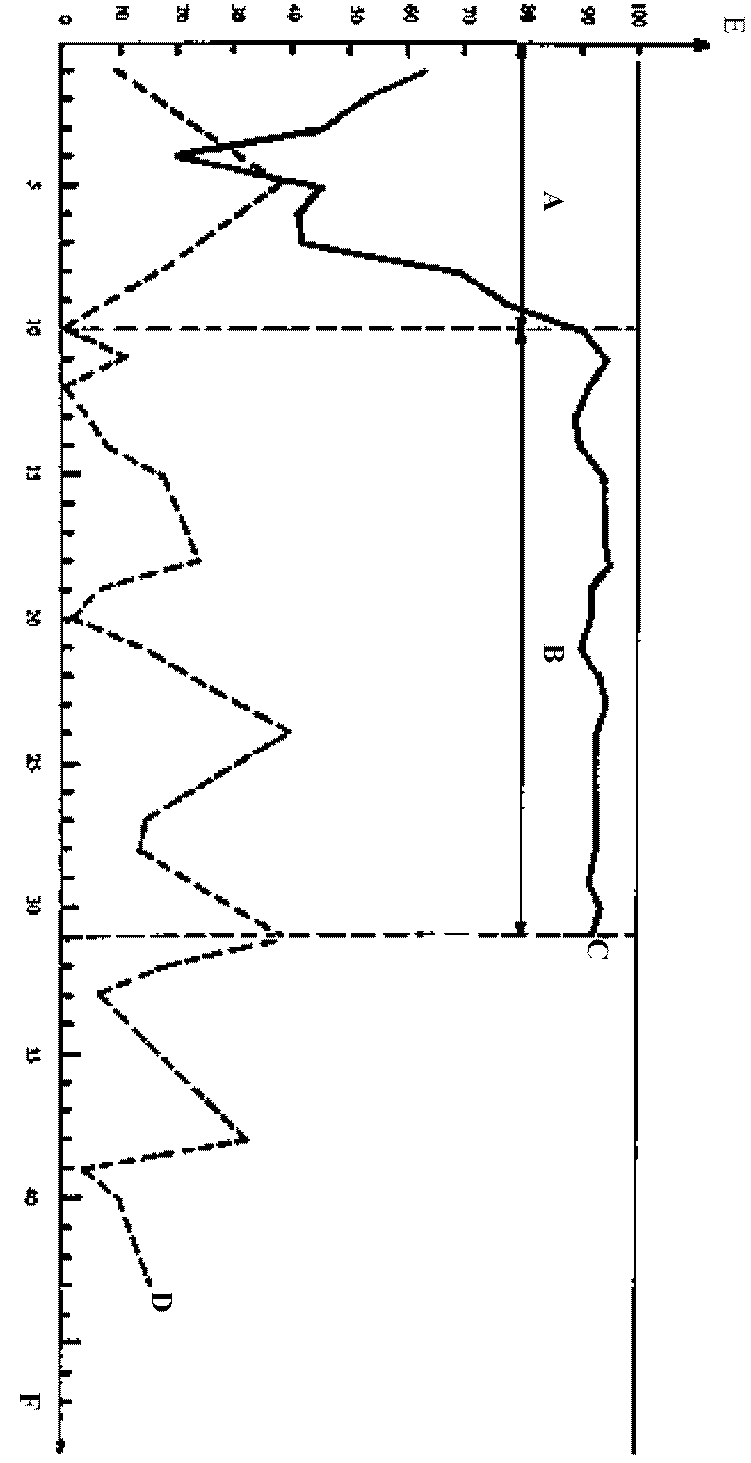
B Период, используемый для расчета (двадцать один день)
C Легко биодеградируемое поверхностно-активное вещество
D Поверхностно-активное вещество, не поддающееся легкой биодеградации
REGULATION (EC) No. 648/2004 OF THE EUROPEAN PARLIAMENT AND OF THE COUNCIL ON DETERGENTS
(Amended by: Commission Regulation (EC) No 907/2006 of 20 June 2006, Regulation (EC) No 1336/2008 of the European Parliament and of the Council of 16 December 2008, Regulation (EC) No 219/2009 of the European Parliament and of the Council of 11 March 2009, Commission Regulation (EC) No 551/2009 of 25 June 2009, Regulation (EU) No 259/2012 of the European Parliament and of the Council of 14 March 2012)
The European Parliament and the Council of the European Union,
Having regard to the Treaty establishing the European Community, and in particular Article 95 thereof,
Having regard to the proposal from the Commission,
Having regard to the Opinion of the European Economic and Social Committee <*>,
<*> OJ C 95, 23.4.2003, p. 24.
Acting in accordance with the procedure laid down in Article 251 of the Treaty <*>,
<*> Opinion of the European Parliament of 10 April 2003 (not yet published in the Official Journal), Council Common Position of 4 November 2003 (OJ C 305 E, 16.12.2003, p. 11) and Position of the European Parliament of 14 January 2004 (not yet published in the Official Journal). Decision of the Council of 11 March 2004.
(1) Council Directives 73/404/EEC of 22 November 1973 on the approximation of the laws of the Member States relating to detergents <1>, 73/405/EEC of 22 November 1973 on the approximation of the laws of the Member States relating to methods of testing the biodegradability of anionic surfactants <2>, 82/242/EEC of 31 March 1982 on the approximation of the laws of the Member States relating to methods of testing the biodegradability of non-ionic surfactants <3>, 82/243/EEC of 31 March 1982 amending Directive 73/405/EEC on the approximation of the laws of the Member States relating to methods of testing the biodegradability of anionic surfactants <4> and 86/94/EEC of 10 March 1986 amending for the second time Directive 73/404/EEC on the approximation of the laws of the Member States relating to detergents <5>, have been significantly amended on several occasions. It is desirable, for reasons of clarity and rationalisation, that the provisions in question should be recast by bringing them all together in a single text. Commission Recommendation 89/542/EEC of 13 September 1989 <6>, as regards labelling provisions concerning detergents and cleaning products, should also be included in the single text.
<1> OJ L 347, 17.12.1973, p. 51. Directive as last amended by Regulation (EC) No 807/2003 (OJ L 122,16.5.2003, p. 36).
<2> OJ L 347, 17.12.1973, p. 53. Directive as amended by Directive 82/243/EEC (OJ L 109, 22.4.1982, p. 11).
<3> OJ L 109, 22.4.1982, p. 1.
<4> OJ L 109, 22.4.1982, p. 18.
<5> OJ L 80, 25.3.1986, p. 51.
<6> OJ L 291, 10.10.1989, p. 55.
(2) Since the objective of this Regulation, to ensure the internal market in detergents, cannot be sufficiently achieved by the Member States, if there is no common technical criteria throughout the Community, and can therefore be better achieved at Community level, the Community may adopt measures, in accordance with the principle of subsidiarity as set out in Article 5 of the Treaty. In accordance with the principle of propotionality, as set out in that Article, this Regulation does not go beyond what is necessary in order to achieve that objective. A Regulation is the appropriate legal instrument as it imposes directly on manufacturers precise requirements to be implemented at the same time and in the same manner throughout the Community; in the area of technical legislation, uniformity of application in the Member States is needed, and this can only be guaranteed by a Regulation.
(3) A new definition for detergents is needed to cover equivalent uses and be in line with developments at Member State level.
(4) It is necessary to introduce a surfactant definition, which was lacking in the existing legislation.
(5) It is important to give a clear and precise description of the relevant types of biodegradability.
(6) Measures concerning detergents should be adopted to ensure the functioning of the internal market and avoid restricting competition in the Community.
(7) As confirmed by the Commission White Paper on the strategy for a future Chemical Policy, appropriate measures concerning detergents should ensure a high level of environmental protection, especially of the aquatic environment.
(8) Detergents are already subject to certain Community provisions concerning their manufacture, proper handling, usage and labelling, in particular with reference to Commission Recommendation 89/542/EEC and Commission Recommendation 98/480/EC of 22 July 1998 concerning good environmental practice for household laundry detergents <*>; Directive 1999/45/EC of the European Parliament and of the Council of 31 May 1999 concerning the approximation of the laws, regulations and administrative provisions of the Member States relating to the classification, packaging and labelling of dangerous preparations <**> applies to detergents.
<*> OJ L 215, 1.8.1998, p. 73.
<**> OJ L 200, 30.7.1999, p. 1. Directive as last amended by Regulation (EC) No 1882/2003 of the European Parliament and of the Council (OJ L 284, 31.10.2003, p. 1).
(9) Ditallow-dimethyl-ammonium-chloride (DTDMAC) and nonylphenol (including ethoxylates derivatives-APEs) are priority substances undergoing at Community level risk assessment activities, in accordance with Council Regulation (EEC) No 793/93 of 23 March 1993 on the evaluation and control of the risks of existing substances <*>, and if necessary adequate strategies to limit the risks of exposure to these substances should therefore be recommended and implemented in the framework of other Community provisions.
<*> OJ L 84, 5.4.1993, p. 1. Regulation as amended by Regulation (EC) No 1882/2003.
(10) The existing legislation on biodegradability of surfactants in detergents only covers primary biodegradability <> and it is only applicable to anionic <> and non-ionic <> surfactants; therefore it should be replaced by new legislation, which lays the main emphasis on ultimate biodegradability and meets the important concerns related to the potential toxicity of persistent metabolites.
<*> Directives 73/404/EEC and 86/94/EEC.
<**> Directives 73/405/EEC and 82/243/EEC.
(11) This requires the introduction of a new set of tests based on EN ISO standards and OECD guidelines, which governs the granting of direct permission for placing detergents on the market.
(12) To provide a high level of protection of the environment, detergents not fulfilling requirements laid down by this Regulation should not be placed on the market.
(13) On 25 November 1999 the Scientific Committee on Toxicity, Ecotoxicity and the Environment issued an opinion on biodegradability of surfactants in detergents and relevance of test-methods for regulatory control in this area.
(14) The existing requirements regarding primary biodegradability should be maintained on a second hierarchy level and supplemented by a complementary risk assessment, for those surfactants failing ultimate biodegradability tests; furthermore surfactants failing primary biodegradability tests should not obtain marketing authorisation by way of derogation
(15) The primary biodegradability requirements should be extended to all surfactants, in particular cationic and amphoteric, whilst allowing the possibility of applying instrumental analyses in those cases in which semi-specific analytical methods are not suitable.
(16) The determination of biodegradability test-methods and the record-keeping of lists of derogations are technical matters and should be revised taking into account technical and scientific developments as well as regulatory developments.
(17) Test-methods should produce data that give sufficient assurance of aerobic biodegradability of surfactants in detergents.
(18) Methods to test biodegradability of surfactants in detergents may produce variable results. In such cases they should be complemented by additional assessments in order to determine the risks of continued use.
(19) Provisions should also be laid down regarding the placing on the market in exceptional cases of surfactants in detergents failing ultimate biodegradability tests and this should take place on the basis of all relevant information to ensure environmental protection and on a case by case basis.
(20) The measures necessary for the implementation of this Regulation should be adopted in accordance with Council Decision 1999/468/EC of 28 June 1999 laying down the procedures for the exercise of implementing powers conferred on the Commission <*>.
<*> OJ L 184, 17.7.1999, p. 23.
(21) It is appropriate to recall that other horizontal legislation is applicable to detergent surfactants, in particular Council Directive 76/769/EEC of 27 July 1976 on the approximation of the laws, regulations and administrative provisions of the Member States relating to restrictions on the marketing and use of certain dangerous substances and preparations <1> by which the marketing and use of dangerous substances covered by this Regulation might be banned or restricted, Council Directive 67/548/EEC of 27 June 1967 on the approximation of laws, regulations and administrative provisions relating to the classification, packaging and labelling of dangerous substances <2>, Commission Directive 93/67/EEC of 20 July 1993 laying down the principles for assessment of risks to man and the environment of substances notified in accordance with Council Directive 67/548/EEC <3>, Regulation (EEC) No 793/93, and Commission Regulation (EC) No 1488/94 of 28 June 1994 laying down the principles for the assessment of risks to man and the environment of existing substances <4>; Directive 98/8/EC of the European Parliament and of the Council of 16 February 1998 concerning the placing of biocidal products on the market <5>; Directive 2004/10/EC of the European Parliament and of the Council of 11 February 2004 on the harmonisation of laws, regulations and administrative provisions relating to the application of the principles of good laboratory practice and the verification of their application for tests on chemical substances (codified version) <6>; Directive 2004/9/EC of the European Parliament and of the Council of 11 February 2004 on the inspection and verification of good laboratory practice (GLP) (codified version) <7>; and Council Directive 86/609/EEC of 24 November 1986 on the approximation of laws, regulations and administrative provisions of the Member States regarding the protection of animals used for experimental and other scientific purposes <8>.
<1> OJ L 262, 27.9.1976, p. 201. Directive as last amended by Commission Directive 2004/21/EC (OJ L 57, 25.2.2004, p. 4).
<2> OJ L 196, 16.8.1967, p. 1. Directive as last amended by Regulation (EC) No 807/2003.
<4> OJ L 161, 29.6.1994, p. 3.
<5> OJ L 123, 24.4.1998, p. 1. Directive as amended by Regulation (EC) No 1882/2003.
<6> OJ L 50, 20.2.2004, p. 44.
<7> OJ L 50, 20.2.2004, p. 28.
<8> OJ L 358, 18.12.1986, p. 1. Directive as amended by Directive 2003/65/EC of the European Parliament and of the Council (OJ L 230, 16.9.2003, p. 32).
(22) It should be the responsibility of manufacturers to refrain from marketing detergents not complying with this Regulation and to have at the disposal of the national authorities the technical files for all substances and mixtures covered by this Regulation; this should also apply to surfactants that have failed to pass the tests mentioned in Annex III.
(23) Manufacturers should be able to request a derogation from the Commission, which should have the possibility to grant such derogation in accordance with the procedure referred to in Article 12(2).
(24) Member States' competent authorities should be able to apply control measures to detergents on the market, but should avoid repeating tests made by the competent laboratories.
(25) The existing labelling provisions for detergents should be continued, including those in Recommendation 89/542/EEC, which are included in this Regulation in order to fulfil the objective of modernising the rules on detergents. Specific labelling is introduced to inform consumers about fragrance substances and preservation agents that are present in detergents. Medical personnel should be able to obtain from the manufacturer upon request a full listing of all ingredients of a detergent to assist them investigate whether a causal link exists between the development of an allergic response and exposure to a particular chemical substance, and Member States should be able to require that such a listing is also made available to a specific public body designated to provide this information to medical personnel.
(26) All the above points call for new legislation replacing the existing legislation; however, for a certain period, Member States can continue to apply their existing laws.
(28) Detergents complying with this Regulation should be allowed to be placed on the market without prejudice to other relevant Community provisions.
(29) In order to ensure the protection of man and the environment from unforeseen risks of detergents, a safeguard clause is needed.
(30) The tests specified for the biodegradability of surfactants should be carried out in laboratories meeting an internationally recognised standard, namely EN/ISO/IEC/17025 or the principles of good laboratory practice; it would not be justified to ask for the application of this latter requirement to existing surfactants to the extent that the available tests on them had been performed before the entering into force of the above standard and still provide a comparable level of scientific quality.
(31) The issues relating to anaerobic biodegradation, the biodegradation of the main non-surfactant organic detergent ingredients, and phosphate content, which are not dealt with in this Regulation should be examined by the Commission and, where this is justified, a proposal should be presented to the European Parliament and the Council. Pending further harmonisation, the Member States may maintain or lay down national rules concerning the above issues.
(32) The five Directives and the Commission Recommendation mentioned in recital (1) which are replaced by this Regulation should be repealed,
1. This Regulation establishes rules designed to achieve the free movement of detergents and surfactants for detergents in the internal market while, at the same time, ensuring a high degree of protection of the environment and human health.
2. For this purpose, this Regulation harmonises the following rules for the placing on the market of detergents and of surfactants for detergents:
- the biodegradability of surfactants in detergents;
- restrictions or bans on surfactants on grounds of biodegradability;
- the additional labelling of detergents, including fragrance allergens;
- the information that manufacturers must hold at the disposal of the Member States' competent authorities and medical personnel;
- limitations on the content of phosphates and other phosphorus compounds in consumer laundry detergents and consumer automatic dishwasher detergents.
For the purpose of this Regulation:
1. «Detergent» means any substance or mixture containing soaps and/or other surfactants intended for washing and cleaning processes. Detergents may be in any form (liquid, powder, paste, bar, cake, moulded piece, shape, etc.) and marketed for or used in household, or institutional or industrial purposes.
Other products to be considered as detergents are:
- «Auxiliary washing mixture», intended for soaking (pre-washing), rinsing or bleaching clothes, household linen, etc.;
- «Laundry fabric-softener», intended to modify the feel of fabrics in processes which are to complement the washing of fabrics;
- «Cleaning mixture», intended for domestic all purposes cleaners and/or other cleaning of surfaces (e.g.: materials, products, machinery, mechanical appliances, means of transport and associated equipment, instruments, apparatus, etc.);
- «Other cleaning and washing mixtures», intended for any other washing and cleaning processes.
1a. «Consumer laundry detergent» means a detergent for laundry placed on the market for use by non-professionals, including in public laundrettes.
1b. «Consumer automatic dishwasher detergent» means a detergent placed on the market for use in automatic dishwashers by non-professionals.
2. «Washing» means the cleaning of laundry, fabrics, dishes and other hard surfaces.
3. «Cleaning» means the process by which an undesirable deposit is dislodged from a substrate or from within a substrate and brought into a state of solution or dispersion.
4. «Substance» means chemical elements and their compounds in the natural state or obtained by any production process, including any additive necessary to preserve the stability of the products and any impurity deriving from the process used, but excluding any solvent which may be separated without affecting the stability of the substance or changing its composition.
5. «Mixture» means a mixture or solution composed of two or more substances.
6. «Surfactant» means any organic substance and/or mixture used in detergents, which has surface-active properties and which consists of one or more hydrophilic and one or more hydrophobic groups of such a nature and size that it is capable of reducing the surface tension of water, and of forming spreading or adsorption monolayers at the water-air interface, and of forming emulsions and/or microemulsions and/or micelles, and of adsorption at water-solid interfaces.
7. «Primary biodegradation» means the structural change (transformation) of a surfactant by micro-organisms resulting in the loss of its surface-active properties due to the degradation of the parent substance and consequential loss of the surface-active property as measured by test methods listed in Annex II.
8. «Ultimate aerobic biodegradation» means the level of biodegradation achieved when the surfactant is totally used by micro-organisms in the presence of oxygen resulting in its breakdown to carbon dioxide, water and mineral salts of any other elements present (mineralisation), as measured by test methods listed in Annex III, and new microbial cellular constituents (biomass).
9. «Placing on the market» means the first making available on the Union market. Import into the Union customs territory shall be deemed to be placing on the market.
9a. «Making available on the market» means any supply for distribution, consumption or use on the Union market in the course of a commercial activity, whether in return for payment or free of charge.
10. «Manufacturer» means the natural or legal person responsible for placing a detergent or a surfactant for a detergent on the market; in particular, a producer, an importer, a packager working for his own account, or any person changing the characteristics of a detergent or of a surfactant for a detergent, or creating or changing the labelling thereof, shall be deemed to be a manufacturer. A distributor who does not change the characteristics, labelling or packaging of a detergent, or of a surfactant for a detergent, shall not be deemed to be a manufacturer, except where he acts as an importer.
11. «Medical personnel» means a registered medical practitioner, or a person working under the direction of a registered medical practitioner, acting to provide patient care, make a diagnosis or administer treatment, and who is bound by professional confidentiality.
12. «Industrial and institutional detergent» means a detergent for washing and cleaning outside the domestic sphere, carried out by specialised personnel using specific products.
1. When placed on the market, detergents and surfactants for detergents referred to in Article 1 shall conform with the conditions, characteristics and limits laid down in this Regulation and its Annexes and, where relevant, with Directive 98/8/EC and with any other relevant Community legislation. Surfactants that are also active substances within the meaning of Directive 98/8/EC and that are used as disinfectants are exempt from the provisions of Annexes II, III, IV and VIII of this Regulation provided:
(a) they are listed in Annex I or IA of Directive 98/8/EC, or
(b) they are constituents of biocidal products authorised under Article 15(1) or 15(2) of Directive 98/8/EC, or
(c) they are constituents of biocidal products allowed under the transitional measures or subject to the 10 year work programme provided for in Article 16 of Directive 98/8/EC.
Instead, such surfactants are deemed to be disinfectants and the detergents of which they are ingredients are subject to the labelling provisions for disinfectants of Annex VII A.
2. Manufacturers of detergents and/or of surfactants for detergents shall be established within the Community.
3. Manufacturers shall be responsible for the conformity of detergents and/or of surfactants for detergents with the provisions of this Regulation and its Annexes.
Limitations based on the biodegradability of surfactants
1. Under this Regulation, surfactants and detergents containing surfactants that meet the criteria for ultimate aerobic biodegradation as laid down in Annex III may be placed on the market without further limitations relating to biodegradability.
2. If a detergent contains surfactants for which the level of ultimate aerobic biodegradation is lower than that stipulated in Annex III, manufacturers of industrial or institutional detergents containing surfactants, and/or of surfactants for industrial or institutional detergents, may ask for derogation. Requests for derogation shall be made and decided in accordance with Articles 5, 6 and 9.
3. The level of primary biodegradability shall be measured for all surfactants in detergents failing ultimate aerobic biodegradation tests. Detergent surfactants, for which the level of primary biodegradability is lower than that stipulated in Annex II, shall not be granted derogation.
Limitations on the content of phosphates and of other phosphorus compounds
Detergents listed in Annex VIa that do not comply with the limitations on the content of phosphates and of other phosphorus compounds laid down in that Annex shall not be placed on the market from the dates set out therein.
1. The request by a manufacturer for derogation shall be made by sending an application to the competent authority of the Member State concerned, referred to in Article 8(1), and to the Commission, providing evidence relating to the criteria mentioned under Article 6(1). Member States can make the request for derogation dependent upon the payment to the Member State's competent authority of a fee. Such fees, if any, shall be levied in a non-discriminatory way and shall not exceed the cost of processing the application.
2. Applications shall include a technical file supplying all the information and justifications necessary for evaluating the safety aspects related to the specific use of surfactants in detergents failing to comply with the biodegradability limits, as set out in Annex III.
In addition to the results of tests stipulated in Annex III, the technical file shall include information and results of tests, as stipulated in Annexes II and IV.
The tests laid down in Annex IV, point 4 shall be carried out on the basis of a tiered approach. The tiered approach will be defined in a technical guidance document to be adopted in accordance with the procedure referred to in Article 12(2) by 8 April 2007. This guidance document will also specify, where appropriate, those tests for which the principles of good laboratory practice should be applied.
3. The competent authority of the Member State, receiving applications for derogation in accordance with paragraphs 1 and 2, shall examine the requests, evaluate their compliance with the conditions for derogation and inform the Commission about the results within six months of receiving the complete application.
If the competent authority of the Member State deems it necessary for the evaluation of the risk which may be caused by a substance and/or a mixture, it shall, within three months of receiving the application, ask for further information, verification and/or confirmatory tests concerning these substances and/or mixtures or their transformation products, of which they have been notified or have received information under this Regulation. The time period for the evaluation of the dossier by the competent authority of the Member State will start only after the dossier is completed with the additional information. If the requested information is not provided within 12 months, the application shall be considered incomplete and thus invalid. In such a case Article 6(2) shall not apply.
If further information on metabolites is sought, stepwise testing strategies should be employed to ensure maximum use of in-vitro and other non-animal test methods.
4. On the basis of, in particular, the evaluation carried out by the Member State, the Commission may grant a derogation in accordance with the procedure referred to in Article 12(2). If necessary, before granting such derogation the Commission shall evaluate further the matters indicated in paragraph 3 of this Article. It shall take its decision within 12 months of receiving the evaluation from the Member State, except in the case of Article 5(4) and (6) of Decision 1999/468/EC where the period shall be 18 months.
5. Such derogations may allow, limit or severely restrict the placing on the market and the use of surfactants as ingredients in detergents, depending on the results of the complementary risk assessment, as defined in Annex IV. They may include a phase-out period for placing on the market and the use of surfactants as ingredients in detergents. The Commission may review a derogation as soon as information comes to light which would justify a significant revision of the technical file that was included in the application for derogation. For this purpose, the manufacturer shall, upon request, supply to the Commission a technical file that has been updated regarding the items mentioned in Annex IV, point 2. On the basis of this updated information, the Commission may decide to prolong, modify or terminate the derogation. Paragraphs 1 to 4 and 6 of this Article and Article 6 shall apply mutatis mutandis.
6. The Commission shall publish the list of surfactants that have obtained derogation, with the corresponding conditions or limitations of use, as provided in Annex V.
Conditions for granting a derogation
1. Where the Commission considers granting a derogation, it shall do so in accordance with the procedure referred to in Article 12(2), and on the basis of the following criteria:
- use in low-dispersive applications, rather than in wide-dispersive applications;
- use in specific industrial and/or institutional applications only;
- the risk to the environment or to health posed by the volume of sales and the pattern of use throughout the Community is small compared to the socio-economic benefits, including food safety and hygiene standards.
2. As long as the Commission has not decided on a request for derogation, the placing on the market and use of the surfactant in question may be maintained, provided the manufacturer can show that the surfactant was already in use on the Community market at the date of entry into force of this Regulation and that the request for derogation was made within two years from that date.
3. If the Commission refuses to grant a derogation, it shall do so within 12 months of receiving from a Member State the evaluation mentioned in Article 5(3), except in the case of Article 5(4) and (6) of Decision 1999/468/EC where the period shall be 18 months. It may set a transitional period during which the placing on the market and use of the surfactant in question shall be phased out. This transitional period shall not exceed two years from the date of the Commission's decision.
4. The Commission shall publish in Annex VI the list of surfactants that have been identified as not complying with this Regulation.
All tests referred to in Articles 3 and 4 and in Annexes II, III, IV and VIII shall be conducted in compliance with the standards mentioned in Annex I.1 and in accordance with testing requirements under Article 10(5) of Regulation (EEC) No 793/93. For this purpose, it is sufficient to apply either the EN ISO/IEC standard or the principles of good laboratory practice, except for those tests for which the principles of good laboratory practice have been made mandatory. In cases where surfactants are used in detergents which were placed on the market before the entry into force of the above standard, existing tests that were performed using the best scientific knowledge available, and that were performed to a standard comparable to those of the standards mentioned in Annex I may be accepted on a case-by-case basis. The manufacturer or the Member State may submit to the Commission any case over which there is doubt or dispute. A decision shall then be taken in accordance with the procedure laid down in Article 12(2).
1. Member States shall appoint the competent authority or authorities responsible for communicating and exchanging information relating to the management of this Regulation and inform the Commission of the full name and address of these authorities.
2. Each Member State shall notify to the other Member States and to the Commission the list of approved laboratories, with their full name and address, that are competent and authorised to carry out the tests required by this Regulation. Member States shall demonstrate the competence of the above laboratories according to the standard EN ISO/IEC 17025 mentioned in Annex I.1. This requirement shall be deemed to be fulfilled if the Member State has verified the compliance of laboratories with the principles of good laboratory practice in accordance with Article 2 of Directive 2004/9/EC.
3. Where the competent authority of a Member State has grounds for believing that an approved laboratory does not possess the competence referred to in paragraph 2, it shall raise the matter in the Committee referred to in Article 12. If the Commission decides that the laboratory does not possess the required competence, the name of the approved laboratory shall be removed from the list referred to in paragraph 4. Article 15(2) shall apply, except in the case of laboratories claiming compliance with the requirements of good laboratory practice, for which the non-compliance provisions of Articles 5 and 6 of Directive 2004/9/EC shall apply.
4. The Commission shall make publicly available the lists of competent authorities, mentioned in paragraph 1, and of approved laboratories, mentioned in paragraph 2.
Information to be provided by manufacturers
1. Without prejudice to Article 45 of Regulation (EC) No 1272/2008 of the European Parliament and of the Council of 16 December 2008 on classification, labelling and packaging of substances and mixtures <*>, manufacturers placing on the market the substances and/or mixtures covered by this Regulation shall hold at the disposal of the competent authorities of the Member States:
<*> OJ L 353, 31.12.2008, p. 1.
- information on one or more results of the tests mentioned in Annex III;
- for those surfactants failing to pass tests mentioned in Annex III, and for which a request for derogation was made as referred to in Article 5:
(i) a technical file on results of the tests mentioned in Annex II,
(ii) a technical file on results of the tests and information mentioned in Annex IV.
2. Whenever substances and/or mixtures covered by this Regulation are placed on the market, the manufacturer shall be responsible for the correct performance of the relevant tests mentioned above. He shall also have available documentation on the testing carried out to demonstrate compliance with this Regulation, and to show that he is allowed to benefit from the property rights concerning the test results, other than for those test results already in the public domain.
3. Manufacturers placing on the market the mixtures covered by this Regulation shall, upon request, make available without delay and free of charge, to any medical personnel, an ingredient datasheet as stipulated in Annex VII C.
This is without prejudice to the right of a Member State to request that such a datasheet be made available to a specific public body to which the Member State has assigned the task of providing this information to medical personnel.
The information contained in the datasheet shall be kept confidential by the specific public body and by the medical personnel, and shall be used only for medical purposes.
1. Member States' competent authorities may apply, as appropriate, all necessary control measures to detergents placed on the market which ensure the compliance of the product with the provisions of this Regulation. The reference method shall be the test and analytical methods referred to in Annex VIII. These control measures shall not oblige manufacturers to repeat tests made by laboratories fulfilling the conditions indicated in Article 8(2), or to pay for any repeat or additional test, provided the initial test has shown compliance of detergents, or surfactants used as ingredients in detergents, with this Regulation.
2. In cases of concern that a test carried out in accordance with the methods listed in Annex II, III, IV or VIII has produced false positive results, the Member States' competent authorities shall notify the Commission and the Commission shall, in accordance with the procedure laid down in Article 12(2), verify those results and take the necessary measures.
1. Paragraphs 2 to 6 are without prejudice to the provisions relating to the classification, labelling and packaging of substances and mixtures in Regulation (EC) No 1272/2008.
2. The following information must appear in legible, visible and indelible characters on the packaging in which the detergents are put up for sale to the consumer:
(a) the name and trade name of the product;
(b) the name or trade name or trademark and full address and telephone number of the party responsible for placing the product on the market;
(c) the address, email address, where available, and telephone number from which the datasheet referred to in Article 9(3) can be obtained.
The same information must appear on all documents accompanying detergents transported in bulk.
3. The packaging of detergents shall indicate the content, in accordance with the specifications provided for in Annex VII A. It shall also indicate instructions for use and special precautions, if required.
4. Additionally, the packaging of consumer laundry detergents and consumer automatic dishwasher detergents shall bear the information provided for in section B of Annex VII.
5. In cases where a Member State has a national requirement to label in the national language(s), the manufacturer and distributor shall comply with that requirement for the information specified in paragraphs 3 and 4.
6. Paragraphs 1 to 5 are without prejudice to existing national rules according to which graphic representations of fruits which may lead the user into error as to the use of liquid products, shall not appear on the packaging in which the detergents are put up for sale to the consumer.
1. The Commission shall be assisted by a Committee.
2. Where reference is made to this paragraph, Articles 5 and 7 of Decision 1999/468/EC shall apply, having regard to the provisions of Article 8 thereof.
The period laid down in Article 5(6) of Decision 1999/468/EC shall be set at three months.
1. The Commission shall be empowered to adopt delegated acts in accordance with Article 13a in order to introduce amendments necessary for adapting Annexes I to IV, VII and VIII to scientific and technical progress. The Commission shall, wherever possible, use European standards.
2. The Commission shall be empowered to adopt delegated acts in accordance with Article 13a in order to introduce amendments to the Annexes of this Regulation regarding solvent-based detergents.
3. Where individual risk-based concentration limits for the fragrance allergens are established by the Scientific Committee on Consumer Safety, the Commission shall adopt delegated acts in accordance with Article 13a in order to adapt the limit of 0,01% set out in section A of Annex VII accordingly.
1. The power to adopt delegated acts is conferred on the Commission subject to the conditions laid down in this Article.
2. The power to adopt delegated acts referred to in Article 13 shall be conferred on the Commission for a period of 5 years from 19 April 2012. By 19 July 2016, the Commission shall draw up a report in respect of the delegation of power. The delegation of power shall be tacitly extended for further periods of 5 years, unless the European Parliament or the Council opposes such extension not later than 3 months before the end of each such period.
3. The delegation of power referred to in Article 13 may be revoked at any time by the European Parliament or by the Council. A decision of revocation shall put an end to the delegation of the power specified in that decision. It shall take effect the day following the publication of the decision in the Official Journal of the European Union or at a later date specified therein. It shall not affect the validity of any delegated acts already in force.
4. As soon as it adopts a delegated act, the Commission shall notify it simultaneously to the European Parliament and to the Council.
5. A delegated act adopted pursuant to Article 13 shall enter into force only if no objection has been expressed either by the European Parliament or the Council within a period of 2 months of notification of that act to the European Parliament and the Council or if, before the expiry of that period, the European Parliament and the Council have both informed the Commission that they will not object. That period shall be extended by 2 months at the initiative of the European Parliament or the Council.
1. Member States shall not prohibit, restrict or impede the making available on the market of detergents, and/or of surfactants for detergents, which comply with the requirements of this Regulation, on grounds that are dealt with in this Regulation.
2. Member States may maintain or lay down national rules concerning restrictions on the content of phosphates and of other phosphorus compounds in detergents for which no restrictions on the content are set out in Annex VIa where justified, in particular, on grounds such as the protection of public health or the environment and where technically and economically feasible alternatives are available.
3. Member States may maintain national rules that were in force on 19 March 2012 concerning restrictions on the content of phosphates and of other phosphorus compounds in detergents for which restrictions set out in Annex VIa have not yet become applicable. Such existing national measures shall be reported to the Commission by 30 September 2012 and may remain in force until the date when the restrictions set out in Annex VIa apply.
4. From 19 March 2012 until 31 December 2016 Member States may adopt national rules that implement the restriction on the content of phosphates and of other phosphorus compounds laid down in the point 2 of Annex VIa, where justified, in particular, on grounds such as the protection of public health or the environment and where technically and economically feasible alternatives are available. Member States shall notify such measures to the Commission in accordance with Directive 98/34/EC of the European Parliament and of the Council of 22 June 1998 laying down a procedure for the provision of information in the field of technical standards and regulations and of rules on Information Society services <*>.
<*> OJ L 204, 21.7.1998, p. 37.
5. The Commission shall make publicly available the list of national measures referred to in paragraphs 3 and 4.
1. Where a Member State has justifiable grounds for believing that a specific detergent, although complying with the requirements of this Regulation, constitutes a risk to the safety or health of humans or of animals or a risk to the environment, it may take all appropriate provisional measures, commensurate with the nature of the risk, in order to ensure that the detergent concerned no longer presents that risk, is withdrawn from the market or recalled within a reasonable period or its availability is otherwise restricted.
The Member State shall immediately inform the other Member States and the Commission thereof, giving the reasons for its decision.
2. After consultation of the Member States, or, if appropriate, of the relevant technical or scientific committee of the Commission, a decision shall be taken on the matter within ninety days in accordance with the procedure referred to in Article 12(2).
1. By 31 December 2014, the Commission shall, taking into account information from Member States on the content of phosphorus in consumer automatic dishwasher detergents placed on the market in their territories and in the light of any existing or new scientific information available to it regarding substances employed in phosphates-containing and alternative formulations, evaluate by way of a thorough assessment whether the restriction set out in point 2 of Annex VIa should be modified. That assessment shall include an analysis of the impact on the environment, industry and consumers of consumer automatic dishwasher detergents with phosphorus levels above and below the limit value set out in Annex VIa, taking into account matters including cost, availability, cleaning efficiency and the impact on waste water treatment. The Commission shall submit that thorough assessment to the European Parliament and to the Council.
2. In addition, if the Commission, on the basis of the thorough assessment referred to in paragraph 1, considers that the restriction of phosphates and other phosphorus compounds used in consumer automatic dishwasher detergents requires revision, it shall, by 1 July 2015, present an appropriate legislative proposal. Any such proposal must be aimed at minimising the negative impact from all consumer automatic dishwasher detergent products on the wider environment, whilst considering any economic costs as identified in that thorough assessment. Unless the European Parliament and the Council, on the basis of such a proposal, decide otherwise by 31 December 2016, the limit value set out in point 2 of Annex VIa shall become the limitation for phosphorus content in consumer automatic dishwasher detergents from the date set out in that point.
1. The following Directives are hereby repealed with effect from 8 October 2005.
- Directive 73/404/EEC;
- Directive 73/405/EEC;
- Directive 82/242/EEC;
- Directive 82/243/EEC and
- Directive 86/94/EEC.
2. Recommendation 89/542/EEC is hereby repealed with effect from 8 October 2005.
3. References made to the repealed Directives shall be construed as being references to this Regulation.
4. On the day of entry into force of this Regulation, Member States shall repeal their laws, regulations and administrative provisions adopted pursuant to the Directives provided for in paragraph 1 or to the Recommendation referred to in paragraph 2.
Member States shall lay down the rules on penalties applicable to infringements of this Regulation and shall take all measures necessary to ensure that they are implemented. This may also include appropriate measures allowing the competent authorities of the Member States to prevent the making available on the market of detergents or surfactants for detergents that fail to comply with this Regulation. The penalties provided for must be effective, proportionate and dissuasive. Member States shall notify those provisions and any subsequent amendment affecting those provisions to the Commission without delay.
Those rules shall include measures allowing the competent authorities of Member States to detain consignments of detergents that fail to comply with this Regulation.
This Regulation shall enter into force 8 October 2005.
This Regulation shall be binding in its entirety and directly applicable in all Member States.
STANDARDS OF ACCREDITATION, GOOD LABORATORY PRACTICE AND ANIMAL PROTECTION CONCERNING THE LABORATORIES THAT ARE COMPETENT AND AUTHORISED TO PROVIDE THE NECESSARY SERVICE FOR CHECKING COMPLIANCE OF DETERGENTS WITH THE REQUIREMENTS OF THIS REGULATION AND ITS ANNEXES
1. Standards applicable at the level of the laboratories:
EN ISO/IEC 17025, General requirements for the competence of testing and calibration laboratories;
2. Standards applicable at the level of the accreditation bodies and good laboratory practice monitoring authorities:
EN 45003, Calibration and testing laboratory accreditation system, general requirements for operation and recognition;
PRIMARY BIODEGRADABILITY TEST METHODS FOR SURFACTANTS IN DETERGENTS
Primary biodegradability is measured by the determination in biodegraded liquors of the remaining level of parent surfactants. This Annex begins with a list of the test-methods common to all classes of surfactants, and then lists under headings A to D the analytical test procedures specific to each class of surfactant.
The pass criterion for primary biodegradability shall be a level of at least 80%, as measured according to the test methods below.
The reference method for the laboratory testing of surfactants in this Regulation is based on the Confirmatory test procedure in the OECD method, described in Annex VIII.1. Changes to the Confirmatory test procedure are permissible provided that they comply with EN ISO 11733.
(1) The OECD method published in the OECD's technical report of 11 June 1976 on the «Proposed Method for the Determination of the Biodegradability of Surfactants in Synthetic Detergents».
(2) The method in use in France, approved by the « arrêté du 24 décembre 1987» published in the Journal officiel de la République française of 30 December 1987, p. 15385, and by the standard NF 73-260 of June 1981, published by the Association française de normalisation (AFNOR).
(3) The method in use in Germany, established by the «Verordnung über die Abbaubarkeit anionischer und nichtionischer grenzflächenaktiver Stoffe in Wasch- und Reinigungsmitteln» of 30 January 1977, published in the Bundesgesetzblatt of 1977, Part I, p. 244, as set out in the Regulation amending that Regulation of 4 June 1986, published in the Bundesgesetzblatt of 1986, Part I, p. 851.
(4) The method in use in the United Kingdom called the «Porous Pot Test» and described in Technical Report No 70 (1978) of the Water Research Centre.
(5) The «Confirmatory test procedure» in the OECD method, described in Annex VIII.1 (including possible changes in operating conditions as proposed in EN ISO 11733). This is also the reference method used for the settlement of litigation.
The determination of anionic surfactants in the tests shall be done by the Methylene Blue Active Substance (MBAS) analysis according to the criteria established in Annex VIII.2. For those anionic surfactants not reacting to the abovementioned MBAS method, or if it seems more appropriate for reasons of efficiency or precision, appropriate specific instrumental analyses such as high performance liquid chromatography (HPLC) or gas chromatography (GC) are to be applied. Samples of the pure surfactant of interest shall be provided by the manufacturer to the competent authorities of the Member States upon request.
The determination of non-ionic surfactants in the tests shall be done by the Bismuth Active Substance (BiAS) method, according to the analytical procedure established in Annex VIII.3.
For those non-ionic surfactants not reacting to the abovementioned BiAS method, or if it seems more appropriate for reasons of efficiency or precision, appropriate specific instrumental analyses such as HPLC or GC are to be applied. Samples of the pure surfactant of interest shall be provided by the manufacturer to the competent authorities of the Member States upon request.
The determination of cationic surfactants in the tests shall be done by the Disulfine Blue Active Substance (DBAS) analysis according to the following DBAS procedures:
The method in use in the Federal Republic of Germany, (1989) DIN 38 409 — Ausgabe: 1989-07.
For those cationic surfactants not reacting to the abovementioned test method, or if it seems more appropriate for reasons of efficiency or precision (this must be justified), appropriate specific instrumental analyses such as HPLC or GC are to be applied. Samples of the pure surfactant of interest shall be provided by the manufacturer to the competent national authorities of the Member States upon request.
The determination of amphoteric surfactants in the tests shall be done by analysis following the procedures listed below:
The method in use in the Federal Republic of Germany, (1989) DIN 38 409-Teil 20.
Orange II method (Boiteux, 1984).
For those amphoteric surfactants not reacting to the abovementioned tests, or if it seems more appropriate for reasons of efficiency or precision (this must be justified), appropriate specific instrumental analyses such as HPLC or GC are to be applied. Samples of the pure surfactant of interest shall be provided by the manufacturer to the competent authorities of the Member States upon request.
ULTIMATE BIODEGRADABILITY (MINERALISATION) TEST METHODS FOR SURFACTANTS IN DETERGENTS
A. The reference method for laboratory testing of surfactant ultimate biodegradability in this Regulation is based on the EN ISO standard 14593: 1999 (CO2 headspace test).
Surfactants in detergents shall be considered as biodegradable if the level of biodegradability (mineralisation) measured according to one of the following tests <*> is at least 60% within 28 days:
<*> These tests are identified as the most suitable for surfactants.
1. EN ISO Standard 14593:1999 — Water quality — Evaluation of ultimate aerobic biodegradability of organic compounds in aqueous medium — Method by analysis of inorganic carbon in sealed vessels (CO2 headspace test). Pre-adaptation is not to be used. The 10-day window principle is not applied (reference method).
2. Directive 67/548/EEC method, Annex V.C.4-C (carbon dioxide (CO2) Eeolution modified Sturm test): pre-adaptation is not to be used. The 10-day window principle is not applied.
3. Directive 67/548/EEC method, Annex V.C.4-E (closed Bottle): pre-adaptation is not to be used. The 10-day window principle is not applied.
4. Directive 67/548/EEC method, Annex V.C.4-D (manometric respirometry): pre-adaptation is not to be used. The 10-day window principle is not applied.
5. Directive 67/548/EEC method, Annex V.C.4-F (MITI: Ministry of International Trade and Industry, Japan): pre-adaptation is not to be used. The 10-day window principle is not applied.
6. ISO 10708:1997 — Water quality — Evaluation in an aqueous medium of the ultimate aerobic biodegradability of organic compounds — Determination of biochemical oxygen demand in a two-phase closed bottle test. Pre-adaptation is not to be used. The 10-day window principle is not applied.
B. Depending on the physical characteristics of the surfactant, one of the methods listed below may be used if appropriately justified <*>. It should be noted that the pass criterion of at least 70% of these methods is to be considered as equivalent to the pass criterion of at least 60% referred to in methods listed in point A. The adequacy of the choice of the methods listed below shall be decided on a case-by-case confirmation, in accordance with Article 5 of this Regulation.
<*> The DOC methods could give results on the removal and not on the ultimate biodegradation. The manometric respirometry and the MITI and two-phase BOD methods would not be appropriate in some cases because the high initial test concentration could be inhibitory.
1. Directive 67/548/EEC method, Annex V.C.4-A (dissolved organic carbon DOC die-away): pre-adaptation is not to be used. The 10-day window principle is not applied. The pass criteria for biodegradability measured according to the test shall be at least 70% within 28 days.
2. Directive 67/548/EEC method, Annex V.C.4-B (modified OECD screening-DOC die-away): pre-adaptation is not to be used. The 10-day window principle is not applied. The pass criteria for biodegradability measured according to the test shall be at least 70% within 28 days.
NB: Those of the abovementioned methods that are taken from Council Directive 67/548/EEC can also be found in the publication «Classification, Packaging and Labelling of Dangerous Substances in the European Union», Part 2: «Testing Methods». European Commission 1997, ISBN 92-828-0076-8.
COMPLEMENTARY RISK ASSESSMENT FOR SURFACTANTS IN DETERGENTS
For those surfactants for which an environmental risk assessment is available in the context of Directive 93/67/EEC, or Regulation (EEC) No 793/93 and Regulation (EC) No 1488/94, and Technical Guidance Documents, this risk assessment shall be considered together with the complementary risk assessment run in the scope of this Regulation.
The complementary risk assessment run in the scope of this Regulation, in case it is likely that recalcitrant metabolites are produced, shall be considered in the context of assessments made on the basis of Directive 93/67/EEC or Regulation (EEC) No 793/93. This is to be assessed case by case and in particular on the basis of the results of the tests referred to in part 3.
The study shall cover the aquatic environmental compartment. Additional information relating to specific risk assessment concerns might be required by the Committee referred to in Article 12(2) on a case by case basis. Additional information might include other environmental compartments such as sewage sludge and soil. A tiered approach shall be adopted concerning the information required for the technical file referred to in Articles 5 and 9. The file shall contain at least the information described under points 1, 2 and 3 below.
However, to minimise testing, and especially to avoid unnecessary animal testing, the additional studies listed under point 4.2.2 should be requested only where such information is necessary and proportionate. In case of dispute concerning the extent of additional information required, a Decision may be taken in accordance with the procedure laid down in Article 12(2).
As noted in Article 13, the guidelines included in this Annex for the Decisions on derogation may be adapted as appropriate on the basis of the accumulated experience.
1.1.1 Names in the IUPAC nomenclature
1.1.2 Other names
1.1.3 CAS number and CAS name (if available)
1.1.4 Einecs <*> or Elincs <**> numbers (if available)
<*> European Inventory of Existing Commercial Substances.
<**> European List of Notified Chemical Substances.
2.2. The information on use patterns given in this section shall be sufficient to allow an approximate but realistic estimate of function and environmental exposure to the surfactant as associated with its use in detergents. It shall include the following:
- importance of the application (societal value),
- use conditions (release scenario),
- use volume,
- availability and suitability of alternatives (performance and economic considerations),
- assessment of relevant environmental information.
Toxicity information on test liquors shall be provided. If no data are available on residue identity, the information referred to in point 4.2.1 may be requested, depending on the potential risk, the importance and the quantity of the surfactant used in detergents. In conflicting cases concerning this information, a Decision may be taken in accordance with the procedure laid down in Article 12(2).
4.1.1 Pre-adapted inoculum
Any of the tests described in Annex III, may be run with pre adapted inoculum in order to provide evidence of the relevance of pre-adaptation for the surfactant.
4.1.2 Inherent Biodegradability Tests
At least one of the tests referred to below shall be included:
- method of the Directive 67/548/EEC, Annex V.C.12 (Modified SCAS test),
- method of the Directive 67/548/EEC, Annex V.C.9 (Zahn-Wellens).
Failure to pass the inherent biodegradability test would indicate potential for persistency which may be considered, in general terms, as sufficient to prohibit the placing on the market of such a surfactant except in cases where the criteria set out in Article 6 indicate that there is no justification for refusing a derogation.
4.1.3 Activated Sludge Simulation Biodegradability Tests
The following tests referred below shall be included:
- method of the Directive 67/548/EEC, Annex V.C.10 (including possible changes in operating conditions as proposed in EN ISO 11733).
Failure to pass the activated sludge simulation biodegradability test would indicate potential for the release of the metabolites by sewage treatment, which may be considered, in general terms, as evidence of need for a more complete risk assessment.
Toxicity information on test liquors is to be provided on:
4.2.1 Chemical and physical information, such as:
- identity of the metabolite (and analytical means by which it was obtained);
- key physical chemical properties (water solubility, Octanol: Water partition coefficient (Log Po/w, etc.).
4.2.2. Effects on organisms. Tests to be conducted in compliance with the principles of good laboratory practice.
Fish: the test recommended is that in Annex V.C.1 of Directive 67/548/EEC
Daphnia: the test recommended is that in Annex V.C.2 of Directive 67/548/EEC
Algae: the test recommended is that in Annex V.C.3 of Directive 67/548/EEC
Bacteria: the test recommended is that in Annex V.C.11 of Directive 67/548/EEC
4.2.3 Degradation
Biotic: the test recommended is that in Annex V.C.5 of Directive 67/548/EEC
Abiotic: the test recommended is that in Annex V.C.7 of Directive 67/548/EEC. The information to be provided will consider as well the potential of metabolites for bio-concentration and their partitioning to the sediment phase.
Moreover, if some metabolites are suspected for endocrine disrupting activity, it is recommended to determine if these have potential to result in adverse affects as soon as validated testing schemes to assess such adverse effects are available.
N.B. All the abovementioned tests can also be consulted in the publication Classification, Packaging and Labelling of Dangerous Substances in the European Union; Part 2: «Testing Methods». European Commission 1997. ISBN 92-828-0076-8.
LIST OF SURFACTANTS THAT HAVE OBTAINED A DEROGATION
By way of derogation granted in accordance with Articles 4 — 6 and in accordance with the procedure laid down in Article 12(2), the following detergent surfactants, which pass the tests stipulated in Annex II, but which fail the tests stipulated in Annex III, may be placed on the market and used subject to the limitations mentioned below.
The «EC number» means the Einecs, ELINCS or NLP number and is the official number of the substance within the European Union.
«Einecs» means the European Inventory of Existing Commercial Chemical Substances. This inventory contains the definitive list of all substances deemed to be on the Community market on 18 September 1981. The Einecs number can be obtained from the European Inventory of Existing Commercial Chemical Substance <*>.
<*> OJ C 146 A, 15.6.1990, p. 1.
«ELINCS» means the European List of Notified Chemical Substances. The ELINCS number can be obtained from the European List of Notified Substances, as amended <*>.
<*> Office for Official Publications of the European Communities, 2006, ISSN 1018-5593 EUR 22543 EN.
«NLP» means No-Longer Polymer. The term polymer is defined in Article 3(5) of Regulation (EC) No 1907/2006 <*> of the European Parliament and of the Council. The NLP number can be obtained from the list of «No-Longer Polymers», as amended <**>.
<*> OJ L 396, 30.12.2006, p. 1, as corrected by OJ L 136, 29.5.2007, p. 3.
<**> Office for Official Publications of the European Communities, 2007, ISSN 1018-5593 EUR 20853 EN/3.
LIST OF BANNED OR RESTRICTED DETERGENT SURFACTANTS
The following detergent surfactants have been identified as not complying with the provisions of this Regulation:
| Name in the IUPAC nomenclature | EC Number | CAS number | Limitations |
|---|---|---|---|
The «EC number» means the Einecs, ELINCS or NLP number and is the official number of the substance within the European Union.
LIMITATIONS ON THE CONTENT OF PHOSPHATES AND OF OTHER PHOSPHORUS COMPOUNDS
LABELLING AND INGREDIENT DATA SHEET
The following provisions on labelling shall apply to the packaging of detergents sold to the general public.
The following weight percentage ranges:
shall be used to indicate the content of the constituents listed below where they are added in a concentration above 0,2% by weight:
- phosphates,
- phosphonates,
- anionic surfactants,
- cationic surfactants,
- amphoteric surfactants,
- non-ionic surfactants,
- oxygen-based bleaching agents,
- chlorine-based bleaching agents,
- EDTA and salts thereof,
- NTA (nitrilotriacetic acid) and salts thereof,
- phenols and halogenated phenols,
- paradichlorobenzene,
- aromatic hydrocarbons,
- aliphatic hydrocarbons,
- halogenated hydrocarbons,
- soap,
- zeolites,
- polycarboxylates.
The following classes of constituent, if added, shall be listed irrespective of their concentration:
If added, preservation agents shall be listed, irrespective of their concentration, using where possible the common nomenclature established under Article 8 of Council Directive 76/768/EEC of 27 July 1976 on the approximation of laws of the Member States relating to cosmetic products <*>.
<*> OJ L 262, 27.9.1976, p. 169. Directive as last amended by Commission Directive 2005/80/EC (OJ L 303, 22.11.2005, p. 32).
If added at concentrations exceeding 0,01% by weight, the allergenic fragrances that appear on the list of substances in Annex III, Part 1 to Directive 76/768/EEC, as a result of its amendment by Directive 2003/15/EC of the European Parliament and of the Council <*> to include the allergenic perfume ingredients from the list first established by the Scientific Committee on Cosmetics and Non-food Products (SCCNFP) in its opinion SCCNFP/0017/98, shall be listed using the nomenclature of that Directive, as shall any other allergenic fragrances that are subsequently added to Annex III, Part 1 to Directive 76/768/EEC by adaptation of that Annex to technical progress.
<*> OJ L 66, 11.3.2003, p. 26.
The website address, from which the list of ingredients mentioned in section D of Annex VII can be obtained, shall be given on the packaging.
For detergents intended to be used in the industrial and institutional sector, and not made available to members of the general public, the abovementioned requirements do not have to be fulfilled if the equivalent information is provided by means of technical data sheets, safety data sheets, or in a similar appropriate manner.
As prescribed in Article 11(4), the following provisions on labelling shall apply to the packaging of detergents sold to the general public.
The packaging of detergents sold to the general public intended to be used as laundry detergents shall bear the following information:
- the recommended quantities and/or dosage instructions expressed in millilitres or grams appropriate to a standard washing machine load, for soft, medium and hard water hardness levels and making provision for one or two cycle washing processes,
- for heavy-duty detergents, the number of standard washing machine loads of «normally soiled» fabrics, and, for detergents for delicate fabrics, the number of standard washing machine loads of «lightly soiled» fabrics, that can be washed with the contents of the package using water of medium hardness, corresponding to 2,5 millimoles CaCO3/l,
- the capacity of any measuring cup, if provided, shall be indicated in millilitres or grams, and markings shall be provided to indicate the dose of detergent appropriate for a standard washing machine load for soft, medium and hard water hardness levels,
The standard washing machine loads are 4,5 kg dry fabric for heavy-duty detergents and 2,5 kg dry fabric for light-duty detergents, in line with the definitions of Commission Decision 1999/476/EC of 10 June 1999 establishing the Ecological Criteria for the award of the Community Eco-label to Laundry Detergents <*>. A detergent shall be considered to be a heavy-duty detergent unless the claims of the manufacturer predominantly promotes fabric care, i.e. low temperature wash, delicate fibres and colours.
<*> OJ L 187, 20.7.1999, p. 52. Decision as amended by Decision 2011/264/EU (OJ L 111, 30.4.2011, p. 34).
Consumer automatic dishwasher detergents
The packaging of detergents sold to the general public intended to be used as automatic dishwasher detergents shall bear the following information:
- the standard dosage expressed in grams or ml or number of tablets for the main washing cycle for normally soiled tableware in a fully loaded 12 place settings dishwasher, making provisions, where relevant, for soft, medium, and hard water hardness.
The following provisions shall apply to the listing of ingredients on the data sheet referred to in Article 9(3).
The data sheet shall list the name of the detergent and that of the manufacturer.
All ingredients shall be listed; in order of decreasing abundance by weight, and the list shall be sub-divided into the following weight percentage ranges:
Impurities shall not be considered to be ingredients.
«Ingredient» means any chemical substance, of synthetic or natural origin, intentionally included in the composition of a detergent. For the purpose of this Annex, a perfume, an essential oil, or a colouring agent shall be considered to be a single ingredient and none of the substances that they contain shall be listed, with the exception of those allergenic fragrance substances that appear on the list of substances in Annex III, Part 1 to Directive 76/768/EEC if the total concentration of the allergenic fragrance substance in the detergent exceeds the limit mentioned in section A.
The common chemical name or IUPAC <*> name and, where available, the INCI <**> name, the CAS number, and the European Pharmacopoeia name, shall be given for each ingredient.
<*> International Union of Pure and Applied Chemistry.
<**> International Nomenclature Cosmetic Ingredient.
Manufacturers shall make available on a website the ingredient data sheet mentioned above except for the following:
- information on weight percentage ranges is not required
- CAS numbers are not required
- the ingredient names shall be given in INCI nomenclature, or where this is not available, the European Pharmacopoeia name, shall be given. If neither name is available, the common chemical name or IUPAC name shall be used instead. For a perfume the word «parfum» shall be used and for a colouring agent, the word «colorant». A perfume, an essential oil, or a colouring agent shall be considered to be a single ingredient and none of the substances that they contain shall be listed, with the exception of those allergenic fragrance substances that appear on the list of substances in Annex III, Part 1 to Directive 76/768/EEC if the total concentration of the allergenic fragrance substance in the detergent exceeds the limit mentioned in section A.
Access to the website shall not be subject to any restriction or condition and the content of the website shall be kept up to date. The website shall include a link to the Commission Pharmacos website or to any other suitable website that provides a table of correspondence between INCI names, European Pharmacopoeia names, and CAS numbers.
This obligation shall not apply to industrial or institutional detergents, or to surfactants for industrial or institutional detergents, for which a technical data sheet or safety data sheet is available.
TEST METHODS AND ANALYTICAL METHODS
The following test and analytical methods apply to control procedures for detergents on the market carried out by Member States:
This method describes a laboratory model of the activated sludge + secondary settler which is designed to simulate municipal sewage treatment. The conditions described are those from the Directives that preceded this Regulation. Improved state-of-the-art operating conditions can be applied to this test method as described in EN ISO 11733.
The method of measurement employs the small-activated sludge plant shown in Figure 1, and in greater detail in Figure 2. The equipment consists of a sewage vessel A for synthetic sewage, dosing pump B, aeration vessel C, settling vessel D, air-lift pump E to recycle the activated sludge, and vessel F for collecting the treated effluent.
Vessels A and F must be of glass or suitable plastic and hold at least twenty-four litres. Pump B must provide a constant flow of synthetic sewage to the aeration vessel; this vessel, during normal operation, contains three litres of mixed liquor. A sintered aeration cube G is suspended in the vessel C at the apex of the cone. The quantity of air blown through the aerator shall be monitored by means of a flow meter H.
A synthetic sewage is employed for the test. Dissolve in each litre of tap water:
- 160 mg peptone;
- 110 mg meat extract;
- 30 mg urea, CO(NH2)2;
- 7 mg sodium chloride, NaCl;
- 4 mg calcium chloride, CaCl2.2H2O;
- 2 mg magnesium sulphate, MgSO4.7H2O;
- 28 mg of di-potassium hydrogen phosphate, K2HPO4;
- and 10 +/- 1 mg of the surfactant.
The synthetic sewage is freshly prepared daily.
Uncompounded surfactants are examined in the original state. Active content of surfactant samples must be determined in order to prepare the synthetic sewage (1.3).
Initially, fill aeration vessel C and settling vessel D with synthetic sewage. The height of the vessel D should be so fixed that the volume contained in the aeration vessel C is three litres. Inoculation is made by introducing 3 ml of a secondary effluent of good quality, freshly collected from a treatment plant dealing with a predominantly domestic sewage. The effluent must be kept under aerobic conditions in the period between sampling and application. Then set the aerator G, air-lift E and dosing device B in operation. The synthetic sewage must pass through the aeration vessel C at a rate of one litre per hour; this gives a mean retention time of three hours.
The rate of aeration should be so regulated that the contents of vessel C are kept constantly in suspension and the dissolved oxygen content is at least 2 mg/l. Foaming must be prevented by appropriate means. Anti-foaming agents that inhibit the activated sludge or contain surfactants must not be used. The air-lift pump E must be set so that the activated sludge from the settling vessel is continually and regularly recycled to aeration vessel C. Sludge which has accumulated around the top of the aeration vessel C, in the base of the settling vessel D, or in the circulation circuit must be returned to the circulation at least once each day by brushing or some other appropriate means. When the sludge fails to settle, its settleability may be increased by the addition of 2 ml portions of a 5% solution of ferric chloride, repeated as necessary.
The effluent from the settling vessel D is accumulated in vessel F for twenty-four hours, following which a sample is taken after thorough mixing. Vessel F must then be carefully cleaned.
The surfactant content (in mg/l) of the synthetic sewage is determined immediately before use.
The surfactant content (in mg/l) of the effluent collected over twenty-four hours in vessel F should be determined analytically by the same method, immediately after collection: otherwise the samples must be preserved, preferably by freezing. The concentrations must be determined to the nearest 0,1 mg/l surfactant
As a check on the efficiency of the process, the chemical oxygen demand (COD) or the dissolved organic carbon (DOC) of the glass fibre filtered effluent accumulated in vessel F and of the filtered synthetic sewage in vessel A is measured at least twice per week.
The reduction in COD or DOC should level off when a roughly regular daily surfactant degradation is obtained at the end of the running-in period shown in Figure 3.
The content of dry matter in the activated sludge contained in the aeration vessel should be determined twice a week in g/l. If it is more than 2,5 g/l, the excess activated sludge must be discarded.
The degradation test is performed at room temperature; this should be steady and kept between 19 — 24 °C.
The percentage degradation of surfactant must be calculated every day on the basis of the surfactant content in mg/l of the synthetic sewage and of the corresponding effluent accumulated in vessel F.
The degradability values thus obtained should be presented graphically as in Figure 3.
The degradability of the surfactant should be calculated as the arithmetic mean of the values obtained over the twenty-one days that follow the running-in and acclimatisation period, during which degradation has been regular and the operation of the plant trouble-free. In any event the duration of the running-in period should not exceed six weeks.
The daily degradation values are calculated to the nearest 0,1% but the final result is given to the nearest whole number.
In some cases it may be permissible to reduce the frequency of sampling but at least fourteen results collected over the twenty-one days which follow the running-in period should be used in calculating the average.
The method is based on the fact that the cationic dye methylene blue forms blue salts with anionic surfactants (MBAS), which can be extracted with chloroform. To eliminate interference, the extraction is first effected from alkaline solution and the extract is then shaken with acidic methylene blue solution. The absorbency of the separated organic phase is measured photometrically at the wavelength of maximum absorption of 650 nm.
2.2.1 Buffer solution pH 10
Dissolve 24 g sodium bicarbonate, NaHCO3 AR, and 27 g anhydrous sodium carbonate (Na2CO3) AR in deionised water and dilute to 1 000 ml.
2.2.2 Neutral methylene blue solution
Dissolve 0,35 g methylene blue AR in deionised water and dilute to 1 000 ml. Prepare the solution at least twenty-four hours before use. The absorbency of the blank chloroform phase, measured against chloroform must not exceed 0,015 per 1 cm of layer thickness at 650 nm.
2.2.3 Acidic methylene blue solution
Dissolve 0,35 g methylene blue AR in 500 ml deionised water and mix with 6,5 ml H2SO4 (d = 1,84 g/ml). Dilute to 1 000 ml with deionised water. Prepare the solution at least twenty-four hours before use. The absorbency of the blank chloroform phase, measured against chloroform must not exceed 0,015 per 1 cm of layer thickness at 650 nm.
2.2.4 Chloroform (trichloromethane) AR freshly distilled
2.2.5 Dodecyl benzene sulphonic acid methyl ester
2.2.6 Ethanolic potassium hydroxide solution, KOH 0,1 M
2.2.7 Ethanol pure, C2H5OH
2.2.8. sulphuric acid, H2SO4 0,5 M
2.2.9 Phenolphthalein solution
Dissolve 1 g phenolphthalein in 50 ml ethanol and add 50 ml deionised water while stirring continuously. Filter off any precipitate obtained.
2.2.10 Methanolic hydrochloric acid: 250 ml hydrochloric acid AR and 750 ml methanol
2.2.11 Separating funnel, 250 ml
2.2.12 Graduated flask, 50 ml
2.2.13 Graduated flask, 500 ml
2.2.14 Graduated flask, 1 000 ml
2.2.15 Round-bottomed flask with ground glass stopper and reflux condenser, 250 ml; boiling granules
2.2.17 Photometer for measurements at 650 nm, with 1 to 5 cm cells
2.2.18 Qualitative grade filter paper
The samples for analysis must not be taken through a layer of foam.
After thorough cleaning with water, the equipment used for the analysis must be thoroughly rinsed with methanolic hydrochloric acid (2.2.10) and then with deionised water before using.
Filter the activated sludge plant influent and effluent to be examined immediately on sampling. Discard the first 100 ml of the filtrates.
Place a measured volume of the sample, neutralised if necessary, into a 250 ml separating funnel (2.2.11). The volume of sample should contain between 20 and 150 g of MBAS. At the lower MBAS content, up to 100 ml of sample may be used. When using less than 100 ml, dilute to 100 ml with deionised water. Add to the sample 10 ml of buffer solution (2.2.1), 5 ml of neutral methylene blue solution (2.2.2) and 15 ml of chloroform (2.2.4). Shake the mixture uniformly and not too vigorously for one minute. After phase separation, run the chloroform layer into a second separating funnel, containing 110 ml of deionised water and 5 ml of acidic methylene blue solution (2.2.3). Shake the mixture for one minute. Pass the chloroform layer through a cotton-wool filter previously cleaned and wetted with chloroform into a graduated flask (2.2.12).
Extract the alkaline and acid solutions three times, using 10 ml of chloroform for the second and third extractions. Filter the combined chloroform extracts through the same cotton wool filter and dilute to the mark in the 50 ml flask (2.2.12) with chloroform used for rewashing the cotton wool. Measure the absorbency of the chloroform solution with a photometer at 650 nm in 1 to 5 cm cells against chloroform. Run a blank determination through the whole procedure.
Prepare a calibration solution from the standard substance dodecylbenzene sulphonic acid methyl ester (tetrapropylene type mol. wt. 340) after saponification into the potassium salt. The MBAS is calculated as sodium dodecyl benzene sulphonate (mol. wt. 348).
From a weighing pipette, weigh 400 to 450 mg of dodecyl-benzene-sulphonic-acid-methyl-ester (2.2.5) to the nearest 0,1 mg in a round-bottomed flask and add 50 ml of ethanolic potassium hydroxide solution (2.2.6) and some boiling granules. After mounting the reflux condenser, boil for one hour. After cooling, wash the condenser and ground glass joint with about 30 ml of ethanol, and add these washings to the contents of the flask. Titrate the solution with sulphuric acid against phenolphthalein until it becomes colourless. Transfer this solution to a 1 000 ml graduated flask (2.2.14), dilute to the mark with deionised water and mix.
Part of this surfactant stock solution is then further diluted. Withdraw 25 ml, transfer to a 500 ml graduated flask (2.2.13), dilute to the mark with deionised water and mix.
This standard solution contains:
\frac{E \times 1,023mgMBASperml}{20000}
where E is the sample weight in mg.
To establish the calibration curve, withdraw 1, 2, 4, 6, 8 ml portions of the standard solution and dilute each to 100 ml with deionised water. Then proceed as stated under item 2.3 including a blank determination.
The amount of anionic surfactant (MBAS) in the sample is read from the calibration curve (2.4). The MBAS content of the sample is given by:
\frac{mgMBAS \times 1000}{V} = MBASmg/l
where: V = ml volume of the sample used.
Express the results as sodium dodecylbenzene sulphonate (MW 348).
Express the results as MBAS mg/l to the nearest 0,1.
Surface active agents are concentrated and isolated by gas stripping. In the sample used, the quantity of non-ionic surfactant should be in the range 250 — 800 g.
The stripped surfactant is dissolved in ethyl acetate.
After phase separation and evaporation of the solvent, the non-ionic surfactant is precipitated in aqueous solution with modified Dragendorff reagent (KBiI4 + BaCl2 + glacial acetic acid).
The precipitate is filtered, washed with glacial acetic acid and dissolved in ammonium tartrate solution. The bismuth in the solution is titrated potentiometrically with pyrrolidinedithiocarbamate solution at pH 4 — 5 using a bright platinum indicator electrode and a calomel or silver/silver chloride reference electrode. The method is applicable to non-ionic surfactants containing 6 — 30 alkylene oxide groups.
The titration result is multiplied by the empirical factor of 54 for conversion to the reference substance nonylphenol condensed with 10 mols ethylene oxide (NP 10).
Reagents are to be made up in deionised water.
3.2.1 Pure ethyl acetate, freshly distilled.
3.2.2 Sodium bicarbonate, NaHCO3 AR.
3.2.3. Dilute hydrochloric acid [20 ml concentrated acid (HCl) diluted to 1 000 ml with water]
3.2.4 Methanol AR, freshly distilled, stored in a glass bottle.
3.2.5 Bromocresol purple, 0,1 g in 100 ml methanol.
3.2.6. Precipitating agent: the precipitating agent is a mixture of two volumes of solution A and one volume of solution B. The mixture is stored in a brown bottle and can be used for up to one week after mixing.
3.2.6.1 Solution A
Dissolve 1,7 g bismuth nitrate, BiONO3.H2O AR, in 20 ml glacial acetic acid, and make up to 100 ml with water. Then dissolve 65 g potassium iodide AR in 200 ml water. Mix these two solutions in a 1 000 ml measuring flask, add 200 ml glacial acetic acid (3.2.7) and make up to 1 000 ml with water.
3.2.6.2 Solution B
Dissolve 290 g barium chloride, BaCl2.2H2O AR, in 1 000 ml of water.
3.2.7. Glacial acetic acid 99 — 100% (lower concentrations are unsuitable).
3.2.8. Ammonium tartrate solution: mix 12,4 g tartaric acid AR and 12,4 ml of ammonia solution AR (d = 0,910 g/ml) and make up to 1 000 ml with water (or use the equivalent amount of ammonium tartrate AR).
3.2.9. Dilute ammonia solution: 40 ml ammonia solution AR (d = 0,910 g/ml) diluted to 1 000 ml with water.
3.2.10. Standard acetate buffer: dissolve 40 g solid sodium hydroxide AR, in 500 ml water in a beaker and allow to cool. Add 120 ml glacial acetic acid (3.2.7). Mix thoroughly, cool and transfer to a 1 000 ml volumetric flask. Make up to the mark with water.
3.2.11. Pyrrolidinedithiocarbamate solution (known as «carbate solution»): dissolve 103 mg sodium pyrrolidinedithiocarbamate, C5H8NNaS2.2H2O, in about 500 ml water, add 10 ml of n-amyl alcohol AR and 0,5 g NaHCO3 AR, and make up to 1 000 ml with water.
3.2.12 Copper sulphate solution (for standardisation of 3.2.11).
Mix 1,249 g copper sulphate, CuSO4.5H2O AR, with 50 ml 0,5 M sulphuric acid and make up to 1 000 ml with water.
Mix 50 ml stock solution with 10 ml 0,5 M H2SO4 and make up to 1 000 ml with water.
3.2.13 Sodium chloride AR.
3.2.14 Gas-stripping apparatus (see Figure 5).
The diameter of the sintered disc must be the same as the internal diameter of the cylinder.
3.2.15 Separating funnel, 250 ml.
3.2.16 Magnetic stirrer with magnet 25 — 30 mm.
3.2.17. Gooch crucible, diameter of the perforated base = 25 mm, Type G4.
3.2.18. Circular glass-fibre filter papers, 27 mm diameter with fibre diameter 0,3 — 1,5 m.
3.2.19. Two filter flasks with adapters and rubber collars, 500 and 250 ml respectively.
3.2.20. Recording potentiometer fitted with a bright platinum indicator electrode and a calomel or silver/silver chloride reference electrode with a 250 mV range, with automatic burette of 20 — 25 ml capacity, or alternative manual equipment.
3.3.1 Concentration and separation of the surfactant
Filter the aqueous sample through a qualitative filter paper. Discard the first 100 ml of the filtrate.
Into the stripping apparatus, previously rinsed with ethyl acetate, place a measured quantity of the sample, such that it contains between 250 — 800 g non-ionic surfactant.
To improve the separation add 100 g sodium chloride and 5 g sodium bicarbonate.
If the volume of the sample exceeds 500 ml, add these salts to the stripping apparatus in solid form, and dissolve by passing nitrogen or air through.
If a smaller-sized sample is used, dissolve the salts in 400 ml water and then add to the stripping apparatus.
Add water to bring the level to the upper stopcock.
Cautiously add 100 ml ethyl acetate on top of the water.
Fill the wash-bottle in the gas-line (nitrogen or air) two-thirds full with ethyl acetate.
Pass a gas stream of 30 — 60 l/h through the apparatus; the use of a flowmeter is recommended. The rate of aeration must be increased gradually at the beginning. The gas rate must be so adjusted that the phases remain noticeably separate to minimise the mixing of the phases and the solution of the ethyl acetate in the water. Stop the gas flow after five minutes.
If there is a reduction of more than 20% in the volume of the organic phase through solution in water, the sublation must be repeated paying special attention to the rate of gas flow.
Run off the organic phase into a separating funnel. Return any water in the separating funnel from the aqueous phase — it should only be a few ml — to the stripping apparatus. Filter the ethyl acetate phase through a dry qualitative filter paper into a 250 ml beaker.
Put a further 100 ml ethyl acetate into the stripping apparatus and again pass nitrogen or air through for five minutes. Draw off the organic phase into the separating funnel used for the first separation, reject the aqueous phase and run the organic phase through the same filter as the first ethyl acetate portion. Rinse both the separating funnel and the filter with about 20 ml ethyl acetate.
Evaporate the ethyl acetate extract to dryness using a water-bath (fume cupboard). Direct a gentle stream of air over the surface of the solution to accelerate the evaporation.
3.3.2 Precipitation and filtration
Dissolve the dry residue from 3.3.1 in 5 ml methanol, add 40 ml water and 0,5 ml dilute HCl (3.2.3) and stir the mixture with a magnetic stirrer.
To this solution add 30 ml of precipitating agent (3.2.6) from a measuring cylinder. The precipitate forms after repeated stirring. After stirring for ten minutes leave the mixture to stand for at least five minutes.
Filter the mixture through a Gooch crucible, the base of which is covered with a glass-fibre filter paper. First wash the filter under suction with about 2 ml glacial acetic acid. Then thoroughly wash the beaker, magnet, and crucible with glacial acetic acid, of which about 40 — 50 ml is necessary. It is not necessary to quantitatively transfer the precipitate adhering to the sides of the beaker, to the filter, because the solution of the precipitate for the titration is returned to the precipitating beaker, and the remaining precipitate will then be dissolved.
3.3.3 Dissolution of the precipitate
Dissolve the precipitate in the filter crucible by the addition of hot ammonium tartrate solution (about 80 °C) (3.2.8) in three portions of 10 ml each. Allow each portion to stand in the crucible for some minutes before being sucked through the filter into the flask.
Put the contents of the filter flask into the beaker used for the precipitation. Rinse the sides of the beaker with a further 20 ml of tartrate solution to dissolve the rest of the precipitate.
Carefully wash the crucible, adapter and filter flask with 150 — 200 ml water, and return the rinsing water to the beaker used for the precipitation.
3.3.4 The titration
Stir the solution using a magnetic stirrer (3.2.16), add a few drops of bromocresol purple (3.2.5) and add the dilute ammonia solution (3.2.9) until the colour turns violet (the solution is initially weakly acid from the residue of acetic acid used for rinsing).
Then add 10 ml standard acetate buffer (3.2.10), immerse the electrodes in the solution, and titrate potentiometrically with standard «carbate solution» (3.2.11), the burette tip being immersed in the solution.
The titration rate should not exceed 2 ml/min.
The endpoint is the intersection of the tangents to the two branches of the potential curve.
It will be observed occasionally that the inflection in the potential curve becomes flattened; this can be eliminated by carefully cleaning the platinum electrode (by polishing with emery paper).
3.3.5 Blank determinations
At the same time run a blank determination through the whole procedure with 5 ml methanol and 40 ml water, according to the instructions in 3.3.2. The blank titration should be below 1 ml, otherwise the purity of the reagents (3.2.3, 3.2.7, 3.2.8, 3.2.9, 3.2.10) is suspect, especially their content of heavy metals, and they must be replaced. The blank must be taken into account in the calculation of the results.
3.3.6 Control of the factor of the «carbate solution»
Determine the factor for the carbate solution on the day of use. To do this, titrate 10 ml of the copper sulphate solution (3.2.12) with «carbate solution» after the addition of 100 ml water and 10 ml standard acetate buffer (3.2.10). If the amount used is a ml, the factor f is:
and all the results of the titration are multiplied by this factor.
Every non-ionic surfactant has its own factor, depending on its composition, particularly on the length of the alkene oxide chain. The concentration of non-ionic surfactant is expressed in relation to a standard substance — a nonyl phenol with ten ethylene oxide units (NP 10) — for which the conversion factor is 0,054.
Using this factor the amount of surfactant present in the sample is found expressed as mg of NP 10 equivalent, as follows:
(b — c) xfx 0,054 = mg non-ionic surfactant as NP 10
b = volume of «carbate solution» used by the sample (ml),
c = volume of «carbate solution» used by the blank (ml),
f = factor of the «carbate solution».
Express the results in mg/l as NP 10 to the nearest 0,1.
4.1.1 Treatment of samples
The treatment of anionic surface-active agents and formulated detergents prior to the determination of primary biodegradability in the confirmatory test is:
| Products | Treatment |
|---|---|
| Anionic surfactants | None |
| Formulated detergents | Alcoholic extraction followed by separation of the anionic surfactants by ion exchange |
The purpose of the alcoholic extraction is to eliminate the insoluble and inorganic ingredients of the commercial product, which in some circumstances might upset the biodegradability test.
4.1.2 Ion-exchange procedure
Isolation and separation of anionic surface active agents from soap, non-ionic and cationic surfactants are required for correct biodegradability tests.
This is achieved by an ion-exchange technique using a macro-porous exchange resin and suitable eluants for fractional elution. Thus soap, anionic and non-ionic surfactants may be isolated in one procedure.
4.1.3 Analytical control
After homogenising, the concentration of anionic surfactants in the synthetic detergent is determined according to the MBAS analytical procedure. The soap content is determined by a suitable analytical method.
This analysis of the products is necessary to calculate the quantities required for preparing fractions for the biodegradability test.
Quantitative extraction is not necessary; however, at least 80% of the anionic surfactants should be extracted. Usually, 90% or more is obtained.
From a homogeneous sample (powders, dried pastes and dried liquids) an ethanol extract is obtained which contains the surfactants, soap and other alcohol-soluble constituents of the synthetic detergent sample.
The ethanol extract is evaporated to dryness, dissolved in an isopropanol/water mixture and the solution obtained is passed through a strongly acidic cation exchange/macro-porous anion exchange combination heated to 50 °C. This temperature is necessary to prevent the precipitation of any fatty acids which may be present in acidic media.
Any non-ionic surfactants remain in the effluent.
Soap fatty acids are separated by extraction with ethanol containing CO2. The anionic surfactants are then obtained as ammonium salts, by elution with an aqueous isopropanolic solution of ammonium bicarbonate. These ammonium salts are used for the degradation test.
Cationic surfactants that might upset the biodegradability test and the analytical procedure are eliminated by the cation exchanger placed above the anion exchanger.
4.3.1 Deionised water
4.3.2 Ethanol, 95% (v/v) C2H5OH (permissible denaturant: methyl ethyl ketone or methanol)
4.3.3 Isopropanol/water mixture (50/50 v/v):
4.3.4. Solution of carbon dioxide in ethanol (approximately 0,1% CO2): using a delivery tube with a built-in sinter, pass carbon dioxide, CO2, through the ethanol (4.3.2) for ten minutes. Use fresh solutions only
4.3.5. Ammonium bicarbonate solution (60/40 v/v): 0,3 mol NH4HCO3 in 1 000 ml of an isopropanol/water mixture consisting of 60 parts by volume isopropanol and 40 parts by volume water (4.3.1)
4.3.6 Cation exchanger (KAT), strongly acidic, resistant to alcohol (50 — 100 mesh)
4.3.7 Anion exchanger (AAT), macro-porous, Merck Lewatit MP 7080 (70 — 150 mesh) or equivalent
4.3.8 Hydrochloric acid, 10% HCl (w/w)
4.3.9. 2 000 ml round-bottomed flask with ground glass stopper and reflux condenser
4.3.10. 90 mm diameter suction filter (heatable) for filter papers
4.3.12. Exchange columns with heating jacket and tap: inner tube 60 mm in diameter and 450 mm in height (see Figure 4)
4.3.13 Water-bath
4.3.14 Vacuum drying oven
4.3.15 Thermostat
4.3.16 Rotary evaporator
4.4.1 Preparation of extract
The quantity of surfactants necessary for the biodegradation test is about 50 g MBAS.
Normally, the quantity of product to be extracted will not exceed 1 000 g, but it may be necessary to extract further quantities of sample. For practical reasons, the quantity of product used should in most cases be limited to 5 000 g in preparing extracts for the biodegradation test.
Experience has shown that there are advantages in using a number of small extractions rather than one large extraction. The exchanger quantities specified are designed for a working capacity of 600 — 700 mmoles of surfactants and soap.
4.4.2 Isolation of alcohol-soluble constituents
Add 250 g of the synthetic detergent to be analysed to 1 250 ml ethanol, heat the mixture to boiling point and reflux for one hour with stirring. Pass the hot alcoholic solution through a coarse-pored suction filter heated to 50 °C and filter rapidly. Wash the flask and suction filter with approximately 200 ml hot ethanol. Collect the filtrate and filter washings in a filter flask.
In the case of pastes or liquid products to be analysed, make sure that not more than 55 g anionic surfactants and 35 g soap are contained in the sample. Evaporate this weighed sample to dryness. Dissolve the residue in 2 000 ml ethanol and proceed as described above. In the case of powders of low apparent density (< 300 g/l) it is recommended to increase the ethanol ratio in the relation 20:1. Evaporate the ethanolic filtrate to dryness, preferably by means of a rotary evaporator. Repeat the operation if a greater quantity of extract is required. Dissolve the residue in 5 000 ml isopropanol/water mixture.
Preparation of ion-exchange columns
4.4.3 CATION-EXCHANGE COLUMN
Place 600 ml cation-exchange resin (4.3.6) in a 3 000 ml beaker and cover by adding 2 000 ml hydrochloric acid (4.3.8). Allow to stand for at least two hours, with occasional stirring.
Decant the acid and transfer the resin into the column (4.3.12) by means of deionised water. The column should contain a glass-wool plug.
Wash the column with deionised water at a rate of 10 — 30 ml/min until the eluate is free of chloride.
Displace the water with 2 000 ml isopropanol/water mixture (4.3.3) at a rate of 10 — 30 ml/min. The exchange column is now ready for operation.
Place 600 ml anion-exchange resin (4.3.7) in a 3 000 ml beaker and cover by adding 2 000 ml deionised water.
Allow the resin to swell for at least two hours.
Transfer the resin into the column by means of deionised water. The column should contain a glass-wool plug.
Wash the column with 0,3 M ammonium bicarbonate solution (4.3.5) until free of chloride. This requires about 5 000 ml solution. Wash again with 2 000 ml deionised water. Displace the water with 2 000 ml isopropanol/water mixture (4.3.3) at a rate of 10 — 30 ml/min. The exchange column is now in the OH-form and ready for operation.
4.4.4. Connect the exchange columns so that the cation-exchange column is placed on top of the anion-exchange column.
Heat the exchange columns to 50 °C using thermostatic control.
Heat 5 000 ml of the solution obtained in item 4.4.2 to 60 °C and pass the solution through the exchanger combination at a rate of 20 ml/min. Wash the columns with 1 000 ml hot isopropanol/water mixture (4.3.3).
To obtain the anionic surface active agents (MBAS), disconnect the KAT column. Using 5 000 ml ethanol/CO2 solution at 50 °C (4.3.4), elute the soap fatty acids out of the KAT column. Reject the eluate.
Then elute the MBAS out of the AAT column with 5 000 ml ammonium bicarbonate solution (4.3.5). Evaporate the eluate to dryness using a steam bath or in a rotary evaporator.
The residue contains the MBAS (as ammonium salt) and possible non-surfactant anionics that have no detrimental effect on the biodegradation test. Add deionised water to the residue until a definite volume is obtained and determine the MBAS content in an aliquot. The solution is used as a standard solution of the anionic synthetic detergents for the biodegradation test. The solution should be kept at a temperature below 5 °C.
Regeneration of ion exchange resins
4.4.5 The cation exchanger is rejected after use.
Passing an additional quantity of ammonium bicarbonate solution (4.3.5) down the column at a flow rate of approximately 10 ml/min until the eluate is free from anionic surfactants (methylene blue test) regenerates the anion-exchange resin.
Then pass 2 000 ml isopropanol/water mixture (4.3.3) down the anion exchanger to wash. The anion exchanger is again ready for operation.
Preliminary treatment of non-ionic surfactants to be tested
5.1.1. The treatment of non-ionic surface-active agents and formulated detergents prior to the determination of primary biodegradability in the confirmatory test is:
The purpose of the alcoholic extraction is to eliminate the insoluble and inorganic ingredients of the commercial product, which in some circumstances might upset the biodegradability test.
| Products | Treatment |
|---|---|
| Non-ionic surfactants | None |
| Formulated detergents | Alcoholic extraction followed by separation of the non-ionic surfactants by ion exchange |
5.1.2. Isolation and separation of non-ionic surface active agents from soap, anionic and cationic surfactants are required for correct biodegradability tests.
This is achieved by an ion exchange technique using a macro-porous exchange resin and suitable eluants for fractional elution. Thus soap, anionic and non-ionic surfactants may be isolated in one procedure.
5.1.3. After homogenising, the concentration of anionic and non-ionic surfactants in the detergent is determined according to the MBAS and BiAS analytical procedure. The soap content is determined by a suitable analytical method.
This analysis of the product is necessary to calculate the quantities required preparing fractions for the biodegradability tests.
Quantitative extraction is not necessary; however, at least 80% of the non-ionic surfactants should be extracted. Usually, 90% or more is obtained.
5.2. From a homogeneous sample (powders, dried paste and dried liquids) an ethanol extract is obtained which contains the surfactants, soap and other alcohol-soluble constituents of the detergent sample.
The ethanol extract is evaporated to dryness, dissolved in an isopropanol/water mixture and the solution obtained is passed through a strongly acidic cation exchange/macro-porous anion exchange combination heated to 50 °C. This temperature is necessary to prevent the precipitation of any fatty acids which may be present in acidic media. The non-ionic surfactants are obtained from the effluent by evaporation.
Cationic surfactants, which might upset the degradation test and the analytical procedure, are eliminated by the cation exchanger placed above the anion exchanger.
5.3.1 Ethanol, C2H5OH 95% (v/v) (permissible denaturant: methyl-ethyl ketone or methanol)
5.3.2 Isopropanol/water mixture (50/50 v/v):
5.3.3. 50 parts by volume isopropanol, CH3CHOH.CH3, and
5.3.4. 0,3 mol NH4HCO3 in 1 000 ml of an isopropanol/water mixture consisting of 60 parts by volume isopropanol and 40 parts by volume water (5.3.1)
Cation exchanger (KAT), strongly acidic, resistant to alcohol (50 — 100 mesh)
5.3.5 Anion exchanger (AAT), macro-porous, Merck Lewatit MP 7080 (70 — 150 mesh) or equivalent
5.3.6 Hydrochloric acid, 10% HCl w/w
5.3.7. 2 000 ml round-bottomed flask with ground glass stopper and reflux condenser
5.3.8. 90 mm diameter suction Filter (heatable) for filter papers
5.3.10. Exchange columns with heating jacket and tap: inner tube 60 mm in diameter and 450 mm in height (see Figure 4)
5.3.11 Water-bath
5.3.12 Vacuum drying oven
5.3.13 Thermostat
5.3.14 Rotary evaporator
5.3.15 Preparation of extract and separation of non-ionic active agents
5.4.1. The quantity of surfactant necessary for the degradation test is about 25 g BiAS.
In preparing extracts for the degradation tests, the quantity of product to be used should be limited to a maximum of 2 000 g. Therefore it may be necessary to carry out the operation two or more times in order to obtain sufficient quantity for the degradation tests.
Experience has shown that there are advantages in using a number of small extractions rather than one large extraction.
Isolation of alcohol-soluble constituents
5.4.2. Add 250 g of the synthetic detergent to be analysed to 1 250 ml ethanol and heat the mixture to boiling point and reflux for one hour with stirring. Pass the hot alcoholic solution through a coarse-pored suction filter heated to 50 °C and filter rapidly. Wash the flask and suction filter with approximately 200 ml hot ethanol. Collect the filtrate and filter washings in a filter flask.
In the case of pastes or liquid products to be analysed, make sure that not more than 25 g anionic surfactants and 35 g soap are contained in the sample. Evaporate this weighed sample to dryness. Dissolve the residue in 500 ml ethanol and proceed as described above.
In the case of powders of low apparent density (< 300 g/l) it is recommended to increase the ethanol ratio in the relation 20:1.
Evaporate the ethanolic filtrate to complete dryness, preferably by means of rotary evaporator. Repeat the operation if a greater quantity of extract is required. Dissolve the residue in 5 000 ml isopropanol/water mixture.
5.4.3 Preparation of ion-exchange columns
Place 600 ml cation-exchange resin (5.3.5) in a 3 000 ml beaker and cover by adding 2 000 ml hydrochloric acid (5.3.7). Allow to stand for at least two hours, with occasional stirring.
Decant the acid and transfer the resin into the column (5.3.11) by means of deionised water. The column should contain a glass-wool plug. Wash the column with deionised water at a rate of 10 — 30 ml/min until the eluate is free of chloride.
Displace the water with 2 000 ml isopropanol/water mixture (5.3.3) at a rate of 10 — 30 ml/min. The exchange column is now ready for operation.
Place 600 ml anion-exchange resin (5.3.6) in a beaker and cover by adding 2 000 ml deionised water. Allow the resin to swell for at least two hours. Transfer the resin into the column by means of deionised water. The column should contain a glass-wool plug.
Wash the column with 0,3 M ammonium bicarbonate solution (5.3.4) until free of chloride. This requires about 5 000 ml solution. Wash again with 2 000 ml deionised water.
Displace the water with 2 000 ml isopropanol/water mixture (5.3.3) at a rate of 10 — 30 ml/min. The exchange column is now in the OH form and ready for operation.
5.4.4 Ion-exchange procedure
Connect the exchange columns so that the cation-exchange column is placed on top of the anion-exchange column. Heat the exchange columns to 50 °C using thermostatic control. Heat 5 000 ml of the solution obtained in item 5.4.2 to 60 °C and pass the solution through the exchanger combination at a rate of 20 ml/min. Wash the columns with 1 000 ml hot isopropanol/water mixture (5.3.3).
To obtain the non-ionic surfactants collect the filtrate and filter washings and evaporate to dryness, preferably by means of a rotary evaporator. The residue contains the BiAS. Add deionised water until a defined volume is obtained and determine the BiAS content in an aliquot. The solution is used as a standard solution of non-ionic surfactants for the degradation test. The solution should be kept at a temperature below 5 °C.
5.4.5 Regeneration of ion exchange resins
The cation exchanger is rejected after use.
Passing about 5 000 — 6 000 ml of ammonium bicarbonate solution (5.3.4) down the column at a flow rate of approximately 10 ml/min until the eluate is free from anionic surfactants (methylene blue test) regenerates the anion-exchange resin. Then pass 2 000 ml isopropanol/water mixture (5.3.3) down the anion exchanger to wash. The anion exchanger is again ready for operation.
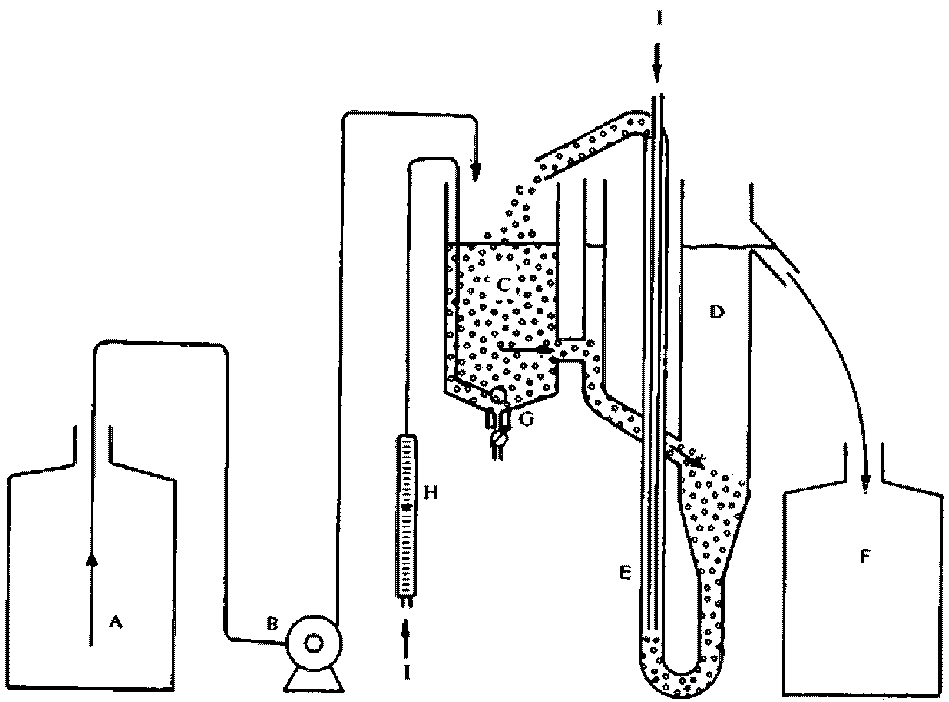
C Aeration chamber (three litres capacity)
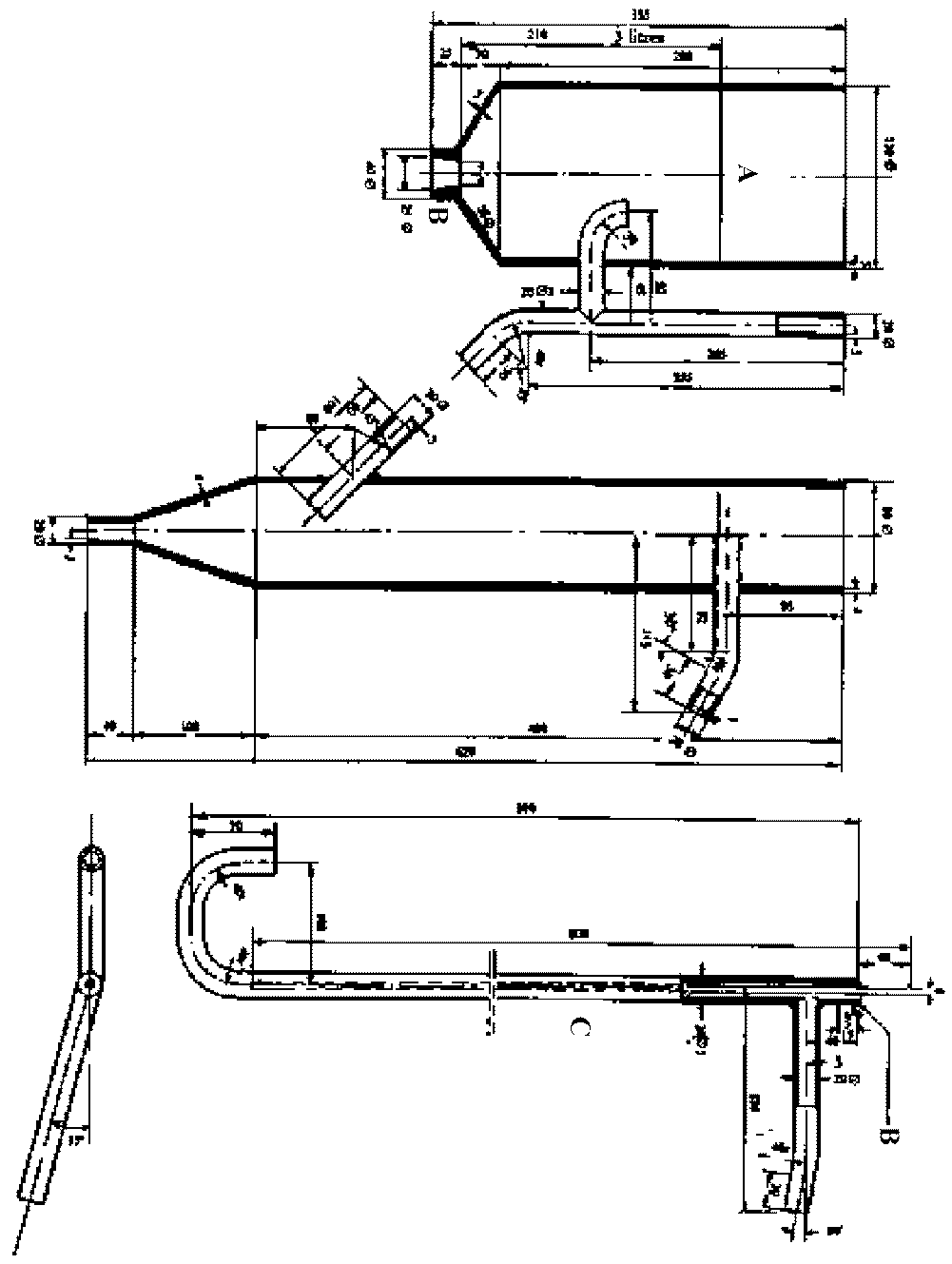
C Glass or waterproof plastic (hard PVC)
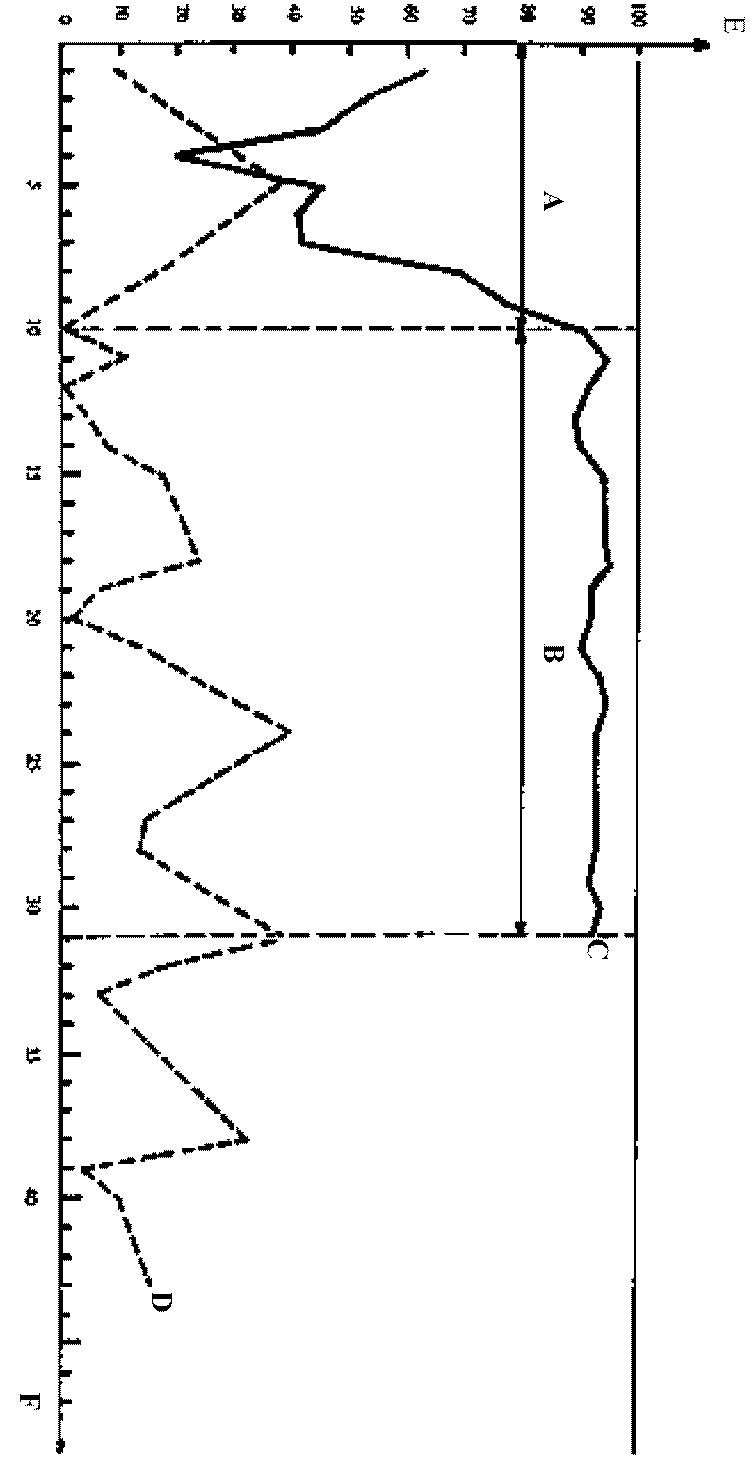
B Period used for calculation (twenty-one days)
C Readily biodegradable surfactant
D Surfactant not readily biodegradable
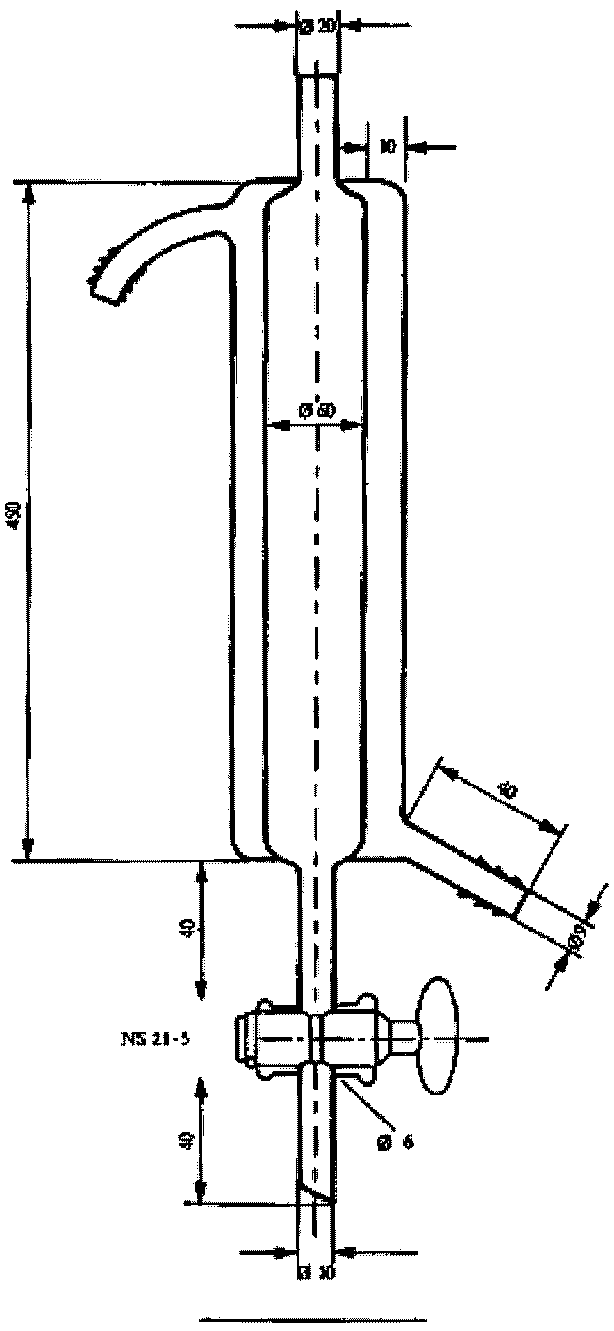
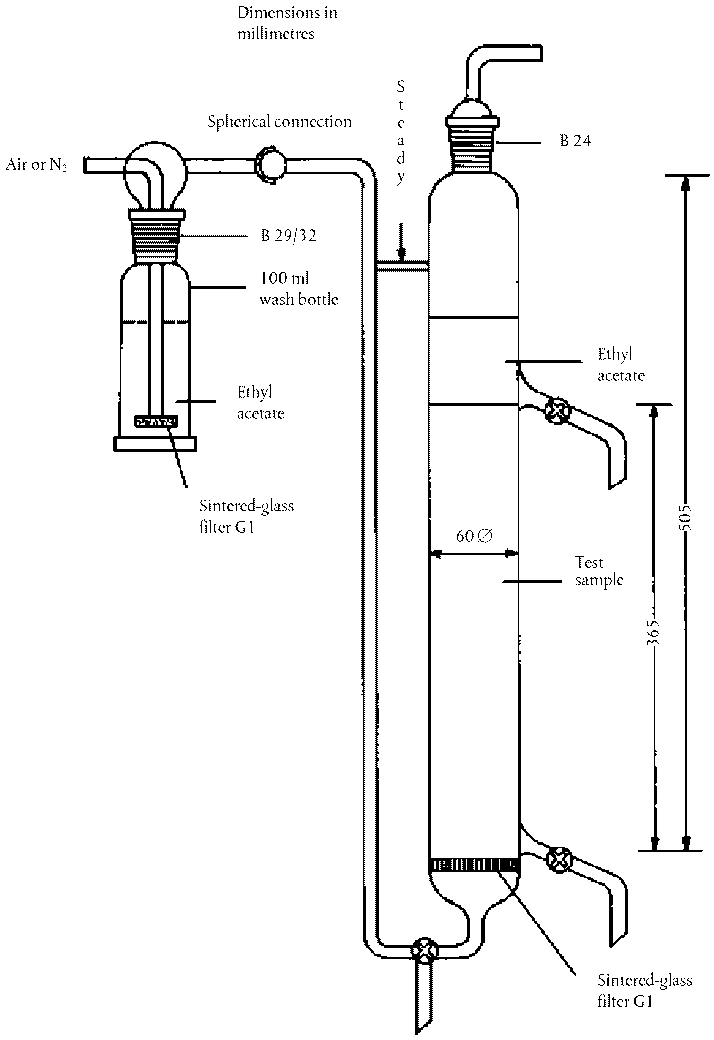
Переход между статьями: Ctrl + ← / →