Глава VII. ЗАКЛЮЧИТЕЛЬНЫЕ И ПЕРЕХОДНЫЕ ПОЛОЖЕНИЯ
Статья 52Директива № 2014/53/ЕС Европейского парламента и Совета Европейского Союза
Актуально на 04.11.2026.
Как цитировать: Статья 52. Директива N 2014/53/ЕС Европейского парламента и Совета Европейского Союза. 2014/53/ЕС. https://bukva.ai/docs/direktiva-201453es/statya-52
Настоящая Директива адресуется государствам-членам ЕС.
Совершено в Страсбурге 16 апреля 2014 г.
ОБОРУДОВАНИЕ, НЕ ПОДПАДАЮЩЕЕ ПОД ДЕЙСТВИЕ
НАСТОЯЩЕЙ ДИРЕКТИВЫ
1. Радиооборудование, используемое радиолюбителями в значении Статьи 1 определения 56 Регламента радиосвязи Международного союза радиосвязи (ITU), кроме тех случаев, когда оборудование поставлено на рынок.
Следующее оборудование должно рассматриваться как оборудование, не поставляемое на рынок:
(a) комплекты радиооборудования, собранные и используемые радиолюбителями;
(b) радиооборудование, модифицированное и используемое радиолюбителями;
(c) оборудование, сконструированное отдельными радиолюбителями в экспериментальных и научных целях, связанных с любительской радиосвязью.
2. Судовое оборудование, подпадающее под действие Директивы 96/98/ЕС Совета ЕС <*>.
<*> Директива 96/98/ЕС Совета ЕС от 20 декабря 1996 г. о судовом оборудовании (ОЖ № L 46, 17.02.1997, стр. 25).
3. Следующее авиационное оборудование, если указанное оборудование подпадает под действие Регламента (ЕС) 2018/1139 Европейского Парламента и Совета ЕС <*> и предназначено исключительно для использования в воздухе:
<*> Регламент (ЕС) 2018/1139 Европейского Парламента и Совета ЕС от 4 июля 2018 г. об общих правилах в сфере гражданской авиации, об учреждении Европейского Агентства по безопасности авиации, об изменении Регламентов (ЕС) 2111/2005, (EC) 1008/2008, (ЕС) 996/2010, (ЕС) 376/2014, Директив 2014/30/ЕС и 2014/53/ЕС Европейского Парламента и Совета ЕС и об отмене Регламентов (EC) 552/2004 и (EC) 216/2008 Европейского Парламента и Совета ЕС и Регламента (ЕЭС) 3922/91 Совета ЕС (ОЖ № L 212, 22.08.2018, стр. 1).
(a) воздушные суда, за исключением беспилотных летательных аппаратов, а также связанные с ними двигатели, винты, детали и неустановленное оборудование;
(b) беспилотные летательные аппараты, а также связанные с ними двигатели, винты, детали и неустановленное оборудование, конструкция которых сертифицирована в соответствии со Статьей 56(1) указанного Регламента и которые предназначены для работы только на частотах, выделенных Регламентом радиосвязи Международного союза по электросвязи для защищенного аэронавигационного использования.
4. Демонстрационные комплекты, изготовленные на заказ, предназначенные для профессионалов и используемые исключительно в экспериментально-методических учреждениях для таких целей.
1. Требования, установленные в пунктах 2 и 3 настоящей Части, должны применяться к следующим категориям или классам радиооборудования:
2. В той мере, в какой они могут подзаряжаться при помощи проводной зарядки, категории или классы радиооборудования, указанные в пункте 1 настоящей Части, должны:
2.1. быть оснащены разъемом USB Type-C, как описано в стандарте EN IEC 62680-1-3:2022 «Интерфейсы универсальной последовательной шины для передачи данных и подачи питания — Часть 1-3: Общие компоненты — Спецификация на кабели и разъемы USB Type - C® », и указанный разъем должен оставаться доступным и работоспособным в любое время;
2.2. иметь возможность подзарядки с помощью кабелей, которые соответствуют стандарту EN IEC 62680-1-3:2022 «Интерфейсы универсальной последовательной шины для передачи данных и подачи питания — Часть 1-3: Общие компоненты — Спецификация на кабели и разъемы USB Type - C® ».
3. В той мере, в какой они могут подзаряжаться при помощи проводной зарядки при напряжении выше 5 вольт, силе тока выше 3 ампер или мощности выше 15 ватт, категории или классы радиооборудования, указанные в пункте 1 настоящей Части, должны:
3.1. включать протокол USB Power Delivery, как описано в стандарте EN IEC 62680-1-2:2022 «Интерфейсы универсальной последовательной шины — Часть 1-2: Общие компоненты — Спецификация USB Power Delivery»;
3.2. гарантировать, что любой дополнительный протокол зарядки обеспечивает полную функциональность протокола USB Power Delivery согласно пункту 3.1, независимо от используемого зарядного устройства.
В случае радиооборудования, подпадающего под действие первого подпараграфа Статьи 3(4), следующая информация должна быть указана в соответствии с требованиями, установленными в Статье 10(8), и может быть дополнительно доступна посредством QR-кодов или аналогичных электронных решений:
(a) в случае всех категорий или классов радиооборудования, на которые распространяются требования, установленные в Части I, описание требуемой мощности проводных зарядных устройств, которые могут использоваться вместе с радиооборудованием, включая минимальную мощность, необходимую для зарядки радиооборудования, и максимальную мощность, необходимую для зарядки радиооборудования с максимальной скоростью зарядки, выраженной в ваттах, путем отображения текста: «мощность, передаваемая зарядным устройством, должна варьироваться от минимальной [xx] ватт, требуемой радиооборудованием, до максимальной [yy] ватт для достижения максимальной скорости зарядки». Количество ватт должно выражать, соответственно, минимальную мощность, требуемую радиооборудованием, и максимальную мощность, требуемую радиооборудованием для достижения максимальной скорости зарядки;
(b) в случае радиооборудования, на которое распространяются требования, установленные в пункте 3 Части I, описание спецификаций, касающихся возможностей зарядки радиооборудования, в той мере, в какой оно может подзаряжаться при помощи проводной зарядки при напряжении выше 5 вольт, или силе тока выше 3 ампер, или мощности выше 15 ватт, включая указание на то, что радиооборудование поддерживает протокол зарядки USB Power Delivery путем отображения текста «быстрая зарядка USB PD» и указание любого другого поддерживаемого протокола зарядки путем отображения его названия в текстовом формате.
1. Пиктограмма должна иметь следующий формат:
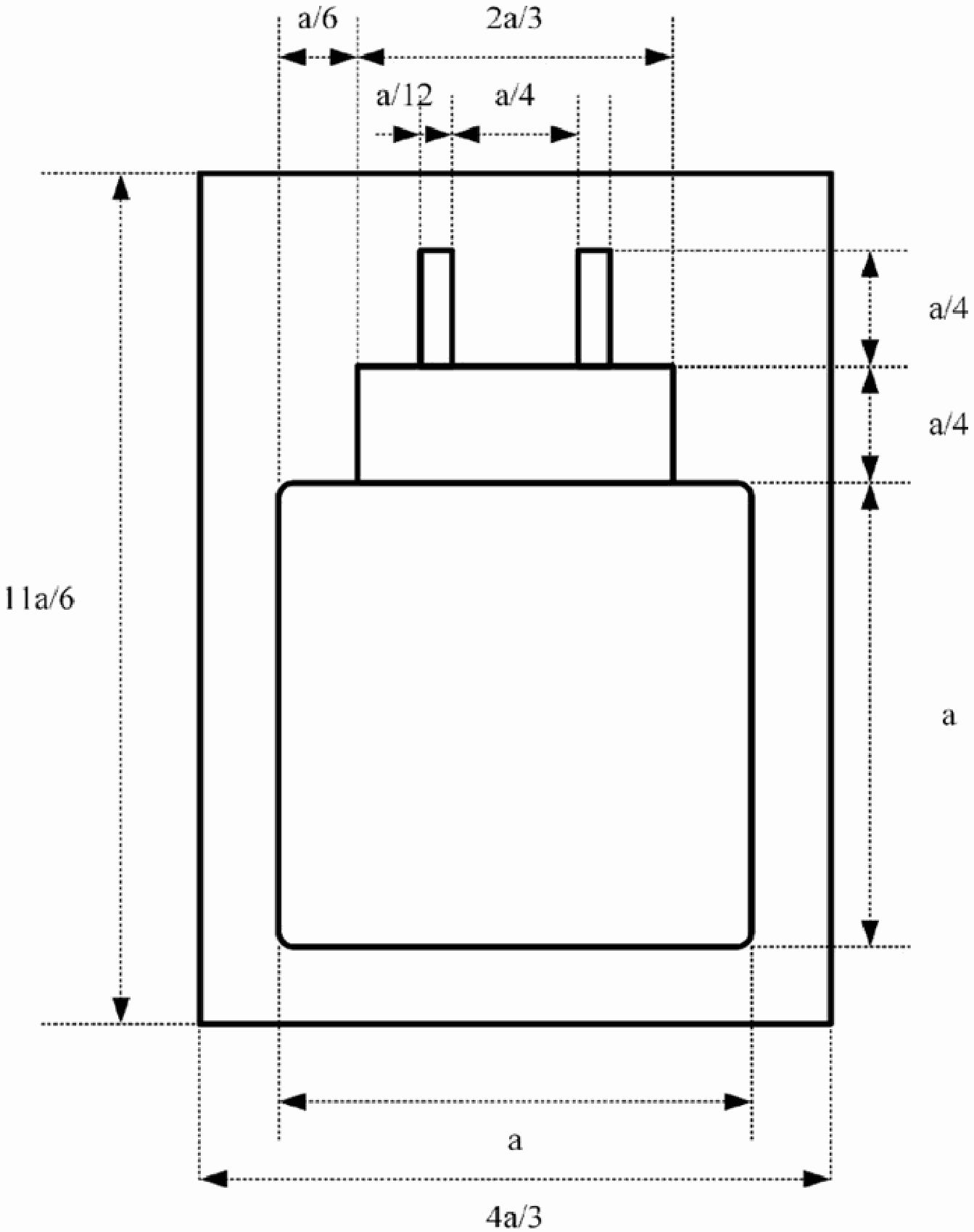
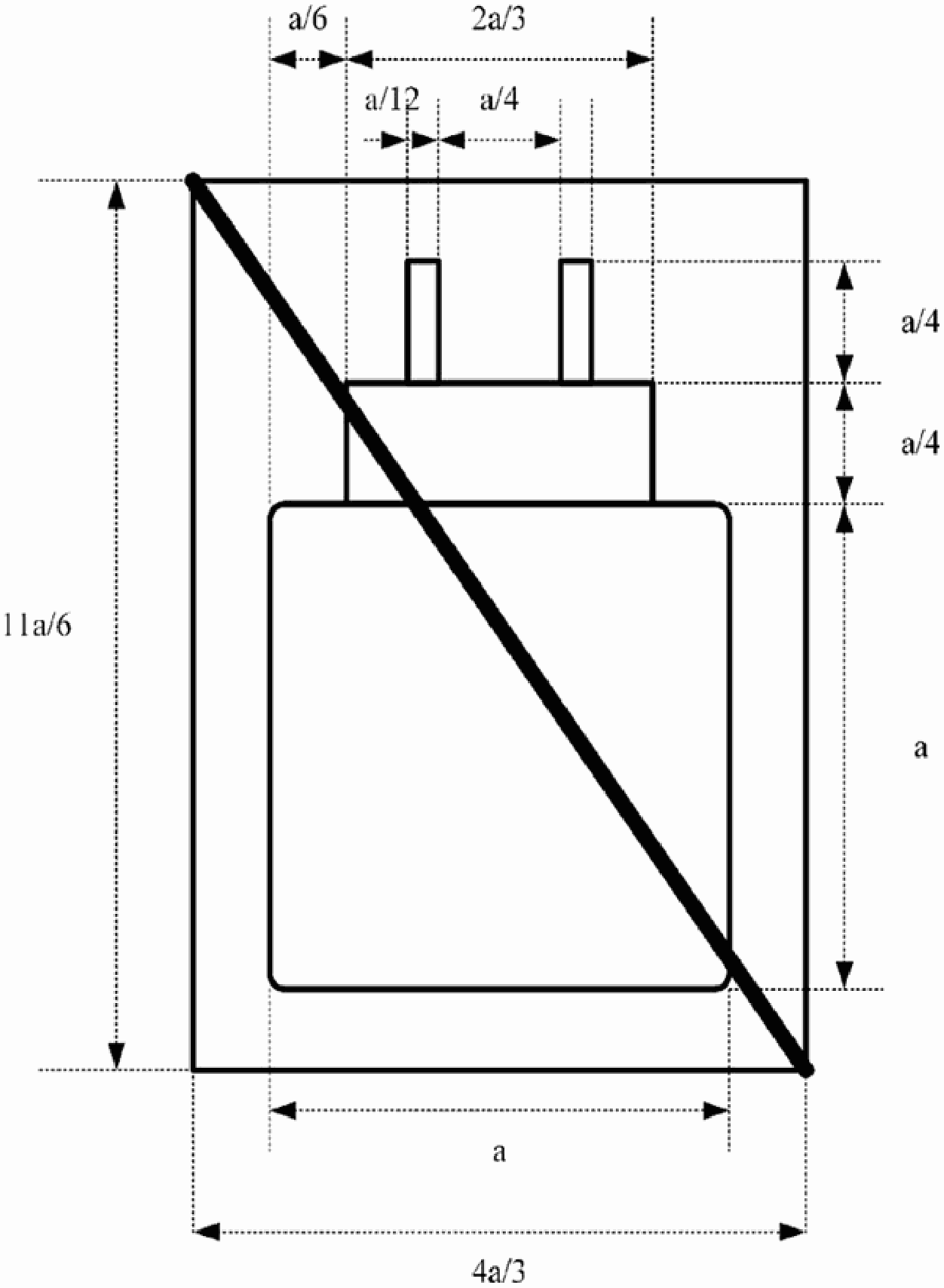
2. Пиктограмма может отличаться по внешнему виду (например, по цвету, сплошному или полому контуру, толщине линий), при условии, что она остается узнаваемой и понятной. Если пиктограмма указана в меньшем или большем размере, пропорции, указанные в чертежах в пункте 1 настоящей Части, должны быть сохранены. Размер «a», указанный в пункте 1 настоящей Части, должен быть не менее 7 мм, вне зависимости от вариантов.
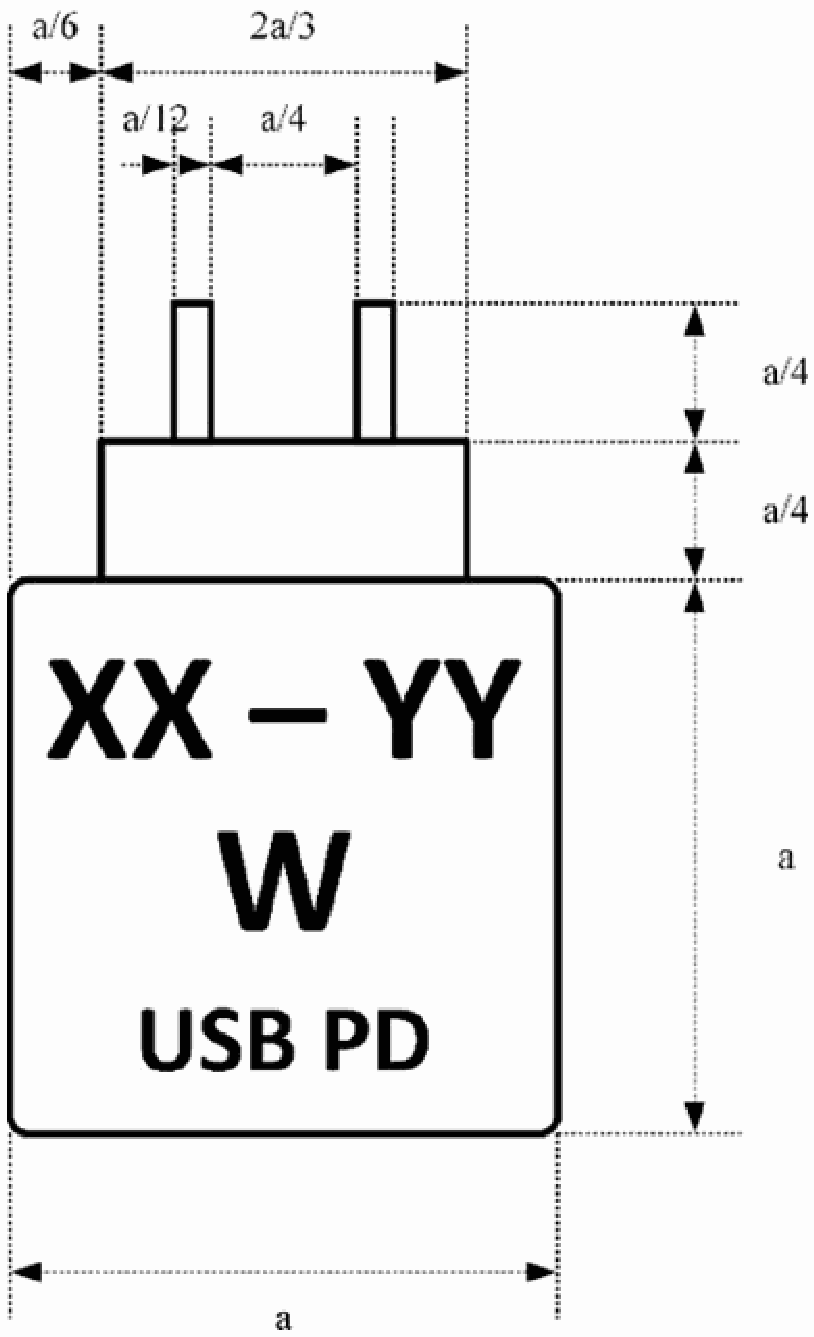
2. Буквы «XX» должны быть заменены цифрой, соответствующей минимальной мощности, требуемой радиооборудованием для зарядки, которая определяет минимальную мощность, необходимую зарядному устройству для зарядки радиооборудования. Буквы «YY» должны быть заменены цифрой, соответствующей максимальной мощности, требуемой радиооборудованием для достижения максимальной скорости зарядки, которая определяет мощность, необходимую зарядному устройству как минимум для достижения указанной максимальной скорости зарядки. Аббревиатура «USB PD» (USB Power Delivery) должна быть отображена, если радиооборудование поддерживает указанный протокол зарядки. «USB PD» — протокол, который обеспечивает максимально быструю подачу тока от зарядного устройства к радиооборудованию, не сокращая срок службы батареи.
3. Этикетка может отличаться по внешнему виду (например, по цвету, сплошному или полому контуру, толщине линий), при условии, что она остается узнаваемой и понятной. Если этикетка указана в меньшем или большем размере, пропорции, указанные в чертеже в пункте 1 настоящей Части, должны быть сохранены. Размер «a», указанный в пункте 1 настоящей Части, должен быть не менее 7 мм, вне зависимости от вариантов.
1. Внутренний контроль производства является процедурой оценки соответствия, по которой производитель выполняет обязательства, установленные в пунктах 2, 3 и 4 настоящего Приложения, и гарантирует и заявляет под свою полную ответственность, что соответствующее радиооборудование удовлетворяет существенным требованиям, установленным в Статье 3.
Производитель должен создать техническую документацию в соответствии со Статьей 21.
Производитель должен принять все необходимые меры, с тем чтобы технологический процесс производства и его мониторинг гарантировали соответствие готового радиооборудования технической документации, указанной в пункте 2 настоящего Приложения, и существенным требованиям, установленным в Статье 3.
4. Маркировка CE и декларация соответствия ЕС
4.1. Производитель должен нанести маркировку CE в соответствии со Статьями 19 и 20 на каждую единицу радиооборудования, которая удовлетворяет установленным в настоящей Директиве требованиям.
4.2. Производитель должен составить письменную декларацию соответствия ЕС для каждого типа радиооборудования и сохранять ее, а также техническую документацию для возможной передачи в распоряжение национальных органов в течение 10 лет после того, как радиооборудование было размещено на рынке. Декларация соответствия ЕС должна идентифицировать радиооборудование, в отношении которого она была составлена.
Копия декларации соответствия ЕС должна быть представлена соответствующим органам по их запросу.
5. Уполномоченный представитель
Обязанности производителя, установленные в пункте 4, могут быть выполнены его уполномоченным представителем от его имени и под его контролем при условии, что указанные обязанности определены в доверенности.
МОДУЛЬ B И МОДУЛЬ C ОЦЕНКИ СООТВЕТСТВИЯ
Экспертиза ЕС типа и соответствие типовому образцу на основе
внутреннего контроля производства
Если делается ссылка на настоящее Приложение, процедура оценки соответствия должна осуществляться согласно Модулю B (Экспертиза ЕС типа) и Модулю C (Соответствие типовому образцу на основе внутреннего контроля производства) настоящего Приложения.
1. Экспертиза ЕС типа является частью процедуры оценки соответствия, в ходе которой нотифицированный орган изучает технический дизайн радиооборудования, проводит проверку достоверности и подтверждает, что технический дизайн радиооборудования соответствует существенным требованиям, указанным в Статье 3.
2. Экспертиза ЕС типа должна осуществляться посредством оценки соответствия технического дизайна радиооборудования, посредством изучения технической документации и подтверждающего доказательства согласно пункту 3, без осуществления изучения образца (тип дизайна).
3. Производитель должен подать заявку на проведение экспертизы ЕС типа в нотифицированный орган по своему выбору.
Заявка должна включать в себя:
(a) наименование и адрес производителя и, если заявку подает уполномоченный представитель, также наименование и адрес уполномоченного представителя;
(b) письменное заявление о том, что та же самая заявка не была подана в любой другой нотифицированный орган;
(c) техническую документацию. Техническая документация должна позволить оценить соответствие радиооборудования установленным в настоящей Директиве требованиям, а также должна содержать соответствующий анализ и оценку риска/рисков. В технической документации должны быть перечислены установленные требования, она должна охватывать в части, касающейся оценки, вопросы, связанные с проектированием, производством и эксплуатацией радиооборудования. Техническая документация должна при необходимости содержать в себе элементы, указанные в Приложении V;
(d) подтверждающее доказательство соответствия технического проектного решения. В подтверждающем доказательстве необходимо указать любые документы, которые были использованы, в частности, в случае, когда существенные гармонизированные стандарты не применялись или применялись не полностью. Подтверждающее доказательство при необходимости должно включать в себя результаты тестов, проведенных согласно другим существенным техническим спецификациям соответствующей лабораторией производителя или другой испытательной лабораторией от его имени и под его контролем.
4. Нотифицированный орган должен изучить техническую документацию и подтверждающее доказательство для того, чтобы оценить соответствие технического дизайна радиооборудования.
5. Нотифицированный орган должен составить отчет об оценке, в котором необходимо зафиксировать деятельность, осуществленную в соответствии с пунктом 4, и результаты такой деятельности. Без ущерба своим обязанностям в соответствии с пунктом 8 нотифицированный орган должен опубликовать содержание указанного отчета, полностью или частично, только с согласия производителя.
6. В случае если типовой образец удовлетворяет требованиям настоящей Директивы, которые применяются в отношении соответствующего радиооборудования, нотифицированный орган должен выдать производителю сертификат о проведении экспертизы ЕС типа. Указанный сертификат должен содержать наименование и адрес производителя, выводы по результатам проверки, аспекты существенных требований, на которые распространяется проверка, условия (при наличии таковых) его действительности и необходимые данные для идентификации типового образца, подвергнутого оценке. Сертификат о проведении экспертизы ЕС типа может иметь одно или более приложений.
Сертификат о проведении экспертизы ЕС типа и его приложения должны содержать всю существенную информацию, позволяющую оценить соответствие произведенного радиооборудования исследуемому типовому образцу и сделать возможным контроль в процессе эксплуатации.
В случае если типовой образец не удовлетворяет установленным в настоящей Директиве требованиям, нотифицированный орган должен отказать в выдаче сертификата о проведении экспертизы ЕС типа и проинформировать об этом заявителя, указав причины своего отказа.
7. Нотифицированный орган должен быть в курсе любых изменений в общепризнанном современном уровне развития техники, которые указывают на то, что одобренный типовой образец больше не соответствует установленным требованиям настоящей Директивы, и должен определить, требуют ли указанные изменения дальнейшего расследования. В таком случае нотифицированный орган должен соответствующим образом проинформировать производителя.
Производитель должен проинформировать нотифицированный орган, у которого временно хранится техническая документация, касающаяся сертификата о проведении экспертизы ЕС типа, обо всех модификациях одобренного типового образца, которые могут повлиять на соответствие радиооборудования существенным требованиям настоящей Директивы или условиям действительности указанного сертификата. Такие модификации требуют дополнительного одобрения в форме дополнения к оригиналу сертификата о проведении экспертизы ЕС типа.
8. Каждый нотифицированный орган должен информировать свой нотифицирующий орган относительно сертификатов о проведении экспертизы ЕС типа и/или любых дополнений к ним, которые он выдал или отозвал; он должен периодически или по требованию предоставлять своему нотифицирующему органу перечень сертификатов и/или любых дополнений к ним, в выдаче которых было отказано, действие которых было приостановлено или иным образом ограничено.
Каждый нотифицированный орган должен информировать другие нотифицированные органы относительно сертификатов о проведении экспертизы ЕС типа и/или дополнений к ним, которые он отказался выдать, отозвал, приостановил или иным образом ограничил их действие, а также, по требованию, относительно выданных им сертификатов и/или дополнений к ним.
Каждый нотифицированный орган должен проинформировать государства-члены ЕС относительно сертификатов о проведении экспертизы ЕС типа, которые он выдал, и/или о дополнениях к ним в тех случаях, когда гармонизированные стандарты, ссылки на которые были опубликованы в Официальном Журнале Европейского Союза, не применялись или применялись не полностью. Государства-члены ЕС, Европейская Комиссия и другие нотифицированные органы могут по запросу получить копию сертификата о проведении экспертизы ЕС типа и/или дополнения к нему. По запросу государства-члены ЕС и Европейская Комиссия могут получить копии технической документации и результаты проверок, проведенных нотифицированным органом. Нотифицированные органы должны сохранять копию сертификата о проведении экспертизы ЕС типа, его приложения и дополнения, а также технический файл, включающий в себя документацию, предоставленную производителем, в течение 10 лет после того, как радиооборудование прошло оценку, или до истечения срока действия указанного сертификата.
9. Производитель должен сохранять копию сертификата о проведении экспертизы ЕС типа, его приложения и дополнения, а также техническую документацию для возможной передачи в распоряжение национальных органов в течение 10 лет после того, как радиооборудование было размещено на рынке.
10. Уполномоченный представитель производителя может подать заявку, указанную в пункте 3, и выполнять обязательства, установленные в пунктах 7 и 9, при условии, что указанные обязанности предусмотрены доверенностью.
1. Соответствие типовому образцу на основе внутреннего контроля производства является частью процедуры оценки соответствия, на основании которой производитель выполняет обязанности, установленные в пунктах 2 и 3, гарантирует и заявляет, что радиооборудование соответствует типовому образцу, описание которого дано в сертификате о проведении экспертизы ЕС типа, и удовлетворяет применимым к нему требованиям настоящей Директивы.
Производитель должен принять все меры, необходимые для того, чтобы технологический процесс производства и его мониторинг гарантировали соответствие произведенного радиооборудования одобренному образцу, описание которого дано в сертификате о проведении экспертизы ЕС типа, и применимым к нему требованиям настоящей Директивы.
3. Маркировка CE и декларация соответствия ЕС
3.1. Производитель должен нанести маркировку CE в соответствии с требованиями Статей 19 и 20 на каждую единицу радиооборудования, которое соответствует образцу, описание которого дано в сертификате о проведении экспертизы ЕС типа, и удовлетворяет требованиям, установленным в настоящей Директиве.
3.2. Производитель должен составить письменную декларацию соответствия ЕС для каждого типа радиооборудования и сохранять ее для возможной передачи в распоряжение национальных органов в течение 10 лет после того, как радиооборудование было размещено на рынке. Декларация соответствия ЕС должна идентифицировать тип радиооборудования, в отношении которого она была составлена.
Копия декларации соответствия ЕС должна быть предоставлена в распоряжение соответствующих органов по их требованию.
4. Уполномоченный представитель
Обязанности производителя, установленные в пункте 3, могут быть выполнены уполномоченным представителем, от его имени и под его контролем при условии, что указанные обязанности предусмотрены доверенностью.
1. Соответствие на основе полного обеспечения качества является процедурой оценки соответствия, на основании которой производитель выполняет обязанности, установленные в пунктах 2 и 5, гарантирует и заявляет под свою полную ответственность, что радиооборудование удовлетворяет применимым к нему требованиям настоящей Директивы.
Производитель должен применять одобренную систему качества для проектирования, производства, окончательной проверки качества и тестирования радиооборудования в соответствии с пунктом 3; он подлежит надзору в соответствии с пунктом 4.
3.1. Производитель должен подать заявку на проведение оценки его системы качества в нотифицированный орган по своему выбору в отношении соответствующего радиооборудования.
(a) наименование и адрес производителя, а также, если заявка подана уполномоченным представителем, наименование и адрес уполномоченного представителя;
(b) техническую документацию по каждому типу радиооборудования, предназначенного для производства. Техническая документация должна содержать при наличии соответствующей возможности элементы, установленные в Приложении V;
(c) документацию о системе качества; и
(d) письменное заявление о том, что та же самая заявка не была подана в любой другой нотифицированный орган.
3.2. Система качества должна гарантировать соответствие радиооборудования применимым к нему требованиям настоящей Директивы.
Все элементы, требования и положения, принятые производителем, должны быть систематически и аккуратно оформлены в виде письменных программ, процедур и инструкций. Документация по указанной системе качества должна обеспечивать согласованную интерпретацию программ качества, планов, руководств и записей.
Она должна, в частности, содержать точное описание:
(a) целей в области качества, а также организационной структуры, обязанностей и полномочий руководства в отношении качества дизайна и продукции;
(b) технических проектных спецификаций, включая стандарты, которые должны будут применяться, и в том случае, если гармонизированные стандарты не будут применяться полностью, средства, которые будут использованы для обеспечения соблюдения существенных требований настоящей Директивы, применимых к радиооборудованию;
(c) методов контроля и верификации дизайна, процессов и систематических мер, которые будут использованы при проектировании радиооборудования упомянутого типового образца радиооборудования;
(d) соответствующих методов производства, контроля качества и обеспечения качества, процессов и систематических мер, которые будут применяться;
(e) проверок и тестов, которые должны будут проводиться до, во время и после производства, и частоты, с которой они должны проводиться;
(f) записей по качеству, например, отчеты о проверке и результаты тестов, калибровочные данные, отчеты о квалификации сотрудников и т.д.;
(g) средств мониторинга достижения требуемого качества дизайна и качества продукции и эффективного функционирования системы качества.
3.3. Нотифицированный орган должен оценить систему качества для того, чтобы определить, удовлетворяет ли она требованиям, указанным в пункте 3.2.
Он должен предположить соответствие указанным требованиям в отношении элементов системы качества, которые соответствуют спецификациям соответствующего гармонизированного стандарта.
В дополнении к опыту в области систем обеспечения качества в составе команды, осуществляющей аудит, должен находиться хотя бы один член, обладающий опытом эксперта по оценке в области соответствующего радиооборудования и радиотехники, а также знающий установленные требования настоящей Директивы. Аудит должен включать в себя посещение служебных помещений производителя с целью проведения оценки. Команда, осуществляющая аудит, должна просмотреть техническую документацию, указанную в пункте 3.1(b), и проверить способность производителя идентифицировать установленные требования настоящей Директивы, а также провести необходимые проверки в целях обеспечения соответствия радиооборудования указанным требованиям.
Производитель или его уполномоченный представитель должны быть уведомлены о соответствующем решении.
В уведомлении должны содержаться выводы аудиторской проверки и мотивированное решение относительно оценки.
3.4. Производитель должен гарантировать выполнение обязательств, связанных с одобренной системой качества, и обеспечить ее функционирование таким образом, чтобы сохранить ее точность и эффективность.
3.5. Производитель должен информировать нотифицированный орган, одобривший систему качества, о любых запланированных изменениях указанной системы.
Нотифицированный орган должен оценить любые предполагаемые изменения и решить, будет ли модифицированная система качества удовлетворять требованиям, указанным в пункте 3.2, или потребуется ее переоценка.
Он должен уведомить производителя о своем решении. В уведомлении должны содержаться выводы по результатам проверки и мотивированное решение относительно оценки.
4. Надзор, осуществляемый под контролем нотифицированного органа
4.1. Целью надзора является обеспечение того, что производитель должным образом выполняет обязанности, связанные с одобренной системой качества.
4.2. Производитель в целях оценки должен разрешить нотифицированному органу доступ к местам проектирования, производства, проверки, тестирования и местам хранения, а также должен предоставить ему всю необходимую информацию, в частности:
(a) документацию о системе качества;
(b) записи по качеству, предусмотренные проектной частью системы качества, например, результаты анализа, расчеты, тесты и т.д.;
(c) записи по качеству, предусмотренные производственной частью системы качества, например, отчеты по результатам проверки и экспериментальные данные, калибровочные данные, отчеты о квалификации сотрудников и т.д.
4.3. Нотифицированный орган должен проводить периодические аудиторские проверки для подтверждения того, что производитель обеспечивает функционирование и применяет систему качества; нотифицированный орган должен представить производителю отчет о проведенной проверке.
4.4. В дополнение к этому нотифицированный орган может наносить незапланированные визиты к производителю. Во время таких визитов нотифицированный орган при необходимости может провести тестирование радиооборудования для того, чтобы проверить нормальное функционирование системы качества. Он должен представить производителю отчет о результатах визита и, если проводилось тестирование, результаты указанного теста.
5. Маркировка CE и декларация соответствия ЕС
5.1. Производитель должен нанести маркировку CE в соответствии со Статьями 19 и 20 и под контролем нотифицированного органа, указанного в пункте 3.1, нанести его идентификационный номер на каждую единицу радиооборудования, которое удовлетворяет требованиям, установленным в Статье 3.
5.2. Производитель должен составить письменную декларацию соответствия ЕС для каждого типа радиооборудования и сохранять ее для возможной передачи в распоряжение национальных органов в течение 10 лет после того, как радиооборудование было размещено на рынке. Декларация соответствия ЕС должна идентифицировать тип радиооборудования, в отношении которого она была составлена.
Копия декларации соответствия ЕС должна быть представлена соответствующим органам по их требованию.
6. Производитель должен в течение 10 лет после того, как радиооборудование было размещено на рынке, сохранять для возможной передачи в распоряжение национальных органов:
(a) техническую документацию, указанную в пункте 3.1;
(b) документацию в отношении системы качества, указанную в пункте 3.1;
(c) одобренное изменение, указанное в пункте 3.5;
(d) решения и отчеты нотифицированного органа, указанные в пунктах 3.5, 4.3 и 4.4.
7. Каждый нотифицированный орган должен информировать свой нотифицирующий орган о выдаче или об отмене разрешений относительно системы качества; он также должен периодически или по требованию предоставлять нотифицирующему органу перечень разрешений относительно системы качества, в выдаче которых он отказал, действие которых он приостановил или иным образом ограничил.
Каждый нотифицированный орган должен информировать другие нотифицированные органы о разрешениях относительно системы качества, в выдаче которых он отказал, действие которых он приостановил или отменил, а также по требованию сообщать о выданных им разрешениях относительно системы качества.
8. Уполномоченный представитель
Обязанности производителя, указанные в пунктах 3.1, 3.5, 5 и 6, могут быть выполнены его уполномоченным представителем, от его имени и под его контролем при условии, что указанные обязанности предусмотрены доверенностью.
Техническая документация должна при наличии соответствующей возможности содержать по меньшей мере следующие элементы:
(a) общее описание радиооборудования, в том числе:
(i) фотографии или иллюстрации внешних контуров, маркировки и внутренней компоновки;
(ii) версии программного обеспечения или встроенных программ, влияющих на соответствие существенным требованиям;
(iii) информацию пользователя и инструкции по установке оборудования;
(b) проектную концепцию, технологические чертежи и схемы компонентов, узлов, контуров и других аналогичных элементов;
(c) описания и пояснения, необходимые для понимания указанных чертежей, схем и функционирования радиооборудования;
(d) перечень гармонизированных стандартов, применяемых полностью или частично, ссылки на которые были опубликованы в Официальном Журнале Европейского Союза, и в том случае, если указанные гармонизированные стандарты не применялись, описание решений, принятых для соблюдения существенных требований, указанных в Статье 3, в том числе перечень других применявшихся технических спецификаций. В случае если гармонизированные стандарты применялись лишь частично, техническая документация должна определить части, которые применялись;
(e) копию декларации соответствия ЕС;
(f) в случае если применялся модуль оценки соответствия, указанный в Приложении III, копию сертификата о проведении экспертизы ЕС типа и его приложения, предоставленные соответствующим нотифицированным органом;
(g) результаты выполненных проектных расчетов, проведенных проверок и других аналогичных элементов;
(i) объяснение соблюдения требований Статьи 10(2) и объяснение указания или неуказания информации на упаковке в соответствии со Статьей 10(10).
ДЕКЛАРАЦИЯ СООТВЕТСТВИЯ ЕС (N XXX) <*>
<*> Производителю необязательно присваивать номер декларации соответствия ЕС.
1. Радиооборудование (вид, тип продукции, номер партии или серии):
2. Наименование и адрес производителя или его уполномоченного представителя:
3. Настоящая декларация выдана под полную ответственность производителя.
4. Предмет декларации (идентификация радиооборудования, позволяющая обеспечить его прослеживаемость; она может включать в себя достаточно четкое цветное изображение в тех случаях, когда это необходимо для идентификации радиооборудования):
5. Предмет декларации, описание которого приводится выше, соответствует определенному законодательству Союза в области гармонизации:
Директива 2014/53/ЕС;
другое законодательство Союза в области гармонизации при необходимости.
6. Ссылки на соответствующие гармонизированные стандарты или ссылки на другие технические спецификации, в отношении которых заявляется соответствие. Ссылки должны быть указаны с идентификационным номером, версией и при необходимости датой опубликования:
7. При необходимости нотифицированный орган ... (наименование, номер) ... выполнил ... (описание вмешательства) ... и выдал сертификат о проведении экспертизы ЕС типа: ...
8. При необходимости описание сопутствующих принадлежностей и компонентов, включая программное обеспечение, которые позволяют радиооборудованию функционировать в соответствии с назначением и предусмотрены в декларации соответствия ЕС:
(наименование, должностная функция) (подпись):
УПРОЩЕННАЯ ДЕКЛАРАЦИЯ СООТВЕТСТВИЯ ЕС
Упрощенная декларация соответствия ЕС, указанная в Статье 10(9), должна быть предоставлена в следующем виде:
Настоящим, [Наименование производителя] заявляет, что тип радиооборудования [обозначение типа радиооборудования] соответствует Директиве 2014/53/ЕС.
Полный текст декларации соответствия ЕС доступен по следующему адресу в сети Интернет:
| Директива 1999/5/ЕС | Настоящая Директива |
|---|---|
| Статья 1 | Статья 1 |
| Статья 2 | Статья 2 |
| Статья 3(1) и (2) | Статья 3(1) и (2) |
| Статья 3(3) и Статья 15a | Статья 3(3), за исключением Статьи 3(3)(i), и Статья 44 |
| Статья 4(1) и Статьи 13 - 15 | Статьи 8 и 45 |
| Статья 4(2) | - |
| Статья 5(1) | Статья 16 |
| Статья 5(2) и (3) | - |
| Статья 6(1) | Статья 6 |
| Статья 6(2) | - |
| Статья 6(3) | Статья 10(8), (9) и (10) |
| Статья 6(4) | - |
| Статья 7(1) и (2) | Статья 7 |
| Статья 7(3), (4) и (5) | - |
| Статья 8(1) и (2) | Статья 9 |
| Статья 8(3) | - |
| Статья 9 | Статьи 39 - 43 |
| Статья 10 | Статья 17 |
| Статья 11 | Статьи 22 - 38 |
| Статья 12 | Статьи 19 и 20 и Статья 10(6) и (7) |
| Статья 16 | - |
| Статья 17 | Статья 47 |
| Статья 18 | Статья 48 |
| Статья 19 | Статья 49 |
| Статья 20 | Статья 50 |
| Статья 21 | Статья 51 |
| Статья 22 | Статья 52 |
| Приложение I | Приложение I |
| Приложение II | Приложение II |
| Приложение III | - |
| Приложение IV | Приложение III |
| Приложение V | Приложение IV |
| Приложение VI | Статья 26 |
| Приложение VII (1) - (4) | Статьи 19 и 20 |
| Приложение VII (5) | Статья 10(10) |
Европейский Парламент считает, что только в тех случаях и в тех пределах, в которых имплементационные акты по смыслу Регламента (ЕС) 182/2011 обсуждаются на заседаниях комитетов, последние могут рассматриваться как «комитологические комитеты» в значении Приложения I к Рамочному соглашению об отношениях между Европейским Парламентом и Европейской Комиссией. Таким образом, заседания комитетов подпадают под действие пункта 15 Рамочного соглашения в тех случаях и в тех пределах, в которых обсуждаются другие вопросы.
OF THE EUROPEAN PARLIAMENT AND OF THE COUNCIL ON THE HARMONISATION OF THE LAWS OF THE MEMBER STATES RELATING TO THE MAKING AVAILABLE ON THE MARKET OF RADIO EQUIPMENT AND REPEALING DIRECTIVE 1999/5/EC <*>
(Amended by: Regulation (EU) 2018/1139 of the European Parliament and of the Council of 4 July 2018, Directive (EU) 2022/2380 of the European Parliament and of the Council of 23 November 2022, Commission Delegated Regulation (EU) 2023/1717 of 27 June 2023)
<*> This text is meant purely as a documentation tool and has no legal effect. The Union's institutions do not assume any liability for its contents. The authentic versions of the relevant acts, including their preambles, are those published in the Official Journal of the European Union and available in EUR-Lex. Those official texts are directly accessible through the links embedded in this document
1. This Directive establishes a regulatory framework for the making available on the market and putting into service in the Union of radio equipment.
2. This Directive shall not apply to equipment listed in Annex I.
3. This Directive shall not apply to radio equipment exclusively used for activities concerning public security, defence, State security, including the economic well-being of the State in the case of activities pertaining to State security matters, and the activities of the State in the area of criminal law.
4. Radio equipment falling within the scope of this Directive shall not be subject to Directive 2014/35/EU, except as set out in point (a) of Article 3(1) of this Directive.
1. For the purposes of this Directive, the following definitions apply:
(1) «radio equipment» means an electrical or electronic product, which intentionally emits and/or receives radio waves for the purpose of radio communication and/or radiodetermination, or an electrical or electronic product which must be completed with an accessory, such as antenna, so as to intentionally emit and/or receive radio waves for the purpose of radio communication and/or radiodetermination;
(3) «radiodetermination» means the determination of the position, velocity and/or other characteristics of an object, or the obtaining of information relating to those parameters, by means of the propagation properties of radio waves;
(4) «radio waves» means electromagnetic waves of frequencies lower than 3 000 GHz, propagated in space without artificial guide;
(5) «radio interface» means the specification of the regulated use of radio spectrum;
(6) «radio equipment class» means a class identifying particular categories of radio equipment which, under this Directive, are considered similar and those radio interfaces for which the radio equipment is designed;
(7) «harmful interference» means harmful interference as defined in point (r) of Article 2 of Directive 2002/21/EC of the European Parliament and of the Council <*>;
<*> Directive 2002/21/EC of the European Parliament and of the Council of 7 March 2002 on a common regulatory framework for electronic communications networks and services (Framework Directive) (OJ L 108, 24.4.2002, p. 33).
(8) «electromagnetic disturbance» means electromagnetic disturbance as defined in point 5 of Article 3(1) of Directive 2014/30/EU;
(9) «making available on the market» means any supply of radio equipment for distribution, consumption or use on the Union market in the course of a commercial activity, whether in return for payment or free of charge;
(10) «placing on the market» means the first making available of radio equipment on the Union market;
(11) «putting into service» means the first use of radio equipment in the Union by its end-user;
(12) «manufacturer» means any natural or legal person who manufactures radio equipment or has radio equipment designed or manufactured, and markets that equipment under his name or trade mark;
(13) «authorised representative» means any natural or legal person established within the Union who has received a written mandate from a manufacturer to act on his behalf in relation to specified tasks;
(14) «importer» means any natural or legal person established within the Union who places radio equipment from a third country on the Union market;
(15) «distributor» means any natural or legal person in the supply chain, other than the manufacturer or the importer, who makes radio equipment available on the market;
(16) «economic operators» means the manufacturer, the authorised representative, the importer and the distributor;
(17) «technical specification» means a document that prescribes technical requirements to be fulfilled by radio equipment;
(18) «harmonised standard» means harmonised standard as defined in point (c) of point 1 of Article 2 of Regulation (EU) No 1025/2012;
(19) «accreditation» means accreditation as defined in point 10 of Article 2 of Regulation (EC) No 765/2008;
(20) «national accreditation body» means national accreditation body as defined in point 11 of Article 2 of Regulation (EC) No 765/2008;
(21) «conformity assessment» means the process demonstrating whether the essential requirements of this Directive relating to radio equipment have been fulfilled;
(22) «conformity assessment body» means a body that performs conformity assessment activities;
(23) «recall» means any measure aimed at achieving the return of radio equipment that has already been made available to the end-user;
(24) «withdrawal» means any measure aimed at preventing radio equipment in the supply chain from being made available on the market;
(25) «Union harmonisation legislation» means any Union legislation harmonising the conditions for the marketing of products;
(26) «CE marking» means a marking by which the manufacturer indicates that the radio equipment is in conformity with the applicable requirements set out in Union harmonisation legislation providing for its affixing.
2. The Commission may adopt implementing acts to determine whether certain categories of electrical or electronic products meet the definition set out in point 1 of paragraph 1 of this Article. Those implementing acts shall be adopted in accordance with the examination procedure referred to in Article 45(3).
(a) the protection of health and safety of persons and of domestic animals and the protection of property, including the objectives with respect to safety requirements set out in Directive 2014/35/EU, but with no voltage limit applying;
(b) an adequate level of electromagnetic compatibility as set out in Directive 2014/30/EU.
2. Radio equipment shall be so constructed that it both effectively uses and supports the efficient use of radio spectrum in order to avoid harmful interference.
3. Radio equipment within certain categories or classes shall be so constructed that it complies with the following essential requirements:
(a) radio equipment interworks with accessories other than the charging devices for the categories or classes of radio equipment, specified in Part I of Annex Ia, which are specifically referred to in paragraph 4 of this Article;
(c) radio equipment can be connected to interfaces of the appropriate type throughout the Union;
(d) radio equipment does not harm the network or its functioning nor misuse network resources, thereby causing an unacceptable degradation of service;
(e) radio equipment incorporates safeguards to ensure that the personal data and privacy of the user and of the subscriber are protected;
(f) radio equipment supports certain features ensuring protection from fraud;
(g) radio equipment supports certain features ensuring access to emergency services;
(h) radio equipment supports certain features in order to facilitate its use by users with a disability;
(i) radio equipment supports certain features in order to ensure that software can only be loaded into the radio equipment where the compliance of the combination of the radio equipment and software has been demonstrated.
The Commission shall be empowered to adopt delegated acts in accordance with Article 44 specifying which categories or classes of radio equipment are concerned by each of the requirements set out in points (a) to (i) of the first subparagraph of this paragraph.
4. Radio equipment falling within the categories or classes specified in Part I of Annex Ia shall be so constructed that it complies with the specifications relating to charging capabilities set out in that Annex for the relevant category or class of radio equipment.
With respect to radio equipment capable of being recharged by means of wired charging, the Commission is empowered to adopt delegated acts in accordance with Article 44 to amend Part I of Annex Ia in the light of scientific and technological progress or market developments in order to ensure a minimum common interoperability between radio equipment and its charging devices, as well as to improve consumer convenience, to reduce environmental waste and to avoid market fragmentation, by:
(b) modifying, adding or removing technical specifications, including references and descriptions, in relation to the charging receptacle(s) and charging communication protocol(s), for each category or class of radio equipment concerned.
The Commission shall continuously assess market developments, market fragmentation and technological progress with a view to identifying categories or classes of radio equipment capable of being recharged by means of wired charging for which the inclusion in Part I of Annex Ia would lead to significant consumer convenience and reduction of environmental waste.
The Commission shall submit a report on the assessment referred to in the third subparagraph to the European Parliament and to the Council, for the first time by 28 December 2025 and every 5 years thereafter, and shall adopt delegated acts pursuant to the second subparagraph, point (a), accordingly.
With respect to radio equipment capable of being recharged by means other than wired charging, the Commission is empowered to adopt delegated acts in accordance with Article 44 in order to amend Part I of Annex Ia in the light of scientific and technological progress or market developments in order to ensure a minimum common interoperability between radio equipment and its charging devices, as well as to improve consumer convenience, to reduce environmental waste and to avoid market fragmentation, by:
(a) introducing, modifying, adding or removing categories or classes of radio equipment;
(b) introducing, modifying, adding or removing technical specifications, including references and descriptions, in relation to charging interface(s) and charging communication protocol(s), for each category or class of radio equipment concerned.
The Commission shall, in accordance with Article 10(1) of Regulation (EU) No 1025/2012, and by 28 December 2024, request one or more European standardisation organisations to draft harmonised standards laying down technical specifications for the charging interface(s) and charging communication protocol(s) for radio equipment capable of being recharged by means other than wired charging. In accordance with the procedure laid down in Article 10(2) of Regulation (EU) No 1025/2012, the Commission shall consult the committee set up under Article 45(1) of this Directive. The requirements as to the content of the requested harmonised standards shall be based on an assessment carried out by the Commission of the current state of wireless charging technologies for radio equipment, covering in particular market developments, market penetration, market fragmentation, technological performance, interoperability, energy efficiency and charging performance.
When preparing the delegated acts referred to in this Article with respect to radio equipment capable of being recharged by means of wired charging, as well as with respect to radio equipment capable of being recharged by means other than wired charging, the Commission shall take into account the degree of market acceptance of the technical specifications under consideration, the resulting consumer convenience and the extent of the reduction of environmental waste and market fragmentation that can be expected from such technical specifications. Technical specifications that are based on relevant available European or international standards shall be deemed to meet the objectives set out in the previous sentence. However, where such European or international standards do not exist, or where the Commission determines, based on its technical assessment, that they do not meet those objectives in an optimal manner, the Commission may set out other technical specifications which better meet those objectives.
Possibility for consumers and other end-users to acquire
certain categories or classes of radio equipment without a
charging device
1. Where an economic operator offers to consumers and other end-users the possibility to acquire the radio equipment referred to in Article 3(4) together with a charging device, the economic operator shall also offer the consumers and other end-users the possibility of acquiring that radio equipment without any charging device.
2. Economic operators shall ensure that the information on whether or not a charging device is included with the radio equipment referred to in Article 3(4) is displayed in a graphic form using a user-friendly and easily accessible pictogram as set out in Part III of Annex Ia when such radio equipment is made available to consumers and other end-users. The pictogram shall be printed on the packaging or affixed to the packaging as a sticker. When the radio equipment is made available to consumers and other end-users, the pictogram shall be displayed in a visible and legible manner and, in the case of distance selling, close to the price indication.
The Commission is empowered to adopt delegated acts in accordance with Article 44 in order to amend Part III of Annex Ia as a consequence of amendments to Parts I and II of that Annex, or as a consequence of future amendments to labelling requirements, or in the light of technological progress, by introducing, modifying, adding or removing any graphic or textual elements.
Provision of information on the compliance of combinations
of radio equipment and software
1. Manufacturers of radio equipment and of software allowing radio equipment to be used as intended shall provide the Member States and the Commission with information on the compliance of intended combinations of radio equipment and software with the essential requirements set out in Article 3. Such information shall result from a conformity assessment carried out in accordance with Article 17, and shall be given in the form of a statement of compliance which includes the elements set out in Annex VI. Depending on the specific combinations of radio equipment and software, the information shall precisely identify the radio equipment and the software which have been assessed, and it shall be continuously updated.
2. The Commission shall be empowered to adopt delegated acts in accordance with Article 44 specifying which categories or classes of radio equipment are concerned by the requirement set out in paragraph 1 of this Article.
3. The Commission shall adopt implementing acts laying down the operational rules for making the information on compliance available for the categories and classes specified by the delegated acts adopted pursuant to paragraph 2 of this Article. Those implementing acts shall be adopted in accordance with the examination procedure referred to in Article 45(3).
Registration of radio equipment types within some categories
1. As from 12 June 2018, manufacturers shall register radio equipment types within categories of radio equipment affected by a low level of compliance with the essential requirements set out in Article 3 within a central system referred to in paragraph 4 of this Article prior to radio equipment within those categories being placed on the market. When registering such radio equipment types, manufacturers shall provide some, or where justified all, elements of the technical documentation listed in points (a), (d), (e), (f), (g), (h) and (i) of Annex V. The Commission shall allocate to each registered radio equipment type a registration number, which manufacturers shall affix on radio equipment placed on the market.
2. The Commission shall be empowered to adopt delegated acts in accordance with Article 44 specifying which categories of radio equipment are concerned by the requirement set out in paragraph 1 of this Article, and the elements of the technical documentation to be provided, taking into account the information on the compliance of radio equipment provided by Member States in accordance with Article 47(1) and following an evaluation of the risk of non-implementation of the essential requirements.
3. The Commission shall adopt implementing acts laying down the operational rules for registration and the operational rules for affixing the registration number on radio equipment for the categories specified by the delegated acts adopted pursuant to paragraph 2 of this Article. Those implementing acts shall be adopted in accordance with the examination procedure referred to in Article 45(3).
4. The Commission shall make available a central system allowing manufacturers to register the required information. That system shall ensure appropriate control of access to information of confidential nature.
5. Following the date of application of a delegated act adopted pursuant to paragraph 2 of this Article, the reports prepared in accordance with Article 47(1) and (2) shall evaluate its impacts.
Member States shall take appropriate measures to ensure that radio equipment is made available on the market only if it complies with this Directive.
Member States shall allow the putting into service and use of radio equipment if it complies with this Directive when it is properly installed, maintained and used for its intended purpose. Without prejudice to their obligations under Decision No 676/2002/EC and to the conditions attached to authorisations for the use of frequencies in conformity with Union law, in particular under Article 9(3) and (4) of Directive 2002/21/EC, Member States may only introduce additional requirements for the putting into service and/or use of radio equipment for reasons related to the effective and efficient use of the radio spectrum, to the avoidance of harmful interference, to the avoidance of electromagnetic disturbances or to public health.
Notification of radio interface specifications
and assignment of radio equipment classes
1. Member States shall notify, in accordance with the procedure set out in Directive 98/34/EC, the radio interfaces which they intend to regulate except:
(a) the radio interfaces which fully and without any deviation comply with the Commission decisions on the harmonised use of radio spectrum adopted pursuant to Decision No 676/2002/EC; and
(b) the radio interfaces which, in accordance with implementing acts adopted pursuant to paragraph 2 of this Article, correspond to radio equipment which can be put into service and used without restrictions within the Union.
2. The Commission shall adopt implementing acts establishing the equivalence between notified radio interfaces and assigning a radio equipment class, details of which shall be published in the Official Journal of the European Union. Those implementing acts shall be adopted in accordance with the examination procedure referred to in Article 45(3).
1. Member States shall not impede, for reasons relating to aspects covered by this Directive, the making available on the market in their territory of radio equipment which complies with this Directive.
2. At trade fairs, exhibitions and similar events, Member States shall not create any obstacles to the display of radio equipment which does not comply with this Directive, provided that a visible sign clearly indicates that such radio equipment may not be made available on the market or put into service until it has been brought into conformity with this Directive. Demonstration of radio equipment may only take place provided that adequate measures, as prescribed by Member States, have been taken to avoid harmful interference, electromagnetic disturbances and risk to the health or safety of persons or of domestic animals or to property.
1. When placing their radio equipment on the market, manufacturers shall ensure that it has been designed and manufactured in accordance with the essential requirements set out in Article 3.
2. Manufacturers shall ensure that radio equipment shall be so constructed that it can be operated in at least one Member State without infringing applicable requirements on the use of radio spectrum.
3. Manufacturers shall draw up the technical documentation referred to in Article 21 and carry out the relevant conformity assessment procedure referred to in Article 17 or have it carried out.
Where compliance of radio equipment with the applicable requirements has been demonstrated by that conformity assessment procedure, manufacturers shall draw up an EU declaration of conformity and affix the CE marking.
4. Manufacturers shall keep the technical documentation and the EU declaration of conformity for 10 years after the radio equipment has been placed on the market.
5. Manufacturers shall ensure that procedures are in place for series production to remain in conformity with this Directive. Changes in radio equipment design or characteristics and changes in the harmonised standards or in other technical specifications by reference to which conformity of radio equipment is declared shall be adequately taken into account.
When deemed appropriate with regard to the risks presented by radio equipment, manufacturers shall, to protect the health and safety of end-users, carry out sample testing of radio equipment made available on the market, investigate, and, if necessary, keep a register of complaints, of non-conforming radio equipment and radio equipment recalls, and shall keep distributors informed of any such monitoring.
6. Manufacturers shall ensure that radio equipment which they have placed on the market bears a type, batch or serial number or other element allowing its identification, or, where the size or nature of the radio equipment does not allow it, that the required information is provided on the packaging, or in a document accompanying the radio equipment.
7. Manufacturers shall indicate on the radio equipment their name, registered trade name or registered trade mark and the postal address at which they can be contacted or, where the size or nature of radio equipment does not allow it, on its packaging, or in a document accompanying the radio equipment. The address shall indicate a single point at which the manufacturer can be contacted. The contact details shall be in a language easily understood by end-users and market surveillance authorities.
8. Manufacturers shall ensure that the radio equipment is accompanied by instructions and safety information. Instructions shall include the information required to use radio equipment in accordance with its intended use. Such information shall include, where applicable, a description of accessories and components, including software, which allow the radio equipment to operate as intended. Such instructions and safety information, as well as any labelling, shall be clear, understandable and intelligible.
The following information shall also be included in the instructions in the case of radio equipment intentionally emitting radio waves:
(a) frequency band(s) in which the radio equipment operates;
(b) maximum radio-frequency power transmitted in the frequency band(s) in which the radio equipment operates.
In the case of radio equipment referred to in Article 3(4), the instructions shall contain information on the specifications relating to the radio equipment's charging capabilities and the compatible charging devices, as set out in Part II of Annex Ia. In addition to being included in the instructions, when the manufacturers make such radio equipment available to consumers and other end-users, the information shall be also displayed on a label, as set out in Part IV of Annex Ia. The label shall be printed in the instructions and on the packaging or affixed to the packaging as a sticker. In the absence of packaging, the sticker with the label shall be affixed to the radio equipment. When the radio equipment is made available to consumers and other end-users, the label shall be displayed in a visible and legible manner and, in the case of distance selling, close to the price indication. Where the size or nature of the radio equipment does not allow otherwise, the label may be printed as a separate document accompanying the radio equipment.
The instructions and safety information referred to in the first, second and third subparagraphs of this paragraph shall be in a language which can be easily understood by consumers and other end-users, as determined by the Member State concerned.
The Commission is empowered to adopt delegated acts in accordance with Article 44 in order to amend Parts II and IV of Annex Ia, as a consequence of amendments to Part I of that Annex, or as a consequence of future amendments to labelling requirements, or in the light of technological progress, by introducing, modifying, adding or removing any details in relation to the information, graphic or textual elements, as set out in this Article.
9. Manufacturers shall ensure that each item of radio equipment is accompanied by a copy of the EU declaration of conformity or by a simplified EU declaration of conformity. Where a simplified EU declaration of conformity is provided, it shall contain the exact internet address where the full text of the EU declaration of conformity can be obtained.
10. In cases of restrictions on putting into service or of requirements for authorisation of use, information available on the packaging shall allow the identification of the Member States or the geographical area within a Member State where restrictions on putting into service or requirements for authorisation of use exist. Such information shall be completed in the instructions accompanying the radio equipment. The Commission may adopt implementing acts specifying how to present that information. Those implementing acts shall be adopted in accordance with the advisory procedure referred to in Article 45(2).
11. Manufacturers who consider or have reason to believe that radio equipment which they have placed on the market is not in conformity with this Directive shall immediately take the corrective measures necessary to bring that radio equipment into conformity, to withdraw it or recall it, if appropriate. Furthermore, where the radio equipment presents a risk, manufacturers shall immediately inform the competent national authorities of the Member States in which they made the radio equipment available on the market to that effect, giving details, in particular, of the non-compliance, of any corrective measures taken and of the results thereof.
12. Manufacturers shall, further to a reasoned request from a competent national authority, provide it with all the information and documentation in paper or electronic form necessary to demonstrate the conformity of the radio equipment with this Directive, in a language which can be easily understood by that authority. They shall cooperate with that authority, at its request, on any action taken to eliminate the risks posed by radio equipment which they have placed on the market.
1. A manufacturer may, by a written mandate, appoint an authorised representative.
The obligations laid down in Article 10(1) and the obligation to draw up technical documentation laid down in Article 10(3) shall not form part of the authorised representative's mandate.
2. An authorised representative shall perform the tasks specified in the mandate received from the manufacturer. The mandate shall allow the authorised representative to do at least the following:
(a) keep the EU declaration of conformity and the technical documentation at the disposal of national market surveillance authorities for 10 years after the radio equipment has been placed on the market;
(b) further to a reasoned request from a competent national authority, provide that authority with all the information and documentation necessary to demonstrate the conformity of radio equipment;
(c) cooperate with the competent national authorities, at their request, on any action taken to eliminate the risks posed by radio equipment covered by the authorised representative's mandate.
1. Importers shall place only compliant radio equipment on the market.
2. Before placing radio equipment on the market importers shall ensure that the appropriate conformity assessment procedure referred to in Article 17 has been carried out by the manufacturer and that the radio equipment is so constructed that it can be operated in at least one Member State without infringing applicable requirements on the use of radio spectrum. They shall ensure that the manufacturer has drawn up the technical documentation, that the radio equipment bears the CE marking and is accompanied by the information and documents referred to in Article 10(8), (9) and (10), and that the manufacturer has complied with the requirements set out in Article 10(6) and (7).
Where an importer considers or has reason to believe that radio equipment is not in conformity with the essential requirements set out in Article 3, he shall not place the radio equipment on the market until it has been brought into conformity. Furthermore, where the radio equipment presents a risk, the importer shall inform the manufacturer and the market surveillance authorities to that effect.
3. Importers shall indicate on the radio equipment their name, registered trade name or registered trade mark and the postal address at which they can be contacted or, where that is not possible, on its packaging or in a document accompanying the radio equipment. This includes cases where the size of radio equipment does not allow it, or where importers would have to open the packaging in order to indicate their name and address on the radio equipment. The contact details shall be in a language easily understood by end-users and market surveillance authorities.
4. Importers shall ensure that the radio equipment is accompanied by instructions and safety information in a language which can be easily understood by consumers and other end-users, as determined by the Member State concerned.
When making the radio equipment referred to in Article 3(4) available to consumers and other end-users, importers shall ensure that:
(a) such radio equipment displays, or is supplied with, a label in accordance with Article 10(8), third subparagraph;
(b) that label is displayed in a visible and legible manner and, in the case of distance selling, close to the price indication.
5. Importers shall ensure that, while radio equipment is under their responsibility, its storage or transport conditions do not jeopardise its compliance with the essential requirements set out in Article 3.
6. When deemed appropriate with regard to the risks presented by radio equipment, importers shall, to protect the health and safety of end-users, carry out sample testing of radio equipment made available on the market, investigate, and, if necessary, keep a register of complaints, of non-conforming radio equipment and radio equipment recalls, and shall keep distributors informed of any such monitoring.
7. Importers who consider or have reason to believe that radio equipment which they have placed on the market is not in conformity with this Directive shall immediately take the corrective measures necessary to bring that radio equipment into conformity, to withdraw it or recall it, if appropriate. Furthermore, where the radio equipment presents a risk, importers shall immediately inform the competent national authorities of the Member States in which they made the radio equipment available on the market to that effect, giving details, in particular, of the non-compliance and of any corrective measures taken.
8. Importers shall, for 10 years after the radio equipment has been placed on the market, keep a copy of the EU declaration of conformity at the disposal of the market surveillance authorities and ensure that the technical documentation can be made available to those authorities, upon request.
9. Importers shall, further to a reasoned request from a competent national authority, provide it with all the information and documentation in paper or electronic form necessary to demonstrate the conformity of radio equipment in a language which can be easily understood by that authority. They shall cooperate with that authority, at its request, on any action taken to eliminate the risks posed by radio equipment which they have placed on the market.
1. When making radio equipment available on the market distributors shall act with due care in relation to the requirements of this Directive.
2. Before making radio equipment available on the market distributors shall verify that the radio equipment bears the CE marking, that it is accompanied by the documents required by this Directive and by the instructions and safety information in a language which can be easily understood by consumers and other end-users in the Member State in which the radio equipment is to be made available on the market, and that the manufacturer and the importer have complied with the requirements set out in Article 10(2) and (6) to (10) and Article 12(3) respectively.
Where a distributor considers or has reason to believe that radio equipment is not in conformity with the essential requirements set out in Article 3, he shall not make the radio equipment available on the market until it has been brought into conformity. Furthermore, where the radio equipment presents a risk, the distributor shall inform the manufacturer or the importer to that effect as well as the market surveillance authorities.
When making the radio equipment referred to in Article 3(4) available to consumers and other end-users, distributors shall ensure that:
(a) such radio equipment displays, or is supplied with, a label in accordance with Article 10(8), third subparagraph;
(b) that label is displayed in a visible and legible manner and, in the case of distance selling, close to the price indication.
3. Distributors shall ensure that, while radio equipment is under their responsibility, its storage or transport conditions do not jeopardise its compliance with the essential requirements set out in Article 3.
4. Distributors who consider or have reason to believe that radio equipment which they have made available on the market is not in conformity with this Directive shall make sure that the corrective measures necessary to bring that radio equipment into conformity, to withdraw it or recall it, if appropriate, are taken. Furthermore, where the radio equipment presents a risk, distributors shall immediately inform the competent national authorities of the Member States in which they made the radio equipment available on the market to that effect, giving details, in particular, of the non-compliance and of any corrective measures taken.
5. Distributors shall, further to a reasoned request from a competent national authority, provide it with all the information and documentation in paper or electronic form necessary to demonstrate the conformity of radio equipment. They shall cooperate with that authority, at its request, on any action taken to eliminate the risks posed by radio equipment which they have made available on the market.
importers and distributors
An importer or distributor shall be considered a manufacturer for the purposes of this Directive and he shall be subject to the obligations of the manufacturer under Article 10, where he places radio equipment on the market under his name or trade mark or modifies radio equipment already placed on the market in such a way that compliance with this Directive may be affected.
Identification of economic operators
Economic operators shall, on request, identify the following to the market surveillance authorities:
(a) any economic operator who has supplied them with radio equipment;
(b) any economic operator to whom they have supplied radio equipment.
Economic operators shall be able to present the information referred to in the first paragraph for 10 years after they have been supplied with the radio equipment and for 10 years after they have supplied the radio equipment.
Radio equipment which is in conformity with harmonised standards or parts thereof the references of which have been published in the Official Journal of the European Union shall be presumed to be in conformity with the essential requirements set out in Article 3 covered by those standards or parts thereof.
Conformity assessment procedures
1. The manufacturer shall perform a conformity assessment of the radio equipment with a view to meeting the essential requirements set out in Article 3. The conformity assessment shall take into account all intended operating conditions and, for the essential requirement set out in point (a) of Article 3(1), the assessment shall also take into account the reasonably foreseeable conditions. Where the radio equipment is capable of taking different configurations, the conformity assessment shall confirm whether the radio equipment meets the essential requirements set out in Article 3 in all possible configurations.
2. Manufacturers shall demonstrate compliance of radio equipment with the essential requirements set out in Article 3(1) and (4) using any of the following conformity assessment procedures:
(a) internal production control set out in Annex II;
(b) EU-type examination that is followed by the conformity to type based on internal production control set out in Annex III;
(c) conformity based on full quality assurance set out in Annex IV.
3. Where, in assessing the compliance of radio equipment with the essential requirements set out in Article 3(2) and (3), the manufacturer has applied harmonised standards the references of which have been published in the Official Journal of the European Union, he shall use any of the following procedures:
(a) internal production control set out in Annex II;
(b) EU-type examination that is followed by the conformity to type based on internal production control set out in Annex III;
(c) conformity based on full quality assurance set out in Annex IV.
4. Where, in assessing the compliance of radio equipment with the essential requirements set out in Article 3(2) and (3), the manufacturer has not applied or has applied only in part harmonised standards the references of which have been published in the Official Journal of the European Union, or where such harmonised standards do not exist, radio equipment shall be submitted with regard to those essential requirements to either of the following procedures:
(a) EU-type examination that is followed by the conformity to type based on internal production control set out in Annex III;
1. The EU declaration of conformity shall state that the fulfilment of the essential requirements set out in Article 3 has been demonstrated.
2. The EU declaration of conformity shall have the model structure set out in Annex VI, shall contain the elements set out in that Annex and shall be continuously updated. It shall be translated into the language or languages required by the Member State in which the radio equipment is placed or made available on the market.
The simplified EU declaration of conformity referred to in Article 10(9) shall contain the elements set out in Annex VII and shall be continuously updated. It shall be translated into the language or languages required by the Member State in which the radio equipment is placed or made available on the market. The full text of the EU declaration of conformity shall be available at the internet address referred to in the simplified EU declaration of conformity, in a language or languages required by the Member State in which the radio equipment is placed or made available on the market.
3. Where radio equipment is subject to more than one Union act requiring an EU declaration of conformity, a single EU declaration of conformity shall be drawn up in respect of all such Union acts. That declaration shall contain the identification of the Union acts concerned including their publication references.
4. By drawing up the EU declaration of conformity, the manufacturer shall assume responsibility for the compliance of the radio equipment with the requirements laid down in this Directive.
1. The CE marking shall be subject to the general principles set out in Article 30 of Regulation (EC) No 765/2008.
2. On account of the nature of radio equipment, the height of the CE marking affixed to radio equipment may be lower than 5 mm, provided that it remains visible and legible.
1. The CE marking shall be affixed visibly, legibly and indelibly to the radio equipment or to its data plate, unless that is not possible or not warranted on account of the nature of radio equipment. The CE marking shall also be affixed visibly and legibly to the packaging.
2. The CE marking shall be affixed before the radio equipment is placed on the market.
3. The CE marking shall be followed by the identification number of the notified body where the conformity assessment procedure set out in Annex IV is applied.
The identification number of the notified body shall have the same height as the CE marking.
The identification number of the notified body shall be affixed by the notified body itself or, under its instructions, by the manufacturer or his authorised representative.
4. Member States shall build upon existing mechanisms to ensure correct application of the regime governing the CE marking and shall take appropriate action in the event of improper use of that marking.
1. The technical documentation shall contain all relevant data or details of the means used by the manufacturer to ensure that radio equipment complies with the essential requirements set out in Article 3. It shall, at least, contain the elements set out in Annex V.
2. The technical documentation shall be drawn up before radio equipment is placed on the market and shall be continuously updated.
3. The technical documentation and correspondence relating to any EU-type examination procedure shall be drawn up in an official language of the Member State in which the notified body is established or in a language acceptable to that body.
4. Where the technical documentation does not comply with paragraphs 1, 2 or 3 of this Article, and in so doing fails to present sufficient relevant data or means used to ensure compliance of radio equipment with the essential requirements set out in Article 3, the market surveillance authority may ask the manufacturer or the importer to have a test performed by a body acceptable to the market surveillance authority at the expense of the manufacturer or the importer within a specified period in order to verify compliance with the essential requirements set out in Article 3.
Member States shall notify the Commission and the other Member States of bodies authorised to carry out third-party conformity assessment tasks under this Directive.
1. Member States shall designate a notifying authority that shall be responsible for setting up and carrying out the necessary procedures for the assessment and notification of conformity assessment bodies and the monitoring of notified bodies, including compliance with Article 28.
2. Member States may decide that the assessment and monitoring referred to in paragraph 1 shall be carried out by a national accreditation body within the meaning of and in accordance with Regulation (EC) No 765/2008.
3. Where the notifying authority delegates or otherwise entrusts the assessment, notification or monitoring referred to in paragraph 1 to a body which is not a governmental entity, that body shall be a legal entity and shall comply mutatis mutandis with the requirements laid down in Article 24. In addition it shall have arrangements to cover liabilities arising out of its activities.
4. The notifying authority shall take full responsibility for the tasks performed by the body referred to in paragraph 3.
1. A notifying authority shall be established in such a way that no conflict of interest with conformity assessment bodies occurs.
2. A notifying authority shall be organised and operated so as to safeguard the objectivity and impartiality of its activities.
3. A notifying authority shall be organised in such a way that each decision relating to notification of a conformity assessment body is taken by competent persons different from those who carried out the assessment.
4. A notifying authority shall not offer or provide any activities that conformity assessment bodies perform or consultancy services on a commercial or competitive basis.
5. A notifying authority shall safeguard the confidentiality of the information it obtains.
6. A notifying authority shall have a sufficient number of competent personnel at its disposal for the proper performance of its tasks.
Member States shall inform the Commission of their procedures for the assessment and notification of conformity assessment bodies and the monitoring of notified bodies, and of any changes thereto.
1. For the purposes of notification, a conformity assessment body shall meet the requirements laid down in paragraphs 2 to 11.
2. A conformity assessment body shall be established under national law of a Member State and have legal personality.
3. A conformity assessment body shall be a third-party body independent of the organisation or the radio equipment it assesses.
A body belonging to a business association or professional federation representing undertakings involved in the design, manufacturing, provision, assembly, use or maintenance of radio equipment which it assesses may, on condition that its independence and the absence of any conflict of interest are demonstrated, be considered such a body.
4. A conformity assessment body, its top level management and the personnel responsible for carrying out the conformity assessment tasks shall not be the designer, manufacturer, supplier, installer, purchaser, owner, user or maintainer of the radio equipment which they assess, nor the representative of any of those parties. This shall not preclude the use of assessed radio equipment that is necessary for the operations of the conformity assessment body or the use of such radio equipment for personal purposes.
A conformity assessment body, its top level management and the personnel responsible for carrying out the conformity assessment tasks shall not be directly involved in the design, manufacture or construction, the marketing, installation, use or maintenance of that radio equipment, or represent the parties engaged in those activities. They shall not engage in any activity that may conflict with their independence of judgement or integrity in relation to conformity assessment activities for which they are notified. This shall in particular apply to consultancy services.
Conformity assessment bodies shall ensure that the activities of their subsidiaries or subcontractors do not affect the confidentiality, objectivity or impartiality of their conformity assessment activities.
5. Conformity assessment bodies and their personnel shall carry out the conformity assessment activities with the highest degree of professional integrity and the requisite technical competence in the specific field and shall be free from all pressures and inducements, particularly financial, which might influence their judgement or the results of their conformity assessment activities, especially as regards persons or groups of persons with an interest in the results of those activities.
6. A conformity assessment body shall be capable of carrying out all the conformity assessment tasks assigned to it by Annexes III and IV in relation to which it has been notified, whether those tasks are carried out by the conformity assessment body itself or on its behalf and under its responsibility.
At all times and for each conformity assessment procedure and each kind or category of radio equipment in relation to which it has been notified, a conformity assessment body shall have at its disposal the necessary:
(a) personnel with technical knowledge and sufficient and appropriate experience to perform the conformity assessment tasks;
(b) descriptions of procedures in accordance with which conformity assessment is carried out, ensuring the transparency and the ability of reproduction of those procedures. It shall have appropriate policies and procedures in place that distinguish between tasks it carries out as a notified body and other activities;
(c) procedures for the performance of activities which take due account of the size of an undertaking, the sector in which it operates, its structure, the degree of complexity of radio equipment technology in question and the mass or serial nature of the production process.
A conformity assessment body shall have the means necessary to perform the technical and administrative tasks connected with the conformity assessment activities in an appropriate manner.
7. The personnel responsible for carrying out conformity assessment tasks shall have the following:
(a) sound technical and vocational training covering all the conformity assessment activities in relation to which the conformity assessment body has been notified;
(b) satisfactory knowledge of the requirements of the assessments they carry out and adequate authority to carry out those assessments;
(c) appropriate knowledge and understanding of the essential requirements set out in Article 3, of the applicable harmonised standards and of the relevant provisions of Union harmonisation legislation and of national legislation;
(d) the ability to draw up EU-type examination certificates or quality system approvals, records and reports demonstrating that assessments have been carried out.
8. The impartiality of the conformity assessment bodies, their top level management and of the personnel responsible for carrying out the conformity assessment tasks shall be guaranteed.
The remuneration of the top level management and personnel responsible for carrying out the conformity assessment tasks of a conformity assessment body shall not depend on the number of assessments carried out or on the results of those assessments.
9. Conformity assessment bodies shall take out liability insurance unless liability is assumed by the State in accordance with national law, or the Member State itself is directly responsible for the conformity assessment.
10. The personnel of a conformity assessment body shall observe professional secrecy with regard to all information obtained in carrying out their tasks under Annexes III and IV or any provision of national law giving effect to them, except in relation to the competent authorities of the Member State in which its activities are carried out. Proprietary rights shall be protected.
11. Conformity assessment bodies shall participate in, or ensure that their personnel responsible for carrying out the conformity assessment tasks are informed of, the relevant standardisation activities, the regulatory activities in the area of radio equipment and frequency planning, and the activities of the notified body coordination group established under the relevant Union harmonisation legislation and shall apply as general guidance the administrative decisions and documents produced as a result of the work of that group.
Where a conformity assessment body demonstrates its conformity with the criteria laid down in the relevant harmonised standards or parts thereof the references of which have been published in the Official Journal of the European Union it shall be presumed to comply with the requirements set out in Article 26 in so far as the applicable harmonised standards cover those requirements.
1. Where a notified body subcontracts specific tasks connected with conformity assessment or has recourse to a subsidiary, it shall ensure that the subcontractor or the subsidiary meets the requirements set out in Article 26 and shall inform the notifying authority accordingly.
2. Notified bodies shall take full responsibility for the tasks performed by subcontractors or subsidiaries wherever these are established.
3. Activities may be subcontracted or carried out by a subsidiary only with the agreement of the client.
4. Notified bodies shall keep at the disposal of the notifying authority the relevant documents concerning the assessment of the qualifications of the subcontractor or the subsidiary and the work carried out by them under Annexes III and IV.
1. A conformity assessment body shall submit an application for notification to the notifying authority of the Member State in which it is established.
2. The application for notification shall be accompanied by a description of the conformity assessment activities, the conformity assessment module or modules and the radio equipment for which that body claims to be competent, as well as by an accreditation certificate, where one exists, issued by a national accreditation body attesting that the conformity assessment body fulfils the requirements laid down in Article 26.
3. Where the conformity assessment body concerned cannot provide an accreditation certificate, it shall provide the notifying authority with all the documentary evidence necessary for the verification, recognition and regular monitoring of its compliance with the requirements laid down in Article 26.
1. Notifying authorities may notify only conformity assessment bodies which have satisfied the requirements laid down in Article 26.
2. They shall notify the Commission and the other Member States using the electronic notification tool developed and managed by the Commission.
3. The notification shall include full details of the conformity assessment activities, the conformity assessment module or modules and the radio equipment concerned and the relevant attestation of competence.
4. Where a notification is not based on an accreditation certificate as referred to in Article 29(2), the notifying authority shall provide the Commission and the other Member States with documentary evidence which attests to the conformity assessment body's competence and the arrangements in place to ensure that that body will be monitored regularly and will continue to satisfy the requirements laid down in Article 26.
5. The body concerned may perform the activities of a notified body only where no objections are raised by the Commission or the other Member States within two weeks of a notification where an accreditation certificate is used or within two months of a notification where accreditation is not used.
Only such a body shall be considered a notified body for the purposes of this Directive.
6. The notifying authority shall notify the Commission and the other Member States of any subsequent relevant changes to the notification.
1. The Commission shall assign an identification number to a notified body.
It shall assign a single such number even where the body is notified under several Union acts.
2. The Commission shall make publicly available the list of the bodies notified under this Directive, including the identification numbers that have been assigned to them and the activities for which they have been notified.
1. Where a notifying authority has ascertained or has been informed that a notified body no longer meets the requirements laid down in Article 26, or that it is failing to fulfil its obligations, the notifying authority shall restrict, suspend or withdraw notification as appropriate, depending on the seriousness of the failure to meet those requirements or fulfil those obligations. It shall immediately inform the Commission and the other Member States accordingly.
2. In the event of restriction, suspension or withdrawal of notification, or where the notified body has ceased its activity, the notifying Member State shall take appropriate steps to ensure that the files of that body are either processed by another notified body or kept available for the responsible notifying and market surveillance authorities at their request.
1. The Commission shall investigate all cases where it doubts, or doubt is brought to its attention regarding, the competence of a notified body or the continued fulfilment by a notified body of the requirements and responsibilities to which it is subject.
2. The notifying Member State shall provide the Commission, on request, with all information relating to the basis for the notification or the maintenance of the competence of the notified body concerned.
3. The Commission shall ensure that all sensitive information obtained in the course of its investigations is treated confidentially.
4. Where the Commission ascertains that a notified body does not meet or no longer meets the requirements for its notification, it shall adopt an implementing act requesting the notifying Member State to take the necessary corrective measures, including withdrawal of notification if necessary.
That implementing act shall be adopted in accordance with the advisory procedure referred to in Article 45(2).
1. Notified bodies shall carry out conformity assessments in accordance with the conformity assessment procedures provided for in Annexes III and IV.
2. Conformity assessments shall be carried out in a proportionate manner, avoiding unnecessary burdens for economic operators. Conformity assessment bodies shall perform their activities taking due account of the size of an undertaking, the sector in which it operates, its structure, the degree of complexity of the radio equipment technology in question and the mass or serial nature of the production process.
In so doing they shall nevertheless respect the degree of rigour and the level of protection required for the compliance of the radio equipment with this Directive.
3. Where a notified body finds that the essential requirements set out in Article 3 or corresponding harmonised standards or other technical specifications have not been met by a manufacturer, it shall require that manufacturer to take appropriate corrective measures and shall not issue an EU-type examination certificate or a quality system approval.
4. Where, in the course of the monitoring of conformity following the issue of an EU-type examination certificate or a quality system approval, a notified body finds that radio equipment no longer complies, it shall require the manufacturer to take appropriate corrective measures and shall suspend or withdraw the EU-type examination certificate or the quality system approval if necessary.
5. Where corrective measures are not taken or do not have the required effect, the notified body shall restrict, suspend or withdraw any EU-type examination certificates or quality system approvals, as appropriate.
Member States shall ensure that an appeal procedure against decisions of the notified bodies is available.
1. Notified bodies shall inform the notifying authority of the following:
(a) any refusal, restriction, suspension or withdrawal of an EU-type examination certificate or a quality system approval in accordance with the requirements of Annexes III and IV;
(b) any circumstances affecting the scope of or conditions for notification;
(c) any request for information which they have received from market surveillance authorities regarding conformity assessment activities;
(d) on request, conformity assessment activities performed within the scope of their notification and any other activity performed, including cross-border activities and subcontracting.
2. Notified bodies shall, in accordance with the requirements of Annexes III and IV, provide the other bodies notified under this Directive carrying out similar conformity assessment activities covering the same categories of radio equipment with relevant information on issues relating to negative and, on request, positive conformity assessment results.
3. Notified bodies shall fulfil information obligations under Annexes III and IV.
The Commission shall provide for the organisation of exchange of experience between the Member States' national authorities responsible for notification policy.
The Commission shall ensure that appropriate coordination and cooperation between bodies notified under this Directive are put in place and properly operated in the form of a sectoral group of notified bodies.
Member States shall ensure that the bodies notified by them participate in the work of that group, directly or by means of designated representatives.
Article 15(3) and Articles 16 to 29 of Regulation (EC) No 765/2008 shall apply to radio equipment.
Procedure at national level for dealing with radio equipment
presenting a risk or not in compliance with essential
requirements
1. Where the market surveillance authorities of a Member State have sufficient reason to believe that radio equipment covered by this Directive presents a risk to the health or safety of persons or to other aspects of public interest protection covered by this Directive, or that it does not comply with at least one of the applicable essential requirements set out in Article 3, they shall carry out an evaluation in relation to the radio equipment concerned covering all relevant requirements laid down in this Directive. The relevant economic operators shall cooperate as necessary with the market surveillance authorities for that purpose.
Where, in the course of the evaluation referred to in the first subparagraph, the market surveillance authorities find that the radio equipment does not comply with the requirements laid down in this Directive, they shall without delay require the relevant economic operator to take all appropriate corrective actions to bring the radio equipment into compliance with those requirements, to withdraw the radio equipment from the market, or to recall it within a reasonable period, commensurate with the nature of the risk, as they may prescribe.
The market surveillance authorities shall inform the relevant notified body accordingly.
Article 21 of Regulation (EC) No 765/2008 shall apply to the measures referred to in the second subparagraph of this paragraph.
2. Where the market surveillance authorities consider that non-compliance is not restricted to their national territory, they shall inform the Commission and the other Member States of the results of the evaluation and of the actions which they have required the economic operator to take.
3. The economic operator shall ensure that all appropriate corrective action is taken in respect of all radio equipment concerned that it has made available on the market throughout the Union.
4. Where the relevant economic operator does not take adequate corrective action within the period referred to in the second subparagraph of paragraph 1, the market surveillance authorities shall take all appropriate provisional measures to prohibit or restrict the radio equipment being made available on their national market, to withdraw the radio equipment from that market or to recall it.
The market surveillance authorities shall inform the Commission and the other Member States, without delay, of those measures.
5. The information referred to in the second subparagraph of paragraph 4 shall include all available details, in particular the data necessary for the identification of the non-compliant radio equipment, the origin of the radio equipment, the nature of the non-compliance alleged and the risk involved, the nature and duration of the national measures taken and the arguments put forward by the relevant economic operator. In particular, the market surveillance authorities shall indicate whether the non-compliance is due to either of the following:
(a) failure of the radio equipment to meet the relevant essential requirements set out in Article 3; or
(b) shortcomings in the harmonised standards referred to in Article 16 conferring a presumption of conformity.
6. Member States other than the Member State initiating the procedure under this Article shall without delay inform the Commission and the other Member States of any measures adopted and of any additional information at their disposal relating to the non-compliance of the radio equipment concerned, and, in the event of disagreement with the adopted national measure, of their objections.
7. Where, within three months of receipt of the information referred to in the second subparagraph of paragraph 4, no objection has been raised by either a Member State or the Commission in respect of a provisional measure taken by a Member State, that measure shall be deemed justified.
8. Member States shall ensure that appropriate restrictive measures, such as withdrawal of the radio equipment from the market, are taken in respect of the radio equipment concerned without delay.
1. Where, on completion of the procedure set out in Article 40(3) and (4), objections are raised against a measure taken by a Member State, or where the Commission considers a national measure to be contrary to Union legislation, the Commission shall without delay enter into consultation with the Member States and the relevant economic operator or operators and shall evaluate the national measure. On the basis of the results of that evaluation, the Commission shall adopt an implementing act determining whether the national measure is justified or not.
The Commission shall address its decision to all Member States and shall immediately communicate it to them and the relevant economic operator or operators.
2. If the national measure is considered justified, all Member States shall take the necessary measures to ensure that the non-compliant radio equipment is withdrawn or recalled from their market, and shall inform the Commission accordingly. If the national measure is considered unjustified, the Member State concerned shall withdraw that measure.
3. Where the national measure is considered justified and the non-compliance of the radio equipment is attributed to shortcomings in the harmonised standards referred to in point (b) of Article 40(5) of this Directive, the Commission shall apply the procedure provided for in Article 11 of Regulation (EU) No 1025/2012.
1. Where, having carried out an evaluation under Article 40(1), a Member State finds that although radio equipment is in compliance with this Directive, it presents a risk to the health or safety of persons or to other aspects of public interest protection covered by this Directive, it shall require the relevant economic operator to take all appropriate measures to ensure that the radio equipment concerned, when placed on the market, no longer presents that risk, to withdraw the radio equipment from the market or to recall it within a reasonable period, commensurate with the nature of the risk, as it may prescribe.
2. The economic operator shall ensure that corrective action is taken in respect of all the radio equipment concerned that he has made available on the market throughout the Union.
3. The Member State shall immediately inform the Commission and the other Member States. That information shall include all available details, in particular the data necessary for the identification of the radio equipment concerned, the origin and the supply chain of radio equipment, the nature of the risk involved and the nature and duration of the national measures taken.
4. The Commission shall without delay enter into consultation with the Member States and the relevant economic operator or operators and shall evaluate the national measures taken. On the basis of the results of that evaluation, the Commission shall decide by means of implementing acts whether the national measure is justified or not and, where necessary, propose appropriate measures.
The implementing acts referred to in the first subparagraph of this paragraph shall be adopted in accordance with the examination procedure referred to in Article 45(3).
On duly justified imperative grounds of urgency relating to the protection of health and safety of persons, the Commission shall adopt immediately applicable implementing acts in accordance with the procedure referred to in Article 45(4).
5. The Commission shall address its decision to all Member States and shall immediately communicate it to them and the relevant economic operator or operators.
1. Without prejudice to Article 40, where a Member State makes one of the following findings, it shall require the relevant economic operator to put an end to the non-compliance concerned:
(a) the CE marking has been affixed in violation of Article 30 of Regulation (EC) No 765/2008 or of Article 20 of this Directive;
(b) the CE marking has not been affixed;
(c) the identification number of the notified body, where the conformity assessment procedure set out in Annex IV is applied, has been affixed in violation of Article 20 or has not been affixed;
(d) the EU declaration of conformity has not been drawn up;
(e) the EU declaration of conformity has not been drawn up correctly;
(f) technical documentation is either not available or not complete;
(fa) the pictogram as referred to in Article 3a(2), or the label as referred to in Article 10(8), has not been drawn up correctly;
(fb) the label as referred to in Article 10(8) does not accompany the radio equipment concerned;
(fc) the pictogram or the label is not affixed or displayed in accordance with Article 3a(2) or Article 10(8), respectively;
(g) the information referred to in Article 10(6) or (7) or Article 12(3) is absent, false or incomplete;
(h) the information referred to in Article 10(8), the EU declaration of conformity referred to in Article 10(9) or the information on usage restrictions referred to in Article 10(10) does not accompany the radio equipment;
(i) requirements on identification of economic operators set out in Article 15 are not fulfilled;
(j) Article 3a(1) or Article 5 is not complied with.
2. Where the non-compliance referred to in paragraph 1 persists, the Member State concerned shall take all appropriate measures to restrict or prohibit corresponding radio equipment being made available on the market or ensure that it is withdrawn or recalled from the market.
1. The power to adopt delegated acts is conferred on the Commission subject to the conditions laid down in this Article.
2. The power to adopt delegated acts referred to in the second subparagraph of Articles 3(3), 4(2) and 5(2) shall be conferred on the Commission for a period of five years from 11 June 2014. The power to adopt delegated acts referred to in Article 3(4), Article 3a(2), second subparagraph, and Article 10(8), fifth subparagraph, shall be conferred on the Commission for a period of 5 years from 27 December 2022. The Commission shall draw up a report in respect of the delegation of power not later than nine months before the end of the five-year period. The delegation of power shall be tacitly extended for periods of an identical duration, unless the European Parliament or the Council opposes such extension not later than three months before the end of each period.
3. The delegation of power referred to in Article 3(3), second subparagraph, Article 3(4), Article 3a(2), second subparagraph, Article 4(2), Article 5(2) and Article 10(8), fifth subparagraph, may be revoked at any time by the European Parliament or by the Council. A decision to revoke shall put an end to the delegation of the power specified in that decision. It shall take effect the day following the publication of the decision in the Official Journal of the European Union or at a later date specified therein. It shall not affect the validity of any delegated acts already in force.
3a. Before adopting a delegated act, the Commission shall consult experts designated by each Member State in accordance with the principles laid down in the Interinstitutional Agreement of 13 April 2016 on Better Law-Making <*>.
<*> OJ L 123, 12.5.2016, p. 1.
4. As soon as it adopts a delegated act, the Commission shall notify it simultaneously to the European Parliament and to the Council.
5. A delegated act adopted pursuant to Article 3(3), second subparagraph, Article 3(4), Article 3a(2), second subparagraph, Article 4(2), Article 5(2) or Article 10(8), fifth subparagraph, shall enter into force only if no objection has been expressed either by the European Parliament or by the Council within a period of 2 months of notification of that act to the European Parliament and the Council or if, before the expiry of that period, the European Parliament and the Council have both informed the Commission that they will not object. That period shall be extended by 2 months at the initiative of the European Parliament or of the Council.
1. The Commission shall be assisted by the Telecommunication Conformity Assessment and Market Surveillance Committee. That committee shall be a committee within the meaning of Regulation (EU) No 182/2011.
2. Where reference is made to this paragraph, Article 4 of Regulation (EU) No 182/2011 shall apply.
3. Where reference is made to this paragraph, Article 5 of Regulation (EU) No 182/2011 shall apply.
4. Where reference is made to this paragraph, Article 8 of Regulation (EU) No 182/2011, in conjunction with Article 5 thereof, shall apply.
5. The committee shall be consulted by the Commission on any matter for which consultation of sectoral experts is required by Regulation (EU) No 1025/2012 or by any other Union legislation.
The committee may furthermore examine any other matter concerning the application of this Directive raised either by its chair or by a representative of a Member State in accordance with its rules of procedure.
Member States shall lay down rules on penalties applicable to infringements by economic operators of the provisions of national law adopted pursuant to this Directive and shall take all measures necessary to ensure that they are enforced. Such rules may include criminal penalties for serious infringements.
The penalties provided for shall be effective, proportionate and dissuasive.
1. Member States shall submit to the Commission regular reports on the application of this Directive by 12 June 2017 and at least every two years thereafter. The reports shall contain a presentation of the market surveillance activities performed by the Member States and provide information on whether and to what extent compliance with the requirements of this Directive has been attained, including in particular requirements on identification of economic operators.
2. The Commission shall review the operation of this Directive and report thereon to the European Parliament and to the Council, by 12 June 2018 and every five years thereafter. The report shall cover progress on drawing up the relevant standards, as well as any problems that have arisen in the course of implementation. The report shall also outline the activities of the Telecommunication Conformity Assessment and Market Surveillance Committee, assess progress in achieving an open competitive market for radio equipment at Union level and examine how the regulatory framework for the making available on the market and putting into service of radio equipment should be developed in order to achieve the following:
(a) ensure that a coherent system is achieved at Union level for all radio equipment;
(b) allow for convergence of the telecommunications, audiovisual and information technology sectors;
(e) ensure that portable radio equipment interworks with accessories, in particular with common chargers;
(f) where radio equipment is fitted with an integral screen, allow the display of the required information on the integral screen.
3. By 28 December 2026, the Commission shall submit to the European Parliament and the Council a report on the impact of the possibility to acquire radio equipment without any charging device and without cables, particularly with regard to consumer convenience, the reduction of environmental waste, behavioural changes and the development of market practices. That report shall be accompanied, if appropriate, by a legislative proposal to amend this Directive to introduce mandatory unbundling of the sale of charging devices and cables from the sale of radio equipment.
Member States shall not impede, for the aspects covered by this Directive, the making available on the market or putting into service of radio equipment covered by this Directive which is in conformity with the relevant Union harmonisation legislation applicable before 13 June 2016 and which was placed on the market before 13 June 2017.
1. Member States shall adopt and publish, by 12 June 2016, the laws, regulations and administrative provisions necessary to comply with this Directive. They shall forthwith communicate the text of those measures to the Commission.
When Member States adopt those measures, they shall contain a reference to this Directive or be accompanied by such a reference on the occasion of their official publication. They shall also include a statement that references in existing laws, regulations and administrative provisions to the Directive repealed by this Directive shall be construed as references to this Directive. Member States shall determine how such reference is to be made and how that statement is to be formulated.
2. Member States shall communicate to the Commission the texts of the main provisions of national law which they adopt in the field covered by this Directive.
References to the repealed Directive shall be construed as references to this Directive and shall be read in accordance with the correlation table in Annex VIII.
This Directive shall enter into force on the twentieth day following that of its publication in the Official Journal of the European Union.
This Directive is addressed to the Member States.
1. Radio equipment used by radio amateurs within the meaning of Article 1, definition 56, of the International Telecommunications Union (ITU) Radio Regulations, unless the equipment is made available on the market.
The following shall be regarded as not being made available on the market:
(a) radio kits for assembly and use by radio amateurs;
(b) radio equipment modified by and for the use of radio amateurs;
(c) equipment constructed by individual radio amateurs for experimental and scientific purposes related to amateur radio.
2. Marine equipment falling within the scope of Council Directive 96/98/EC <*>.
<*> Council Directive 96/98/EC of 20 December 1996 on marine equipment (OJ L 46, 17.2.1997, p. 25).
3. The following aviation equipment, where that equipment falls within the scope of Regulation (EU) 2018/1139 of the European Parliament and of the Council <*> and is intended exclusively for airborne use:
<*> Regulation (EU) 2018/1139 of the European Parliament and of the Council of 4 July 2018 on common rules in the field of civil aviation and establishing a European Union Aviation Safety Agency, and amending Regulations (EC) No 2111/2005, (EC) No 1008/2008, (EU) No 996/2010, (EU) No 376/2014 and Directives 2014/30/EU and 2014/53/EU of the European Parliament and of the Council, and repealing Regulations (EC) No 552/2004 and (EC) No 216/2008 of the European Parliament and of the Council and Council Regulation (EEC) No 3922/91 (OJ L 212, 22.8.2018, p. 1).
(a) aircraft, other than unmanned aircraft, as well as associated engines, propellers, parts and non-installed equipment;
(b) unmanned aircraft, as well as associated engines, propellers, parts and non-installed equipment, the design of which is certified in accordance with Article 56(1) of that Regulation and which are intended to operate only on frequencies allocated by the Radio Regulations of the International Telecommunications Union for protected aeronautical use.
4. Custom-built evaluation kits destined for professionals to be used solely at research and development facilities for such purposes.
SPECIFICATIONS AND INFORMATION RELATING TO CHARGING APPLICABLE TO CERTAIN CATEGORIES OR CLASSES OF RADIO EQUIPMENT
1. The requirements set out in points 2 and 3 of this Part shall apply to the following categories or classes of radio equipment:
2. In so far as they are capable of being recharged by means of wired charging, the categories or classes of radio equipment referred to in point 1 of this Part shall:
2.1. be equipped with the USB Type-C receptacle, as described in the standard EN IEC 62680-1-3:2022 «Universal serial bus interfaces for data and power — Part 1-3: Common components — USB Type - C® Cable and Connector Specification», and that receptacle shall remain accessible and operational at all times;
2.2. be capable of being charged with cables which comply with the standard EN IEC 62680-1-3:2022 «Universal serial bus interfaces for data and power — Part 1-3: Common components — USB Type - C® Cable and Connector Specification».
3. In so far as they are capable of being recharged by means of wired charging at voltages higher than 5 Volts, currents higher than 3 Amperes or powers higher than 15 Watts, the categories or classes of radio equipment referred to in point 1 of this Part shall:
3.1. incorporate the USB Power Delivery, as described in the standard EN IEC 62680-1-2:2022 «Universal serial bus interfaces for data and power — Part 1-2: Common components — USB Power Delivery specification»;
3.2. ensure that any additional charging protocol allows for the full functionality of the USB Power Delivery referred to in point 3.1, irrespective of the charging device used.
Information on specifications relating to charging capabilities and the compatible charging devices
In the case of radio equipment falling within the scope of Article 3(4), first subparagraph, the following information shall be indicated in accordance with the requirements set out in Article 10(8), and may be made available in addition by means of QR codes or similar electronic solutions:
(a) in the case of all categories or classes of radio equipment which are subject to the requirements set out in Part I, a description of the power requirements of the wired charging devices that can be used with that radio equipment, including the minimum power required to charge the radio equipment, and the maximum power required to charge the radio equipment at the maximum charging speed expressed in Watts by displaying the text: «the power delivered by the charger must be between min [xx] Watts required by the radio equipment, and max [yy] Watts in order to achieve the maximum charging speed». The number of Watts shall express, respectively, the minimum power required by the radio equipment, and the maximum power required by the radio equipment to achieve the maximum charging speed;
(b) in the case of radio equipment which is subject to the requirements set out in point 3 of Part I, a description of the specifications relating to charging capabilities of the radio equipment, in so far as it is capable of being recharged by means of wired charging at voltages higher than 5 Volts or currents higher than 3 Amperes or powers higher than 15 Watts, including an indication that the radio equipment supports the USB Power Delivery charging protocol by displaying the text «USB PD fast charging» and an indication of any other supported charging protocol by displaying its name in text format.
Pictogram indicating whether or not a charging device is included with the radio equipment
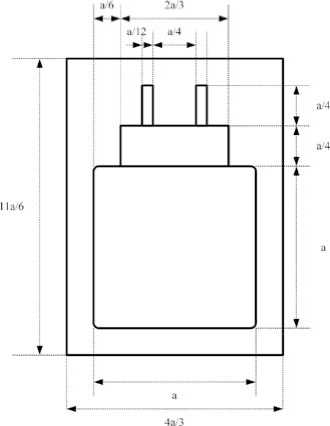
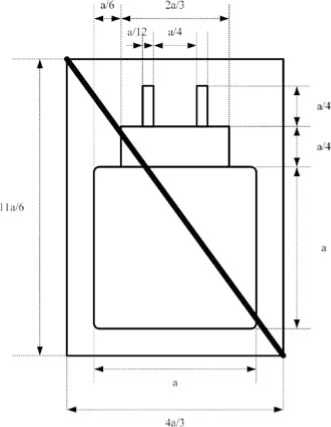
2. The pictogram may vary in appearance (e.g. as to its colour, solid or hollow, line thickness), provided that it remains visible and legible. If the pictogram is reduced or enlarged, the proportions set out in the drawings in point 1 of this Part shall be maintained. The dimension «a» referred to in point 1 of this Part shall be greater than or equal to 7 mm, irrespective of the variation.
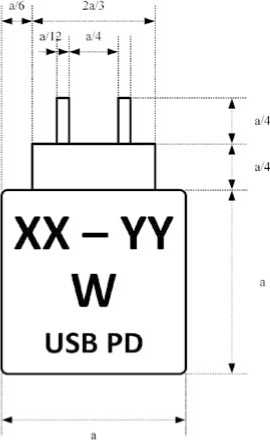
2. The letters «XX» shall be replaced by the figure corresponding to the minimum power required by the radio equipment to charge, which determines the minimum power that a charging device needs to supply to charge the radio equipment. The letters «YY» shall be replaced by the figure corresponding to the maximum power required by the radio equipment to achieve maximum charging speed, which determines the power that a charging device needs to supply at least to achieve that maximum charging speed. The abbreviation «USB PD» (USB Power Delivery) shall be displayed if the radio equipment supports that charging communication protocol. «USB PD» is a protocol that negotiates the fastest delivery of current from the charging device to the radio equipment without shortening the battery lifetime.
3. The label may vary in appearance (e.g. as to its colour, solid or hollow, line thickness), provided that it remains visible and legible. If the label is reduced or enlarged, the proportions set out in the drawing in point 1 of this Part shall be maintained. The dimension «a» referred to in point 1 of this Part shall be greater than or equal to 7 mm, irrespective of the variation.
CONFORMITY ASSESSMENT MODULE A
1. Internal production control is the conformity assessment procedure whereby the manufacturer fulfils the obligations laid down in points 2, 3 and 4 of this Annex, and ensures and declares on his sole responsibility that the radio equipment concerned satisfies the essential requirements set out in Article 3.
The manufacturer shall establish the technical documentation in accordance with Article 21.
The manufacturer shall take all measures necessary so that the manufacturing process and its monitoring ensure compliance of the manufactured radio equipment with the technical documentation referred to in point 2 of this Annex and with the relevant essential requirements set out in Article 3.
4. CE marking and EU declaration of conformity
4.1. The manufacturer shall affix the CE marking in accordance with Articles 19 and 20 to each item of radio equipment that satisfies the applicable requirements of this Directive.
4.2. The manufacturer shall draw up a written EU declaration of conformity for each radio equipment type and keep it together with the technical documentation at the disposal of the national authorities for 10 years after the radio equipment has been placed on the market. The EU declaration of conformity shall identify the radio equipment for which it has been drawn up.
A copy of the EU declaration of conformity shall be made available to the relevant authorities upon request.
The manufacturer's obligations set out in point 4 may be fulfilled by his authorised representative, on his behalf and under his responsibility, provided that they are specified in the mandate.
CONFORMITY ASSESSMENT MODULES B AND C
When reference is made to this Annex, the conformity assessment procedure shall follow Modules B (EU-type examination) and C (Conformity to type based on internal production control) of this Annex.
1. EU-type examination is the part of a conformity assessment procedure in which a notified body examines the technical design of the radio equipment and verifies and attests that the technical design of the radio equipment meets the essential requirements set out in Article 3.
2. EU-type examination shall be carried out by assessment of the adequacy of the technical design of the radio equipment through examination of the technical documentation and supporting evidence referred to in point 3, without examination of a specimen (design type).
3. The manufacturer shall lodge an application for EU-type examination with a single notified body of his choice.
(a) the name and address of the manufacturer and, if the application is lodged by the authorised representative, his name and address as well;
(b) a written declaration that the same application has not been lodged with any other notified body;
(c) the technical documentation. The technical documentation shall make it possible to assess the radio equipment's conformity with the applicable requirements of this Directive and shall include an adequate analysis and assessment of the risk(s). The technical documentation shall specify the applicable requirements and cover, as far as relevant for the assessment, the design, manufacture and operation of the radio equipment. The technical documentation shall contain, wherever applicable, the elements set out in Annex V;
(d) the supporting evidence for the adequacy of the technical design solution. That supporting evidence shall mention any documents that have been used, in particular where the relevant harmonised standards have not been applied or have not been fully applied. The supporting evidence shall include, where necessary, the results of tests carried out in accordance with other relevant technical specifications by the appropriate laboratory of the manufacturer, or by another testing laboratory on his behalf and under his responsibility.
4. The notified body shall examine the technical documentation and supporting evidence to assess the adequacy of the technical design of the radio equipment.
5. The notified body shall draw up an evaluation report that records the activities undertaken in accordance with point 4 and their outcomes. Without prejudice to its obligations as provided in point 8, the notified body shall release the content of that report, in full or in part, only with the agreement of the manufacturer.
6. Where the type meets the requirements of this Directive that apply to the radio equipment concerned, the notified body shall issue an EU-type examination certificate to the manufacturer. That certificate shall contain the name and address of the manufacturer, the conclusions of the examination, the aspects of the essential requirements covered by the examination, the conditions (if any) for its validity and the necessary data for identification of the assessed type. The EU-type examination certificate may have one or more annexes attached.
The EU-type examination certificate and its annexes shall contain all relevant information to allow the conformity of manufactured radio equipment with the examined type to be evaluated and to allow for in-service control.
Where the type does not satisfy the applicable requirements of this Directive, the notified body shall refuse to issue an EU-type examination certificate and shall inform the applicant accordingly, giving detailed reasons for its refusal.
7. The notified body shall keep itself apprised of any changes in the generally acknowledged state of the art which indicate that the approved type may no longer comply with the applicable requirements of this Directive, and shall determine whether such changes require further investigation. If so, the notified body shall inform the manufacturer accordingly.
The manufacturer shall inform the notified body that holds the technical documentation relating to the EU-type examination certificate of all modifications to the approved type that may affect the conformity of the radio equipment with the essential requirements of this Directive or the conditions for validity of that certificate. Such modifications shall require additional approval in the form of an addition to the original EU-type examination certificate.
8. Each notified body shall inform its notifying authority concerning the EU-type examination certificates and/or any additions thereto which it has issued or withdrawn, and shall, periodically or upon request, make available to its notifying authority the list of such certificates and/or any additions thereto refused, suspended or otherwise restricted.
Each notified body shall inform the other notified bodies concerning the EU-type examination certificates and/or any additions thereto which it has refused, withdrawn, suspended or otherwise restricted, and, upon request, concerning such certificates and/or additions thereto which it has issued.
Each notified body shall inform the Member States of EU-type examination certificates it has issued and/or additions thereto in those cases where harmonised standards the references of which have been published in the Official Journal of the European Union have not been applied or not been fully applied. The Member States, the Commission and the other notified bodies may, on request, obtain a copy of the EU-type examination certificates and/or additions thereto. On request, the Member States and the Commission may obtain a copy of the technical documentation and the results of the examinations carried out by the notified body. The notified body shall keep a copy of the EU-type examination certificate, its annexes and additions, as well as the technical file including the documentation submitted by the manufacturer for 10 years after the radio equipment has been assessed or until the expiry of the validity of that certificate.
9. The manufacturer shall keep a copy of the EU-type examination certificate, its annexes and additions together with the technical documentation at the disposal of the national authorities for 10 years after the radio equipment has been placed on the market.
10. The manufacturer's authorised representative may lodge the application referred to in point 3 and fulfil the obligations set out in points 7 and 9, provided that they are specified in the mandate.
1. Conformity to type based on internal production control is the part of a conformity assessment procedure whereby the manufacturer fulfils the obligations laid down in points 2 and 3, and ensures and declares that the radio equipment concerned is in conformity with the type described in the EU-type examination certificate and satisfies the requirements of this Directive that apply to it.
The manufacturer shall take all measures necessary so that the manufacturing process and its monitoring ensure conformity of the manufactured radio equipment with the approved type described in the EU-type examination certificate and with the requirements of this Directive that apply to it.
3. CE marking and EU declaration of conformity
3.1. The manufacturer shall affix the CE marking in accordance with Articles 19 and 20 to each item of radio equipment that is in conformity with the type described in the EU-type examination certificate and satisfies the applicable requirements of this Directive.
3.2. The manufacturer shall draw up a written EU declaration of conformity for each radio equipment type and keep it at the disposal of the national authorities for 10 years after the radio equipment has been placed on the market. The EU declaration of conformity shall identify the radio equipment type for which it has been drawn up.
A copy of the EU declaration of conformity shall be made available to the relevant authorities upon request.
The manufacturer's obligations set out in point 3 may be fulfilled by his authorised representative, on his behalf and under his responsibility, provided that they are specified in the mandate.
1. Conformity based on full quality assurance is the conformity assessment procedure whereby the manufacturer fulfils the obligations laid down in points 2 and 5, and ensures and declares on his sole responsibility that the radio equipment concerned satisfies the requirements of this Directive that apply to it.
The manufacturer shall operate an approved quality system for design, manufacture, final radio equipment inspection and testing of the radio equipment concerned as specified in point 3 and shall be subject to surveillance as specified in point 4.
3.1. The manufacturer shall lodge an application for assessment of his quality system with the notified body of his choice, for the radio equipment concerned.
(a) the name and address of the manufacturer and, if the application is lodged by the authorised representative, his name and address as well;
(b) the technical documentation for each radio equipment type intended to be manufactured. The technical documentation shall contain, wherever applicable, the elements set out in Annex V;
(c) the documentation concerning the quality system; and
(d) a written declaration that the same application has not been lodged with any other notified body.
3.2. The quality system shall ensure compliance of the radio equipment with the requirements of this Directive that apply to it.
All the elements, requirements and provisions adopted by the manufacturer shall be documented in a systematic and orderly manner in the form of written policies, procedures and instructions. That quality system documentation shall permit a consistent interpretation of the quality programmes, plans, manuals and records. It shall, in particular, contain an adequate description of:
(a) the quality objectives and the organisational structure, responsibilities and powers of the management with regard to design and product quality;
(b) the technical design specifications, including standards, that will be applied and, where the relevant harmonised standards will not be applied in full, the means that will be used to ensure that the essential requirements of this Directive that apply to the radio equipment will be met;
(c) the design control and design verification techniques, processes and systematic actions that will be used when designing radio equipment pertaining to the radio equipment type covered;
(d) the corresponding manufacturing, quality control and quality assurance techniques, processes and systematic actions that will be used;
(e) the examinations and tests that will be carried out before, during and after manufacture, and the frequency with which they will be carried out;
(f) the quality records, such as inspection reports and test data, calibration data, reports concerning the qualifications of the personnel, etc.;
(g) the means of monitoring the achievement of the required design and product quality and the effective operation of the quality system.
3.3. The notified body shall assess the quality system to determine whether it satisfies the requirements referred to in point 3.2.
It shall presume conformity with those requirements in respect of the elements of the quality system that comply with the corresponding specifications of the relevant harmonised standard.
In addition to experience in quality management systems, the auditing team shall have at least one member experienced as an assessor in the relevant radio equipment field and radio equipment technology concerned, and knowledge of the applicable requirements of this Directive. The audit shall include an assessment visit to the manufacturer's premises. The auditing team shall review the technical documentation referred to in point 3.1(b) to verify the manufacturer's ability to identify the applicable requirements of this Directive and to carry out the necessary examinations with a view to ensuring compliance of the radio equipment with those requirements.
The manufacturer or his authorised representative shall be notified of the decision.
The notification shall contain the conclusions of the audit and the reasoned assessment decision.
3.4. The manufacturer shall undertake to fulfil the obligations arising out of the quality system as approved and to maintain it so that it remains adequate and efficient.
3.5. The manufacturer shall keep the notified body that has approved the quality system informed of any intended change to the quality system.
The notified body shall evaluate any proposed changes and decide whether the modified quality system will continue to satisfy the requirements referred to in point 3.2 or whether a reassessment is necessary.
It shall notify the manufacturer of its decision. The notification shall contain the conclusions of the examination and the reasoned assessment decision.
4. Surveillance under the responsibility of the notified body
4.1. The purpose of surveillance is to make sure that the manufacturer duly fulfils the obligations arising out of the approved quality system.
4.2. The manufacturer shall, for assessment purposes, allow the notified body access to the design, manufacture, inspection, testing and storage sites, and shall provide it with all necessary information, in particular:
(b) the quality records as provided for by the design part of the quality system, such as results of analyses, calculations, tests, etc.;
(c) the quality records as provided for by the manufacturing part of the quality system, such as inspection reports and test data, calibration data, reports concerning the qualifications of the personnel, etc.
4.3. The notified body shall carry out periodic audits to make sure that the manufacturer maintains and applies the quality system and shall provide the manufacturer with an audit report.
4.4. In addition, the notified body may pay unexpected visits to the manufacturer. During such visits, the notified body may, if necessary, carry out radio equipment tests, or have them carried out, in order to check the proper functioning of the quality system. It shall provide the manufacturer with a visit report and, if tests have been carried out, with a test report.
5.1. The manufacturer shall affix the CE marking in accordance with Articles 19 and 20 and, under the responsibility of the notified body referred to in point 3.1, the latter's identification number to each item of radio equipment that satisfies the applicable requirements set out in Article 3.
5.2. The manufacturer shall draw up a written EU declaration of conformity for each radio equipment type and keep it at the disposal of the national authorities for 10 years after the radio equipment has been placed on the market. The EU declaration of conformity shall identify the radio equipment type for which it has been drawn up.
A copy of the EU declaration of conformity shall be made available to the relevant authorities upon request.
6. The manufacturer shall, for a period ending 10 years after the radio equipment has been placed on the market, keep at the disposal of the national authorities:
(a) the technical documentation referred to in point 3.1;
(b) the documentation concerning the quality system referred to in point 3.1;
(c) the change referred to in point 3.5, as approved;
(d) the decisions and reports of the notified body referred to in points 3.5, 4.3 and 4.4.
7. Each notified body shall inform its notifying authority of quality system approvals issued or withdrawn, and shall, periodically or upon request, make available to its notifying authority the list of quality system approvals refused, suspended or otherwise restricted.
Each notified body shall inform the other notified bodies of quality system approvals which it has refused, suspended or withdrawn, and, upon request, of quality system approvals which it has issued.
The manufacturer's obligations set out in points 3.1, 3.5, 5 and 6 may be fulfilled by his authorised representative, on his behalf and under his responsibility, provided that they are specified in the mandate.
The technical documentation shall, wherever applicable, contain at least the following elements:
(a) a general description of the radio equipment including:
(i) photographs or illustrations showing external features, marking and internal layout;
(ii) versions of software or firmware affecting compliance with essential requirements;
(iii) user information and installation instructions;
(b) conceptual design and manufacturing drawings and schemes of components, sub-assemblies, circuits and other relevant similar elements;
(c) descriptions and explanations necessary for the understanding of those drawings and schemes and the operation of the radio equipment;
(d) a list of the harmonised standards applied in full or in part the references of which have been published in the Official Journal of the European Union, and, where those harmonised standards have not been applied, descriptions of the solutions adopted to meet the essential requirements set out in Article 3, including a list of other relevant technical specifications applied. In the event of partly applied harmonised standards, the technical documentation shall specify the parts which have been applied;
(e) copy of the EU declaration of conformity;
(f) where the conformity assessment module in Annex III has been applied, copy of the EU-type examination certificate and its annexes as delivered by the notified body involved;
(g) results of design calculations made, examinations carried out, and other relevant similar elements;
(i) an explanation of the compliance with the requirement of Article 10(2) and of the inclusion or not of information on the packaging in accordance with Article 10(10).
EU DECLARATION OF CONFORMITY (No XXX) <*>
<*> It is optional for the manufacturer to assign a number to the EU declaration of conformity.
1. Radio equipment (product, type, batch or serial number):
2. Name and address of the manufacturer or his authorised representative:
3. This declaration of conformity is issued under the sole responsibility of the manufacturer.
4. Object of the declaration (identification of the radio equipment allowing traceability; it may include a colour image of sufficient clarity where necessary for the identification of the radio equipment):
5. The object of the declaration described above is in conformity with the relevant Union harmonisation legislation:
Other Union harmonisation legislation where applicable
6. References to the relevant harmonised standards used or references to the other technical specifications in relation to which conformity is declared. References must be listed with their identification number and version and, where applicable, date of issue:
7. Where applicable, the notified body ... (name, number) ... performed ... (description of intervention) ... and issued the EU- type examination certificate: ...
8. Where applicable, description of accessories and components, including software, which allow the radio equipment to operate as intended and covered by the EU declaration of conformity:
Signed for and on behalf of: ...
SIMPLIFIED EU DECLARATION OF CONFORMITY
The simplified EU declaration of conformity referred to in Article 10(9) shall be provided as follows:
Hereby, [Name of manufacturer] declares that the radio equipment type [designation of type of radio equipment] is in compliance with Directive 2014/53/EU.
The full text of the EU declaration of conformity is available at the following internet address:
The European Parliament considers that only when and insofar as implementing acts in the sense of Regulation (EU) No 182/2011 are discussed in meetings of committees, can the latter be considered as «comitology committees» within the meaning of Annex I to the Framework Agreement on the relations between the European Parliament and the European Commission. Meetings of committees thus fall within the scope of point 15 of the Framework Agreement when and insofar as other issues are discussed.
Переход между статьями: Ctrl + ← / →