---
title: "Директива N 2014/68/ЕС Европейского парламента и Совета Европейского Союза"
number: "2014/68/ЕС"
issuer: "Европейский Союз"
status: действует
canonical: "https://bukva.ai/docs/direktiva-201468es/statya-52"
---
# Статья 52
### Статья 52
Адресаты
Настоящая Директива адресована государствам-членам ЕС.
Совершено в Брюсселе 15 мая 2014 г.
**СУЩЕСТВЕННЫЕ ТРЕБОВАНИЯ**
**ПО БЕЗОПАСНОСТИ**
**ПРЕДВАРИТЕЛЬНЫЕ ЗАМЕЧАНИЯ**
1. Обязательства, вытекающие из существенных требований по безопасности, указанных в настоящем Приложении, для оборудования, работающего под давлением, также распространяются на сборочные единицы, представляющие определенную опасность.
2. Существенные требования по безопасности, установленные в настоящей Директиве, являются обязательными. Обязательства, вытекающие из указанных существенных требований по безопасности, применяются только в случае, если в отношении соответствующего оборудования, работающего под давлением, существует определенная опасность при его использовании согласно условиям, обоснованно прогнозируемым производителем.
3. Производитель обязан проанализировать опасности и риски для того, чтобы определить те из них, которые распространяются на его оборудование вследствие его давления; он должен спроектировать и сконструировать оборудование с учетом указанного анализа.
4. Существенные требования по безопасности должны интерпретироваться и применяться таким образом, чтобы при проектировании и производстве учитывались современный уровень развития техники и существующая практика, а также технико-экономические факторы, которые соответствуют высокому уровню защиты здоровья и безопасности.
1.1. Оборудование, работающее под давлением, должно быть спроектировано, произведено, проверено и при необходимости оснащено и установлено таким образом, чтобы обеспечить его безопасность при вводе в эксплуатацию в соответствии с инструкциями производителя или обоснованно прогнозируемыми условиями.
- устранить или уменьшить опасность в той мере, в какой это осуществимо на практике;
- применять соответствующие меры защиты от опасностей, которые не могут быть устранены;
- в соответствующих случаях информировать пользователей об остаточных опасностях и указывать на необходимость принятия специальных мер по уменьшению рисков при установке и/или использовании оборудования.
1.3. В случае если существует потенциальная возможность неправильного использования или такая возможность может четко прогнозироваться, оборудование, работающее под давлением, необходимо проектировать таким образом, чтобы предотвратить риск вследствие его неправильного использования или, если это не представляется возможным, предусмотреть соответствующее предупреждение о том, что оборудование, работающее под давлением, не должно использоваться подобным образом.
Оборудование, работающее под давлением, должно проектироваться должным образом, с учетом всех существенных факторов для того, чтобы обеспечить его безопасность в течение всего срока службы.
При проектировании необходимо учитывать соответствующие коэффициенты безопасности на основании комплексных методов, которые, как известно, последовательно включают соответствующие запасы надежности относительно всех соответствующих видов повреждений и неисправностей.
2.2.1. Оборудование, работающее под давлением, должно быть спроектировано для нагрузок, соответствующих его целевому назначению и другим обоснованно прогнозируемым эксплуатационным условиям. В частности, необходимо учитывать следующие факторы:
- внутреннее/внешнее давление;
- температуру окружающей среды и рабочую температуру;
- статическое давление и массу содержимого в рабочих и тестовых условиях;
- нагрузку движения, ветровую и сейсмическую нагрузку;
- силу и моменты реакции, обусловленные опорами, креплениями, трубами, и пр.;
- коррозию и эрозию, усталость конструкции, и пр.;
- разложение нестабильных жидких сред.
Необходимо принимать во внимание различные нагрузки, которые могут возникнуть в одно и то же время, с учетом вероятности их одновременного возникновения.
##### 2.2.2 Проектирование для достаточной прочности должно основываться на одном из следующих методов:
- по общему правилу на методе расчета, указанном в [пункте 2.2.3](https://bukva.ai/docs/direktiva-201468es/statya-52#p100670), дополненном при необходимости методом экспериментального проектирования, указанным в [пункте 2.2.4](https://bukva.ai/docs/direktiva-201468es/statya-52#p100701);
- на методе экспериментального проектирования без расчета согласно [пункту 2.2.4](https://bukva.ai/docs/direktiva-201468es/statya-52#p100701), если произведение максимально допустимого давления PS и объема V составляет менее 6000 бар на литр или произведение PS на DN - менее 3000 бар.
##### 2.2.3 Метод расчета
a) Удержание давления и другие аспекты нагрузки
Допустимое напряжение для оборудования, работающего под давлением, необходимо ограничивать с учетом обоснованно прогнозируемых видов повреждений и неисправностей в условиях эксплуатации. В этой связи необходимо применять коэффициенты безопасности для полного устранения любой неточности, возникающей в результате производства, фактических условий эксплуатации, напряжений, моделей расчета, свойств и поведения материала.
Указанные методы расчета должны обеспечивать достаточные запасы надежности, соответствующие при необходимости требованиям [пункта 7](https://bukva.ai/docs/direktiva-201468es/statya-52#p100865).
Требования, изложенные выше, могут соблюдаться посредством применения в соответствующих случаях одного из следующих методов в качестве дополнения или в сочетании с другим методом, если это необходимо:
- проектирование по формуле;
- проектирование посредством анализа;
- проектирование с учетом механики разрушения.
b) Прочность
Для того чтобы установить прочность соответствующего оборудования, работающего под давлением, необходимо осуществить соответствующие проектные расчеты.
В частности:
- расчетные давления не должны быть меньше максимально допустимых показателей давления и должны учитывать гидростатический напор и динамическое давление жидкой среды, а также разложение нестабильных жидких сред. В случае если сосуд разделен на отдельные камеры под давлением, перегородка должна быть спроектирована исходя из самого высокого возможного давления в камере по сравнению с самым низким давлением, возможным в смежной камере;
- расчетные температуры должны предусматривать соответствующие запасы надежности;
- при проектировании необходимо учесть все возможные комбинации температуры и давления, которые могут возникнуть в обоснованно прогнозируемых условиях эксплуатации оборудования;
- максимальные показатели напряжения и концентрации пикового напряжения должны находиться в безопасных пределах;
- при расчете относительно удержания давления необходимо использовать значения, соответствующие свойствам материала, на основе документально подтвержденных данных с учетом положений [пункта 4](https://bukva.ai/docs/direktiva-201468es/statya-52#p100825) совместно с соответствующими коэффициентами безопасности. Характеристики материала, которые следует принять во внимание, при необходимости должны включать в себя:
- предел текучести, 0,2% - или 1,0% условного предела текучести при расчетной температуре;
- предел прочности на растяжение;
- зависящую от времени прочность, т.е. предел ползучести;
- данные об усталости конструкции;
- модуль Юнга (модуль упругости);
- соответствующую величину пластической деформации;
- ударную прочность;
- вязкость разрушения;
- соответствующие коэффициенты соединений должны применяться к свойствам материалов в зависимости, например, от типа неразрушающего испытания, свойств соединенных материалов и предусмотренных условий эксплуатации;
- при проектировании необходимо учитывать все обоснованно прогнозируемые механизмы ухудшения характеристик (например, коррозию, ползучесть, усталость) в соответствии с целевым использованием оборудования. В инструкциях, указанных в пункте 3.4, необходимо обратить внимание на определенные особенности дизайна, которые имеют отношение к сроку службы оборудования, например:
- в отношении ползучести: расчетные часы работы при заданных температурах;
- в отношении усталости: расчетное число циклов при заданных уровнях напряжения;
- в отношении коррозии: расчетный допуск на коррозию.
c) Стабильность
В случае, когда расчетная толщина не предусматривает соответствующей структурной стабильности, следует принять необходимые меры по исправлению ситуации с учетом рисков при транспортировке, а также при погрузке или разгрузке.
##### 2.2.4 Метод экспериментального проектирования
Проектирование оборудования может быть утверждено полностью или частично посредством соответствующей программы испытаний, выполненных на образце, представляющем оборудование или категорию оборудования.
Программа испытаний должна быть четко определена до начала испытаний и утверждена нотифицированным органом, ответственным за модуль оценки соответствия проекта, если он существует.
Указанная программа должна определить условия испытаний и критерии для принятия или отказа. Фактические значения основных параметров и характеристик материалов, которые являются составной частью проверенного оборудования, должны измеряться до начала испытания.
В соответствующем случае в ходе испытаний необходимо обеспечить возможность наблюдения за критическими зонами оборудования, работающего под давлением, с помощью соответствующих контрольно-измерительных приборов, способных регистрировать деформации и напряжения с достаточной точностью.
Программа испытаний должна включать в себя:
a) испытание прочности под давлением, целью которого является проверка того, что при давлении с определенным запасом надежности относительно максимально допустимого давления в оборудовании не обнаружатся значительные протечки или деформации, превышающие определенную пороговую величину.
Давление при испытании должно определяться на основе разности между значениями геометрических и материальных измерений характеристик, проведенных при условиях испытания, и значениями, используемыми в проектных целях; оно должно учитывать разность между температурой при проведении испытаний и расчетной температурой;
b) в случае наличия опасности ползучести или усталости соответствующие испытания, определенные на основе установленных для оборудования условий эксплуатации, например, времени удержания при заданных температурах, числа циклов при заданных уровнях напряжения;
c) при необходимости, дополнительные испытания относительно других факторов, указанных в [пункте 2.2.1](https://bukva.ai/docs/direktiva-201468es/statya-52#p100658), таких как коррозия, внешние повреждения.
Режим функционирования, определенный для оборудования, работающего под давлением, должен исключать любую обоснованно прогнозируемую опасность при эксплуатации оборудования. В соответствующих случаях особое внимание необходимо уделить:
- закупоривающим устройствам и устройствам открывания;
- рискам, связанным со сбросом давления;
- приборам, не допускающим физический доступ при наличии внутри оборудования давления или вакуума;
- температуре поверхности с учетом целевого использования;
- разложению нестабильных жидких сред.
В частности, оборудование, работающее под давлением, оснащенное смотровым люком, должно быть оборудовано автоматическим или ручным устройством, позволяющим пользователю убедиться в том, что его открывание не представляет никакой опасности. Также в случае, когда открывание люка может быть выполнено быстро, оборудование, работающее под давлением, должно быть оснащено устройством, исключающим его открывание всякий раз, когда давление или температура жидкой среды представляют опасность.
a) Оборудование, работающее под давлением, должно быть спроектировано и сконструировано таким образом, чтобы можно было выполнить все необходимые проверки по обеспечению безопасности;
b) средства определения внутреннего состояния оборудования должны быть доступны при необходимости для обеспечения постоянной безопасности оборудования, например, отверстия для физического доступа к внутренней части оборудования, работающего под давлением, для того, чтобы можно было безопасно и эргономично провести соответствующие проверки;
c) другие средства обеспечения безопасного режима оборудования, работающего под давлением, могут применяться в следующих ситуациях, когда:
- оно слишком маленькое для физического внутреннего доступа;
- открывание оборудования, работающего под давлением, может негативно сказаться на функционировании его внутренней части;
- содержащееся вещество, как было доказано, не является вредным для материала, из которого произведено оборудование, работающее под давлением, и никакие другие механизмы внутреннего разрушения не являются обоснованно прогнозируемыми.
Необходимо предусмотреть соответствующие средства для дренирования и вентиляции оборудования, работающего под давлением, при необходимости:
- во избежание такого вредного воздействия, как гидравлический удар, разрушение вакуума, коррозия и неконтролируемые химические реакции. Необходимо учесть все этапы работы и испытания, особенно испытание под давлением;
- для обеспечения возможности безопасной очистки, проверки и обслуживания.
При необходимости следует предусмотреть соответствующее допустимое отклонение или защиту от коррозии или другого химического воздействия, принимая во внимание целевое и обоснованно прогнозируемое использование.
В случае наличия возможности появления сильной эрозии или абразивного истирания необходимо принять соответствующие меры для того, чтобы:
- минимизировать указанное воздействие посредством соответствующего дизайна, например, дополнительной толщины материала, или посредством использования футеровочного или облицовочного материала;
- обеспечить возможность замены деталей, которые могут подвергаться наибольшему воздействию;
- акцентировать внимание в инструкциях, указанных в пункте 3.4, на мерах, необходимых для постоянной и безопасной эксплуатации.
Сборочные единицы должны быть спроектированы таким образом, чтобы:
- компоненты, которые должны быть собраны вместе, были подходящими по качеству и надежными для работы;
- все компоненты были соответствующим образом соединены и собраны.
В соответствующих случаях оборудование, работающее под давлением, должно быть спроектировано, снабжено приспособлениями, или должны быть созданы условия для их установки таким образом, чтобы гарантировать безопасное заполнение и разгрузку, в частности, относительно рисков, таких как:
a) при заполнении:
- переполнение или превышение допустимого давления, руководствуясь, в частности, степенью заполнения или давлением пара при исходной температуре;
- нестабильность оборудования, работающего под давлением;
b) при разгрузке: неконтролируемый выброс жидкой среды под давлением;
c) при заполнении или разгрузке: небезопасное соединение и разъединение.
В случае если при обоснованно прогнозируемых условиях допустимые пределы могут быть превышены, оборудование, работающее под давлением, должно быть оборудовано соответствующими защитными устройствами, или должны быть созданы условия для их установки, за исключением оборудования, защита которого обеспечивается с помощью других защитных устройств внутри сборочной единицы.
Соответствующее устройство или комбинация таких устройств должны определяться на основе особых характеристик оборудования или сборочной единицы.
Соответствующие защитные устройства и их комбинации включают в себя:
a) защитные приспособления, определение которых указано в [пункте 4 статьи 2](https://bukva.ai/docs/direktiva-201468es/statya-2#p100167);
b) при необходимости соответствующие контрольные устройства, такие как устройства индикации и/или устройства аварийной сигнализации, которые позволяют осуществить соответствующие действия автоматически или в ручном режиме для поддержания оборудования, работающего под давлением, в допустимых пределах.
##### 2.11.1 Защитные приспособления:
- должны быть спроектированы и сконструированы таким образом, чтобы быть надежными и пригодными для целевой эксплуатации, и в соответствующих случаях должны учитывать требования по обслуживанию и по проведению испытаний устройств;
- не должны зависеть от других функций, за исключением случаев, когда указанные функции не могут повлиять на их функцию безопасности;
- должны соответствовать основным принципам проектирования для того, чтобы обеспечить соответствующую и надежную защиту. Указанные принципы включают, в частности, режим сохранности, резервирование, разнообразие и самодиагностику.
##### 2.11.2 Устройства, ограничивающие давление
Указанные устройства должны проектироваться таким образом, чтобы давление постоянно не превышало максимально допустимое давление PS; однако в соответствующих случаях допускается кратковременное резкое повышение давления в соответствии со спецификациями, установленными в пункте 7.3.
##### 2.11.3 Устройства контроля температуры
Указанные устройства должны иметь соответствующее время срабатывания по соображениям безопасности в соответствии с функцией измерения.
В соответствующих случаях оборудование, работающее под давлением, должно быть спроектировано и при необходимости оборудовано соответствующими сопутствующими приспособлениями, или их установка должна быть предусмотрена таким образом, чтобы удовлетворять требованиям по ограничению ущерба в случае наружного возгорания с учетом целевого использования оборудования.
Производитель должен обеспечить грамотное выполнение положений, установленных на этапе проектирования, посредством применения соответствующих технологий и процедур, особенно относительно аспектов, изложенных ниже.
##### 3.1.1 Подготовка комплектующих деталей
Подготовка комплектующих деталей (например, формовка и закругление кромок) не должна приводить к возникновению дефектов, трещин или изменений в механических характеристиках, которые могут отрицательно сказываться на безопасности оборудования, работающего под давлением.
##### 3.1.2 Неразъемное соединение
Неразъемные соединения и прилегающие зоны не должны иметь наружных или внутренних дефектов, негативно влияющих на безопасность оборудования.
Свойства неразъемных соединений должны соответствовать минимальным свойствам, определенным для соединяемых материалов, за исключением случаев, когда в проектных расчетах специально учитываются другие соответствующие значения свойств.
В отношении оборудования, работающего под давлением, неразъемное соединение компонентов, которые способствуют сопротивлению давления оборудования, и компонентов, которые напрямую крепятся к ним, должно осуществляться соответствующим квалифицированным персоналом в соответствии с требуемыми эксплуатационными процедурами.
В отношении оборудования, работающего под давлением, [категорий II](https://bukva.ai/docs/direktiva-201468es/statya-52#p100904), [III](https://bukva.ai/docs/direktiva-201468es/statya-52#p100907) и [IV](https://bukva.ai/docs/direktiva-201468es/statya-52#p100910) эксплуатационные процедуры и персонал должны быть утверждены компетентной третьей стороной, которая по инициативе производителя может являться:
- нотифицированным органом;
- независимой организацией, уполномоченной государством-членом ЕС согласно [статье 20](https://bukva.ai/docs/direktiva-201468es/statya-20#p100391).
Для выполнения указанных утверждений третья сторона должна провести проверки и испытания, предусмотренные в соответствующих гармонизированных стандартах, или равнозначные проверки и испытания, или она должна поручить их проведение.
##### 3.1.3 Неразрушающие испытания
В отношении оборудования, работающего под давлением, неразрушающие испытания неразъемных соединений должны проводиться соответствующим квалифицированным персоналом. В отношении оборудования, работающего под давлением, [категорий III](https://bukva.ai/docs/direktiva-201468es/statya-52#p100907) и [IV](https://bukva.ai/docs/direktiva-201468es/statya-52#p100910) персонал должен быть утвержден независимой организацией, уполномоченной государством-членом ЕС в соответствии со [статьей 20](https://bukva.ai/docs/direktiva-201468es/statya-20#p100391).
##### 3.1.4 Термическая обработка
В случае наличия опасности того, что производственный процесс изменит свойства материала в той степени, в которой это может привести к ухудшению безопасности оборудования, работающего под давлением, на определенной стадии производства должна применяться соответствующая термическая обработка.
##### 3.1.5 Прослеживаемость
Для идентификации материала, из которого изготовлены компоненты оборудования, способствующие сопротивлению давления, с помощью соответствующих средств необходимо установить и соблюдать соответствующие процедуры с момента получения материала на протяжении всего производства вплоть до окончательных испытаний произведенного оборудования, работающего под давлением.
Оборудование, работающее под давлением, подлежит окончательной оценке, описание которой приведено ниже.
##### 3.2.1 Заключительная проверка
Оборудование, работающее под давлением, должно проходить заключительную проверку для того, чтобы оценить его соответствие требованиям настоящей Директивы посредством визуального осмотра и изучения сопровождающей документации. В рамках указанной проверки может быть принято во внимание испытание, проведенное в процессе производства. По мере необходимости по соображениям безопасности необходимо проводить заключительную проверку внутри и снаружи на каждой части оборудования в соответствующих случаях в ходе производства (например, если изучение во время заключительной проверки больше не представляется возможным).
##### 3.2.2 Технологическое испытание
Окончательная оценка оборудования, работающего под давлением, должна включать в себя испытание на устойчивость к воздействию давления, которое обычно проводится в форме испытания на гидростатическое давление при давлении, которое в соответствующих случаях не ниже значения, указанного в пункте 7.4.
В отношении серийно выпускаемого оборудования, работающего под давлением, [категории I](https://bukva.ai/docs/direktiva-201468es/statya-52#p100901) указанное испытание может проводиться на основе статистических расчетов.
В случае если испытание на гидростатическое давление является опасным или неосуществимым, могут проводиться другие признанные эффективными испытания. До проведения указанных испытаний, отличных от испытания на гидростатическое давление, необходимо применять дополнительные меры, такие как неразрушающие испытания или другие методы, имеющие равнозначную ценность.
##### 3.2.3 Проверка защитных устройств
В отношении сборочных единиц окончательная оценка должна включать в себя проверку защитных устройств на предмет полного соответствия требованиям, указанным в пункте 2.10.
В дополнение к маркировке CE, указанной в [статьях 18](https://bukva.ai/docs/direktiva-201468es/statya-18#p100374) и [19](https://bukva.ai/docs/direktiva-201468es/statya-19#p100377), и информации, которая должна быть указана в соответствии со [статьей 6 (6)](https://bukva.ai/docs/direktiva-201468es/statya-6#p100244) и [статьей 8 (3)](https://bukva.ai/docs/direktiva-201468es/statya-8#p100263), необходимо предоставить следующую информацию:
a) в отношении всего оборудования, работающего под давлением:
- год производства;
- данные, обеспечивающие идентификацию оборудования, работающего под давлением, в соответствии с его характером, например, обозначение типа, серии или партии и серийный номер;
- существенные максимально/минимально допустимые пределы;
b) в зависимости от типа оборудования, работающего под давлением, дополнительную информацию, необходимую для безопасной установки, эксплуатации или использования в соответствующих случаях, технического обслуживания и периодической проверки:
- объем (V) оборудования, работающего под давлением, в литрах;
- номинальный размер трубопровода (DN);
- давление при испытании (PT) в барах и дата испытания;
- установленное давление защитного устройства в барах;
- производительность оборудования, работающего под давлением, в кВт;
- напряжение источника электропитания в вольтах (V);
- целевое назначение;
- коэффициент заполнения (кг/литр);
- максимальная масса заполнения в килограммах;
- масса пустого изделия в килограммах;
- группа жидкой среды;
c) при необходимости предупреждения, прикрепленные на оборудование, работающее под давлением, должны обращать внимание на его неправильное использование, которое, как показал опыт, может случаться.
Информация, указанная в [пунктах "a"](https://bukva.ai/docs/direktiva-201468es/statya-52#p100796), ["b"](https://bukva.ai/docs/direktiva-201468es/statya-52#p100800) и ["c"](https://bukva.ai/docs/direktiva-201468es/statya-52#p100812), должна быть указана на оборудовании, работающем под давлением, или на табличке основных данных, прочно прикрепленной к оборудованию, за исключением следующего:
- при необходимости во избежание повторной маркировки отдельных частей, таких как компоненты трубопровода, предназначенные для одной и той же сборочной единицы, может использоваться соответствующая документация;
- если оборудование, работающее под давлением, слишком маленькое, например, сопутствующие приспособления, то соответствующая информация может быть указана на этикетке, прикрепленной к оборудованию, работающему под давлением;
- данные о массе для наполнения и предупреждения, предусмотренные [пунктом "c"](https://bukva.ai/docs/direktiva-201468es/statya-52#p100812), могут быть указаны на этикетке или другим соответствующим способом при условии, что они останутся разборчивыми в течение определенного промежутка времени.
a) В том случае, когда оборудование, работающее под давлением, поставляется на рынок, оно должно сопровождаться по мере необходимости инструкциями для пользователя, содержащими всю необходимую информацию о мерах по обеспечению безопасности относительно:
- установки, включая сборку различных частей оборудования, работающего под давлением;
- ввода в эксплуатацию;
- использования;
- технического обслуживания, в том числе проверок, осуществляемых пользователем.
b) В инструкциях должна содержаться информация, прилагаемая к оборудованию, работающему под давлением, в соответствии с пунктом 3.3, за исключением обозначения серии; также они должны сопровождаться при необходимости техническими документами, чертежами и диаграммами, необходимыми для полного понимания указанных инструкций.
c) В соответствующем случае в инструкциях должны также содержаться указания на риски, возникающие в результате неправильного использования в соответствии с [пунктом 1.3](https://bukva.ai/docs/direktiva-201468es/statya-52#p100652), и на особенности дизайна в соответствии с [пунктом 2.2.3](https://bukva.ai/docs/direktiva-201468es/statya-52#p100670).
Материалы, использованные для производства оборудования, работающего под давлением, должны быть пригодны для такого применения в течение предусмотренного срока службы, кроме случаев, когда предусмотрена их замена.
Присадочный материал для сварки и другие соединительные материалы должны соответствующим образом удовлетворять только существенным требованиям пунктов 4.1, [4.2 "a"](https://bukva.ai/docs/direktiva-201468es/statya-52#p100835) и [первого параграфа пункта 4.3](https://bukva.ai/docs/direktiva-201468es/statya-52#p100841) отдельно и в соединении.
a) должны иметь свойства, соответствующие всем обоснованно прогнозируемым условиям эксплуатации и всем условиям испытаний, и, в частности, они должны обладать достаточно высокой пластичностью и прочностью. В соответствующих случаях характеристики материалов должны соответствовать требованиям пункта 7.5. Кроме того, следует проявлять осторожность, в частности, при выборе материала, для того чтобы избежать разрушения, возникшего по причине хрупкости материала, при необходимости; если по особым причинам должен использоваться хрупкий материал, необходимо принять соответствующие меры;
b) должны быть достаточно химически стойкими по отношению к жидкой среде, содержащейся в оборудовании, работающем под давлением; химические и физические свойства, необходимые для эксплуатационной безопасности, не должны подвергаться существенному воздействию в течение предусмотренного срока службы оборудования;
c) не должны подвергаться значительному влиянию "старения";
d) должны быть пригодными для запланированной технологической обработки;
e) должны выбираться таким образом, чтобы избежать существенного нежелательного воздействия при соединении вместе различных видов материалов;
a) соответствующим образом определить значения, необходимые для проектных расчетов, указанных в [пункте 2.2.3](https://bukva.ai/docs/direktiva-201468es/statya-52#p100670), и существенные характеристики материалов, а также их обработку, указанную в пункте 4.1;
b) предусмотреть в своей технической документации элементы, касающиеся соответствия спецификациям материалов настоящей Директивы, в одной из следующих форм:
- посредством использования материалов, соответствующих гармонизированным стандартам;
- посредством использования материалов, предусмотренных европейским разрешением на применение материалов для оборудования, работающего под давлением, в соответствии со [статьей 15](https://bukva.ai/docs/direktiva-201468es/statya-15#p100350);
- посредством отдельной оценки материала;
c) в отношении оборудования, работающего под давлением, [категорий III](https://bukva.ai/docs/direktiva-201468es/statya-52#p100907) и [IV](https://bukva.ai/docs/direktiva-201468es/statya-52#p100910) отдельная оценка материала должна выполняться нотифицированным органом, отвечающим за осуществление процедур оценки соответствия оборудования, работающего под давлением.
4.3. Производитель оборудования должен принять соответствующие меры, гарантирующие, что использованный материал соответствует требуемой спецификации. В частности, в отношении всех материалов необходимо получить документы, подготовленные производителем материала и подтверждающие соответствие спецификации.
Для основных частей оборудования, несущих давление, [категорий II](https://bukva.ai/docs/direktiva-201468es/statya-52#p100904), [III](https://bukva.ai/docs/direktiva-201468es/statya-52#p100907) и [IV](https://bukva.ai/docs/direktiva-201468es/statya-52#p100910) указанная документация должна предоставляться в виде сертификата о специальном контроле готовой продукции.
В случае если производитель материала имеет в своем распоряжении соответствующую систему контроля качества, сертифицированную компетентным органом, учрежденным в Союзе, и прошедшую специальную оценку в отношении материалов, предполагается, что сертификаты, выданные производителем, удостоверяют соответствие существенным требованиям настоящего пункта.
**ОСОБЫЕ ТРЕБОВАНИЯ В ОТНОШЕНИИ ОБОРУДОВАНИЯ,**
**РАБОТАЮЩЕГО ПОД ДАВЛЕНИЕМ**
В дополнение к установленным требованиям [пунктов 1](https://bukva.ai/docs/direktiva-201468es/statya-52#p100646) - [4](https://bukva.ai/docs/direktiva-201468es/statya-52#p100825) в отношении оборудования, работающего под давлением, предусмотренного [пунктами 5](https://bukva.ai/docs/direktiva-201468es/statya-52#p100846) и [6](https://bukva.ai/docs/direktiva-201468es/statya-52#p100856), применяются следующие требования.
**5. ОБОРУДОВАНИЕ, РАБОТАЮЩЕЕ ПОД ДАВЛЕНИЕМ,**
**С ОГНЕВЫМ ПОДВОДОМ ТЕПЛОТЫ ИЛИ ИНЫМ ОБРАЗОМ НАГРЕВАЕМОЕ**
**ОБОРУДОВАНИЕ, РАБОТАЮЩЕЕ ПОД ДАВЛЕНИЕМ, С РИСКОМ**
**ПЕРЕГРЕВА СОГЛАСНО СТАТЬЕ 4 (1)**
Указанное оборудование, работающее под давлением, включает в себя:
- парогенераторы и водонагреватели, согласно [статье 4 (1) "b"](https://bukva.ai/docs/direktiva-201468es/statya-4#p100211), например, котлы, работающие на органическом топливе, и водогрейные котлы, пароперегреватели и вторичные пароперегреватели, котлы-утилизаторы, котлы для сжигания отходов, электродные котлы или электрические котлы иммерсионного типа, автоклавы, а также их сопутствующие приспособления и при необходимости их системы обработки воды питания котла и подачи топлива;
- оборудование технологического нагрева, не связанного с генерацией пара и горячей воды, подпадающее под действие [статьи 4 (1) "a"](https://bukva.ai/docs/direktiva-201468es/statya-4#p100204), например, нагреватели для химических и других сходных процессов и оборудование под давлением для пищевой промышленности.
Указанное оборудование, работающее под давлением, должно быть рассчитано, спроектировано и сконструировано таким образом, чтобы избежать или минимизировать риски значительной разгерметизации вследствие перегрева. При необходимости следует гарантировать, что:
a) предусмотрены соответствующие средства защиты для ограничения таких рабочих параметров, как подвод тепла, отбор тепла и, где применимо, уровень жидкой среды таким образом, чтобы избежать любого риска локального или общего перегрева;
b) предусмотрены точки отбора проб в случае, если необходимо провести оценку свойств жидкой среды, таким образом, чтобы избежать рисков, связанных с отложениями и/или коррозией;
c) предусмотрены соответствующие меры для устранения рисков повреждений вследствие отложений;
d) предусмотрены средства безопасного удаления остаточного тепла после отключения;
e) приняты меры для предотвращения опасного накопления воспламеняющихся смесей горючих веществ или обратного удара пламени.
6.
ТРУБОПРОВОД СОГЛАСНО [СТАТЬЕ 4 (1) "C"](https://bukva.ai/docs/direktiva-201468es/statya-4#p100212)
**7. ОСОБЫЕ КОЛИЧЕСТВЕННЫЕ ТРЕБОВАНИЯ ДЛЯ ОПРЕДЕЛЕННОГО**
**ОБОРУДОВАНИЯ, РАБОТАЮЩЕГО ПОД ДАВЛЕНИЕМ**
Следующие положения применяются по общему правилу. Однако если они не применяются, включая случаи, когда не указаны материалы и не применяются гармонизированные стандарты, производитель должен подтвердить, что были приняты соответствующие меры для достижения равнозначного общего уровня безопасности.
Положения, установленные в настоящем разделе, дополняют существенные требования по безопасности [пунктов 1](https://bukva.ai/docs/direktiva-201468es/statya-52#p100646) - [6](https://bukva.ai/docs/direktiva-201468es/statya-52#p100856) для оборудования, работающего под давлением, в отношении которого они применяются.
##### 7.1.1 Обозначения
$R_{e/t}$ - предел текучести, который показывает значение при расчетной температуре:
- верхнего предела потока для материала, представляющего нижние и верхние пределы потока;
- условного предела текучести аустенитной стали и нелегированного алюминия при остаточной деформации 1,0%;
- условного предела текучести при остаточной деформации 0,2% в других случаях.
$R_{m/20}$ обозначает минимальное значение предела прочности на растяжение при 20 °C.
$R_{m/t}$ обозначает предел прочности на растяжение при расчетной температуре.
7.1.2. Допустимое общее мембранное напряжение для преимущественно статических нагрузок и температур, находящихся вне допустимого предела, в котором ползучесть является существенной, не должно превышать меньшее из следующих значений в зависимости от использованного материала:
- в отношении ферритной стали, в том числе нормализованной (нормализованной прокатной) стали, за исключением мелкозернистой стали и в особенности термообработанной стали 2/3 от $R_{e/t}$ и 5/12 от $R_{m/20}$ ;
- в отношении аустенитной стали:
- если ее относительное удлинение после разрыва превышает 30%, 2/3 от $R_{e/t}$ ;
- или, как альтернативный вариант, если ее относительное удлинение после разрыва превышает 35%, 5/6 от $R_{e/t}$ , и 1/3 от $R_{m/t}$ ,
- в отношении нелегированной или низколегированной литой стали 10/19 от $R_{e/t}$ и 1/3 от $R_{m/20}$ ;
- в отношении алюминия 2/3 от $R_{e/t}$ ;
- в отношении алюминиевых сплавов, за исключением дисперсионно-твердеющих сплавов, 2/3 от $R_{e/t}$ и 5/12 от $R_{m/20}$ .
Для сварных швов коэффициент соединения не должен превышать следующих значений:
- в отношении оборудования, подлежащего разрушающим и неразрушающим испытаниям, которые подтверждают, что вся серия швов не имеет существенных дефектов: 1;
- в отношении оборудования, подлежащего произвольному неразрушающему испытанию: 0,85;
- в отношении оборудования, не подлежащего неразрушающему испытанию, за исключением визуального осмотра: 0,7.
При необходимости следует учитывать тип напряжения и механико-технологические свойства соединения.
Мгновенный скачок давления, указанный в [пункте 2.11.2](https://bukva.ai/docs/direktiva-201468es/statya-52#p100759), необходимо удерживать на уровне 10% от максимально допустимого давления.
В отношении сосудов под давлением гидростатическое испытательное давление, указанное в [пункте 3.2.2](https://bukva.ai/docs/direktiva-201468es/statya-52#p100788), не должно быть меньше:
- чем давление, соответствующее максимальной нагрузке, которой может подвергаться оборудование, работающее под давлением, при эксплуатации с учетом его максимально допустимого давления и его максимально допустимой температуры, умноженные на коэффициент 1,25;
- чем максимально допустимое давление, умноженное на коэффициент 1,43, в зависимости от того, что больше.
За исключение случаев, когда в соответствии с другими критериями, которые должны быть приняты во внимание, требуются другие значения, сталь рассматривается как в достаточной степени пластичная для того, чтобы удовлетворять требованиям [пункта 4.1 "a"](https://bukva.ai/docs/direktiva-201468es/statya-52#p100829), если в ходе испытания на растяжение, проведенного в соответствии со стандартной процедурой, ее удлинение после разрыва будет не меньше 14% и ее энергия разрыва при изгибе, измеренная на испытательном образце ISO V, будет не менее 27 Дж при температуре, не превышающей 20 °C, но не выше, чем самая низкая запланированная рабочая температура.
**СХЕМЫ**
**ОЦЕНКИ СООТВЕТСТВИЯ**
1. Ссылки в схемах на категории модулей являются следующими:
| I | = | [Модуль A](https://bukva.ai/docs/direktiva-201468es/statya-52#p100957) |
| --- | --- | --- |
| II | = | [Модули A2](https://bukva.ai/docs/direktiva-201468es/statya-52#p100976), [D1](https://bukva.ai/docs/direktiva-201468es/statya-52#p101154), [E1](https://bukva.ai/docs/direktiva-201468es/statya-52#p101271) |
| III | = | [Модули B](https://bukva.ai/docs/direktiva-201468es/statya-52#p101003) (типовой проектный образец) + [D](https://bukva.ai/docs/direktiva-201468es/statya-52#p101100), [B](https://bukva.ai/docs/direktiva-201468es/statya-52#p101003) (типовой проектный образец) + [F](https://bukva.ai/docs/direktiva-201468es/statya-52#p101336), [B](https://bukva.ai/docs/direktiva-201468es/statya-52#p101003) (типовой производственный образец) + [E](https://bukva.ai/docs/direktiva-201468es/statya-52#p101217), [B](https://bukva.ai/docs/direktiva-201468es/statya-52#p101003) (типовой производственный образец) + [C2](https://bukva.ai/docs/direktiva-201468es/statya-52#p101082), [H](https://bukva.ai/docs/direktiva-201468es/statya-52#p101390) |
| IV | = | [Модули B](https://bukva.ai/docs/direktiva-201468es/statya-52#p101003) (типовой производственный образец) + [D](https://bukva.ai/docs/direktiva-201468es/statya-52#p101100), [B](https://bukva.ai/docs/direktiva-201468es/statya-52#p101003) (типовой производственный образец) + [F](https://bukva.ai/docs/direktiva-201468es/statya-52#p101336), [G](https://bukva.ai/docs/direktiva-201468es/statya-52#p101359), [H1](https://bukva.ai/docs/direktiva-201468es/statya-52#p101453) |
2. Защитные приспособления, определение которых приведено в [пункте 4 статьи 2](https://bukva.ai/docs/direktiva-201468es/statya-2#p100167), и указанные в [статье 4 (1) "d"](https://bukva.ai/docs/direktiva-201468es/statya-4#p100219), классифицируются по [категории IV](https://bukva.ai/docs/direktiva-201468es/statya-52#p100910). Однако в виде исключения защитные приспособления, произведенные для специфического оборудования, могут классифицироваться по той же категории, что и оборудование, для которого они изготовлены.
3. Приспособления, работающие под давлением, определение которых приведено в [пункте 5 статьи 2](https://bukva.ai/docs/direktiva-201468es/statya-2#p100168) и которые указаны в [статье 4 (1) "d"](https://bukva.ai/docs/direktiva-201468es/statya-4#p100219), классифицируются на основе:
-
их максимально допустимого давления PS;
-
их объема (V) или их номинального размера (DN) в соответствующих случаях;
-
группы жидких сред, для которых они предназначены.
Рисунок 1
Сосуды, указанные в [статье 4 (1) "a"i", первый абзац](https://bukva.ai/docs/direktiva-201468es/statya-4#p100206)
В порядке исключения сосуды, предназначенные для содержания в них нестабильного газа и относящиеся к [категории I](https://bukva.ai/docs/direktiva-201468es/statya-52#p100901) или [II](https://bukva.ai/docs/direktiva-201468es/statya-52#p100904) на основании [рисунка 1](https://bukva.ai/docs/direktiva-201468es/statya-52#p100922), должны классифицироваться по [категории III](https://bukva.ai/docs/direktiva-201468es/statya-52#p100907).
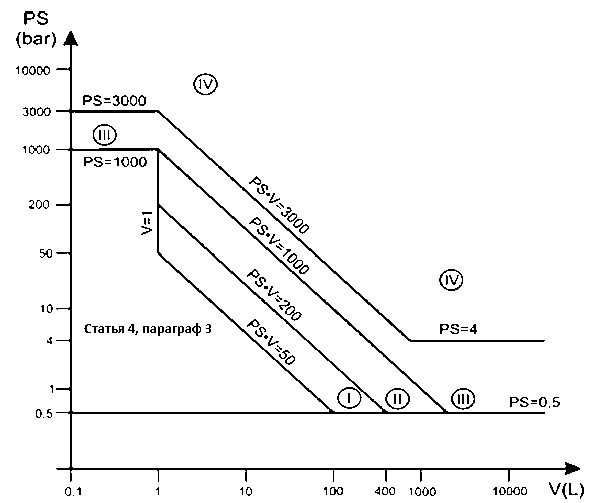
Рисунок 2
Сосуды, указанные в [статье 4 (1) "a"i", второй абзац](https://bukva.ai/docs/direktiva-201468es/statya-4#p100207)
В порядке исключения переносные огнетушители и баллоны для дыхательной аппаратуры должны классифицироваться как минимум по [категории III](https://bukva.ai/docs/direktiva-201468es/statya-52#p100907).
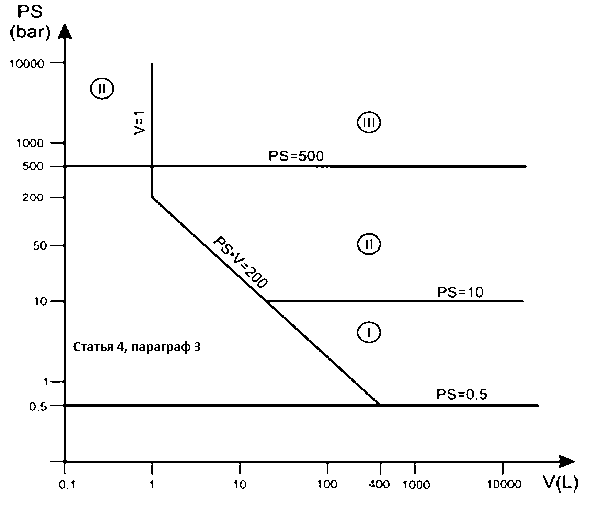
Рисунок 3
Сосуды, указанные в [статье 4 (1) "a"ii", первый абзац](https://bukva.ai/docs/direktiva-201468es/statya-4#p100209)
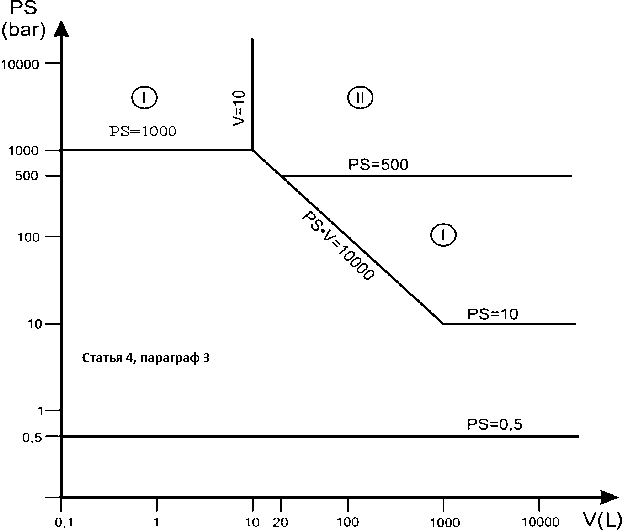
Сосуды, указанные в [статье 4 (1) "a"ii", второй абзац](https://bukva.ai/docs/direktiva-201468es/statya-4#p100210)
В порядке исключения сборочные единицы, предназначенные для генерации теплой воды, как указано во [втором подпараграфе статьи 4 (2)](https://bukva.ai/docs/direktiva-201468es/statya-4#p100224), подлежат либо экспертизе ЕС типа ([модуль B](https://bukva.ai/docs/direktiva-201468es/statya-52#p101003) - типовой проектный образец) относительно их соответствия существенным требованиям, указанным в пунктах 2.10, 2.11, 3.4, [5 "a"](https://bukva.ai/docs/direktiva-201468es/statya-52#p100851) и [5 "d"](https://bukva.ai/docs/direktiva-201468es/statya-52#p100854) Приложения I, либо полному обеспечению качества [(модуль H)](https://bukva.ai/docs/direktiva-201468es/statya-52#p101390).
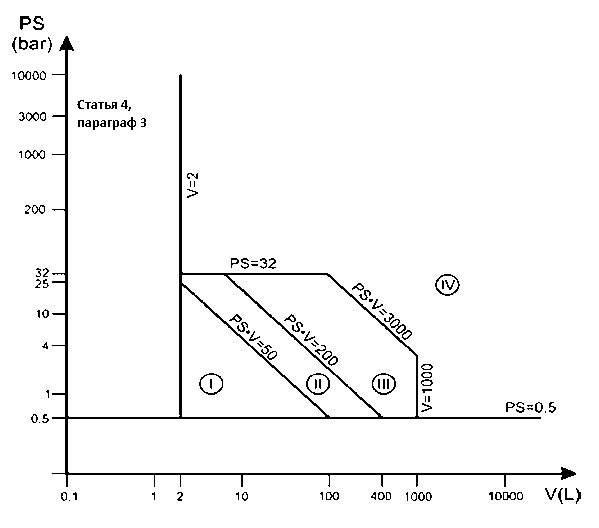
Рисунок 5
Оборудование, работающее под давлением,
указанное в [статье 4 (1) "b"](https://bukva.ai/docs/direktiva-201468es/statya-4#p100211)
В порядке исключения дизайн автоклавов подлежит процедуре оценки соответствия, эквивалентной как минимум одному из модулей [категории III](https://bukva.ai/docs/direktiva-201468es/statya-52#p100907).
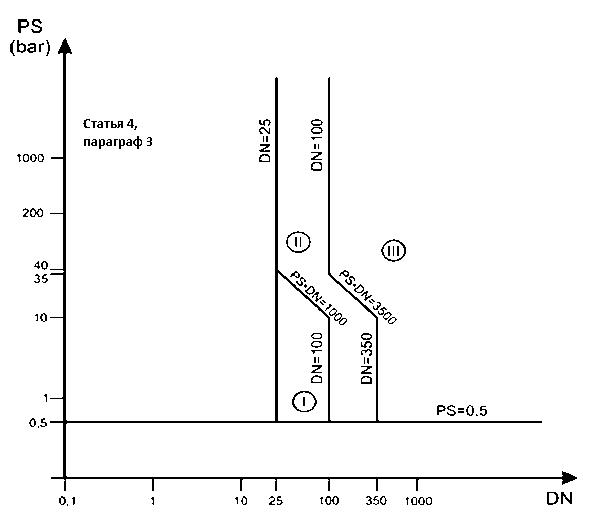
Рисунок 6
Трубопроводы, указанные в [статье 4 (1) "c"i", первый абзац](https://bukva.ai/docs/direktiva-201468es/statya-4#p100214)
В порядке исключения трубопроводы, предназначенные для нестабильных газов и относящиеся к [категории I](https://bukva.ai/docs/direktiva-201468es/statya-52#p100901) или [II](https://bukva.ai/docs/direktiva-201468es/statya-52#p100904) на основе [рисунка 6](https://bukva.ai/docs/direktiva-201468es/statya-52#p100941), должны классифицироваться по [категории III](https://bukva.ai/docs/direktiva-201468es/statya-52#p100907).
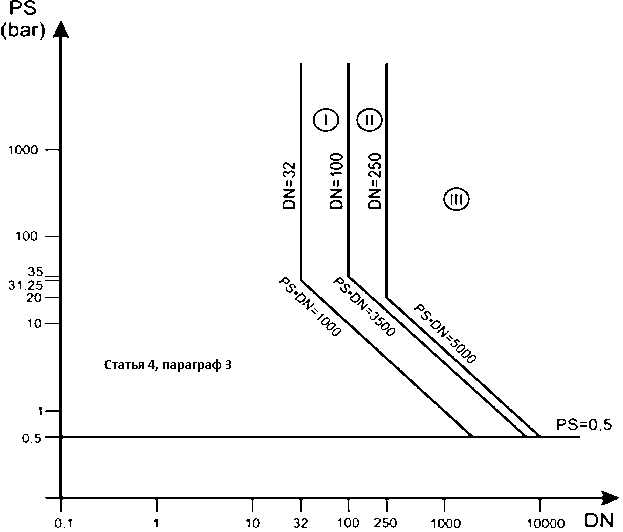
Рисунок 7
Трубопроводы, указанные в [статье 4 (1) "c"i", второй абзац](https://bukva.ai/docs/direktiva-201468es/statya-4#p100215)
В порядке исключения все трубопроводы, содержащие жидкие среды при температуре свыше 350 °C и относящиеся к [категории II](https://bukva.ai/docs/direktiva-201468es/statya-52#p100904), на основе [рисунка 7](https://bukva.ai/docs/direktiva-201468es/statya-52#p100945) должны классифицироваться по [категории III](https://bukva.ai/docs/direktiva-201468es/statya-52#p100907).
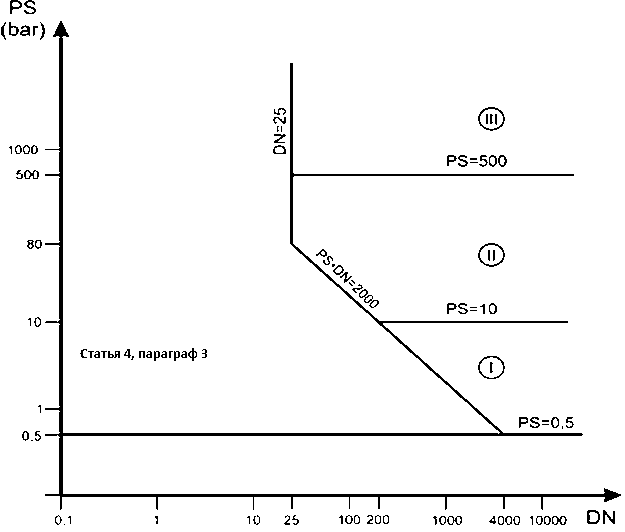
Рисунок 8
Трубопроводы, указанные в [статье 4 (1) "c"ii", первый абзац](https://bukva.ai/docs/direktiva-201468es/statya-4#p100217)
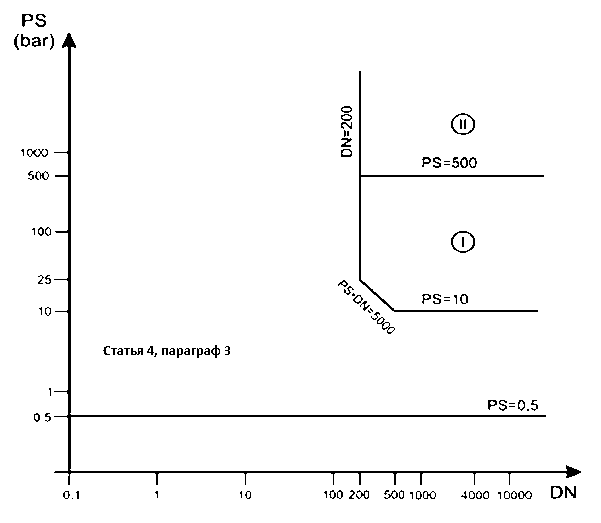
Рисунок 9
Трубопроводы, указанные в [статье 4 (1) "c"ii", второй абзац](https://bukva.ai/docs/direktiva-201468es/statya-4#p100218)
**ПРОЦЕДУРЫ**
**ОЦЕНКИ СООТВЕТСТВИЯ**
Обязанности, вытекающие из положений об оборудовании, работающем под давлением, указанных в настоящем Приложении, также применяются в отношении сборочных единиц.
**1. МОДУЛЬ A (ВНУТРЕННИЙ КОНТРОЛЬ ПРОИЗВОДСТВА)**
1. Внутренний контроль производства является процедурой оценки соответствия, посредством которой производитель выполняет обязательства, установленные в [пунктах 2](https://bukva.ai/docs/direktiva-201468es/statya-52#p100959), [3](https://bukva.ai/docs/direktiva-201468es/statya-52#p100968) и [4](https://bukva.ai/docs/direktiva-201468es/statya-52#p100970), гарантирует и заявляет под свою полную ответственность, что соответствующее оборудование, работающее под давлением, удовлетворяет требованиям настоящей Директивы.
2. Техническая документация
Производитель должен разработать техническую документацию.
Техническая документация должна позволить провести оценку оборудования, работающего под давлением, на предмет его соответствия существенным требованиям. Она должна включать в себя соответствующий анализ и оценку риска или рисков. Техническая документация должна устанавливать применимые требования и охватывать в части, касающейся оценки соответствия, проектирование, производство и эксплуатацию оборудования, работающего под давлением. При наличии соответствующей возможности техническая документация должна содержать как минимум следующие элементы:
- общее описание оборудования, работающего под давлением;
- проектную концепцию и технологические чертежи и схемы компонентов, подузлов, цепей и т.д.;
- описания и пояснения, необходимые для понимания указанных чертежей, схем и функционирования оборудования, работающего под давлением;
- перечень гармонизированных стандартов, применяемых полностью или частично, ссылки на которые были опубликованы в Официальном журнале Европейского Союза, и в случае, если указанные гармонизированные стандарты не применялись, описание решений, принятых для обеспечения существенных требований по безопасности настоящей Директивы. В случае если гармонизированные стандарты применялись лишь частично, техническая документация должна определить части, которые применялись;
- результаты выполненных проектных расчетов, проведенных проверок и т.д.;
- протоколы испытаний.
3. Производство
Производитель должен принять все необходимые меры, с тем чтобы производственный процесс и его мониторинг гарантировали соответствие готового оборудования, работающего под давлением, технической документации, указанной в [пункте 2](https://bukva.ai/docs/direktiva-201468es/statya-52#p100959), и требованиям настоящей Директивы.
4. Маркировка CE и декларация соответствия ЕС
4.1. Производитель должен нанести маркировку CE на каждую единицу оборудования, работающего под давлением, которое удовлетворяет установленным в настоящей Директиве требованиям.
4.2. Производитель должен составить письменную декларацию соответствия ЕС для каждой модели оборудования, работающего под давлением, и сохранять ее, а также техническую документацию для возможной передачи в распоряжение национальных органов в течение 10 лет после того, как оборудование, работающее под давлением, было размещено на рынке. Декларация соответствия ЕС должна позволять идентифицировать оборудование, работающее под давлением, в отношении которого она была составлена.
Копия декларации соответствия ЕС должна быть предоставлена соответствующим органам по их запросу.
5. Уполномоченный представитель
Обязанности производителя, установленные в [пункте 4](https://bukva.ai/docs/direktiva-201468es/statya-52#p100970), могут быть выполнены от его имени и под его контролем его уполномоченным представителем при условии, что указанные обязанности определены в доверенности.
**2. МОДУЛЬ A2: ВНУТРЕННИЙ КОНТРОЛЬ ПРОИЗВОДСТВА**
**С КОНТРОЛИРУЕМЫМИ ПРОВЕРКАМИ ОБОРУДОВАНИЯ, РАБОТАЮЩЕГО**
**ПОД ДАВЛЕНИЕМ, ЧЕРЕЗ ПРОИЗВОЛЬНЫЕ ИНТЕРВАЛЫ ВРЕМЕНИ**
1. Внутренний контроль производства с контролируемыми проверками оборудования, работающего под давлением, через произвольные интервалы времени является процедурой оценки соответствия, посредством которой производитель выполняет обязательства, установленные в [пунктах 2](https://bukva.ai/docs/direktiva-201468es/statya-52#p100978), [3](https://bukva.ai/docs/direktiva-201468es/statya-52#p100986), [4](https://bukva.ai/docs/direktiva-201468es/statya-52#p100988) и [5](https://bukva.ai/docs/direktiva-201468es/statya-52#p100997), гарантирует и заявляет под свою полную ответственность, что соответствующее оборудование, работающее под давлением, удовлетворяет требованиям настоящей Директивы.
2. Техническая документация
Производитель должен разработать техническую документацию. Техническая документация должна позволить провести оценку оборудования, работающего под давлением, на предмет его соответствия существенным требованиям. Она должна включать в себя соответствующий анализ и оценку риска или рисков. Техническая документация должна устанавливать применимые требования и охватывать в части, касающейся оценки соответствия, проектирование, производство и эксплуатацию оборудования, работающего под давлением. При наличии соответствующей возможности техническая документация должна содержать как минимум следующие элементы:
- общее описание оборудования, работающего под давлением;
- проектную концепцию и технологические чертежи и схемы компонентов, подузлов, цепей и т.д.;
- описания и пояснения, необходимые для понимания указанных чертежей, схем и функционирования оборудования, работающего под давлением;
- перечень гармонизированных стандартов, применяемых полностью или частично, ссылки на которые были опубликованы в Официальном журнале Европейского Союза, и в том случае, если указанные гармонизированные стандарты не применялись, описание решений, принятых для обеспечения существенных требований по безопасности настоящей Директивы. В случае если гармонизированные стандарты применялись лишь частично, техническая документация должна определить части, которые применялись;
- результаты выполненных проектных расчетов, проведенных проверок и т.д.;
- протоколы испытаний.
3. Производство
Производитель должен принять все необходимые меры с тем, чтобы производственный процесс и его мониторинг гарантировали соответствие готового оборудования, работающего под давлением, технической документации, указанной в [пункте 2](https://bukva.ai/docs/direktiva-201468es/statya-52#p100978), и применимым к нему требованиям настоящей Директивы.
4. Окончательная оценка и проверки оборудования, работающего под давлением
Производитель должен выполнить окончательную оценку оборудования, работающего под давлением, которая подлежит контролю в форме внеплановых проверок нотифицированного органа, выбранного производителем.
Нотифицированный орган должен провести проверки изделия или распорядиться об их проведении, через произвольные интервалы времени, определенные указанным органом, для того, чтобы подтвердить качество внутренних проверок оборудования, работающего под давлением, принимая во внимание inter alia технологическую сложность оборудования, работающего под давлением, и объем производства.
Во время внеплановых проверок нотифицированный орган должен:
- установить, что производитель на самом деле проводит окончательную оценку в соответствии с пунктом 3.2 Приложения I;
- отобрать образцы оборудования, работающего под давлением, из производственных или складских помещений для проведения проверок. Нотифицированный орган определяет количество образцов оборудования, а также необходимость проведения или распоряжения о проведении окончательной оценки всех или части образцов оборудования, работающего под давлением.
Применяемая процедура отбора образцов направлена на определение того, осуществляется ли процесс производства оборудования, работающего под давлением, в приемлемых пределах с целью обеспечения соответствия оборудования, работающего под давлением.
В случае если один или более элементов оборудования, работающего под давлением, или сборочная единица не отвечают требованиям, нотифицированный орган должен принять соответствующие меры.
В процессе производства производитель под контролем нотифицированного органа должен нанести идентификационный номер указанного органа.
5. Маркировка CE и декларация соответствия ЕС
5.1. Производитель должен нанести маркировку CE на каждую единицу оборудования, работающего под давлением, которое удовлетворяет установленным в настоящей Директиве требованиям.
5.2. Производитель должен составить письменную декларацию соответствия ЕС для каждой модели оборудования, работающего под давлением, и сохранять ее, а также техническую документацию для возможной передачи в распоряжение национальных органов в течение 10 лет после того, как оборудование, работающее под давлением, было размещено на рынке. Декларация соответствия ЕС должна позволять идентифицировать оборудование, работающее под давлением, в отношении которого она была составлена.
Копия декларации соответствия ЕС должна быть предоставлена соответствующим органам по их запросу.
6. Уполномоченный представитель
Обязанности производителя, установленные в [пункте 5](https://bukva.ai/docs/direktiva-201468es/statya-52#p100997), могут быть выполнены от его имени и под его контролем его уполномоченным представителем при условии, что указанные обязанности определены в доверенности.
**3. МОДУЛЬ B: ЭКСПЕРТИЗА ЕС ТИПА**
1. Экспертиза ЕС типа (типовой производственный образец) является частью процедуры оценки соответствия, посредством которой нотифицированный орган исследует технический проект оборудования, работающего под давлением, проверяет и подтверждает, что технический проект оборудования, работающего под давлением, соответствует требованиям настоящей Директивы.
2. Экспертиза ЕС типа (типовой производственный образец) должна состоять из оценки качества технического проекта оборудования, работающего под давлением, посредством изучения технической документации и подтверждающего доказательства, указанного в [пункте 3](https://bukva.ai/docs/direktiva-201468es/statya-52#p101007), а также посредством исследования образца комплектного оборудования, работающего под давлением, представляющего соответствующее производство.
3. Производитель должен подать заявку на проведение экспертизы ЕС типа в один нотифицированный орган по своему выбору.
Заявка должна включать в себя:
- наименование и адрес производителя и, если заявку подает уполномоченный представитель, также наименование и адрес уполномоченного представителя;
- письменное заявление о том, что та же самая заявка не была подана в любой другой нотифицированный орган;
- техническую документацию. Техническая документация должна позволить провести оценку оборудования, работающего под давлением, на предмет его соответствия существенным требованиям настоящей Директивы. Она должна включать в себя соответствующий анализ и оценку риска или рисков. Техническая документация должна устанавливать применимые требования и охватывать в части, касающейся оценки соответствия, проектирование, производство и эксплуатацию оборудования, работающего под давлением. При наличии соответствующей возможности техническая документация должна содержать как минимум следующие элементы:
- общее описание оборудования, работающего под давлением;
- проектную концепцию и технологические чертежи и схемы компонентов, подузлов, цепей и т.д.;
- описания и пояснения, необходимые для понимания указанных чертежей, схем и функционирования оборудования, работающего под давлением;
- перечень гармонизированных стандартов, применяемых полностью или частично, ссылки на которые были опубликованы в Официальном журнале Европейского Союза, и в случае, если указанные гармонизированные стандарты не применялись, описание решений, принятых для обеспечения существенных требований по безопасности настоящей Директивы. В случае если гармонизированные стандарты применялись лишь частично, техническая документация должна определить части, которые применялись;
- результаты выполненных проектных расчетов, проведенных проверок и т.д.;
- протоколы испытаний;
- информацию относительно испытаний, предусмотренных на производстве;
- информацию относительно квалификации или аттестации персонала в соответствии с требованиями [пунктов 3.1.2](https://bukva.ai/docs/direktiva-201468es/statya-52#p100770) и [3.1.3](https://bukva.ai/docs/direktiva-201468es/statya-52#p100778) Приложения I;
- образцы, характерные для намеченного производства.
Образцы могут охватывать различные версии оборудования, работающего под давлением, при условии, что различия между версиями не влияют на уровень безопасности.
Нотифицированный орган может потребовать предоставить дополнительные образцы, если это необходимо для осуществления программы испытания;
- доказательство, подтверждающее правильность принятого технического проектного решения. В подтверждающем доказательстве необходимо указать любые документы, которые были использованы, в частности, в том случае, когда существенные гармонизированные стандарты применялись не в полной мере. Подтверждающее доказательство при необходимости должно включать в себя результаты испытаний, проведенных в соответствующей лаборатории производителя, применяющей иные существенные технические спецификации, или в другой испытательной лаборатории от его имени и под его контролем.
4. Нотифицированный орган должен:
4.1. изучить техническую документацию и подтверждающее доказательство для того, чтобы оценить качество технического проекта оборудования, работающего под давлением, и производственных процессов.
В частности, нотифицированный орган должен:
- провести оценку материалов в том случае, если они не соответствуют существенным гармонизированным стандартам или европейскому разрешению на применение материалов для оборудования, работающего под давлением, и проверить сертификат, выданный производителем материала, в соответствии с [пунктом 4.3](https://bukva.ai/docs/direktiva-201468es/statya-52#p100841). Приложения I;
- утвердить процедуры для осуществления неразъемного соединения частей оборудования, работающего под давлением, или убедиться в том, что они были ранее утверждены в соответствии с [пунктом 3.1.2](https://bukva.ai/docs/direktiva-201468es/statya-52#p100770) Приложения I;
- убедиться в том, что сотрудники, осуществляющие неразъемное соединение частей оборудования, работающего под давлением, и проводящие неразрушающие испытания, квалифицированы или аттестованы в соответствии с [пунктами 3.1.2](https://bukva.ai/docs/direktiva-201468es/statya-52#p100770) или [3.1.3](https://bukva.ai/docs/direktiva-201468es/statya-52#p100778) Приложения I;
4.2. убедиться в том, что образец или образцы произведены в соответствии с технической документацией, и установить элементы, которые были спроектированы в соответствии с положениями существенных гармонизированных стандартов, а также элементы, которые были спроектированы с использованием других существенных технических спецификаций, без применения существенных положений указанных стандартов;
4.3. провести соответствующие исследования и необходимые испытания для того, чтобы проверить, правильно ли применялись выбранные производителем решения, указанные в соответствующих гармонизированных стандартах.
4.4. провести соответствующие исследования и необходимые испытания для того, чтобы проверить, соответствуют ли решения, принятые производителем, который применяет другие соответствующие технические спецификации, существенным требованиям по безопасности настоящей Директивы в случае, когда решения, указанные в соответствующих гармонизированных стандартах, не применялись;
4.5. согласовать с производителем место проведения исследований и испытаний.
5. Нотифицированный орган должен составить отчет об оценке, в котором необходимо зафиксировать деятельность, осуществленную в соответствии с [пунктом 4](https://bukva.ai/docs/direktiva-201468es/statya-52#p101024), и результаты такой деятельности. Без ущерба своим обязанностям по отношению к нотифицирующему органу нотифицированный орган должен обнародовать содержание указанного отчета, полностью или частично, только с согласия производителя.
6. В случае если типовой образец удовлетворяет требованиям настоящей Директивы, нотифицированный орган должен выдать производителю сертификат экспертизы ЕС типа (типовой производственный образец). Без ущерба действию [пункта 7](https://bukva.ai/docs/direktiva-201468es/statya-52#p101039) указанный сертификат действителен в течение 10 лет с правом продления. Он должен содержать наименование и адрес производителя, выводы по результатам испытаний, условия (при наличии таковых) его действительности и необходимые данные для идентификации утвержденного типового образца.
К сертификату должен прилагаться перечень соответствующих частей технической документации, а копия должна храниться у нотифицированного органа.
Сертификат и его приложения должны содержать всю существенную информацию, позволяющую провести оценку готового оборудования, работающего под давлением, на предмет его соответствия исследованному типовому образцу и обеспечивающую возможность проведения эксплуатационного контроля.
В случае если типовой образец не удовлетворяет установленным в настоящей Директиве требованиям, нотифицированный орган должен отказать в выдаче сертификата экспертизы ЕС типа (типовой производственный образец). Он должен проинформировать об этом заявителя, указав причины своего отказа. Необходимо предусмотреть процедуру рассмотрения жалоб.
7. Нотифицированный орган должен быть в курсе любых изменений в принятом современном уровне развития техники, которые указывают на то, что утвержденный типовой образец, по всей видимости, больше не соответствует установленным требованиям настоящей Директивы, и должен определить, требуют ли указанные изменения дополнительного изучения образца. В таком случае нотифицированный орган должен соответствующим образом проинформировать производителя.
Производитель должен проинформировать нотифицированный орган, у которого хранится техническая документация, касающаяся сертификата экспертизы ЕС типа (типовой производственный образец), обо всех модификациях утвержденного типового образца, которые могут повлиять на соответствие оборудования, работающего под давлением, существенным требованиям по безопасности настоящей Директивы или условиям действительности указанного сертификата. Такие модификации требуют дополнительного утверждения в форме дополнения к первоначальному сертификату об экспертизе ЕС типа (типовой производственный образец).
8. Каждый нотифицированный орган должен информировать свой нотифицирующий орган о сертификатах экспертизы ЕС типа (типовой производственный образец) и/или любых дополнениях к ним, которые он выдал или аннулировал; он должен периодически или по требованию предоставлять своему нотифицирующему органу перечень сертификатов и/или любых дополнений к ним, в выдаче которых он отказал, действие которых приостановил или иным образом ограничил.
Каждый нотифицированный орган должен информировать другие нотифицированные органы о сертификатах экспертизы ЕС типа (типовой производственный образец) и/или дополнениях к ним, которые он отказался выдать, аннулировал, приостановил или иным образом ограничил их действие, а также, по требованию, о выданных им сертификатах и/или дополнениях к ним.
Европейская Комиссия, государства-члены ЕС и другие нотифицированные органы могут по запросу получить копию сертификатов экспертизы ЕС типа (типовой производственный образец) и/или дополнений к нему. По запросу Европейская комиссия и государства-члены ЕС могут получить копию технической документации и результаты проверок, проведенных нотифицированным органом. Нотифицированный орган должен сохранять копию сертификата экспертизы ЕС типа (типовой производственный образец), его приложений и дополнений, а также технический файл, включающий в себя документацию, представленную производителем, до истечения срока действия указанного сертификата.
9. Производитель должен сохранять копию сертификата экспертизы ЕС типа (типовой производственный образец), его приложений и дополнений, а также техническую документацию для возможной передачи в распоряжение национальных органов в течение 10 лет после того, как оборудование, работающее под давлением, было размещено на рынке.
10. Уполномоченный представитель производителя может подать заявку, указанную в [пункте 3](https://bukva.ai/docs/direktiva-201468es/statya-52#p101007), и выполнять обязательства, установленные в [пунктах 7](https://bukva.ai/docs/direktiva-201468es/statya-52#p101039) и [9](https://bukva.ai/docs/direktiva-201468es/statya-52#p101044), при условии, что указанные обязанности предусмотрены доверенностью.
1. Экспертиза ЕС типа (типовой проектный образец) является частью процедуры оценки соответствия, посредством которой нотифицированный орган исследует технический проект оборудования, работающего под давлением, проверяет и подтверждает, что технический проект оборудования, работающего под давлением, соответствует требованиям настоящей Директивы.
2. Экспертиза ЕС типа (типовой проектный образец) должна состоять из оценки качества технического проекта оборудования, работающего под давлением, посредством изучения технической документации и подтверждающего доказательства, указанного в [пункте 3](https://bukva.ai/docs/direktiva-201468es/statya-52#p101050), без проведения исследования образца.
Метод экспериментального проектирования, предусмотренный в [пункте 2.2.4](https://bukva.ai/docs/direktiva-201468es/statya-52#p100701) Приложения I, не должен применяться в рамках настоящего модуля.
3. Производитель должен подать заявку на проведение экспертизы ЕС типа (типовой проектный образец) в один нотифицированный орган по своему выбору.
Заявка должна включать в себя:
- наименование и адрес производителя и, если заявку подает уполномоченный представитель, также наименование и адрес уполномоченного представителя;
- письменное заявление о том, что та же самая заявка не была подана в любой другой нотифицированный орган;
- техническую документацию. Техническая документация должна позволить провести оценку оборудования, работающего под давлением, на предмет его соответствия существенным требованиям настоящей Директивы. Она должна включать в себя соответствующий анализ и оценку риска или рисков. Техническая документация должна устанавливать применимые требования и охватывать в части, касающейся оценки соответствия, проектирование, производство и эксплуатацию оборудования, работающего под давлением. При наличии соответствующей возможности техническая документация должна содержать как минимум следующие элементы:
- общее описание оборудования, работающего под давлением;
- проектную концепцию и технологические чертежи и схемы компонентов, подузлов, цепей и т.д.;
- описания и пояснения, необходимые для понимания указанных чертежей, схем и функционирования оборудования, работающего под давлением;
- перечень гармонизированных стандартов, применяемых полностью или частично, ссылки на которые были опубликованы в Официальном журнале Европейского Союза, и в том случае, если указанные гармонизированные стандарты не применялись, описание решений, принятых для обеспечения существенных требований по безопасности настоящей Директивы. В случае если гармонизированные стандарты применялись лишь частично, техническая документация должна определить части, которые применялись;
- результаты выполненных проектных расчетов, проведенных проверок и т.д.;
- информацию относительно квалификации или аттестации персонала в соответствии с требованиями [пунктов 3.1.2](https://bukva.ai/docs/direktiva-201468es/statya-52#p100770) и [3.1.3](https://bukva.ai/docs/direktiva-201468es/statya-52#p100778) Приложения I;
- доказательство, подтверждающее правильность принятого технического проектного решения. В подтверждающем доказательстве необходимо указать любые документы, которые были использованы, в частности, в том случае, когда существенные гармонизированные стандарты применялись не в полной мере. Подтверждающее доказательство при необходимости должно включать в себя результаты испытаний, проведенных соответствующей лабораторией производителя или другой испытательной лабораторией от его имени и под его контролем.
Заявка может охватывать различные версии оборудования, работающего под давлением, при условии, что различия между версиями не влияют на уровень безопасности.
4. Нотифицированный орган должен:
4.1. изучить техническую документацию и подтверждающее доказательство для того, чтобы оценить качество технического проекта изделия.
В частности, нотифицированный орган должен:
- провести оценку материалов в случае, если они не соответствуют существенным гармонизированным стандартам или европейскому разрешению на применение материалов для оборудования, работающего под давлением;
- утвердить процедуры для осуществления неразъемного соединения частей оборудования, работающего под давлением, или убедиться в том, что они были ранее утверждены в соответствии с [пунктом 3.1.2](https://bukva.ai/docs/direktiva-201468es/statya-52#p100770) Приложения I;
4.2. провести соответствующие исследования для того, чтобы проверить, правильно ли применялись выбранные производителем решения, указанные в соответствующих гармонизированных стандартах.
4.3. провести соответствующие исследования для того, чтобы проверить, соответствуют ли принятые производителем решения существенным требованиям по безопасности настоящей Директивы в случае, если решения, указанные в соответствующих гармонизированных стандартах, не применялись.
5. Нотифицированный орган должен составить отчет об оценке, в котором необходимо зафиксировать деятельность, осуществленную в соответствии с [пунктом 4](https://bukva.ai/docs/direktiva-201468es/statya-52#p101063), и результаты такой деятельности. Без ущерба своим обязанностям по отношению к нотифицирующему органу нотифицированный орган должен обнародовать содержание указанного отчета, полностью или частично, только с согласия производителя.
6. В случае если проект удовлетворяет требованиям настоящей Директивы, нотифицированный орган должен выдать производителю сертификат экспертизы ЕС типа (типовой проектный образец). Без ущерба действию [пункта 7](https://bukva.ai/docs/direktiva-201468es/statya-52#p101075) указанный сертификат действителен в течение 10 лет с правом продления. Он должен содержать наименование и адрес производителя, выводы по результатам испытания, условия (при наличии таковых) его действительности и необходимые данные для идентификации утвержденного проекта.
К сертификату должен прилагаться перечень соответствующих частей технической документации, а копия должна храниться у нотифицированного органа.
Сертификат и его приложения должны содержать всю существенную информацию, позволяющую провести оценку готового оборудования, работающего под давлением, на предмет его соответствия испытанному проекту и обеспечивающую возможность проведения эксплуатационного контроля.
В случае если проект не удовлетворяет установленным в настоящей Директиве требованиям, нотифицированный орган должен отказать в выдаче сертификата экспертизы ЕС типа (типовой проектный образец). Он должен проинформировать об этом заявителя, указав причины своего отказа.
7. Нотифицированный орган должен быть в курсе любых изменений в принятом современном уровне развития техники, которые указывают на то, что утвержденный проект, по всей видимости, больше не соответствует установленным требованиям настоящей Директивы, и должен определить, требуют ли указанные изменения дополнительного изучения. В таком случае нотифицированный орган должен соответствующим образом проинформировать производителя.
Производитель должен проинформировать нотифицированный орган, у которого хранится техническая документация, касающаяся сертификата экспертизы ЕС типа (типовой проектный образец), обо всех модификациях утвержденного проекта, которые могут повлиять на соответствие оборудования, работающего под давлением, существенным требованиям по безопасности настоящей Директивы или условиям действительности указанного сертификата. Такие модификации требуют дополнительного утверждения в форме дополнения к первоначальному сертификату экспертизы ЕС типа (типовой проектный образец).
8. Каждый нотифицированный орган должен информировать свои нотифицирующие органы о сертификатах экспертизы ЕС типа (типовой проектный образец) и/или любых дополнениях к ним, которые он выдал или аннулировал; он должен периодически или по требованию предоставлять своим нотифицирующим органам перечень сертификатов и/или любых дополнений к ним, в выдаче которых он отказал, действие которых приостановил или иным образом ограничил.
Каждый нотифицированный орган должен информировать другие нотифицированные органы о сертификатах экспертизы ЕС типа (типовой проектный образец) и/или дополнениях к ним, которые он отказался выдать, аннулировал, приостановил или иным образом ограничил их действие, а также, по требованию, о выданных им сертификатах и/или дополнениях к ним.
Европейская комиссия, государства-члены ЕС и другие нотифицированные органы могут по запросу получить копию сертификата экспертизы ЕС типа (типовой проектный образец) и/или дополнений к нему. По запросу Европейская комиссия и государства-члены ЕС могут получить копию технической документации и результаты проверок, проведенных нотифицированным органом. Нотифицированный орган должен сохранять копию сертификата экспертизы ЕС типа (типовой проектный образец), его приложений и дополнений, а также технический файл, включающий в себя документацию, предоставленную производителем, до истечения срока действия указанного сертификата.
9. Производитель должен сохранять копию сертификата экспертизы ЕС типа (типовой проектный образец), его приложений и дополнений, а также техническую документацию для возможной передачи в распоряжение национальных органов в течение 10 лет после того, как оборудование, работающее под давлением, было размещено на рынке.
10. Уполномоченный представитель производителя может подать заявку, указанную в [пункте 3](https://bukva.ai/docs/direktiva-201468es/statya-52#p101050), и выполнять обязательства, установленные в [пунктах 7](https://bukva.ai/docs/direktiva-201468es/statya-52#p101075) и [9](https://bukva.ai/docs/direktiva-201468es/statya-52#p101080), при условии, что указанные обязанности предусмотрены доверенностью.
**4. МОДУЛЬ C2: СООТВЕТСТВИЕ ТИПОВОМУ ОБРАЗЦУ НА ОСНОВЕ**
**ВНУТРЕННЕГО КОНТРОЛЯ ПРОИЗВОДСТВА С КОНТРОЛИРУЕМЫМИ**
**ПРОВЕРКАМИ ОБОРУДОВАНИЯ, РАБОТАЮЩЕГО ПОД ДАВЛЕНИЕМ,**
**ЧЕРЕЗ ПРОИЗВОЛЬНЫЕ ИНТЕРВАЛЫ ВРЕМЕНИ**
1. Соответствие типовому образцу на основе внутреннего контроля производства с контролируемыми проверками оборудования, работающего под давлением, через произвольные интервалы времени является частью процедуры оценки соответствия, посредством которой производитель выполняет обязанности, установленные в [пунктах 2](https://bukva.ai/docs/direktiva-201468es/statya-52#p101084), [3](https://bukva.ai/docs/direktiva-201468es/statya-52#p101086) и [4](https://bukva.ai/docs/direktiva-201468es/statya-52#p101094), гарантирует и заявляет под свою полную ответственность, что оборудование, работающее под давлением, соответствует типовому образцу, указанному в сертификате экспертизы ЕС типа, и удовлетворяет применимым к нему требованиям настоящей Директивы.
2. Производство
Производитель должен принять все меры, необходимые для того, чтобы производственный процесс и его мониторинг гарантировали соответствие произведенного оборудования, работающего под давлением, типовому образцу, описание которого указано в сертификате экспертизы ЕС типа, и применимым к нему требованиям настоящей Директивы.
3. Окончательная оценка и проверки оборудования, работающего под давлением
Нотифицированный орган, выбранный производителем, должен провести проверки изделия или распорядиться об их проведении, через произвольные интервалы времени, определенные указанным органом, для того, чтобы подтвердить качество окончательной оценки и внутренних проверок оборудования, работающего под давлением, принимая во внимание inter alia технологическую сложность оборудования, работающего под давлением, и объем производства.
Нотифицированный орган должен установить, что производитель на самом деле проводит окончательную оценку в соответствии с пунктом 3.2 Приложения I.
В целях проверки соответствия оборудования, работающего под давлением, существенным требованиям настоящей Директивы необходимо исследовать репрезентативный образец готового оборудования, работающего под давлением, взятый нотифицированным органом на месте производства до размещения оборудования на рынке, также необходимо провести соответствующие испытания, установленные определенной частью гармонизированных стандартов, и/или равнозначные испытания, применяющие иные технические спецификации.
Нотифицированный орган определяет количество образцов оборудования, а также необходимость проведения или распоряжения о проведении окончательной оценки всех или части образцов оборудования, работающего под давлением.
В случае если образец не соответствует допустимому уровню качества продукции, орган должен принять соответствующие меры.
Применяемая процедура отбора образцов направлена на определение того, осуществляется ли процесс производства оборудования, работающего под давлением, в приемлемых пределах с целью обеспечения соответствия оборудования, работающего под давлением.
В случае если испытания проводятся нотифицированным органом, производитель в процессе производства под контролем нотифицированного органа должен нанести идентификационный номер указанного органа.
4. Маркировка CE и декларация соответствия ЕС
4.1. Производитель должен нанести маркировку CE на каждую единицу оборудования, работающего под давлением, или сборочные единицы, которые соответствуют типовому образцу, указанному в сертификате экспертизы ЕС типа, и удовлетворяют установленным в настоящей Директиве требованиям.
4.2. Производитель должен составить письменную декларацию соответствия ЕС для каждой модели оборудования, работающего под давлением, и сохранять ее для возможной передачи в распоряжение национальных органов в течение 10 лет после того, как оборудование, работающее под давлением, было размещено на рынке. Декларация соответствия ЕС должна позволять идентифицировать модель оборудования, работающего под давлением, в отношении которого она была составлена.
Копия декларации соответствия ЕС должна быть предоставлена соответствующим органам по их запросу.
5. Уполномоченный представитель
Обязанности производителя, установленные в [пункте 4](https://bukva.ai/docs/direktiva-201468es/statya-52#p101094), могут быть выполнены от его имени и под его контролем его уполномоченным представителем при условии, что указанные обязанности определены в доверенности.
**5. МОДУЛЬ D: СООТВЕТСТВИЕ ТИПОВОМУ ОБРАЗЦУ НА ОСНОВЕ**
**ОБЕСПЕЧЕНИЯ КАЧЕСТВА ПРОЦЕССА ПРОИЗВОДСТВА**
1. Соответствие типовому образцу на основе обеспечения качества процесса производства является частью процедуры оценки соответствия, посредством которой производитель выполняет обязанности, установленные в [пунктах 2](https://bukva.ai/docs/direktiva-201468es/statya-52#p101102) и [5](https://bukva.ai/docs/direktiva-201468es/statya-52#p101142), гарантирует и заявляет под свою полную ответственность, что оборудование, работающее под давлением, или сборочная единица соответствуют типовому образцу, указанному в сертификате экспертизы ЕС типа, и удовлетворяют применимым к нему требованиям настоящей Директивы.
2. Производство
Производитель должен применять утвержденную систему качества для производства, окончательной проверки качества и испытания оборудования, работающего под давлением, в соответствии с [пунктом 3](https://bukva.ai/docs/direktiva-201468es/statya-52#p101104); он подлежит надзору в соответствии с [пунктом 4](https://bukva.ai/docs/direktiva-201468es/statya-52#p101129).
3. Система качества
3.1. Производитель должен подать заявку на проведение оценки своей системы качества в отношении соответствующего оборудования, работающего под давлением, в нотифицированный орган по своему выбору.
Заявка должна включать в себя:
- наименование и адрес производителя, а также, если заявка подана уполномоченным представителем, наименование и адрес уполномоченного представителя;
- письменное заявление о том, что та же самая заявка не была подана в любой другой нотифицированный орган;
- всю существенную информацию о типе оборудования, работающего под давлением;
- документацию относительно системы качества;
- техническую документацию по каждому утвержденному типовому образцу и копию сертификата экспертизы ЕС типа.
3.2. Система качества должна гарантировать, что оборудование, работающее под давлением, соответствует типовому образцу, указанному в сертификате экспертизы ЕС типа, и отвечает применимым к нему требованиям настоящей Директивы.
Все элементы, требования и положения, принятые производителем, должны быть систематически и аккуратно оформлены в виде письменных программ, процедур и инструкций. Документация по указанной системе качества должна обеспечивать согласованную интерпретацию программ, планов, руководств и протоколов, касающихся качества.
Она должна, в частности, содержать точное описание:
- целей в области обеспечения качества, а также организационной структуры, обязанностей и полномочий руководства в отношении обеспечения качества оборудования, работающего под давлением;
- соответствующих методик, процессов и систематических мер в области производства, контроля и обеспечения качества, которые должны будут применяться, в частности, процедур, используемых для неразъемного соединения частей в соответствии с [пунктом 3.1.2](https://bukva.ai/docs/direktiva-201468es/statya-52#p100770) Приложения I;
- проверок и испытаний, которые должны будут проводиться до, в процессе и после производства, и частоты, с которой они должны проводиться;
- записей по качеству, например, протоколы проверок и результаты испытаний, калибровочные данные, отчеты о квалификации или аттестации соответствующего персонала, в частности персонала, осуществляющего неразъемное соединение частей оборудования и проводящего неразрушающие испытания в соответствии с [пунктами 3.1.2](https://bukva.ai/docs/direktiva-201468es/statya-52#p100770) и [3.1.3](https://bukva.ai/docs/direktiva-201468es/statya-52#p100778) Приложения I, и т.д.; и
- средств контроля над достижением требуемого уровня качества и эффективным функционированием системы качества.
3.3. Нотифицированный орган должен оценить систему качества для того, чтобы определить, удовлетворяет ли она требованиям, указанным в [пункте 3.2](https://bukva.ai/docs/direktiva-201468es/statya-52#p101112).
Он должен предположить, что элементы системы качества, которые соответствуют спецификациям соответствующего гармонизированного стандарта, отвечают указанным требованиям.
В составе команды аудиторов должен находиться хотя бы один член, который в дополнение к опыту в области систем управления качеством обладает опытом в области оценки соответствующего оборудования, работающего под давлением, и технологии производства оборудования, работающего под давлением, а также знает установленные требования настоящей Директивы. Аудит должен включать в себя посещение служебных помещений производителя с целью проведения проверки.
Команда аудиторов должна просмотреть техническую документацию, указанную в [пятом абзаце пункта 3.1](https://bukva.ai/docs/direktiva-201468es/statya-52#p101111), и проверить способность производителя идентифицировать установленные требования настоящей Директивы и провести необходимые проверки в целях обеспечения соответствия изделия указанным требованиям.
Производитель должен быть уведомлен о соответствующем решении. В уведомлении должны содержаться выводы аудиторской проверки и мотивированное решение по результатам оценки.
3.4. Производитель должен взять на себя выполнение обязательств, связанных с утвержденной системой качества, и обеспечить ее точное и эффективное функционирование.
3.5. Производитель должен информировать нотифицированный орган, утвердивший систему качества, о любых запланированных изменениях указанной системы.
Нотифицированный орган должен оценить предполагаемые изменения и решить, будет ли модифицированная система качества по-прежнему удовлетворять требованиям, указанным в [пункте 3.2](https://bukva.ai/docs/direktiva-201468es/statya-52#p101112), или потребуется ее повторная оценка.
Он должен уведомить производителя о своем решении. В уведомлении должны содержаться выводы по результатам проверки и мотивированное решение по результатам оценки.
4. Надзор, осуществляемый под контролем нотифицированного органа
4.1. Целью надзора является обеспечение того, что производитель должным образом выполняет обязанности, связанные с утвержденной системой качества.
4.2. Производитель в целях оценки должен разрешить нотифицированному органу доступ к местам производства, проверки, испытания и хранения, а также должен предоставить ему всю необходимую информацию, в частности:
- документацию относительно системы качества;
- записи относительно качества, например, протоколы проверок и экспериментальные данные, калибровочные данные, отчеты о квалификации сотрудников и т.д.
4.3. Нотифицированный орган должен проводить периодические аудиторские проверки для подтверждения того, что производитель обеспечивает функционирование и надлежащим образом применяет систему качества; нотифицированный орган должен представить производителю отчет о проведенной проверке. Частота проведения периодических проверок должна быть такой, чтобы полная повторная оценка проводилась каждые три года.
4.4. В дополнение к этому нотифицированный орган может осуществлять внеплановые проверки производителя. Необходимость таких дополнительных проверок и их частота будут определяться на основе системы контрольных проверок, используемой нотифицированным органом. В частности, в рамках указанной системы необходимо учесть следующие факторы:
- категорию оборудования, работающего под давлением;
- результаты предыдущих надзорных проверок;
- необходимость контроля исполнения корректирующих мер;
- особые условия, связанные с утверждением системы качества при необходимости;
- значительные изменения в организации, принципах или технологиях производства.
Во время указанных проверок нотифицированный орган может при необходимости провести испытание изделия или поручить его проведение для того, чтобы подтвердить, что система качества функционирует должным образом. Нотифицированный орган должен представить производителю отчет о проверке и протокол испытаний, если они проводились.
5. Маркировка CE и декларация соответствия ЕС
5.1. Производитель должен нанести маркировку CE, а также под контролем нотифицированного органа, указанного в [пункте 3.1](https://bukva.ai/docs/direktiva-201468es/statya-52#p101105), его идентификационный номер на каждую единицу оборудования, работающего под давлением, которое соответствует типовому образцу, указанному в сертификате экспертизы ЕС типа, и удовлетворяет установленным в настоящей Директиве требованиям.
5.2. Производитель должен составить письменную декларацию соответствия ЕС для каждой модели оборудования, работающего под давлением, и сохранять ее для возможной передачи в распоряжение национальных органов в течение 10 лет после того, как оборудование, работающее под давлением, было размещено на рынке. Декларация соответствия ЕС должна позволять идентифицировать модель оборудования, работающего под давлением, в отношении которого она была составлена.
Копия декларации соответствия ЕС должна быть предоставлена соответствующим органам по их запросу.
6. Производитель должен в течение 10 лет после того, как оборудование, работающее под давлением, было размещено на рынке, сохранять для возможной передачи в распоряжение национальных органов:
- документацию, указанную в [пункте 3.1](https://bukva.ai/docs/direktiva-201468es/statya-52#p101105);
- информацию об изменении, указанном в [пункте 3.5](https://bukva.ai/docs/direktiva-201468es/statya-52#p101126);
- решения и отчеты нотифицированного органа, указанные в [пунктах 3.3](https://bukva.ai/docs/direktiva-201468es/statya-52#p101120), [3.5](https://bukva.ai/docs/direktiva-201468es/statya-52#p101126), [4.3](https://bukva.ai/docs/direktiva-201468es/statya-52#p101134) и [4.4](https://bukva.ai/docs/direktiva-201468es/statya-52#p101135).
7. Каждый нотифицированный орган должен информировать свои нотифицирующие органы о выданных или аннулированных разрешениях относительно системы качества; он также должен периодически или по требованию предоставлять нотифицирующим органам перечень разрешений относительно системы качества, в выдаче которых он отказал, действие которых он приостановил или иным образом ограничил.
Каждый нотифицированный орган должен информировать другие нотифицированные органы о разрешениях относительно системы качества, в выдаче которых он отказал, действие которых он приостановил, аннулировал или иным образом ограничил, а также по требованию сообщать о выданных им разрешениях относительно системы качества.
8. Уполномоченный представитель
Обязанности производителя, указанные в [пунктах 3.1](https://bukva.ai/docs/direktiva-201468es/statya-52#p101105), [3.5](https://bukva.ai/docs/direktiva-201468es/statya-52#p101126), [5](https://bukva.ai/docs/direktiva-201468es/statya-52#p101142) и [6](https://bukva.ai/docs/direktiva-201468es/statya-52#p101146), могут быть выполнены от его имени и под его контролем его уполномоченным представителем при условии, что указанные обязанности предусмотрены доверенностью.
**6. МОДУЛЬ D1: ОБЕСПЕЧЕНИЕ КАЧЕСТВА**
**ПРОИЗВОДСТВЕННОГО ПРОЦЕССА**
1. Обеспечение качества производственного процесса - это процедура оценки соответствия, посредством которой производитель выполняет обязанности, установленные в [пунктах 2](https://bukva.ai/docs/direktiva-201468es/statya-52#p101156), [4](https://bukva.ai/docs/direktiva-201468es/statya-52#p101165) и [7](https://bukva.ai/docs/direktiva-201468es/statya-52#p101205), гарантирует и заявляет под свою полную ответственность о том, что соответствующее оборудования, работающее под давлением, удовлетворяет применимым к нему требованиям настоящей Директивы.
2. Техническая документация
Производитель должен разработать техническую документацию. Техническая документация должна позволить провести оценку оборудования, работающего под давлением, на предмет его соответствия существенным требованиям. Она должна включать в себя соответствующий анализ и оценку риска или рисков. Техническая документация должна устанавливать применимые требования и охватывать в части, касающейся оценки соответствия, проектирование, производство и эксплуатацию оборудования. При наличии соответствующей возможности техническая документация должна содержать как минимум следующие элементы:
- общее описание оборудования, работающего под давлением;
- проектную концепцию и технологические чертежи и схемы компонентов, подузлов, цепей и т.д.;
- описания и пояснения, необходимые для понимания указанных чертежей, схем и функционирования оборудования, работающего под давлением;
- перечень гармонизированных стандартов, применяемых полностью или частично, ссылки на которые были опубликованы в Официальном журнале Европейского Союза, и в том случае, если указанные гармонизированные стандарты не применялись, описание решений, принятых для обеспечения существенных требований по безопасности настоящей Директивы. В случае если гармонизированные стандарты применялись лишь частично, техническая документация должна определить части, которые применялись;
- результаты выполненных проектных расчетов, проведенных проверок и т.д.;
- протоколы испытаний.
3. Производитель должен сохранять техническую документацию для возможной передачи в распоряжение соответствующих национальных органов в течение 10 лет после того, как оборудование, работающее под давлением, было размещено на рынке.
4. Производство
Производитель должен применять утвержденную систему качества для производства, окончательной проверки качества и испытания оборудования, работающего под давлением, в соответствии с [пунктом 5](https://bukva.ai/docs/direktiva-201468es/statya-52#p101167); он подлежит надзору в соответствии с [пунктом 6](https://bukva.ai/docs/direktiva-201468es/statya-52#p101191).
5. Система качества
5.1. Производитель должен подать заявку на проведение оценки своей системы качества в отношении соответствующего оборудования, работающего под давлением, в нотифицированный орган по своему выбору.
Заявка должна включать в себя:
- наименование и адрес производителя, а также, если заявка подана уполномоченным представителем, наименование и адрес уполномоченного представителя;
- письменное заявление о том, что та же самая заявка не была подана в любой другой нотифицированный орган;
- всю существенную информацию о типе оборудования, работающего под давлением;
- документацию относительно системы качества;
- техническую документацию, указанную в [пункте 2](https://bukva.ai/docs/direktiva-201468es/statya-52#p101156).
5.2. Система качества должна гарантировать, что оборудование, работающее под давлением, соответствует применимым к нему требованиям настоящей Директивы.
Все элементы, требования и положения, принятые производителем, должны быть систематически и аккуратно оформлены в виде письменных программ, процедур и инструкций. Документация по указанной системе качества должна обеспечивать согласованную интерпретацию программ, планов, руководств и протоколов, касающихся качества.
Она должна, в частности, содержать точное описание:
- целей в области обеспечения качества, а также организационной структуры, обязанностей и полномочий руководства в отношении обеспечения качества оборудования, работающего под давлением;
- соответствующих методик, процессов и систематических мер в области производства, контроля и обеспечения качества, которые должны будут применяться, в частности, процедур, используемых для неразъемного соединения частей в соответствии с [пунктом 3.1.2](https://bukva.ai/docs/direktiva-201468es/statya-52#p100770) Приложения I;
- проверок и испытаний, которые должны будут проводиться до, в процессе и после производства, и частоты, с которой они должны проводиться;
- записей по качеству, например, протоколы проверок и результаты испытаний, калибровочные данные, отчеты о квалификации или аттестации соответствующего персонала, в частности персонала, осуществляющего неразъемное соединение частей оборудования и проводящего неразрушающие испытания в соответствии с [пунктом 3.1.2](https://bukva.ai/docs/direktiva-201468es/statya-52#p100770) Приложения I, и т.д.;
- средств контроля над достижением требуемого качества и эффективным функционированием системы качества.
5.3. Нотифицированный орган должен оценить систему качества для того, чтобы определить, удовлетворяет ли она требованиям, указанным в [пункте 5.2](https://bukva.ai/docs/direktiva-201468es/statya-52#p101175). Предполагается, что элементы системы качества, которые находятся в соответствии с существенными гармонизированными стандартами, отвечают требованиям, указанным в [пункте 5.2](https://bukva.ai/docs/direktiva-201468es/statya-52#p101175).
В составе команды аудиторов должен находиться хотя бы один член, который в дополнение к опыту в области систем управления качеством обладает опытом в области оценки технологии производства оборудования, работающего под давлением, а также знает установленные требования настоящей Директивы. Аудит должен включать в себя посещение служебных помещений производителя с целью проведения проверок.
Команда аудиторов должна просмотреть техническую документацию, указанную в [пункте 2](https://bukva.ai/docs/direktiva-201468es/statya-52#p101156), для того, чтобы проверить способность производителя идентифицировать установленные требования настоящей Директивы и провести необходимые проверки в целях обеспечения соответствия оборудования, работающего под давлением, указанным требованиям.
Производитель должен быть уведомлен о соответствующем решении. В уведомлении должны содержаться выводы аудиторской проверки и мотивированное решение по результатам оценки.
5.4. Производитель должен взять на себя выполнение обязательств, связанных с утвержденной системой качества, и обеспечить ее точное и эффективное функционирование.
5.5. Производитель должен информировать нотифицированный орган, утвердивший систему качества, о любых запланированных изменениях указанной системы.
Нотифицированный орган должен оценить предполагаемые изменения и решить, будет ли модифицированная система качества по-прежнему удовлетворять требованиям, указанным в [пункте 5.2](https://bukva.ai/docs/direktiva-201468es/statya-52#p101175), или потребуется ее повторная оценка.
Он должен уведомить производителя о своем решении. В уведомлении должны содержаться выводы по результатам проверки и мотивированное решение по результатам оценки.
6. Надзор, осуществляемый под контролем нотифицированного органа
6.1. Целью надзора является обеспечение того, что производитель должным образом выполняет обязанности, связанные с утвержденной системой качества.
6.2. Производитель в целях оценки должен разрешить нотифицированному органу доступ к местам производства, проверки, испытания и хранения, а также должен предоставить ему всю необходимую информацию, в частности:
- документацию относительно системы качества;
- техническую документацию, указанную в [пункте 2](https://bukva.ai/docs/direktiva-201468es/statya-52#p101156);
- записи относительно качества, например, протоколы проверок и экспериментальные данные, калибровочные данные, отчеты о квалификации сотрудников и т.д.
6.3. Нотифицированный орган должен проводить периодические аудиторские проверки для подтверждения того, что производитель обеспечивает функционирование и надлежащим образом применяет систему качества; нотифицированный орган должен представить производителю отчет о проведенной проверке. Частота проведения периодических проверок должна быть такой, чтобы полная повторная оценка проводилась каждые три года.
6.4. В дополнение к этому нотифицированный орган может осуществлять внеплановые проверки производителя. Необходимость таких дополнительных проверок и их частота будут определяться на основе системы контрольных проверок, используемой нотифицированным органом. В частности, в рамках указанной системы необходимо учесть следующие факторы:
- категорию оборудования, работающего под давлением;
- результаты предыдущих надзорных проверок;
- необходимость контроля исполнения корректирующих мер;
- особые условия, связанные с утверждением системы качества, при необходимости;
- значительные изменения в организации, принципах или технологиях производства.
Во время указанных проверок нотифицированный орган может при необходимости провести испытание изделия или поручить его проведение для того, чтобы подтвердить, что система качества функционирует должным образом. Нотифицированный орган должен представить производителю отчет о проверке и протокол испытаний, если они проводились.
7. Маркировка CE и декларация соответствия ЕС
7.1. Производитель должен нанести маркировку CE, а также под контролем нотифицированного органа, указанного в [пункте 5.1](https://bukva.ai/docs/direktiva-201468es/statya-52#p101168), его идентификационный номер на каждую единицу оборудования, работающего под давлением, которое удовлетворяет установленным в настоящей Директиве требованиям.
7.2. Производитель должен составить письменную декларацию соответствия ЕС для каждой модели оборудования, работающего под давлением, и сохранять ее для возможной передачи в распоряжение национальных органов в течение 10 лет после того, как оборудование, работающее под давлением, было размещено на рынке. Декларация соответствия ЕС должна позволять идентифицировать модель оборудования, работающего под давлением, в отношении которого она была составлена.
Копия декларации соответствия ЕС должна быть предоставлена соответствующим органам по их запросу.
8. Производитель должен в течение 10 лет после того, как оборудование, работающее под давлением, было размещено на рынке, сохранять для возможной передачи в распоряжение национальных органов:
- документацию, указанную в [пункте 5.1](https://bukva.ai/docs/direktiva-201468es/statya-52#p101168);
- информацию об изменении, указанном в [пункте 5.5](https://bukva.ai/docs/direktiva-201468es/statya-52#p101188);
- решения и отчеты нотифицированного органа, указанные в [пунктах 5.5](https://bukva.ai/docs/direktiva-201468es/statya-52#p101188), [6.3](https://bukva.ai/docs/direktiva-201468es/statya-52#p101197) и [6.4](https://bukva.ai/docs/direktiva-201468es/statya-52#p101198).
9. Каждый нотифицированный орган должен информировать свои нотифицирующие органы о выданных или аннулированных разрешениях относительно системы качества; он также должен периодически или по требованию представлять нотифицирующим органам перечень разрешений относительно системы качества, в выдаче которых он отказал, действие которых он приостановил или иным образом ограничил.
Каждый нотифицированный орган должен информировать другие нотифицированные органы о разрешениях относительно системы качества, в выдаче которых он отказал, действие которых он приостановил или аннулировал, а также по требованию сообщать о выданных им разрешениях относительно системы качества.
10. Уполномоченный представитель
Обязанности производителя, указанные в [пунктах 3](https://bukva.ai/docs/direktiva-201468es/statya-52#p101164), [5.1](https://bukva.ai/docs/direktiva-201468es/statya-52#p101168), [5.5](https://bukva.ai/docs/direktiva-201468es/statya-52#p101188), [7](https://bukva.ai/docs/direktiva-201468es/statya-52#p101205) и [8](https://bukva.ai/docs/direktiva-201468es/statya-52#p101209), могут быть выполнены от его имени и под его контролем его уполномоченным представителем при условии, что указанные обязанности предусмотрены доверенностью.
**7. МОДУЛЬ E: СООТВЕТСТВИЕ ТИПОВОМУ ОБРАЗЦУ НА ОСНОВЕ**
**ОБЕСПЕЧЕНИЯ КАЧЕСТВА ОБОРУДОВАНИЯ,**
**РАБОТАЮЩЕГО ПОД ДАВЛЕНИЕМ**
1. Соответствие типовому образцу на основе обеспечения качества оборудования, работающего под давлением, является частью процедуры оценки соответствия, посредством которой производитель выполняет обязанности, установленные в [пунктах 2](https://bukva.ai/docs/direktiva-201468es/statya-52#p101219) и [5](https://bukva.ai/docs/direktiva-201468es/statya-52#p101259), гарантирует и заявляет под свою полную ответственность о том, что оборудование, работающее под давлением, соответствует типовому образцу, указанному в сертификате экспертизы ЕС типа, и удовлетворяет применимым к нему требованиям настоящей Директивы.
2. Производство
Производитель должен применять утвержденную систему качества для окончательной проверки качества и испытания соответствующего оборудования, работающего под давлением, в соответствии с [пунктом 3](https://bukva.ai/docs/direktiva-201468es/statya-52#p101221); он подлежит надзору в соответствии с [пунктом 4](https://bukva.ai/docs/direktiva-201468es/statya-52#p101244).
3. Система качества
3.1. Производитель должен подать заявку на проведение оценки своей системы качества в отношении соответствующего оборудования, работающего под давлением, в нотифицированный орган по своему выбору.
Заявка должна включать в себя:
- наименование и адрес производителя, а также, если заявка подана уполномоченным представителем, наименование и адрес уполномоченного представителя;
- письменное заявление о том, что та же самая заявка не была подана в любой другой нотифицированный орган;
- всю существенную информацию о типе оборудования, работающего под давлением;
- документацию относительно системы качества;
- техническую документацию по утвержденному типовому образцу и копию сертификата экспертизы ЕС типа.
3.2. Система качества должна гарантировать соответствие продукции типовому образцу, указанному в сертификате экспертизы ЕС типа, и установленным требованиям настоящей Директивы.
Все элементы, требования и положения, принятые производителем, должны быть систематически и аккуратно оформлены в виде письменных программ, процедур и инструкций. Документация по указанной системе качества должна обеспечивать согласованную интерпретацию программ, планов, руководств и протоколов, касающихся качества.
Она должна, в частности, содержать точное описание:
- целей в области обеспечения качества, а также организационной структуры, обязанностей и полномочий руководства в отношении обеспечения качества изделия;
- проверок и испытаний, которые должны будут проводиться после производства оборудования;
- записей по качеству, например, протоколы проверок и результаты испытаний, калибровочные данные, отчеты о квалификации или аттестации соответствующего персонала, в частности, персонала, осуществляющего неразъемное соединение частей оборудования и проводящего неразрушающие испытания в соответствии с [пунктами 3.1.2](https://bukva.ai/docs/direktiva-201468es/statya-52#p100770) и [3.1.3](https://bukva.ai/docs/direktiva-201468es/statya-52#p100778) Приложения I;
- средств контроля над эффективным функционированием системы качества.
3.3. Нотифицированный орган должен оценить систему качества для того, чтобы определить, удовлетворяет ли она требованиям, указанным в [пункте 3.2](https://bukva.ai/docs/direktiva-201468es/statya-52#p101229). Он должен предположить, что элементы системы качества, которые соответствуют спецификациям соответствующего гармонизированного стандарта, отвечают указанным требованиям.
В составе команды аудиторов должен находиться хотя бы один член, который в дополнение к опыту в области систем управления качеством обладает опытом в области оценки соответствующего оборудования, работающего под давлением, и технологии производства оборудования, работающего под давлением, а также знает установленные требования настоящей Директивы. Аудит должен включать в себя посещение служебных помещений производителя с целью проведения оценки.
Команда аудиторов должна просмотреть техническую документацию, указанную в [пятом абзаце пункта 3.1](https://bukva.ai/docs/direktiva-201468es/statya-52#p101228), для того, чтобы проверить способность производителя идентифицировать установленные требования настоящей Директивы и провести необходимые проверки в целях обеспечения соответствия оборудования, работающего под давлением, указанным требованиям.
Производитель должен быть уведомлен о соответствующем решении. В уведомлении должны содержаться выводы аудиторской проверки и мотивированное решение по результатам оценки.
3.4. Производитель должен взять на себя выполнение обязательств, связанных с утвержденной системой качества, и обеспечить ее точное и эффективное функционирование.
3.5. Производитель должен информировать нотифицированный орган, утвердивший систему качества, о любых запланированных изменениях указанной системы.
Нотифицированный орган должен оценить предполагаемые изменения и решить, будет ли модифицированная система качества удовлетворять требованиям, указанным в [пункте 3.2](https://bukva.ai/docs/direktiva-201468es/statya-52#p101229), или потребуется ее повторная оценка.
Он должен уведомить производителя о своем решении. В уведомлении должны содержаться выводы по результатам проверки и мотивированное решение по результатам оценки.
4. Надзор, осуществляемый под контролем нотифицированного органа
4.1. Целью надзора является обеспечение того, что производитель должным образом выполняет обязанности, связанные с утвержденной системой качества.
4.2. Производитель в целях оценки должен разрешить нотифицированному органу доступ к местам производства, проверки, испытания и хранения, он также должен предоставить ему всю необходимую информацию, в частности:
- документацию относительно системы качества;
- техническую документацию;
- записи относительно качества, например, протоколы проверок и экспериментальные данные, калибровочные данные, отчеты о квалификации сотрудников и т.д.
4.3. Нотифицированный орган должен проводить периодические аудиторские проверки для подтверждения того, что производитель обеспечивает функционирование и надлежащим образом применяет систему качества; нотифицированный орган должен представить производителю отчет о проведенной проверке. Частота проведения периодических проверок должна быть такой, чтобы полная повторная оценка проводилась каждые три года.
4.4. В дополнение к этому нотифицированный орган может осуществлять внеплановые проверки производителя.
Необходимость таких дополнительных проверок и их частота будут определяться на основе системы контрольных проверок, используемой нотифицированным органом. В частности, в рамках указанной системы необходимо учесть следующие факторы:
- категорию оборудования, работающего под давлением;
- результаты предыдущих надзорных проверок;
- необходимость контроля исполнения корректирующих мер;
- особые условия, связанные с утверждением системы качества, при необходимости;
- значительные изменения в организации, принципах или технологиях производства.
Во время указанных проверок нотифицированный орган может при необходимости проводить испытания изделия или поручить их проведение для того, чтобы подтвердить, что система качества функционирует должным образом. Нотифицированный орган должен представить производителю отчет о проверке и протокол испытаний, если они проводились.
5. Маркировка CE и декларация соответствия ЕС
5.1. Производитель должен нанести маркировку CE, а также под контролем нотифицированного органа, указанного в [пункте 3.1](https://bukva.ai/docs/direktiva-201468es/statya-52#p101222), его идентификационный номер на каждую единицу оборудования, работающего под давлением, которое соответствует типовому образцу, указанному в сертификате экспертизы ЕС типа, и удовлетворяет установленным в настоящей Директиве требованиям.
5.2. Производитель должен составить письменную декларацию соответствия ЕС для каждой модели оборудования, работающего под давлением, и сохранять ее для возможной передачи в распоряжение национальных органов в течение 10 лет после того, как оборудование, работающее под давлением, было размещено на рынке. Декларация соответствия ЕС должна позволять идентифицировать модель изделия, в отношении которого она была составлена.
Копия декларации соответствия ЕС должна быть предоставлена соответствующим органам по их запросу.
6. Производитель должен в течение 10 лет после того, как оборудование, работающее под давлением, было размещено на рынке, сохранять для возможной передачи в распоряжение национальных органов:
- документацию, указанную в [пункте 3.1](https://bukva.ai/docs/direktiva-201468es/statya-52#p101222);
- информацию об изменении, указанном в [пункте 3.5](https://bukva.ai/docs/direktiva-201468es/statya-52#p101241);
- решения и отчеты нотифицированного органа, указанные в [пунктах 3.3](https://bukva.ai/docs/direktiva-201468es/statya-52#p101236), [3.5](https://bukva.ai/docs/direktiva-201468es/statya-52#p101241), [4.3](https://bukva.ai/docs/direktiva-201468es/statya-52#p101250) и [4.4](https://bukva.ai/docs/direktiva-201468es/statya-52#p101251).
7. Каждый нотифицированный орган должен информировать свои нотифицирующие органы о выданных или аннулированных разрешениях относительно системы качества; он также должен периодически или по требованию предоставлять нотифицирующим органам перечень разрешений относительно системы качества, в выдаче которых он отказал, действие которых он приостановил или иным образом ограничил.
Каждый нотифицированный орган должен информировать другие нотифицированные органы о разрешениях относительно системы качества, в выдаче которых он отказал, действие которых он приостановил или аннулировал, а также по требованию сообщать о выданных им разрешениях относительно системы качества.
8. Уполномоченный представитель
Обязанности производителя, указанные в [пунктах 3.1](https://bukva.ai/docs/direktiva-201468es/statya-52#p101222), [3.5](https://bukva.ai/docs/direktiva-201468es/statya-52#p101241), [5](https://bukva.ai/docs/direktiva-201468es/statya-52#p101259) и [6](https://bukva.ai/docs/direktiva-201468es/statya-52#p101263), могут быть выполнены от его имени и под его контролем его уполномоченным представителем при условии, что указанные обязанности предусмотрены доверенностью.
**8. МОДУЛЬ E1: ОБЕСПЕЧЕНИЕ КАЧЕСТВА ОКОНЧАТЕЛЬНОЙ ПРОВЕРКИ**
**И ИСПЫТАНИЯ ОБОРУДОВАНИЯ, РАБОТАЮЩЕГО ПОД ДАВЛЕНИЕМ**
1. Обеспечение качества окончательной проверки и испытания оборудования, работающего под давлением, - это процедура оценки соответствия, посредством которой производитель выполняет обязанности, установленные в [пунктах 2](https://bukva.ai/docs/direktiva-201468es/statya-52#p101273), [4](https://bukva.ai/docs/direktiva-201468es/statya-52#p101282) и [7](https://bukva.ai/docs/direktiva-201468es/statya-52#p101324), гарантирует и заявляет под свою полную ответственность о том, что соответствующее оборудование, работающее под давлением, удовлетворяет применимым к нему требованиям настоящей Директивы.
2. Техническая документация
Производитель должен разработать техническую документацию. Техническая документация должна позволить провести оценку оборудования, работающего под давлением, на предмет его соответствия существенным требованиям. Она должна включать в себя соответствующий анализ и оценку риска или рисков. Техническая документация должна устанавливать применимые требования и охватывать в части, касающейся оценки соответствия, проектирование, производство и эксплуатацию оборудования, работающего под давлением. При наличии соответствующей возможности техническая документация должна содержать как минимум следующие элементы:
- общее описание оборудования, работающего под давлением;
- проектную концепцию и технологические чертежи и схемы компонентов, подузлов, цепей и т.д.;
- описания и пояснения, необходимые для понимания указанных чертежей, схем и функционирования оборудования, работающего под давлением;
- перечень гармонизированных стандартов, применяемых полностью или частично, ссылки на которые были опубликованы в Официальном журнале Европейского Союза, и в том случае, если указанные гармонизированные стандарты не применялись, описание решений, принятых для обеспечения существенных требований по безопасности настоящей Директивы. В случае если гармонизированные стандарты применялись лишь частично, техническая документация должна определить части, которые применялись;
- результаты выполненных проектных расчетов, проведенных проверок и т.д.;
- протоколы испытаний.
3. Производитель должен сохранять техническую документацию для возможной передачи в распоряжение соответствующих национальных органов в течение 10 лет после того, как оборудование, работающее под давлением, было размещено на рынке.
4. Производство
Производитель должен применять утвержденную систему качества для окончательной проверки качества и испытания оборудования, работающего под давлением, в соответствии с [пунктом 5](https://bukva.ai/docs/direktiva-201468es/statya-52#p101284); он подлежит надзору в соответствии с [пунктом 6](https://bukva.ai/docs/direktiva-201468es/statya-52#p101310).
5. Система качества
5.1. Производитель должен подать заявку на проведение оценки своей системы качества в отношении соответствующего оборудования, работающего под давлением, в нотифицированный орган по своему выбору.
Заявка должна включать в себя:
- наименование и адрес производителя, а также, если заявка подана уполномоченным представителем, наименование и адрес уполномоченного представителя;
- письменное заявление о том, что та же самая заявка не была подана в любой другой нотифицированный орган;
- всю существенную информацию о типе оборудования, работающего под давлением;
- документацию относительно системы качества; и
- техническую документацию, указанную в [пункте 2](https://bukva.ai/docs/direktiva-201468es/statya-52#p101273).
5.2. Система качества должна гарантировать, что оборудование, работающее под давлением, соответствует применимым к нему требованиям настоящей Директивы.
В рамках системы качества необходимо проверить каждый элемент оборудования, работающего под давлением, также должны быть проведены соответствующие испытания, установленные в соответствующем стандарте или стандартах согласно [статье 12](https://bukva.ai/docs/direktiva-201468es/statya-12#p100290), или равнозначные испытания и, в частности, окончательная оценка, указанная в пункте 3.2 Приложения I, для того, чтобы гарантировать соответствие оборудования применимым к нему требованиям настоящей Директивы.
Все элементы, требования и положения, принятые производителем, должны быть систематически и аккуратно оформлены в виде письменных программ, процедур и инструкций. Документация по указанной системе качества должна обеспечивать согласованную интерпретацию программ, планов, руководств и протоколов, касающихся качества.
Она должна, в частности, содержать точное описание:
- целей в области обеспечения качества, а также организационной структуры, обязанностей и полномочий руководства в отношении обеспечения качества оборудования, работающего под давлением;
- процедур, применяемых для неразъемного соединения частей, утвержденных в соответствии с [пунктом 3.1.2](https://bukva.ai/docs/direktiva-201468es/statya-52#p100770) Приложения I;
- проверок и испытаний, которые должны будут проводиться после производства;
- записей по качеству, например, протоколы проверок и результаты испытаний, калибровочные данные, отчеты о квалификации или аттестации соответствующего персонала, в частности персонала, осуществляющего неразъемное соединение частей оборудования в соответствии с [пунктом 3.1.2](https://bukva.ai/docs/direktiva-201468es/statya-52#p100770) Приложения I;
- средств контроля над эффективным функционированием системы качества.
5.3. Нотифицированный орган должен оценить систему качества для того, чтобы определить, удовлетворяет ли она требованиям, указанным в [пункте 5.2](https://bukva.ai/docs/direktiva-201468es/statya-52#p101292).
Он должен предположить, что элементы системы качества, которые соответствуют спецификациям соответствующего гармонизированного стандарта, отвечают указанным требованиям.
В составе команды аудиторов должен находиться хотя бы один член, который в дополнение к опыту в области систем управления качеством обладает опытом в области оценки соответствующего оборудования, работающего под давлением, и технологии производства оборудования, работающего под давлением, а также знает установленные требования настоящей Директивы. Аудит должен включать в себя посещение служебных помещений производителя с целью проведения проверок.
Команда аудиторов должна просмотреть техническую документацию, указанную в [пункте 2](https://bukva.ai/docs/direktiva-201468es/statya-52#p101273), для того, чтобы проверить способность производителя идентифицировать установленные требования настоящей Директивы и провести необходимые проверки в целях обеспечения соответствия оборудования, работающего под давлением, указанным требованиям.
Производитель должен быть уведомлен о соответствующем решении. В уведомлении должны содержаться выводы аудиторской проверки и мотивированное решение по результатам оценки.
5.4. Производитель должен взять на себя выполнение обязательств, связанных с утвержденной системой качества, и обеспечить ее точное и эффективное функционирование.
5.5. Производитель должен информировать нотифицированный орган, утвердивший систему качества, о любых запланированных изменениях указанной системы.
Нотифицированный орган должен оценить предполагаемые изменения и решить, будет ли модифицированная система качества удовлетворять требованиям, указанным в [пункте 5.2](https://bukva.ai/docs/direktiva-201468es/statya-52#p101292), или потребуется ее повторная оценка.
Он должен уведомить производителя о своем решении. В уведомлении должны содержаться выводы по результатам проверки и мотивированное решение по результатам оценки.
6. Надзор, осуществляемый под контролем нотифицированного органа
6.1. Целью надзора является обеспечение того, что производитель должным образом выполняет обязанности, связанные с утвержденной системой качества.
6.2. Производитель в целях оценки должен разрешить нотифицированному органу доступ к местам производства, проверки, испытания и хранения, а также должен предоставить ему всю необходимую информацию, в частности:
- документацию относительно системы качества;
- техническую документацию, указанную в [пункте 2](https://bukva.ai/docs/direktiva-201468es/statya-52#p101273);
- записи относительно качества, например, протоколы проверок и экспериментальные данные, калибровочные данные, отчеты о квалификации сотрудников и т.д.
6.3. Нотифицированный орган должен проводить периодические аудиторские проверки для подтверждения того, что производитель обеспечивает функционирование и надлежащим образом применяет систему качества; нотифицированный орган должен представить производителю отчет о проведенной проверке. Частота проведения периодических проверок должна быть такой, чтобы полная повторная оценка проводилась каждые три года.
6.4. В дополнение к этому нотифицированный орган может проводить внеплановые проверки производителя. Необходимость таких дополнительных проверок и их частота будут определяться на основе системы контрольных проверок, используемой нотифицированным органом. В частности, в рамках указанной системы необходимо учесть следующие факторы:
- категорию оборудования;
- результаты предыдущих надзорных проверок;
- необходимость контроля исполнения корректирующих мер;
- особые условия, связанные с утверждением системы качества, при необходимости;
- значительные изменения в организации, принципах или технологиях производства.
Во время указанных проверок нотифицированный орган может при необходимости провести испытания изделия или поручить их проведение для того, чтобы подтвердить, что система качества функционирует должным образом. Нотифицированный орган должен представить производителю отчет о проверке и протокол испытаний, если они проводились.
7. Маркировка CE и декларация соответствия ЕС
7.1. Производитель должен нанести маркировку CE, а также под контролем нотифицированного органа, указанного в [пункте 5.1](https://bukva.ai/docs/direktiva-201468es/statya-52#p101285), его идентификационный номер на каждый предмет оборудования, работающего под давлением, который удовлетворяет установленным в настоящей Директиве требованиям.
7.2. Производитель должен составить письменную декларацию соответствия ЕС для каждой модели оборудования, работающего под давлением, и сохранять ее для возможной передачи в распоряжение национальных органов в течение 10 лет после того, как оборудование, работающее под давлением, было размещено на рынке. Декларация соответствия ЕС должна позволять идентифицировать модель оборудования, работающего под давлением, в отношении которого она была составлена.
Копия декларации соответствия ЕС должна быть предоставлена соответствующим органам по их запросу.
8. Производитель должен в течение 10 лет после того, как оборудование, работающее под давлением, было размещено на рынке, сохранять для возможной передачи в распоряжение национальных органов:
- документацию, указанную в [пункте 5.1](https://bukva.ai/docs/direktiva-201468es/statya-52#p101285);
- информацию об изменении, указанном в [пункте 5.5](https://bukva.ai/docs/direktiva-201468es/statya-52#p101307);
- решения и отчеты нотифицированного органа, указанные в [пунктах 5.3](https://bukva.ai/docs/direktiva-201468es/statya-52#p101301), [5.5](https://bukva.ai/docs/direktiva-201468es/statya-52#p101307), [6.3](https://bukva.ai/docs/direktiva-201468es/statya-52#p101316) и [6.4](https://bukva.ai/docs/direktiva-201468es/statya-52#p101317).
9. Каждый нотифицированный орган должен информировать свои нотифицирующие органы о выданных или аннулированных разрешениях относительно системы качества; он также должен периодически или по требованию представлять нотифицирующим органам перечень разрешений относительно системы качества, в выдаче которых он отказал, действие которых он приостановил или иным образом ограничил.
Каждый нотифицированный орган должен информировать другие нотифицированные органы о разрешениях относительно системы качества, в выдаче которых он отказал, действие которых он приостановил или аннулировал, а также по требованию сообщать о выданных им разрешениях относительно системы качества.
10. Уполномоченный представитель
Обязанности производителя, указанные в [пунктах 3](https://bukva.ai/docs/direktiva-201468es/statya-52#p101281), [5.1](https://bukva.ai/docs/direktiva-201468es/statya-52#p101285), [5.5](https://bukva.ai/docs/direktiva-201468es/statya-52#p101307), [7](https://bukva.ai/docs/direktiva-201468es/statya-52#p101324) и [8](https://bukva.ai/docs/direktiva-201468es/statya-52#p101328), могут быть выполнены от его имени и под его контролем его уполномоченным представителем при условии, что указанные обязанности предусмотрены доверенностью.
**9. МОДУЛЬ F: СООТВЕТСТВИЕ ТИПОВОМУ ОБРАЗЦУ НА ОСНОВЕ**
**ВЕРИФИКАЦИИ ОБОРУДОВАНИЯ, РАБОТАЮЩЕГО ПОД ДАВЛЕНИЕМ**
1. Соответствие типовому образцу на основе верификации оборудования, работающего под давлением, является частью процедуры оценки соответствия, посредством которой производитель выполняет обязательства, установленные в [пунктах 2](https://bukva.ai/docs/direktiva-201468es/statya-52#p101338) и [5](https://bukva.ai/docs/direktiva-201468es/statya-52#p101351), гарантирует и заявляет под свою полную ответственность о том, что оборудование, работающее под давлением, подпадающее под действие положений [пункта 3](https://bukva.ai/docs/direktiva-201468es/statya-52#p101340), соответствует типовому образцу, указанному в сертификате экспертизы ЕС типа, и удовлетворяет применимым к нему требованиям настоящей Директивы.
2. Производство
Производитель должен принять все меры, необходимые для того, чтобы производственный процесс и его мониторинг гарантировали соответствие готовых изделий утвержденному типовому образцу, указанному в сертификате экспертизы ЕС типа, а также применимым к ним требованиям настоящей Директивы.
3. Верификация
Нотифицированный орган, выбранный производителем, должен провести соответствующие проверки и испытания для того, чтобы проверить соответствие оборудования, работающего под давлением, утвержденному типовому образцу, указанному в сертификате экспертизы ЕС типа, и соответствующим требованиям настоящей Директивы.
Для того чтобы проверить соответствие оборудования, работающего под давлением, установленным требованиям, испытания и проверки должны осуществляться в отношении каждого изделия в соответствии с [пунктом 4](https://bukva.ai/docs/direktiva-201468es/statya-52#p101343).
4. Верификация соответствия посредством проверки и испытания каждого оборудования, работающего под давлением
4.1. Все оборудование, работающее под давлением, должно проверяться по отдельности, испытания, установленные в соответствующем гармонизированном стандарте/стандартах, или равнозначные испытания должны проводиться для того, чтобы подтвердить соответствие утвержденному типовому образцу, указанному в сертификате экспертизы ЕС типа, и соответствующим требованиям настоящей Директивы. В отсутствии указанного гармонизированного стандарта соответствующий нотифицированный орган должен определить, какие испытания должны быть проведены.
В частности, нотифицированный орган должен:
- удостовериться в том, что персонал, осуществляющий неразъемное соединение частей оборудования и проводящий неразрушающие испытания, обладает соответствующей квалификацией и утвержден в соответствии с [пунктами 3.1.2](https://bukva.ai/docs/direktiva-201468es/statya-52#p100770) и [3.1.3](https://bukva.ai/docs/direktiva-201468es/statya-52#p100778) Приложения I;
- проверить сертификат, выданный производителем материала, в соответствии с [пунктом 4.3](https://bukva.ai/docs/direktiva-201468es/statya-52#p100841) Приложения I;
- провести или поручить проведение окончательной проверки и испытания, указанных в пункте 3.2 Приложения I, а также при необходимости проверить защитные устройства.
4.2. Нотифицированный орган должен выдать сертификат соответствия относительно проведенных проверок и испытаний; он должен нанести идентификационный номер или поручить его нанесение под своим контролем на каждую единицу утвержденного оборудования, работающего под давлением.
Производитель должен сохранять сертификаты соответствия и в случае возможной проверки предоставлять их национальным органам в течение 10 лет после того, как оборудование, работающее под давлением, было размещено на рынке.
5. Маркировка CE и декларация соответствия ЕС
5.1. Производитель должен нанести маркировку CE, а также под контролем нотифицированного органа, указанного в [пункте 3](https://bukva.ai/docs/direktiva-201468es/statya-52#p101340), его идентификационный номер на каждый отдельный предмет оборудования, работающего под давлением, которое соответствует утвержденному типовому образцу, указанному в сертификате экспертизы ЕС типа, и удовлетворяет установленным в настоящей Директиве требованиям.
5.2. Производитель должен составить письменную декларацию соответствия ЕС для каждой модели оборудования, работающего под давлением, и сохранять ее для возможной передачи в распоряжение национальных органов в течение 10 лет после того, как оборудование, работающее под давлением, было размещено на рынке. Декларация соответствия ЕС должна позволять идентифицировать модель оборудования, работающего под давлением, в отношении которого она была составлена.
Копия декларации соответствия ЕС должна быть предоставлена соответствующим органам по их запросу.
Производитель может также нанести идентификационный номер нотифицированного органа на оборудование, работающее под давлением, при согласии нотифицированного органа, указанного в [пункте 3](https://bukva.ai/docs/direktiva-201468es/statya-52#p101340), и под его контролем.
6. При согласии нотифицированного органа и только под его контролем производитель может нанести идентификационный номер нотифицированного органа на оборудование, работающее под давлением, в процессе производства.
7. Уполномоченный представитель
Обязанности производителя могут быть выполнены от его имени и под его контролем его уполномоченным представителем при условии, что указанные обязанности предусмотрены доверенностью. Уполномоченный представитель может не выполнять обязанности производителя, указанные в [пункте 2](https://bukva.ai/docs/direktiva-201468es/statya-52#p101338).
**10. МОДУЛЬ G: СООТВЕТСТВИЕ НА ОСНОВЕ**
**ВЕРИФИКАЦИИ ЕДИНИЦЫ ОБОРУДОВАНИЯ**
1. Соответствие на основе верификации единицы оборудования - это процедура оценки соответствия, посредством которой производитель выполняет обязательства, установленные в [пунктах 2](https://bukva.ai/docs/direktiva-201468es/statya-52#p101361), [3](https://bukva.ai/docs/direktiva-201468es/statya-52#p101373) и [5](https://bukva.ai/docs/direktiva-201468es/statya-52#p101384), гарантирует и заявляет под свою полную ответственность о том, что оборудование, работающее под давлением, подпадающее под действие положений [пункта 4](https://bukva.ai/docs/direktiva-201468es/statya-52#p101375), соответствует применимым к нему требованиям настоящей Директивы.
2. Техническая документация
Производитель должен разработать техническую документацию и предоставить ее в распоряжение нотифицированного органа, указанного в [пункте 4](https://bukva.ai/docs/direktiva-201468es/statya-52#p101375).
Техническая документация должна позволить провести оценку оборудования, работающего под давлением, на предмет его соответствия существенным требованиям. Она должна включать в себя соответствующий анализ и оценку риска или рисков. Техническая документация должна устанавливать применимые требования и охватывать в части, касающейся оценки соответствия, проектирование, производство и эксплуатацию оборудования, работающего под давлением.
При наличии соответствующей возможности техническая документация должна содержать как минимум следующие элементы:
- общее описание оборудования, работающего под давлением;
- проектную концепцию и технологические чертежи и схемы компонентов, подузлов, цепей и т.д.;
- описания и пояснения, необходимые для понимания указанных чертежей, схем и функционирования оборудования, работающего под давлением;
- перечень гармонизированных стандартов, применяемых полностью или частично, ссылки на которые были опубликованы в Официальном журнале Европейского Союза, и в том случае, если указанные гармонизированные стандарты не применялись, описание решений, принятых для обеспечения существенных требований по безопасности настоящей Директивы. В случае если гармонизированные стандарты применялись лишь частично, техническая документация должна определить части, которые применялись;
- результаты выполненных проектных расчетов, проведенных проверок и т.д.;
- протоколы испытаний;
- соответствующие данные, связанные с утверждением технологий производства и методик испытаний, а также с квалификаций или аттестацией задействованного персонала в соответствии с [пунктами 3.1.2](https://bukva.ai/docs/direktiva-201468es/statya-52#p100770) и [3.1.3](https://bukva.ai/docs/direktiva-201468es/statya-52#p100778) Приложения I.
Производитель должен сохранять техническую документацию для возможной передачи в распоряжение соответствующих национальных органов в течение 10 лет после того, как оборудование, работающее под давлением, было размещено на рынке.
3. Производство
Производитель должен принять все меры, необходимые для того, чтобы производственный процесс и его мониторинг гарантировали соответствие готового оборудования, работающего под давлением, установленным в настоящей Директиве требованиям.
4. Верификация
Нотифицированный орган, выбранный производителем, должен провести соответствующие проверки и испытания, установленные в соответствующем гармонизированном стандарте/стандартах, и/или равнозначные испытания для того, чтобы проверить соответствие оборудования, работающего под давлением, установленным в настоящей Директиве требованиям, или поручить их проведение. В отсутствие указанного гармонизированного стандарта нотифицированный орган должен определить, какие испытания должны быть проведены при применении других технических специализаций.
В частности, нотифицированный орган должен:
- проверить техническую документацию относительно методик проектирования и производственного процесса;
- провести оценку использованных материалов в том случае, когда они не соответствуют гармонизированным стандартам или европейскому разрешению на применение материалов для оборудования, работающего под давлением, и проверить сертификат, выданный производителем материала, в соответствии с [пунктом 4.3](https://bukva.ai/docs/direktiva-201468es/statya-52#p100841) Приложения I;
- утвердить процедуры осуществления неразъемного соединения частей оборудования или убедиться в том, что они были ранее утверждены в соответствии с [пунктом 3.1.2](https://bukva.ai/docs/direktiva-201468es/statya-52#p100770) Приложения I;
- проверить квалификации или аттестации, требуемые согласно [пунктам 3.1.2](https://bukva.ai/docs/direktiva-201468es/statya-52#p100770) и [3.1.3](https://bukva.ai/docs/direktiva-201468es/statya-52#p100778) Приложения I;
- провести окончательную проверку, указанную в [пункте 3.2.1](https://bukva.ai/docs/direktiva-201468es/statya-52#p100786) Приложения I, выполнить или поручить выполнение испытания, указанного в [пункте 3.2.2](https://bukva.ai/docs/direktiva-201468es/statya-52#p100788) Приложения I, а также при необходимости проверить защитные устройства.
Нотифицированный орган должен выдать сертификат соответствия относительно проведенных проверок и испытаний; он должен нанести идентификационный номер или поручить его нанесение под своим контролем на утвержденное оборудование, работающее под давлением. Производитель должен сохранять сертификаты соответствия для возможной передачи в распоряжение национальных органов в течение 10 лет после того, как оборудование, работающее под давлением, было размещено на рынке.
5. Маркировка CE и декларация соответствия ЕС
5.1. Производитель должен нанести маркировку CE, а также под контролем нотифицированного органа, указанного в [пункте 4](https://bukva.ai/docs/direktiva-201468es/statya-52#p101375), его идентификационный номер на каждую единицу оборудования, работающего под давлением, которое удовлетворяет установленным в настоящей Директиве требованиям.
5.2. Производитель должен составить письменную декларацию соответствия ЕС и сохранять ее для возможной передачи в распоряжение национальных органов в течение 10 лет после того, как оборудование, работающее под давлением, было размещено на рынке. Декларация соответствия ЕС должна позволять идентифицировать оборудование, работающее под давлением, в отношении которого она была составлена.
Копия декларации соответствия ЕС должна быть предоставлена соответствующим органам по их запросу.
6. Уполномоченный представитель
Обязанности производителя, указанные в [пунктах 2](https://bukva.ai/docs/direktiva-201468es/statya-52#p101361) и [5](https://bukva.ai/docs/direktiva-201468es/statya-52#p101384), могут быть выполнены от его имени и под его контролем его уполномоченным представителем при условии, что указанные обязанности предусмотрены доверенностью.
**11. МОДУЛЬ H: СООТВЕТСТВИЕ НА ОСНОВЕ**
**ПОЛНОГО ОБЕСПЕЧЕНИЯ КАЧЕСТВА**
1. Соответствие на основе полного обеспечения качества является процедурой оценки соответствия, посредством которой производитель выполняет обязанности, установленные в [пунктах 2](https://bukva.ai/docs/direktiva-201468es/statya-52#p101392) и [5](https://bukva.ai/docs/direktiva-201468es/statya-52#p101440), гарантирует и заявляет под свою полную ответственность, что оборудование, работающее под давлением, удовлетворяет применимым к нему требованиям настоящей Директивы.
2. Производство
Производитель должен применять утвержденную систему качества для проектирования, производства, окончательной проверки качества и испытания оборудования, работающего под давлением, в соответствии с [пунктом 3](https://bukva.ai/docs/direktiva-201468es/statya-52#p101394); он подлежит надзору в соответствии с [пунктом 4](https://bukva.ai/docs/direktiva-201468es/statya-52#p101425).
3. Система качества
3.1. Производитель должен подать заявку на проведение оценки своей системы качества в отношении соответствующего оборудования, работающего под давлением, в нотифицированный орган по своему выбору.
Заявка должна включать в себя:
- наименование и адрес производителя, а также, если заявка подана уполномоченным представителем, наименование и адрес уполномоченного представителя;
- техническую документацию по одной модели каждого типа оборудования, работающего под давлением, предназначенного для производства. При наличии соответствующей возможности техническая документация должна содержать как минимум следующие элементы:
- общее описание оборудования, работающего под давлением;
- проектную концепцию и технологические чертежи и схемы компонентов, подузлов, цепей и т.д.;
- описания и пояснения, необходимые для понимания указанных чертежей, схем и функционирования оборудования, работающего под давлением;
- перечень гармонизированных стандартов, применяемых полностью или частично, ссылки на которые были опубликованы в Официальном журнале Европейского Союза, и в том случае, если указанные гармонизированные стандарты не применялись, описание решений, принятых для обеспечения существенных требований по безопасности настоящей Директивы. В случае если гармонизированные стандарты применялись лишь частично, техническая документация должна определить части, которые применялись;
- результаты выполненных проектных расчетов, проведенных проверок и т.д.;
- протоколы испытаний;
- документацию относительно системы качества;
- письменное заявление о том, что та же самая заявка не была подана в любой другой нотифицированный орган;
3.2. Система качества должна гарантировать, что оборудование, работающее под давлением, соответствует применимым к нему требованиям настоящей Директивы.
Все элементы, требования и положения, принятые производителем, должны быть систематически и аккуратно оформлены в виде письменных программ, процедур и инструкций. Документация по указанной системе качества должна обеспечивать согласованную интерпретацию программ, планов, руководств и протоколов, касающихся качества.
Она должна, в частности, содержать точное описание:
- целей в области обеспечения качества, а также организационной структуры, обязанностей и полномочий руководства в отношении обеспечения качества проекта и качества изделия;
- технических проектных спецификаций, включая стандарты, которые должны будут применяться и в том случае, если гармонизированные стандарты не будут применяться полностью, средства, которые будут использованы для обеспечения соблюдения существенных требований настоящей Директивы, применимых к оборудованию, работающему под давлением;
- методов, процессов и систематических мер контроля и верификации проектирования, которые будут использованы при проектировании оборудования, работающего под давлением, относительно типового образца изделия с учетом материалов в соответствии с [пунктом 4](https://bukva.ai/docs/direktiva-201468es/statya-52#p100825) Приложения I;
- соответствующих методов, процессов и систематических мер производства, контроля и обеспечения качества, которые будут применяться, особенность процедур, применяемых для неразъемного соединения частей в соответствии с [пунктом 3.1.2](https://bukva.ai/docs/direktiva-201468es/statya-52#p100770) Приложения I;
- проверок и испытаний, которые должны проводиться до, в процессе и после производства, и частоты, с которой они должны проводиться;
- записей по качеству, например, протоколы проверок и результаты испытаний, калибровочные данные, отчеты о квалификации или аттестации соответствующего персонала, в частности, тех сотрудников, которые осуществляют неразъемное соединение частей оборудования и проводят неразрушающие испытания в соответствии с [пунктами 3.1.2](https://bukva.ai/docs/direktiva-201468es/statya-52#p100770) и [3.1.3](https://bukva.ai/docs/direktiva-201468es/statya-52#p100778) Приложения I, и т.д.;
- средств контроля над достижением требуемого качества проектирования и качества оборудования, работающего под давлением, и эффективным функционированием системы качества.
3.3. Нотифицированный орган должен оценить систему качества для того, чтобы определить, удовлетворяет ли она требованиям, указанным в [пункте 3.2](https://bukva.ai/docs/direktiva-201468es/statya-52#p101407). Он должен предположить, что элементы системы качества, которые соответствуют спецификациям соответствующего гармонизированного стандарта, отвечают указанным требованиям.
В составе команды аудиторов должен находиться хотя бы один член, который в дополнение к опыту в области систем управления качеством обладает опытом эксперта в области технологии производства оборудования, работающего под давлением, а также знает установленные в настоящей Директиве требования. Аудит должен включать в себя посещение служебных помещений производителя с целью проведения оценки.
Команда аудиторов должна просмотреть техническую документацию, указанную в [третьем абзаце пункта 3.1](https://bukva.ai/docs/direktiva-201468es/statya-52#p101399), проверить способность производителя идентифицировать установленные требования настоящей Директивы и провести необходимые проверки в целях обеспечения соответствия оборудования, работающего под давлением, указанным требованиям.
Производитель или его уполномоченный представитель должен быть уведомлен о соответствующем решении. В уведомлении должны содержаться выводы аудиторской проверки и мотивированное решение по результатам оценки.
3.4. Производитель должен взять на себя выполнение обязательств, связанных с утвержденной системой качества, и обеспечить ее точное и эффективное функционирование.
3.5. Производитель должен информировать нотифицированный орган, утвердивший систему качества, о любых запланированных изменениях указанной системы.
Нотифицированный орган должен оценить предполагаемые изменения и решить, будет ли модифицированная система качества удовлетворять требованиям, указанным в [пункте 3.2](https://bukva.ai/docs/direktiva-201468es/statya-52#p101407), или потребуется ее повторная оценка.
Он должен уведомить производителя о своем решении. В уведомлении должны содержаться выводы по результатам проверки и мотивированное решение по результатам оценки.
4. Надзор, осуществляемый под контролем нотифицированного органа
4.1. Целью надзора является обеспечение того, что производитель должным образом выполняет обязанности, связанные с утвержденной системой качества.
4.2. Производитель в целях оценки должен разрешить нотифицированному органу доступ к местам проектирования, производства, проверки, испытания и хранения, а также должен предоставить ему всю необходимую информацию, в частности:
- документацию относительно системы качества;
- записи относительно качества, предусмотренные проектной частью системы качества, например, результаты анализа, расчеты, испытания и т.д.;
- записи относительно качества, предусмотренные производственной частью системы качества, например, протоколы проверок и экспериментальные данные, калибровочные данные, отчеты о квалификации сотрудников и т.д.
4.3. Нотифицированный орган должен проводить периодические аудиторские проверки для подтверждения того, что производитель обеспечивает функционирование и надлежащим образом применяет систему качества; нотифицированный орган должен представить производителю отчет о проведенной проверке. Частота проведения периодических проверок должна быть такой, чтобы полная повторная оценка проводилась каждые три года.
4.4. В дополнение к этому нотифицированный орган может проводить внеплановые проверки производителя.
Необходимость таких дополнительных проверок и их частота будут определяться на основе системы контрольных проверок, используемой нотифицированным органом. В частности, в рамках указанной системы необходимо учесть следующие факторы:
- категорию оборудования;
- результаты предыдущих надзорных проверок;
- необходимость контроля исполнения корректирующих мер;
- особые условия, связанные при необходимости с утверждением системы качества;
- значительные изменения в организации, принципах или технологиях производства.
Во время указанных проверок нотифицированный орган может при необходимости провести испытания изделия или поручить их проведение для того, чтобы подтвердить, что система качества функционирует должным образом. Нотифицированный орган должен представить производителю отчет о проверке и протокол испытаний, если они проводились.
5. Маркировка CE и декларация соответствия ЕС
5.1. Производитель должен нанести маркировку CE, а также под контролем нотифицированного органа, указанного в [пункте 3.1](https://bukva.ai/docs/direktiva-201468es/statya-52#p101395), его идентификационный номер на каждую единицу оборудования, работающего под давлением, которое удовлетворяет установленным в настоящей Директиве требованиям.
5.2. Производитель должен составить письменную декларацию соответствия ЕС для каждой модели оборудования, работающего под давлением, и сохранять ее для возможной передачи в распоряжение национальных органов в течение 10 лет после того, как оборудование, работающее под давлением, было размещено на рынке. Декларация соответствия ЕС должна позволять идентифицировать модель оборудования, работающего под давлением, в отношении которого она была составлена.
Копия декларации соответствия ЕС должна быть предоставлена соответствующим органам по их запросу.
6. Производитель должен в течение 10 лет после того, как оборудование, работающее под давлением, было размещено на рынке, сохранять для возможной передачи в распоряжение национальных органов:
- техническую документацию, указанную в [пункте 3.1](https://bukva.ai/docs/direktiva-201468es/statya-52#p101395);
- документацию относительно системы качества, указанную в [пункте 3.1](https://bukva.ai/docs/direktiva-201468es/statya-52#p101395);
- информацию об изменении, указанном в [пункте 3.4](https://bukva.ai/docs/direktiva-201468es/statya-52#p101421);
- решения и отчеты нотифицированного органа, указанные в [пунктах 3.3](https://bukva.ai/docs/direktiva-201468es/statya-52#p101417), [3.4](https://bukva.ai/docs/direktiva-201468es/statya-52#p101421), [4.3](https://bukva.ai/docs/direktiva-201468es/statya-52#p101431) и [4.4](https://bukva.ai/docs/direktiva-201468es/statya-52#p101432).
7. Каждый нотифицированный орган должен информировать свои нотифицирующие органы о выданных или аннулированных разрешениях относительно системы качества; он также должен периодически или по требованию представлять нотифицирующим органам перечень разрешений относительно системы качества, в выдаче которых он отказал, действие которых он приостановил или иным образом ограничил.
Каждый нотифицированный орган должен информировать другие нотифицированные органы о разрешениях относительно системы качества, в выдаче которых он отказал, действие которых он приостановил или аннулировал, а также по требованию должен сообщать о выданных им разрешениях относительно системы качества.
8. Уполномоченный представитель
Обязанности производителя, указанные в [пунктах 3.1](https://bukva.ai/docs/direktiva-201468es/statya-52#p101395), [3.5](https://bukva.ai/docs/direktiva-201468es/statya-52#p101422), [5](https://bukva.ai/docs/direktiva-201468es/statya-52#p101440) и [6](https://bukva.ai/docs/direktiva-201468es/statya-52#p101444), могут быть выполнены от его имени и под его контролем его уполномоченным представителем при условии, что указанные обязанности предусмотрены доверенностью.
**12. МОДУЛЬ H1: СООТВЕТСТВИЕ НА ОСНОВЕ ПОЛНОГО**
**ОБЕСПЕЧЕНИЯ КАЧЕСТВА С ПРОВЕРКОЙ ПРОЕКТА**
1. Соответствие на основе полного обеспечения качества с проверкой проекта, а также специальный надзор за окончательной оценкой является процедурой оценки соответствия, посредством которой производитель выполняет обязанности, установленные в [пунктах 2](https://bukva.ai/docs/direktiva-201468es/statya-52#p101455) и [6](https://bukva.ai/docs/direktiva-201468es/statya-52#p101532), гарантирует и заявляет под свою полную ответственность, что оборудование, работающее под давлением, удовлетворяет применимым к нему требованиям настоящей Директивы.
2. Производство
Производитель должен применять утвержденную систему качества для проектирования, производства, окончательной проверки качества и испытания соответствующего изделия в соответствии с [пунктом 3](https://bukva.ai/docs/direktiva-201468es/statya-52#p101457); он подлежит надзору в соответствии с [пунктом 5](https://bukva.ai/docs/direktiva-201468es/statya-52#p101514). Точность технического проекта оборудования, работающего под давлением, должны быть проверена в соответствии с [пунктом 4](https://bukva.ai/docs/direktiva-201468es/statya-52#p101491).
3. Система качества
3.1. Производитель должен подать заявку на проведение оценки своей системы качества в отношении соответствующего оборудования, работающего под давлением, в нотифицированный орган по своему выбору.
Заявка должна включать в себя:
- наименование и адрес производителя, а также, если заявка подана уполномоченным представителем, наименование и адрес уполномоченного представителя;
- техническую документацию по одной модели каждого типа оборудования, работающего под давлением, предназначенного для производства. При наличии соответствующей возможности техническая документация должна содержать как минимум следующие элементы:
- общее описание оборудования, работающего под давлением;
- проектную концепцию и технологические чертежи и схемы компонентов, подузлов, цепей и т.д.;
- описания и пояснения, необходимые для понимания указанных чертежей, схем и функционирования оборудования, работающего под давлением;
- перечень гармонизированных стандартов, применяемых полностью или частично, ссылки на которые были опубликованы в Официальном журнале Европейского Союза, и в том случае, если указанные гармонизированные стандарты не применялись, описание решений, принятых для обеспечения существенных требований по безопасности настоящей Директивы. В случае если гармонизированные стандарты применялись лишь частично, техническая документация должна определить части, которые применялись;
- результаты выполненных проектных расчетов, проведенных проверок и т.д.;
- протоколы испытаний;
- документацию относительно системы качества;
- письменное заявление о том, что та же самая заявка не была подана в любой другой нотифицированный орган;
3.2. Система качества должна гарантировать, что оборудование, работающее под давлением, соответствует применимым к нему требованиям настоящей Директивы.
Все элементы, требования и положения, принятые производителем, должны быть систематически и аккуратно оформлены в виде письменных программ, процедур и инструкций. Документация по указанной системе качества должна обеспечивать согласованную интерпретацию программ, планов, руководств и протоколов, касающихся качества.
Она должна, в частности, содержать точное описание:
- целей в области обеспечения качества, а также организационной структуры, обязанностей и полномочий руководства в отношении обеспечения качества проекта и качества изделия;
- технических проектных спецификаций, включая стандарты, которые должны будут применяться, и в том случае, если гармонизированные стандарты не будут применяться полностью, средства, которые будут использованы для обеспечения соблюдения существенных требований по безопасности настоящей Директивы, применимых к оборудованию, работающему под давлением;
- методов процессов и систематических мер контроля и верификации проектирования, которые будут использованы при проектировании оборудования, работающего под давлением, относительно типового образца изделия с учетом материалов в соответствии с [пунктом 4](https://bukva.ai/docs/direktiva-201468es/statya-52#p100825) Приложения I;
- соответствующих методов процессов и систематических мер производства, контроля и обеспечения качества, которые будут применяться, особенность процедур, применяемых для неразъемного соединения частей в соответствии с [пунктом 3.1.2](https://bukva.ai/docs/direktiva-201468es/statya-52#p100770) Приложения I;
- проверок и испытаний, которые должны будут проводиться до, в процессе и после производства, и частоты, с которой они должны проводиться;
- записей по качеству, например, протоколы проверок и результаты испытаний, калибровочные данные, отчеты о квалификации или аттестации соответствующего персонала, в частности, тех сотрудников, которые осуществляют неразъемное соединение частей оборудования и проводят неразрушающие испытания в соответствии с [пунктами 3.1.2](https://bukva.ai/docs/direktiva-201468es/statya-52#p100770) и [3.1.3](https://bukva.ai/docs/direktiva-201468es/statya-52#p100778) Приложения I, и т.д.;
- средств контроля над достижением требуемого качества проектирования и качества оборудования, работающего под давлением, и эффективным функционированием системы качества.
3.3. Нотифицированный орган должен оценить систему качества для того, чтобы определить, удовлетворяет ли она требованиям, указанным в [пункте 3.2](https://bukva.ai/docs/direktiva-201468es/statya-52#p101470).
Он должен предположить, что элементы системы качества, которые соответствуют спецификациям соответствующего гармонизированного стандарта, отвечают указанным требованиям. В составе команды аудиторов должен находиться хотя бы один член, который в дополнение к опыту в области систем управления качеством обладает опытом эксперта в области соответствующего оборудования, работающего под давлением, и в области технологии производства оборудования, работающего под давлением, а также знает установленные в настоящей Директиве требования. Аудит должен включать в себя посещение служебных помещений производителя с целью проведения оценки.
Команда аудиторов должна просмотреть техническую документацию, указанную во [втором абзаце пункта 3.1](https://bukva.ai/docs/direktiva-201468es/statya-52#p101461), проверить способность производителя идентифицировать установленные требования настоящей Директивы и провести необходимые проверки в целях обеспечения соответствия оборудования, работающего под давлением, указанным требованиям.
Производитель или его уполномоченный производитель должен быть уведомлен о соответствующем решении.
В уведомлении должны содержаться выводы аудиторской проверки и мотивированное решение по результатам оценки.
3.4. Производитель должен взять на себя выполнение обязательств, связанных с утвержденной системой качества, и обеспечить ее точное и эффективное функционирование.
3.5. Производитель должен информировать нотифицированный орган, утвердивший систему качества, о любых запланированных изменениях указанной системы.
Нотифицированный орган должен оценить предполагаемые изменения и решить, будет ли модифицированная система качества удовлетворять требованиям, указанным в [пункте 3.2](https://bukva.ai/docs/direktiva-201468es/statya-52#p101470), или потребуется ее повторная оценка.
Он должен уведомить производителя о своем решении. В уведомлении должны содержаться выводы по результатам проверки и мотивированное решение по результатам оценки.
3.6. Каждый нотифицированный орган должен информировать свои нотифицирующие органы о выданных или аннулированных разрешениях относительно системы качества; он также должен периодически или по требованию предоставлять нотифицирующим органам перечень разрешений относительно системы качества, в выдаче которых он отказал, действие которых он приостановил или иным образом ограничил.
Каждый нотифицированный орган должен информировать другие нотифицированные органы о разрешениях относительно системы качества, в выдаче которых он отказал, действие которых он приостановил или аннулировал, а также по требованию сообщать о выданных им разрешениях относительно системы качества.
4. Проверка проекта
4.1. Производитель должен подать заявку на проведение проверки проекта каждой единицы оборудования, работающего под давлением, не предусмотренного предыдущей проверкой проекта, в нотифицированный орган, указанный в [пункте 3.1](https://bukva.ai/docs/direktiva-201468es/statya-52#p101458).
4.2. Заявка должна давать представление о проектировании, производстве и функционировании оборудования, работающего под давлением, и должна обеспечивать возможность проведения оценки соответствия указанного оборудования применимым к нему требованиям настоящей Директивы. Она должна включать в себя:
- наименование и адрес производителя;
- письменное заявление о том, что та же самая заявка не была подана в любой другой нотифицированный орган;
- техническую документацию. Техническая документация должна позволить провести оценку оборудования, работающего под давлением, на предмет его соответствия существенным требованиям настоящей Директивы. Она должна включать в себя соответствующий анализ и оценку риска или рисков. Техническая документация должна устанавливать применимые требования и охватывать в части, касающейся оценки соответствия, проектирование и эксплуатацию оборудования, работающего под давлением. При наличии соответствующей возможности техническая документация должна содержать как минимум следующие элементы:
- общее описание оборудования, работающего под давлением;
- проектную концепцию и технологические чертежи и схемы компонентов, подузлов, цепей и т.д.;
- описания и пояснения, необходимые для понимания указанных чертежей, схем и функционирования оборудования, работающего под давлением;
- перечень гармонизированных стандартов, применяемых полностью или частично, ссылки на которые были опубликованы в Официальном журнале Европейского Союза, и в том случае, если указанные гармонизированные стандарты не применялись, описание решений, принятых для обеспечения существенных требований по безопасности настоящей Директивы. В случае если гармонизированные стандарты применялись лишь частично, техническая документация должна определить части, которые применялись;
- результаты выполненных проектных расчетов, проведенных проверок и т.д.; и
- протоколы испытаний;
- подтверждающее доказательство соответствия технического проекта. В подтверждающем доказательстве необходимо указать любые документы, которые были использованы, в частности, в случае, когда существенные гармонизированные стандарты применялись не в полной мере. Подтверждающее доказательство при необходимости должно включать в себя результаты испытаний, проведенных соответствующей лабораторией производителя или другой испытательной лабораторией от его имени и под его контролем.
4.3. Нотифицированный орган должен проверить заявку и в том случае, если проект отвечает требованиям настоящей Директивы, которые применяются в отношении оборудования, работающего под давлением, должен выдать производителю сертификат о проведении экспертизы ЕС проекта. В сертификате указывается наименование и адрес производителя, заключения по результатам проверки, условия (при наличии) его действительности и данные, необходимые для идентификации утвержденного проекта. Сертификат может иметь одно или более приложений.
Сертификат и его приложения должны содержать всю существенную информацию, позволяющую оценить соответствие готовых изделий утвержденному проекту и при необходимости предусматривающую эксплуатационный контроль.
В случае если проект не удовлетворяет установленным в настоящей Директиве требованиям, нотифицированный орган должен отказать в выдаче сертификата о проведении экспертизы ЕС проекта и проинформировать об этом заявителя, указав причины отказа.
4.4. Нотифицированный орган должен быть в курсе любых изменений в принятом современном уровне развития техники, которые указывают на то, что утвержденный проект, по всей видимости, больше не соответствует установленным требованиям настоящей Директивы, и должен определить, требуют ли указанные изменения дополнительного изучения. В таком случае нотифицированный орган должен соответствующим образом проинформировать производителя.
Производитель должен проинформировать нотифицированный орган, который выдал сертификат о проведении экспертизы ЕС проекта, обо всех модификациях утвержденного проекта, которые могут повлиять на соответствие оборудования, работающего под давлением, существенным требованиям по безопасности настоящей Директивы или условиям действительности указанного сертификата. Такие модификации требуют дополнительного утверждения - от нотифицированного органа, который выдал сертификат о проверке проекта ЕС, - в форме дополнения к первоначальному сертификату о проведении экспертизы ЕС проекта.
4.5. Каждый нотифицированный орган должен информировать свои нотифицирующие органы о сертификатах о проведении экспертизы ЕС проекта и/или любых дополнениях к ним, которые он выдал или аннулировал; он должен периодически или по требованию представлять своим нотифицирующим органам перечень сертификатов и/или любых дополнений к ним, в выдаче которых он отказал, действие которых приостановил или иным образом ограничил.
Каждый нотифицированный орган должен информировать другие нотифицированные органы о сертификатах о проведении экспертизы ЕС проекта и/или дополнениях к ним, которые он отказался выдать, аннулировал, приостановил или иным образом ограничил их действие, а также, по требованию, о выданных им сертификатах и/или дополнениях к ним.
Европейская комиссия, государства-члены ЕС и другие нотифицированные органы могут по запросу получить копию сертификата о проведении экспертизы ЕС проекта и/или дополнений к нему. По запросу Европейская комиссия и государства-члены ЕС могут получить копию технической документации и результаты проверок, проведенных нотифицированным органом.
Нотифицированный орган должен сохранять копию сертификата о проверке проекта ЕС, его приложений и дополнений, а также технический файл, включающий в себя документацию, предоставленную производителем, до истечения срока действия указанного сертификата.
4.6. Производитель должен сохранять копию сертификата о проведении экспертизы ЕС проекта, его приложений и дополнений, а также техническую документацию для возможной передачи в распоряжение национальных органов в течение 10 лет после того, как оборудование, работающее под давлением, было размещено на рынке.
5. Надзор, осуществляемый под контролем нотифицированного органа
5.1. Целью надзора является обеспечение того, что производитель должным образом выполняет обязанности, связанные с утвержденной системой качества.
5.2. Производитель в целях оценки должен разрешить нотифицированному органу доступ к местам проектирования, производства, проверки, испытания и хранения, а также должен предоставить ему всю необходимую информацию, в частности:
- документацию относительно системы качества;
- записи относительно качества, предусмотренные проектной частью системы качества, например, результаты анализа, расчеты, испытания и т.д.;
- записи относительно качества, предусмотренные производственной частью системы качества, например, протоколы проверок и экспериментальные данные, калибровочные данные, отчеты о квалификации сотрудников и т.д.
5.3. Нотифицированный орган должен проводить периодические аудиторские проверки для подтверждения того, что производитель обеспечивает функционирование и надлежащим образом применяет систему качества; нотифицированный орган должен представить производителю отчет о проведенной проверке. Частота проведения периодических проверок должна быть такой, чтобы полная повторная оценка проводилась каждые три года.
5.4. В дополнение к этому нотифицированный орган может проводить внеплановые проверки производителя.
Необходимость таких дополнительных проверок и их частота будут определяться на основе системы контрольных проверок, используемой нотифицированным органом. В частности, в рамках указанной системы необходимо учесть следующие факторы:
- категорию оборудования;
- результаты предыдущих надзорных проверок;
- необходимость контроля исполнения корректирующих мер;
- особые условия, связанные при необходимости с утверждением системы качества;
- значительные изменения в организации, принципах или технологиях производства.
Во время указанных проверок нотифицированный орган может при необходимости провести испытание изделия или поручить его проведение для того, чтобы подтвердить, что система качества функционирует должным образом. Нотифицированный орган должен представить производителю отчет о проверке и протоколы испытаний, если они проводились.
Окончательная оценка, указанная в разделе 3.2 Приложения I, подлежит усиленному надзору в форме внеплановых проверок нотифицированного органа. В ходе указанных проверок нотифицированный орган должен провести проверки оборудования, работающего под давлением.
Нотифицированный орган должен представить производителю отчет о проверках, а также протокол испытаний в случае, если они проводились.
6. Маркировка CE и декларация соответствия ЕС
6.1. Производитель должен нанести маркировку CE, а также под контролем нотифицированного органа, указанного в [пункте 3.1](https://bukva.ai/docs/direktiva-201468es/statya-52#p101458), его идентификационный номер на каждый предмет оборудования, работающего под давлением, которое удовлетворяет установленным в настоящей Директиве требованиям.
6.2. Производитель должен составить письменную декларацию соответствия ЕС для каждой модели оборудования, работающего под давлением, и сохранять ее для возможной передачи в распоряжение национальных органов в течение 10 лет после того, как оборудование, работающее под давлением, было размещено на рынке. Декларация соответствия ЕС должна позволять идентифицировать модель оборудования, работающего под давлением, в отношении которого она была составлена. В ней должен быть указан при необходимости номер сертификата о проведении экспертизы ЕС проекта.
Копия декларации соответствия ЕС должна быть предоставлена соответствующим органам по их запросу.
7. Производитель должен в течение 10 лет после того, как оборудование, работающее под давлением, было размещено на рынке, сохранять для возможной передачи в распоряжение национальных органов:
- документацию относительно системы качества, указанную в [пункте 3.1](https://bukva.ai/docs/direktiva-201468es/statya-52#p101458);
- информацию об изменении, указанном в [пункте 3.5](https://bukva.ai/docs/direktiva-201468es/statya-52#p101486);
- решения и отчеты нотифицированного органа, указанные в [пунктах 3.5](https://bukva.ai/docs/direktiva-201468es/statya-52#p101486), [5.3](https://bukva.ai/docs/direktiva-201468es/statya-52#p101520) и [5.4](https://bukva.ai/docs/direktiva-201468es/statya-52#p101521).
8. Уполномоченный представитель
Уполномоченный представитель производителя может подать заявку, указанную в [пунктах 4.1](https://bukva.ai/docs/direktiva-201468es/statya-52#p101492) и [4.2](https://bukva.ai/docs/direktiva-201468es/statya-52#p101493); он также может выполнять обязанности, указанные в [пунктах 3.1](https://bukva.ai/docs/direktiva-201468es/statya-52#p101458), [3.5](https://bukva.ai/docs/direktiva-201468es/statya-52#p101486), [4.4](https://bukva.ai/docs/direktiva-201468es/statya-52#p101507), [4.6](https://bukva.ai/docs/direktiva-201468es/statya-52#p101513), [6](https://bukva.ai/docs/direktiva-201468es/statya-52#p101532) и [7](https://bukva.ai/docs/direktiva-201468es/statya-52#p101536), от имени и под контролем производителя при условии, что указанные обязанности предусмотрены доверенностью.
**ДЕКЛАРАЦИЯ**
СООТВЕТСТВИЯ ЕС (N XXXX) [<*>](https://bukva.ai/docs/direktiva-201468es/statya-52#p101545)
---
<*> Производителю необязательно присваивать номер декларации соответствия ЕС.
1. Оборудование, работающее под давлением, или сборочная единица (изделие, тип, номер партии или серии):
2. Наименование и адрес производителя или при необходимости его уполномоченного представителя:
3. Настоящая декларация соответствия выдана под полную ответственность производителя.
4. Предмет декларации (идентификация оборудования, работающего под давлением, или сборочной единицы, позволяющая обеспечить его прослеживаемость; в тех случаях, когда это необходимо для идентификации оборудования, работающего под давлением, или сборочной единицы, она может включать в себя его изображение):
- описание оборудования, работающего под давлением, или сборочной единицы;
- последующая процедура оценки соответствия;
- в отношении сборочных единиц описание оборудования, работающего под давлением, составляющего сборочную единицу, и последующая процедура оценки соответствия.
5. Предмет декларации, описание которого приводится выше, соответствует определенному законодательству Союза в области гармонизации:
6. Ссылки на соответствующие гармонизированные стандарты или ссылки на другие технические спецификации, в отношении которых заявляется соответствие:
7. При необходимости наименование, адрес и номер нотифицированного органа, который выполнил оценку соответствия, номер выданного сертификата и ссылки на сертификат экспертизы ЕС типа (типовой производственный образец), сертификат экспертизы ЕС типа (типовой проектный образец), сертификат о проверке проекта ЕС или сертификат соответствия.
9. Дополнительная информация:
Подписано и от имени:
(место и дата выдачи):
(наименование, должностная функция) (подпись):
(в соответствующем случае сведения о лице, уполномоченном подписывать декларацию, имеющую обязательную юридическую силу, от имени производителя или его уполномоченного представителя).
Отмененная Директива и перечень последовательных
изменений и дополнений к ней
(согласно [статье 50](https://bukva.ai/docs/direktiva-201468es/statya-50#p100625))
| Директива 97/23/ЕС Европейского парламента и Совета ЕС
(ОЖ N L 181, 09.07.1997, стр. 1). | |
| --- | --- |
| Регламент (ЕС) 1882/2003 Европейского парламента и Совета ЕС
(ОЖ N L 284, 31.10.2003, стр. 1). | Только пункт 13 Приложения I |
| [Регламент](https://bukva.ai/docs/reglament-10252012/statya-1) (ЕС) 1025/2012 Европейского парламента и Совета ЕС
(ОЖ N L 316, 14.11.2012, стр. 12). | Только [пункт "f" статьи 26 (1)](https://bukva.ai/docs/reglament-10252012/statya-26#p100330) |
Часть B
Предельный срок для преобразования в национальное
право и дата применения
(согласно [статье 49](https://bukva.ai/docs/direktiva-201468es/statya-49#p100616))
| Директива | Срок для преобразования в национальное право | Дата применения |
| --- | --- | --- |
| 97/23/ЕС | 29 мая 1999 г. | 29 ноября 1999 г. [<*>](https://bukva.ai/docs/direktiva-201468es/statya-52#p101578) |
---
<*> В соответствии со статьей 20 (3) Директивы 97/23/ЕС государства-члены ЕС должны разрешить ввод в эксплуатацию оборудования, работающего под давлением, и сборочных единиц, которые соответствуют требованиям, действующим на их территории, на дату применения Директивы после указанной даты.
Приложение VI
**КОРРЕЛЯЦИОННАЯ ТАБЛИЦА**
| Директива 97/23/ЕС | Настоящая Директива |
| --- | --- |
| Статья 1 (1) | [Статья 1 (1)](https://bukva.ai/docs/direktiva-201468es/statya-1#p100105) |
| Статья 1 (2) | [Статья 2 (1)](https://bukva.ai/docs/direktiva-201468es/statya-2#p100164) - [(14)](https://bukva.ai/docs/direktiva-201468es/statya-2#p100177) |
| Статья 1 (3) | [Статья 1 (2)](https://bukva.ai/docs/direktiva-201468es/statya-1#p100106) |
| - | [Статья 2 (15)](https://bukva.ai/docs/direktiva-201468es/statya-2#p100178) - [(32)](https://bukva.ai/docs/direktiva-201468es/statya-2#p100195) |
| Статья 2 | [Статья 3](https://bukva.ai/docs/direktiva-201468es/statya-3#p100196) |
| Статья 3 | [Статья 4](https://bukva.ai/docs/direktiva-201468es/statya-4#p100201) |
| Статья 4 (1) | [Статья 5 (1)](https://bukva.ai/docs/direktiva-201468es/statya-5#p100229) |
| Статья 4 (2) | [Статья 5 (3)](https://bukva.ai/docs/direktiva-201468es/statya-5#p100232) |
| - | [Статья 6](https://bukva.ai/docs/direktiva-201468es/statya-6#p100234) |
| - | [Статья 7](https://bukva.ai/docs/direktiva-201468es/statya-7#p100249) |
| - | [Статья 8](https://bukva.ai/docs/direktiva-201468es/statya-8#p100257) |
| - | [Статья 9](https://bukva.ai/docs/direktiva-201468es/statya-9#p100271) |
| - | [Статья 10](https://bukva.ai/docs/direktiva-201468es/statya-10#p100280) |
| - | [Статья 11](https://bukva.ai/docs/direktiva-201468es/statya-11#p100283) |
| Статья 5 | - |
| Статья 6 | - |
| - | [Статья 12 (1)](https://bukva.ai/docs/direktiva-201468es/statya-12#p100292) |
| Статья 7 (1) | [Статья 45](https://bukva.ai/docs/direktiva-201468es/statya-45#p100591) |
| Статья 7 (2) | [Статья 44 (1)](https://bukva.ai/docs/direktiva-201468es/statya-44#p100585) |
| Статья 7 (3) | - |
| Статья 7 (4) | [Статья 44 (5), второй подпараграф](https://bukva.ai/docs/direktiva-201468es/statya-44#p100590) |
| Статья 8 | - |
| Статья 9 (1) | [Статья 13 (1), вступительное предложение](https://bukva.ai/docs/direktiva-201468es/statya-13#p100296) |
| Статья 9 (2), пункт 1 | - |
| - | [Статья 13 (1) "a"](https://bukva.ai/docs/direktiva-201468es/statya-13#p100298) |
| Статья 9 (2), пункт 2 | [Статья 13 (1) "b"](https://bukva.ai/docs/direktiva-201468es/statya-13#p100317) |
| Статья 9 (3) | [Статья 13 (2)](https://bukva.ai/docs/direktiva-201468es/statya-13#p100318) |
| Статья 10 | [Статья 14](https://bukva.ai/docs/direktiva-201468es/statya-14#p100319) |
| Статья 11 (1) | [Статья 15 (1)](https://bukva.ai/docs/direktiva-201468es/statya-15#p100352) |
| Статья 11 (2) | [Статья 15 (2)](https://bukva.ai/docs/direktiva-201468es/statya-15#p100353) |
| Статья 11 (3) | [Статья 15 (3)](https://bukva.ai/docs/direktiva-201468es/statya-15#p100354) |
| Статья 11 (4) | [Статья 12 (2)](https://bukva.ai/docs/direktiva-201468es/statya-12#p100293) |
| - | [Статья 15 (4)](https://bukva.ai/docs/direktiva-201468es/statya-15#p100355) |
| Статья 11 (5) | [Статья 15 (5)](https://bukva.ai/docs/direktiva-201468es/statya-15#p100356) |
| - | [Статья 15 (6)](https://bukva.ai/docs/direktiva-201468es/statya-15#p100357) |
| Статья 12 | - |
| Статья 13 | - |
| Статья 14 (1) | [Статья 16 (1)](https://bukva.ai/docs/direktiva-201468es/statya-16#p100361) |
| Статья 14 (2) | [Статья 5 (2)](https://bukva.ai/docs/direktiva-201468es/statya-5#p100231) |
| Статья 14 (3) - (8) | [Статья 16 (2)](https://bukva.ai/docs/direktiva-201468es/statya-16#p100362) - [(7)](https://bukva.ai/docs/direktiva-201468es/statya-16#p100367) |
| Статья 14 (9) и (10) | - |
| - | [Статья 17](https://bukva.ai/docs/direktiva-201468es/statya-17#p100368) |
| - | [Статья 18](https://bukva.ai/docs/direktiva-201468es/statya-18#p100374) |
| Статья 15 (1) | - |
| Статья 15 (2) | [Статья 19 (1)](https://bukva.ai/docs/direktiva-201468es/statya-19#p100379) |
| Статья 15 (3) | [Статья 19 (2)](https://bukva.ai/docs/direktiva-201468es/statya-19#p100384) |
| Статья 15 (4) и (5) | - |
| - | [Статья 19 (3)](https://bukva.ai/docs/direktiva-201468es/statya-19#p100385) - [(6)](https://bukva.ai/docs/direktiva-201468es/statya-19#p100389) |
| - | [Статья 20](https://bukva.ai/docs/direktiva-201468es/statya-20#p100391) |
| - | [Статья 21](https://bukva.ai/docs/direktiva-201468es/statya-21#p100394) |
| - | [Статья 22](https://bukva.ai/docs/direktiva-201468es/statya-22#p100400) |
| - | [Статья 23](https://bukva.ai/docs/direktiva-201468es/statya-23#p100408) |
| - | [Статья 24](https://bukva.ai/docs/direktiva-201468es/statya-24#p100412) |
| - | [Статья 25](https://bukva.ai/docs/direktiva-201468es/statya-25#p100438) |
| - | [Статья 26](https://bukva.ai/docs/direktiva-201468es/statya-26#p100462) |
| - | [Статья 27](https://bukva.ai/docs/direktiva-201468es/statya-27#p100465) |
| - | [Статья 28](https://bukva.ai/docs/direktiva-201468es/statya-28#p100471) |
| - | [Статья 29](https://bukva.ai/docs/direktiva-201468es/statya-29#p100476) |
| - | [Статья 30](https://bukva.ai/docs/direktiva-201468es/statya-30#p100485) |
| - | [Статья 31](https://bukva.ai/docs/direktiva-201468es/statya-31#p100491) |
| - | [Статья 32](https://bukva.ai/docs/direktiva-201468es/statya-32#p100495) |
| - | [Статья 33](https://bukva.ai/docs/direktiva-201468es/statya-33#p100500) |
| - | [Статья 34](https://bukva.ai/docs/direktiva-201468es/statya-34#p100507) |
| - | [Статья 35](https://bukva.ai/docs/direktiva-201468es/statya-35#p100516) |
| - | [Статья 36](https://bukva.ai/docs/direktiva-201468es/statya-36#p100519) |
| - | [Статья 37](https://bukva.ai/docs/direktiva-201468es/statya-37#p100527) |
| - | [Статья 38](https://bukva.ai/docs/direktiva-201468es/statya-38#p100530) |
| Статья 16 | - |
| Статья 17 | - |
| Статья 18 | - |
| - | [Статья 39](https://bukva.ai/docs/direktiva-201468es/statya-39#p100535) |
| - | [Статья 40](https://bukva.ai/docs/direktiva-201468es/statya-40#p100538) |
| - | [Статья 41](https://bukva.ai/docs/direktiva-201468es/statya-41#p100554) |
| - | [Статья 42](https://bukva.ai/docs/direktiva-201468es/statya-42#p100560) |
| - | [Статья 43](https://bukva.ai/docs/direktiva-201468es/statya-43#p100569) |
| - | [Статья 44 (2)](https://bukva.ai/docs/direktiva-201468es/statya-44#p100586) - [(4)](https://bukva.ai/docs/direktiva-201468es/statya-44#p100588) |
| - | [Статья 44 (5), первый подпараграф](https://bukva.ai/docs/direktiva-201468es/statya-44#p100589) |
| - | [Статья 46](https://bukva.ai/docs/direktiva-201468es/statya-46#p100599) |
| - | [Статья 47](https://bukva.ai/docs/direktiva-201468es/statya-47#p100607) |
| Статья 19 | - |
| Статья 20 (1) - (2) | - |
| Статья 20 (3) | [Статья 48 (1)](https://bukva.ai/docs/direktiva-201468es/statya-48#p100613) |
| - | [Статья 48 (2)](https://bukva.ai/docs/direktiva-201468es/statya-48#p100614) и [(3)](https://bukva.ai/docs/direktiva-201468es/statya-48#p100615) |
| - | [Статья 49](https://bukva.ai/docs/direktiva-201468es/statya-49#p100616) |
| - | [Статья 50](https://bukva.ai/docs/direktiva-201468es/statya-50#p100625) |
| - | [Статья 51](https://bukva.ai/docs/direktiva-201468es/statya-51#p100630) |
| Статья 21 | [Статья 52](https://bukva.ai/docs/direktiva-201468es/statya-52#p100634) |
| Приложение I | [Приложение I](https://bukva.ai/docs/direktiva-201468es/statya-52#p100640) |
| Приложение II | [Приложение II](https://bukva.ai/docs/direktiva-201468es/statya-52#p100899) |
| Приложение III, вступительный текст | Приложение III, [вступительный текст](https://bukva.ai/docs/direktiva-201468es/statya-52#p100956) |
| Приложение III, модуль A | Приложение III, [пункт 1, модуль A](https://bukva.ai/docs/direktiva-201468es/statya-52#p100957) |
| Приложение III, модуль A1 | Приложение III, [пункт 2, модуль A2](https://bukva.ai/docs/direktiva-201468es/statya-52#p100976) |
| Приложение III, модуль B | Приложение III, пункт 3.1, модуль B, экспертиза ЕС типа - типовой производственный образец |
| Приложение III, модуль B1 | Приложение III, пункт 3.2, модуль B, экспертиза ЕС типа - типовой проектный образец |
| Приложение III, модуль C1 | Приложение III, [пункт 4, модуль C2](https://bukva.ai/docs/direktiva-201468es/statya-52#p101082) |
| Приложение III, модуль D | Приложение III, [пункт 5, модуль D](https://bukva.ai/docs/direktiva-201468es/statya-52#p101100) |
| Приложение III, модуль D1 | Приложение III, [пункт 6, модуль D1](https://bukva.ai/docs/direktiva-201468es/statya-52#p101154) |
| Приложение III, модуль E | Приложение III, [пункт 7, модуль E](https://bukva.ai/docs/direktiva-201468es/statya-52#p101217) |
| Приложение III, модуль E1 | Приложение III, [пункт 8, модуль E1](https://bukva.ai/docs/direktiva-201468es/statya-52#p101271) |
| Приложение III, модуль F | Приложение III, [пункт 9, модуль F](https://bukva.ai/docs/direktiva-201468es/statya-52#p101336) |
| Приложение III, модуль G | Приложение III, [пункт 10, модуль G](https://bukva.ai/docs/direktiva-201468es/statya-52#p101359) |
| Приложение III, модуль H | Приложение III, [пункт 11, модуль H](https://bukva.ai/docs/direktiva-201468es/statya-52#p101390) |
| Приложение III, модуль H1 | Приложение III, [пункт 12, модуль H1](https://bukva.ai/docs/direktiva-201468es/statya-52#p101453) |
| Приложение IV | - |
| Приложение V | - |
| Приложение VI | - |
| Приложение VII | [Приложение IV](https://bukva.ai/docs/direktiva-201468es/statya-52#p101543) |
| - | [Приложение V](https://bukva.ai/docs/direktiva-201468es/statya-52#p101561) |
| - | Приложение VI |
Европейский парламент считает, что только в тех случаях и в той мере, в которых на заседаниях комитетов обсуждаются имплементационные акты по смыслу [Регламента](https://bukva.ai/docs/reglament-1822011/statya-1) (ЕС) 182/2011, вышеуказанные комитеты могут рассматриваться в качестве "комитетов в рамках процедуры комитологии" по смыслу приложения I к Рамочному соглашению об отношениях между Европейским парламентом и Европейской комиссией. Следовательно, в тех случаях и в той мере, в которых на заседаниях комитетов обсуждаются другие вопросы, рассматриваемые заседания подпадают под сферу действия пункта 15 указанного Рамочного соглашения.
DIRECTIVE No. 2014/68/EU
**OF THE EUROPEAN PARLIAMENT AND OF THE COUNCIL**
**ON THE HARMONISATION OF THE LAWS OF THE MEMBER STATES**
**RELATING TO THE MAKING AVAILABLE ON THE MARKET**
**OF PRESSURE EQUIPMENT**
**(RECAST)**
(Brussels, 15.V.2014)
(Text with EEA relevance)
The European Parliament and the Council of the European Union,
Having regard to the Treaty on the Functioning of the European Union, and in particular Article 114 thereof,
Having regard to the proposal from the European Commission,
After transmission of the draft legislative act to the national parliaments,
Having regard to the opinion of the European Economic and Social Committee <*>,
---
<*> OJ C 67, 6.3.2014, p. 101.
Acting in accordance with the ordinary legislative procedure <*>,
---
<*> Position of the European Parliament of 15 April 2014 (not yet published in the Official Journal) and decision of the Council of 13 May 2014.
Whereas:
(1) Directive 97/23/EC of the European Parliament and of the Council <*> has been substantially amended <**>. Since further amendments are to be made, that Directive should be recast in the interests of clarity.
---
<*> Directive 97/23/EC of the European Parliament and of the Council of 29 May 1997 on the approximation of the laws of the Member States concerning pressure equipment (OJ L 181, 9.7.1997, p. 1).
<**> See Annex V, Part A.
(2) Regulation (EC) No 765/2008 of the European Parliament and of the Council <*> lays down rules on the accreditation of conformity assessment bodies, provides a framework for the market surveillance of products and for controls on products from third countries, and lays down the general principles of the CE marking.
---
<*> Regulation (EC) No 765/2008 of the European Parliament and of the Council of 9 July 2008 setting out the requirements for accreditation and market surveillance relating to the marketing of products and repealing Regulation (EEC) No 339/93 (OJ L 218, 13.8.2008, p. 30).
(3) Decision No 768/2008/EC of the European Parliament and of the Council <*> lays down common principles and reference provisions intended to apply across sectoral legislation in order to provide a coherent basis for revision or recasts of that legislation. Directive 97/23/EC should therefore be adapted to that Decision.
---
<*> Decision No 768/2008/EC of the European Parliament and of the Council of 9 July 2008 on a common framework for the marketing of products and repealing Council Decision 93/465/EEC (OJ L 218, 13.8.2008, p. 82).
(4) This Directive covers pressure equipment and assemblies which are new to the Union market when they are placed on the market; that is to say they are either new pressure equipment or assemblies made by a manufacturer established in the Union or pressure equipment or assemblies, whether new or second-hand, imported from a third country.
(5) This Directive should apply to all forms of supply, including distance selling.
(6) This Directive should apply to pressure equipment subject to a maximum allowable pressure PS greater than 0,5 bar. Pressure equipment subject to a pressure of not more than 0,5 bar does not pose a significant risk due to pressure. Therefore, there should not be any obstacle to its free movement within the Union.
(7) This Directive should also apply to assemblies composed of several pieces of pressure equipment assembled to constitute an integrated and functional whole. Those assemblies may range from simple assemblies such as pressure cookers to complex assemblies such as water tube boilers. If the manufacturer of an assembly intends to place it on the market and put it into service as an assembly - and not in the form of its constituent non-assembled elements - that assembly should comply with this Directive. However, this Directive should not apply to the assembly of pressure equipment on the site and under the responsibility of a user who is not the manufacturer, as in the case of industrial installations.
(8) This Directive should harmonise national provisions on risks due to pressure. The other risks which this equipment may present may fall within the scope of other Directives dealing with those risks.
(9) However, some pressure equipment is covered by other Directives based on Article 114 of the Treaty on the Functioning of the European Union (TFEU). The provisions laid down in some of those Directives deal also with the risk due to pressure. Those Directives are considered adequate to provide appropriate protection where the risk due to pressure associated with such equipment remains small. Therefore, such equipment should be excluded from the scope of this Directive.
(10) For some pressure equipment covered by international agreements for its international transport, national transport and pressure hazards and risks are dealt with by Union Directives based on such agreements. Those Directives extend the application of those agreements to national transport, in order to ensure the free movement of dangerous goods whilst enhancing transport safety. Such equipment which is covered by Directive 2008/68/EC of the European Parliament and of the Council <*> and by Directive 2010/35/EU of the European Parliament and of the Council <**> should be excluded from the scope of this Directive.
---
<*> Directive 2008/68/EC of the European Parliament and of the Council of 24 September 2008 on the inland transport of dangerous goods (OJ L 260, 30.9.2008, p. 13).
<**> Directive 2010/35/EU of the European Parliament and of the Council of 16 June 2010 on transportable pressure equipment and repealing Council Directives 76/767/EEC, 84/525/EEC, 84/526/EEC, 84/527/EEC and 1999/36/EC (OJ L 165, 30.6.2010, p. 1).
(11) Certain types of pressure equipment, although subject to a maximum allowable pressure PS greater than 0,5 bar, do not present any significant risk due to pressure, and therefore the free movement of such equipment in the Union should not be hindered if it has been legally manufactured or placed on the market in a Member State. It is not necessary in order to ensure free movement of such equipment to include it within the scope of this Directive. Consequently it should be expressly excluded from its scope.
(12) Other pressure equipment subject to a maximum allowable pressure greater than 0,5 bar and presenting a significant risk due to pressure, but in respect of which free movement and an appropriate level of safety are guaranteed, should be excluded from the scope of this Directive. Such exclusions should, however, be regularly reviewed in order to ascertain whether it is necessary to take action at Union level.
(13) The scope of this Directive should be based on a general definition of the term "pressure equipment" so as to allow for the technical development of products.
(14) Compliance with the essential safety requirements is necessary in order to ensure the safety of pressure equipment. Those requirements should be subdivided into general and specific requirements that need to be met by pressure equipment. In particular the specific requirements should take account of particular types of pressure equipment. Certain types of pressure equipment in categories III and IV should be subject to a final assessment comprising final inspection and proof tests.
(15) Member States should be in a position to allow the showing at trade fairs of pressure equipment which is not yet in conformity with the requirements of this Directive. During demonstrations, appropriate safety measures should be taken in accordance with the general safety rules of the Member State concerned to ensure the safety of persons.
(16) Directive 97/23/EC provides for a classification of pressure equipment in categories, according to the ascending level of hazard. This includes the classification of the fluid contained in the pressure equipment as dangerous or not, according to Council Directive 67/548/EEC <*>. On 1 June 2015 Directive 67/548/EEC is to be repealed and replaced by Regulation (EC) No 1272/2008 of the European Parliament and of the Council <**>, which implements in the Union the Globally Harmonised System of Classification and Labelling of Chemicals that has been adopted at international level, within the United Nations structure. Regulation (EC) No 1272/2008 introduces new hazard classes and categories only partially corresponding to those provided for by Directive 67/548/EEC. Directive 97/23/EC should therefore be aligned to Regulation (EC) No 1272/2008 while maintaining the existing levels of protection provided for in that Directive.
---
<*> Council Directive 67/548/EEC of 27 June 1967 on the approximation of the laws, regulations and administrative provisions relating to the classification, packaging and labelling of dangerous substances (OJ 196, 16.8.1967, p. 1).
<**> Regulation (EC) No 1272/2008 of the European Parliament and of the Council of 16 December 2008 on classification, labelling and packaging of substances and mixtures, amending and repealing Directives 67/548/EEC and 1999/45/EC, and amending Regulation (EC) No 1907/2006 (OJ L 353, 31.12.2008, p. 1).
(17) Economic operators should be responsible for the compliance of pressure equipment and assemblies with the requirements of this Directive, in relation to their respective roles in the supply chain, so as to ensure a high level of protection of public interests, such as health and safety of persons, and the protection of domestic animals and of property, and to guarantee fair competition on the Union market.
(18) All economic operators intervening in the supply and distribution chain should take appropriate measures to ensure that they only make available on the market pressure equipment and assemblies which are in conformity with this Directive. It is necessary to provide for a clear and proportionate distribution of obligations which correspond to the role of each economic operator in the supply and distribution chain.
(19) The manufacturer, having detailed knowledge of the design and production process, is best placed to carry out the conformity assessment procedure. Conformity assessment should therefore remain solely the obligation of the manufacturer.
(20) In order to facilitate the communication between economic operators, market surveillance authorities and consumers, Member States should encourage economic operators to include a website address in addition to the postal address.
(21) It is necessary to ensure that pressure equipment and assemblies from third countries entering the Union market comply with the requirements of this Directive, and in particular that appropriate conformity assessment procedures have been carried out by manufacturers with regard to that pressure equipment or those assemblies. Provision should therefore be made for importers to make sure that the pressure equipment or assembly they place on the market complies with the requirements of this Directive and that they do not place on the market pressure equipment or assemblies which do not comply with such requirements or presents a risk. Provision should also be made for importers to make sure that the conformity assessment procedures have been carried out and that marking of pressure equipment or assemblies and documentation drawn up by manufacturers are available for inspection by the competent national authorities.
(22) When placing pressure equipment or assemblies on the market, every importer should indicate on the pressure equipment or assembly his name, registered trade name or registered trade mark and the postal address at which he can be contacted. Exceptions should be provided for in cases where the size or nature of the pressure equipment or assembly does not allow it. This includes cases where the importer would have to open the packaging to put his name and address on the pressure equipment or assembly.
(23) The distributor makes pressure equipment or assemblies available on the market after they have been placed on the market by the manufacturer or the importer and should act with due care to ensure that its handling of the pressure equipment or assembly does not adversely affect the compliance of the pressure equipment or assembly with the requirements of this Directive.
(24) Any economic operator that either places pressure equipment or assemblies on the market under his own name or trademark or modifies pressure equipment or assemblies in such a way that compliance with the requirements of this Directive may be affected should be considered to be the manufacturer and should assume the obligations of the manufacturer.
(25) Distributors and importers, being close to the market place, should be involved in market surveillance tasks carried out by the competent national authorities, and should be prepared to participate actively, providing those authorities with all necessary information relating to the pressure equipment or assembly concerned.
(26) Ensuring traceability of pressure equipment and assemblies throughout the whole supply chain helps to make market surveillance simpler and more efficient. An efficient traceability system facilitates market surveillance authorities' task of tracing economic operators who made non-compliant pressure equipment or assemblies available on the market.
(27) When keeping the information required under this Directive for the identification of other economic operators, economic operators should not be required to update such information in respect of other economic operators who have either supplied them with pressure equipment or an assembly or to whom they have supplied pressure equipment or an assembly.
(28) This Directive should be limited to the expression of the essential safety requirements. In order to facilitate conformity assessment with those requirements it is necessary to provide for a presumption of conformity for pressure equipment or assemblies which are in conformity with harmonised standards that are adopted in accordance with Regulation (EU) No 1025/2012 of the European Parliament and of the Council <*> for the purpose of expressing detailed technical specifications of those requirements, especially with regard to the design, manufacture and testing of pressure equipment or assemblies.
---
<*> Regulation (EU) No 1025/2012 of the European Parliament and of the Council of 25 October 2012 on European standardisation, amending Council Directives 89/686/EEC and 93/15/EEC and Directives 94/9/EC, 94/25/EC, 95/16/EC, 97/23/EC, 98/34/EC, 2004/22/EC, 2007/23/EC, 2009/23/EC and 2009/105/EC of the European Parliament and of the Council and repealing Council Decision 87/95/EEC and Decision No 1673/2006/EC of the European Parliament and of the Council (OJ L 316, 14.11.2012, p. 12).
(29) Regulation (EU) No 1025/2012 provides for a procedure for objections to harmonised standards where those standards do not entirely satisfy the requirements of this Directive.
(30) Manufacturing of pressure equipment calls for the utilisation of safe materials. In the absence of harmonised standards the characteristics of the materials intended for repeated use should be established. Those characteristics should be established by European approvals for materials, such approvals being issued by one of the notified bodies specifically designated for that task. The materials conforming to the European approvals should benefit from a presumption of conformity with the essential safety requirements of this Directive.
(31) In view of the nature of the risks involved in the use of pressure equipment and assemblies and in order to enable economic operators to demonstrate and the competent authorities to ensure that pressure equipment or assemblies made available on the market comply with the essential safety requirements, it is necessary to provide for conformity assessment procedures. Those procedures should be devised in the light of the level of hazard which is inherent in the pressure equipment or assembly. Therefore, for each category of pressure equipment there should be an adequate procedure or a choice between different procedures of equivalent stringency. Decision No 768/2008/EC establishes modules for conformity assessment procedures, which include procedures from the least to the most stringent, in proportion to the level of risk involved and the level of safety required. In order to ensure inter-sectoral coherence and to avoid ad-hoc variants, conformity assessment procedures should be chosen from among those modules. The details added to those procedures are justified by the nature of the verification required for pressure equipment.
(32) Member States should be in a position to authorise user inspectorates to carry out certain tasks for conformity assessment in the framework of this Directive. For that purpose this Directive should set out criteria for the authorisation of user inspectorates by Member States.
(33) Under certain procedures for conformity assessment it should be possible for each item to be inspected and tested by a notified body or a user inspectorate as part of the final assessment of the pressure equipment or assembly. In other cases provision should be made to ensure that the final assessment may be monitored by a notified body by means of unexpected visits.
(34) Manufacturers should draw up an EU declaration of conformity to provide information required under this Directive on the conformity of the pressure equipment or assembly with the requirements of this Directive and of other relevant Union harmonisation legislation.
(35) To ensure effective access to information for market surveillance purposes, in cases where pressure equipment or an assembly is covered by several pieces of Union harmonisation legislation, the information required to identify all applicable Union acts should be available in a single EU declaration of conformity. In order to reduce the administrative burden on economic operators, that single EU declaration of conformity may be a dossier made up of relevant individual declarations of conformity.
(36) A check on compliance with the essential safety requirements is necessary in order to provide effective protection for consumers, other users and third parties.
(37) Pressure equipment and assemblies should, as a general rule, bear the CE marking. The CE marking, indicating the conformity of pressure equipment or assemblies, is the visible consequence of a whole process comprising conformity assessment in a broad sense. General principles governing the CE marking and its relationship to other markings are set out in Regulation (EC) No 765/2008. Rules governing the affixing of the CE marking should be laid down in this Directive.
(38) For pressure equipment defined in this Directive which presents only a minor pressure risk and for which certification procedures are therefore not justified, the CE marking should not be affixed.
(39) Certain conformity assessment procedures set out in this Directive require the intervention of conformity assessment bodies, which are notified by the Member States to the Commission.
(40) Experience has shown that the criteria set out in Directive 97/23/EC that conformity assessment bodies have to fulfil to be notified to the Commission are not sufficient to ensure a uniformly high level of performance of those bodies throughout the Union. It is, however, essential that all conformity assessment bodies perform their functions to the same level and under conditions of fair competition. That requires the setting of obligatory requirements for conformity assessment bodies wishing to be notified in order to provide conformity assessment services.
(41) If a conformity assessment body demonstrates conformity with the criteria laid down in harmonised standards, it should be presumed to comply with the corresponding requirements set out in this Directive.
(42) In order to ensure a consistent level of conformity assessment quality, it is also necessary to set requirements for notifying authorities and other bodies involved in the assessment, notification and monitoring of conformity assessment bodies.
(43) The system set out in this Directive should be complemented by the accreditation system provided for in Regulation (EC) No 765/2008. Since accreditation is an essential means of verifying the competence of conformity assessment bodies, it should also be used for the purposes of notification.
(44) Transparent accreditation as provided for in Regulation (EC) No 765/2008, ensuring the necessary level of confidence in certificates of conformity, should be considered by the national public authorities throughout the Union as the preferred means of demonstrating the technical competence of conformity assessment bodies. However, national authorities may consider that they possess the appropriate means of carrying out that evaluation themselves. In such cases, in order to ensure the appropriate level of credibility of evaluations carried out by other national authorities, they should provide the Commission and the other Member States with the necessary documentary evidence demonstrating the compliance of the conformity assessment bodies evaluated with the relevant regulatory requirements.
(45) Conformity assessment bodies frequently subcontract parts of their activities linked to the assessment of conformity or have recourse to a subsidiary. In order to safeguard the level of protection required for the pressure equipment or assembly to be placed on the Union market, it is essential that conformity assessment subcontractors and subsidiaries fulfil the same requirements as notified bodies in relation to the performance of conformity assessment tasks. Therefore, it is important that the assessment of the competence and the performance of bodies to be notified and the monitoring of bodies already notified cover also activities carried out by subcontractors and subsidiaries.
(46) It is necessary to increase the efficiency and transparency of the notification procedure and, in particular, to adapt it to new technologies so as to enable online notification.
(47) Since conformity assessment bodies may offer their services throughout the Union, it is appropriate to give the other Member States and the Commission the opportunity to raise objections concerning a notified body. It is therefore important to provide for a period during which any doubts or concerns as to the competence of conformity assessment bodies can be clarified before they start operating as notified bodies.
(48) In the interests of competitiveness, it is crucial that conformity assessment bodies apply the conformity assessment procedures without creating unnecessary burdens for economic operators. For the same reason, and to ensure equal treatment of economic operators, consistency in the technical application of the conformity assessment procedures needs to be ensured. That can best be achieved through appropriate coordination and cooperation between conformity assessment bodies.
(49) Member States should take all appropriate measures to ensure that pressure equipment and assemblies may be placed on the market only if, when properly stored and used for their intended purpose, or under conditions of use which can be reasonably foreseen, they do not endanger the health and safety of persons. Pressure equipment or assemblies should be considered as non-compliant with the essential safety requirements laid down in this Directive only under conditions of use which can be reasonably foreseen, that is when such use could result from lawful and readily predictable human behaviour.
(50) In order to ensure uniform conditions for the implementation of this Directive, implementing powers should be conferred to the Commission. Those powers should be exercised in accordance with Regulation (EU) No 182/2011 of the European Parliament and of the Council <*>.
---
<*> Regulation (EU) No 182/2011 of the European Parliament and of the Council of 16 February 2011 laying down the rules and general principles concerning mechanisms for control by Member States of the Commission's exercise of implementing powers (OJ L 55, 28.2.2011, p. 13).
(51) The advisory procedure should be used for the adoption of implementing acts requesting the notifying Member State to take the necessary corrective measures in respect of notified bodies that do not meet or no longer meet the requirements for their notification.
(52) The examination procedure should be used for the adoption of implementing acts with respect to European approvals for materials presenting shortcomings and whose references were already published in the Official Journal of the European Union, given that such decisions could have consequences on the presumption of conformity with the applicable essential requirements.
(53) The Commission should adopt immediately applicable implementing acts where, in duly justified cases relating to compliant pressure equipment or assemblies which present a risk to the health or safety of persons, to domestic animals or to property, imperative grounds of urgency so require.
(54) In line with established practice, the committee set up by this Directive can play a useful role in examining matters concerning the application of this Directive raised either by its chair or by a representative of a Member State in accordance with its rules of procedure.
(55) When matters relating to this Directive, other than its implementation or infringements, are being examined, i.e. in a Commission expert group, the European Parliament should in line with existing practice receive full information and documentation and, where appropriate, an invitation to attend such meetings.
(56) The Commission should, by means of implementing acts and, given their special nature, acting without the application of Regulation (EU) No 182/2011, determine whether measures taken by Member States in respect of non-compliant pressure equipment or assemblies are justified or not.
(57) In order to take into account emerging very serious safety reasons, the power to adopt acts in accordance with Article 290 TFEU should be delegated to the Commission in respect of amendments to classification of pressure equipment or assemblies. The reclassification should be based on appropriate evidence and justification in each case. It is of particular importance that the Commission carry out appropriate consultations during its preparatory work, including at expert level.
(58) The Commission, when preparing and drawing up delegated acts, should ensure a simultaneous, timely and appropriate transmission of relevant documents to the European Parliament and to the Council.
(59) Directive 97/23/EC provides for a transitional arrangement enabling pressure equipment and assemblies which comply with the national regulations in force on the date of application of Directive 97/23/EC to be put into service. For reasons of legal certainty, it is necessary to include that transitional arrangement also in this Directive.
(60) It is necessary to provide for reasonable transitional arrangements that allow the making available on the market and the putting into service, without the need to comply with further product requirements, of pressure equipment and assemblies that have already been placed on the market in accordance with Directive 97/23/EC before the date of application of national measures transposing this Directive. Distributors should therefore be able to supply pressure equipment and assemblies that have been placed on the market, namely stock that is already in the distribution chain, before the date of application of national measures transposing this Directive.
(61) Member States should lay down rules on penalties applicable to infringements of the provisions of national law adopted pursuant to this Directive and ensure that those rules are enforced. The penalties provided for should be effective, proportionate and dissuasive.
(62) Since the objective of this Directive, namely to ensure that pressure equipment or assemblies on the market fulfil the requirements providing a high level of protection of health and safety of persons and protection of domestic animals or property while guaranteeing the functioning of the internal market cannot be sufficiently achieved by the Member States but can rather, by reason of its scale and effects, be better achieved at Union level, the Union may adopt measures, in accordance with the principle of subsidiarity as set out in Article 5 of the Treaty on European Union. In accordance with the principle of proportionality, as set out in that Article, this Directive does not go beyond what is necessary in order to achieve that objective.
(63) The obligation to transpose this Directive into national law should be confined to those provisions which represent a substantive amendment as compared to the earlier Directive. The obligation to transpose the provisions which are unchanged arises under the earlier Directive.
(64) This Directive should be without prejudice to the obligations of the Member States relating to the time-limit for transposition into national law and the date of application of the Directive set out in Annex V, Part B,
Have adopted this Directive:
Chapter 1. GENERAL PROVISIONS
Article 1
Scope
1. This Directive shall apply to the design, manufacture and conformity assessment of pressure equipment and assemblies with a maximum allowable pressure PS greater than 0,5 bar.
2. This Directive shall not apply to:
(a) pipelines comprising piping or a system of piping designed for the conveyance of any fluid or substance to or from an installation (onshore or offshore) starting from and including the last isolation device located within the confines of the installation, including all the annexed equipment designed specifically for pipelines; this exclusion shall not apply to standard pressure equipment such as may be found in pressure reduction stations or compression stations;
(b) networks for the supply, distribution and discharge of water and associated equipment and headraces such as penstocks, pressure tunnels, pressure shafts for hydroelectric installations and their related specific accessories;
(c) simple pressure vessels covered by Directive 2014/29/EU of the European Parliament and of the Council <*>;
---
<*> Directive 2014/29/EU of the European Parliament and of the Council of 26 February 2014 on the harmonisation of the laws of the Member States relating to the making available on the market of simple pressure vessels (OJ L 96, 29.3.2014, p. 45).
(d) aerosol dispensers covered by Council Directive 75/324/EEC <*>;
---
<*> Council Directive 75/324/EEC of 20 May 1975 on the approximation of the laws of the Member States relating to aerosol dispensers (OJ L 147, 9.6.1975, p. 40).
(e) equipment intended for the functioning of vehicles defined by the following legal acts:
(i) Directive 2007/46/EC of the European Parliament and of the Council <*>;
---
<*> Directive 2007/46/EC of the European Parliament and of the Council of 5 September 2007 establishing a framework for the approval of motor vehicles and their trailers, and of systems, components and separate technical units intended for such vehicles (Framework Directive) (OJ L 263, 9.10.2007, p. 1).
(ii) Regulation (EU) No 167/2013 of the European Parliament and of the Council <*>;
---
<*> Regulation (EU) No 167/2013 of the European Parliament and of the Council of 5 February 2013 on the approval and market surveillance of agricultural and forestry vehicles (OJ L 60, 2.3.2013, p. 1).
(iii) Regulation (EU) No 168/2013 of the European Parliament and of the Council <*>;
---
<*> Regulation (EU) No 168/2013 of the European Parliament and of the Council of 15 January 2013 on the approval and market surveillance of two- or three-wheel vehicles and quadricycles (OJ L 60, 2.3.2013, p. 52).
(f) equipment classified as no higher than category I under Article 13 of this Directive and covered by one of the following Directives:
(i) Directive 2006/42/EC of the European Parliament and of the Council <*>;
---
<*> Directive 2006/42/EC of the European Parliament and of the Council of 17 May 2006 on machinery, and amending Directive 95/16/EC (OJ L 157, 9.6.2006, p. 24).
(ii) Directive 2014/33/EU of the European Parliament and of the Council <*>;
---
<*> Directive 2014/33/EU of the European Parliament and of the Council of 26 February 2014 on the harmonisation of the laws of the Member States relating to lifts and safety components for lifts (OJ L 96, 29.3.2014, p. 251).
(iii) Directive 2014/35/EU of the European Parliament and of the Council <*>;
---
<*> Directive 2014/35/EU of the European Parliament and of the Council of 26 February 2014 on the harmonisation of the laws of the Member States relating to the making available on the market of electrical equipment designed for use within certain voltage limits (OJ L 96, 29.3.2014, p. 357).
(iv) Council Directive 93/42/EEC <*>;
---
<*> Council Directive 93/42/EEC of 14 June 1993 concerning medical devices (OJ L 169, 12.7.1993, p. 1).
(v) Directive 2009/142/EC of the European Parliament and of the Council <*>;
---
<*> Directive 2009/142/EC of the European Parliament and of the Council of 30 November 2009 relating to appliances burning gaseous fuels (OJ L 330, 16.12.2009, p. 10).
(vi) Directive 2014/34/EU of the European Parliament and of the Council <*>;
---
<*> Directive 2014/34/EU of the European Parliament and the Council of 26 February 2014 on the harmonisation of the laws of the Member States relating to equipment and protective systems intended for use in potentially explosive atmospheres (OJ L 96, 29.3.2014, p. 309).
(g) equipment covered by point (b) of Article 346(1) TFEU;
(h) items specifically designed for nuclear use, failure of which may cause an emission of radioactivity;
(i) well-control equipment used in the petroleum, gas or geothermal exploration and extraction industry and in underground storage which is intended to contain and/or control well pressure; this shall comprise the wellhead (Christmas tree), the blow out preventers (BOP), the piping manifolds and all their equipment upstream;
(j) equipment comprising casings or machinery where the dimensioning, choice of material and manufacturing rules are based primarily on requirements for sufficient strength, rigidity and stability to meet the static and dynamic operational effects or other operational characteristics and for which pressure is not a significant design factor; such equipment may include:
(i) engines including turbines and internal combustion engines;
(ii) steam engines, gas/steam turbines, turbo-generators, compressors, pumps and actuating devices;
(k) blast furnaces including the furnace cooling system, hot-blast recuperators, dust extractors and blast-furnace exhaust-gas scrubbers and direct reducing cupolas, including the furnace cooling, gas converters and pans for melting, re-melting, de-gassing and casting of steel, iron and non-ferrous metals;
(l) enclosures for high-voltage electrical equipment such as switchgear, control gear, transformers, and rotating machines;
(m) pressurised pipes for the containment of transmission systems, e.g. for electrical power and telephone cables;
(n) ships, rockets, aircraft and mobile off-shore units, as well as equipment specifically intended for installation on board or the propulsion thereof;
(o) pressure equipment consisting of a flexible casing, e.g. tyres, air cushions, balls used for play, inflatable craft, and other similar pressure equipment;
(p) exhaust and inlet silencers;
(q) bottles or cans for carbonated drinks for final consumption;
(r) vessels designed for the transport and distribution of drinks having a $PS·V$ of not more than 500 $bar·L$ and a maximum allowable pressure not exceeding 7 bar;
(s) equipment covered by Directive 2008/68/EC and Directive 2010/35/EU and equipment covered by the International Maritime Dangerous Goods Code and the Convention on International Civil Aviation;
(t) radiators and pipes in warm water heating systems;
(u) vessels designed to contain liquids with a gas pressure above the liquid of not more than 0,5 bar.
For the purposes of this Directive, the following definitions shall apply:
(1) "pressure equipment" means vessels, piping, safety accessories and pressure accessories, including, where applicable, elements attached to pressurised parts, such as flanges, nozzles, couplings, supports, lifting lugs;
(2) "vessel" means a housing designed and built to contain fluids under pressure including its direct attachments up to the coupling point connecting it to other equipment; a vessel may be composed of more than one chamber;
(3) "piping" means piping components intended for the transport of fluids, when connected together for integration into a pressure system; piping includes in particular a pipe or system of pipes, tubing, fittings, expansion joints, hoses, or other pressure-bearing components as appropriate; heat exchangers consisting of pipes for the purpose of cooling or heating air shall be considered as piping;
(4) "safety accessories" means devices designed to protect pressure equipment against the allowable limits being exceeded, including devices for direct pressure limitation, such as safety valves, bursting disc safety devices, buckling rods, controlled safety pressure relief systems (CSPRS), and limiting devices, which either activate the means for correction or provide for shutdown or shutdown and lockout, such as pressure switches or temperature switches or fluid level switches and safety related measurement control and regulation (SRMCR) devices;
(5) "pressure accessories" means devices with an operational function and having pressure-bearing housings;
(6) "assemblies" means several pieces of pressure equipment assembled by a manufacturer to constitute an integrated and functional whole;
(7) "pressure" means pressure relative to atmospheric pressure, i.e. gauge pressure. As a consequence, vacuum is designated by a negative value;
(8) "maximum allowable pressure PS" means the maximum pressure for which the equipment is designed, as specified by the manufacturer, and defined at a location specified by him, being either the connection of protective and/or limiting devices, or the top of equipment or, if not appropriate, any point specified;
(9) "maximum/minimum allowable temperature TS" means the maximum/minimum temperatures for which the equipment is designed, as specified by the manufacturer;
(10) "volume (V)" means the internal volume of a chamber, including the volume of nozzles to the first connection or weld and excluding the volume of permanent internal parts;
(11) "nominal size (DN)" means a numerical designation of size which is common to all components in a piping system other than components indicated by outside diameters or by thread size; it is a convenient round number for reference purposes and is only loosely related to manufacturing dimensions; the nominal size is designated by DN followed by a number;
(12) "fluids" means gases, liquids and vapours in pure phase as well as mixtures thereof; fluids may contain a suspension of solids;
(13) "permanent joints" means joints which cannot be disconnected except by destructive methods;
(14) "European approval for materials" means a technical document defining the characteristics of materials intended for repeated use in the manufacture of pressure equipment which are not covered by any harmonised standard;
(15) "making available on the market" means any supply of pressure equipment or assemblies for distribution or use on the Union market in the course of a commercial activity, whether in return for payment or free of charge;
(16) "placing on the market" means the first making available of pressure equipment or assemblies on the Union market;
(17) "putting into service" means the first use of pressure equipment or an assembly by its user;
(18) "manufacturer" means any natural or legal person who manufactures pressure equipment or an assembly or has such equipment or assembly designed or manufactured, and markets that pressure equipment or assembly under his name or trademark or uses it for his own purposes;
(19) "authorised representative" means any natural or legal person established within the Union who has received a written mandate from a manufacturer to act on his behalf in relation to specified tasks;
(20) "importer" means any natural or legal person established within the Union who places pressure equipment or assemblies from a third country on the Union market;
(21) "distributor" means any natural or legal person in the supply chain, other than the manufacturer or the importer, who makes pressure equipment or assemblies available on the market;
(22) "economic operators" means the manufacturer, the authorised representative, the importer and the distributor;
(23) "technical specification" means a document that prescribes technical requirements to be fulfilled by pressure equipment or assemblies;
(24) "harmonised standard" means harmonised standard as defined in point (c) of Article 2(1) of Regulation (EU) No 1025/2012;
(25) "accreditation" means accreditation as defined in point 10 of Article 2 of Regulation (EC) No 765/2008;
(26) "national accreditation body" means national accreditation body as defined in point 11 of Article 2 of Regulation (EC) No 765/2008;
(27) "conformity assessment" means the process demonstrating whether the essential safety requirements of this Directive relating to pressure equipment or assemblies have been fulfilled;
(28) "conformity assessment body" means a body that performs conformity assessment activities including calibration, testing, certification and inspection;
(29) "recall" means any measure aimed at achieving the return of pressure equipment or assemblies that have already been made available to consumers or other users;
(30) "withdrawal" means any measure aimed at preventing pressure equipment or assemblies in the supply chain from being made available on the market;
(31) "CE marking" means a marking by which the manufacturer indicates that the pressure equipment or assembly is in conformity with the applicable requirements set out in Union harmonisation legislation providing for its affixing;
(32) "Union harmonisation legislation" means any Union legislation harmonising the conditions for the marketing of products.
Article 3
Making available on the market and putting into service
1. Member States shall take all appropriate measures to ensure that pressure equipment and assemblies may be made available on the market and put into service only if they satisfy the requirements of this Directive when properly installed and maintained and used for the purposes for which they are intended.
2. This Directive shall not affect Member States' entitlement to lay down such requirements as they may deem necessary to ensure that persons and, in particular, workers are protected during use of the pressure equipment or assembly in question provided that this does not mean modifications to such equipment or assembly in a way not specified in this Directive.
3. At trade fairs, exhibitions, demonstrations and other similar events, Member States shall not prevent the showing of pressure equipment or assemblies which do not comply with this Directive, provided that a visible sign clearly indicates that such pressure equipment or assemblies may not be made available on the market and/or put into service until they are brought into conformity. During demonstrations, appropriate safety measures shall be taken in accordance with any requirements laid down by the competent authority of the Member State concerned in order to ensure the safety of persons.
Article 4
Technical requirements
1. The following pressure equipment shall satisfy the essential safety requirements set out in Annex I:
(a) vessels, except those referred to in point (b), for:
(i) gases, liquefied gases, gases dissolved under pressure, vapours and also those liquids whose vapour pressure at the maximum allowable temperature is greater than 0,5 bar above normal atmospheric pressure (1013 mbar) within the following limits:
- for fluids in Group 1 with a volume greater than 1 L and a product of PS and V greater than 25 $bar·L$ , or with a pressure PS greater than 200 bar (Annex II, table 1),
- for fluids in Group 2, with a volume greater than 1 L and a product of PS and V is greater than 50 $bar·L$ , or with a pressure PS greater than 1000 bar, and all portable extinguishers and bottles for breathing apparatus (Annex II, table 2);
(ii) liquids having a vapour pressure at the maximum allowable temperature of not more than 0,5 bar above normal atmospheric pressure (1013 mbar) within the following limits:
- for fluids in Group 1 with a volume greater than 1 L and a product of PS and V greater than 200 $bar·L$ , or with a pressure PS greater than 500 bar (Annex II, table 3),
- for fluids in Group 2 with a pressure PS greater than 10 bar and a product of PS and V greater than 10000 $bar·L$ , or with a pressure PS greater than 1000 bar (Annex II, table 4);
(b) fired or otherwise heated pressure equipment with the risk of overheating intended for generation of steam or superheated water at temperatures higher than 110 °C having a volume greater than 2 L, and all pressure cookers (Annex II, table 5);
(c) piping intended for:
(i) gases, liquefied gases, gases dissolved under pressure, vapours and those liquids whose vapour pressure at the maximum allowable temperature is greater than 0,5 bar above normal atmospheric pressure (1013 mbar) within the following limits:
- for fluids in Group 1 with a DN greater than 25 (Annex II, table 6),
- for fluids in Group 2 with a DN greater than 32 and a product of PS and DN greater than 1000 bar (Annex II, table 7);
(ii) liquids having a vapour pressure at the maximum allowable temperature of not more than 0,5 bar above normal atmospheric pressure (1013 mbar) within the following limits:
- for fluids in Group 1 with a DN greater than 25 and a product of PS and DN greater than 2000 bar (Annex II, table 8),
- for fluids in Group 2 with a PS greater than 10 bar, a DN greater than 200 and a product of PS and DN greater than 5000 bar (Annex II, table 9).
(d) safety and pressure accessories intended for equipment covered by points (a), (b), and (c) including where such equipment is incorporated into an assembly.
2. The following assemblies which include at least one item of pressure equipment covered by paragraph 1 shall satisfy the essential safety requirements set out in Annex I:
(a) assemblies intended for generating steam or superheated water at a temperature higher than 110 °C comprising at least one item of fired or otherwise heated pressure equipment presenting a risk of overheating;
(b) assemblies other than those referred to in point (a), if the manufacturer intends them to be made available on the market and put into service as assemblies.
By way of derogation from the first subparagraph, assemblies intended for generating warm water at temperatures not greater than 110 °C which are manually fed with solid fuels and have a $PS·V$ greater than 50 $bar·L$ shall comply with the essential safety requirements referred to in points 2.10, 2.11, 3.4, 5 (a) and 5 (d) of Annex I.
3. Pressure equipment and assemblies below or equal to the limits set out in points (a), (b) and (c) of paragraph 1 and in paragraph 2 respectively shall be designed and manufactured in accordance with the sound engineering practice of a Member State in order to ensure safe use. Pressure equipment and assemblies shall be accompanied by adequate instructions for use.
Without prejudice to other applicable Union harmonisation legislation providing for its affixing, such equipment or assemblies shall not bear the CE marking referred to in Article 18.
Article 5
Free movement
1.
Member States shall not, on grounds of the risks due to pressure, prohibit, restrict or impede the making available on the market or the putting into service under the conditions specified by the manufacturer of pressure equipment or assemblies which comply with this Directive.
Member States shall not, on grounds of the risks due to pressure, prohibit, restrict or impede the making available on the market or the putting into service of pressure equipment or assemblies which comply with Article 4(3).
2.
When a Member State has designated a user inspectorate in accordance with the requirements set out in Article 25, it may not, on grounds of the risks due to pressure, prohibit, restrict or impede the placing on the market or putting into service under the conditions provided for in Article 16, of pressure equipment or assemblies the conformity of which has been assessed by a user inspectorate designated by another Member State in accordance with the requirements set out in Article 25.
3.
Member States may require, to the extent that it is needed for safe and correct use of pressure equipment and assemblies, the information referred to in points 3.3 and 3.4 of Annex I to be provided in the official language(s) of the Union which may be determined by the Member State in which the equipment or assembly is made available on the market.
Chapter 2. OBLIGATIONS OF ECONOMIC OPERATORS
Article 6
Obligations of manufacturers
1. When placing their pressure equipment or assemblies referred to in Article 4(1) and (2) on the market or using them for their own purposes, manufacturers shall ensure that they have been designed and manufactured in accordance with the essential safety requirements set out in Annex I.
When placing their pressure equipment or assemblies referred to in Article 4(3) on the market or using them for their own purposes, manufacturers shall ensure that they have been designed and manufactured in accordance with the sound engineering practice of a Member State.
2. For the pressure equipment or assemblies referred to in Article 4(1) and (2), manufacturers shall draw up the technical documentation referred to in Annex III and carry out the relevant conformity assessment procedure referred to in Article 14 or have it carried out.
Where compliance of the pressure equipment or assemblies referred to in Article 4(1) and (2) with the applicable requirements has been demonstrated by the procedure referred to in the first subparagraph of this paragraph, manufacturers shall draw up an EU declaration of conformity and affix the CE marking.
3. Manufacturers shall keep the technical documentation and the EU declaration of conformity for 10 years after pressure equipment or assemblies have been placed on the market.
4. Manufacturers shall ensure that procedures are in place for series production to remain in conformity with this Directive. Changes in design or characteristics of pressure equipment or assemblies and changes in the harmonised standards or in other technical specifications by reference to which conformity of pressure equipment or assemblies is declared shall be adequately taken into account.
When deemed appropriate with regard to the risks presented by pressure equipment or assemblies, manufacturers shall, to protect the health and safety of consumers and other users, carry out sample testing of pressure equipment or assemblies made available on the market, investigate, and, if necessary, keep a register of complaints of non-conforming pressure equipment and assemblies and recalls of such equipment, and shall keep distributors informed of any such monitoring.
5. Manufacturers shall ensure that their pressure equipment or assemblies bear a type, batch or serial number or other element allowing their identification, or, where the size or nature of the equipment or assembly does not allow it, that the required information is provided on the packaging or in a document accompanying the equipment.
6. Manufacturers shall indicate on the pressure equipment or assembly their name, registered trade name or registered trade mark and the postal address at which they can be contacted or, where that is not possible, on the packaging or in a document accompanying the equipment or assembly. The address shall indicate a single point at which the manufacturer can be contacted. The contact details shall be in a language easily understood by consumers, other users and market surveillance authorities.
7. Manufacturers shall ensure that the pressure equipment or assemblies referred to in Article 4(1) and (2) is accompanied by instructions and safety information in accordance with points 3.3 and 3.4 of Annex I, in a language which can be easily understood by consumers and other users, as determined by the Member State concerned. Such instructions and safety information shall be clear, understandable and intelligible.
Manufacturers shall ensure that the pressure equipment or assemblies referred to in Article 4(3) are accompanied by instructions and safety information in accordance with Article 4(3), in a language which can be easily understood by consumers and other users, as determined by the Member State concerned. Such instructions and safety information shall be clear, understandable and intelligible.
8. Manufacturers who consider or have reason to believe that pressure equipment or assemblies which they have placed on the market are not in conformity with this Directive shall immediately take the corrective measures necessary to bring that pressure equipment or those assemblies into conformity, to withdraw it or recall it, if appropriate. Furthermore, where pressure equipment or assemblies present a risk, manufacturers shall immediately inform the competent national authorities of the Member States in which they made that pressure equipment or those assemblies available on the market to that effect, giving details, in particular, of the non-compliance and of any corrective measures taken.
9. Manufacturers shall, further to a reasoned request from a competent national authority, provide it with all the information and documentation necessary to demonstrate the conformity of the pressure equipment or assembly with this Directive, in a language which can be easily understood by that authority. That information and documentation may be provided in paper or electronic form. They shall cooperate with that authority, at its request, on any action taken to eliminate the risks posed by the pressure equipment or assembly which they have placed on the market.
Article 7
Authorised representatives
1. A manufacturer may, by a written mandate, appoint an authorised representative.
The obligations laid down in Article 6(1) and the obligation to draw up technical documentation referred to in Article 6(2) shall not form part of the authorised representative's mandate.
2. An authorised representative shall perform the tasks specified in the mandate received from the manufacturer. The mandate shall allow the authorised representative to do at least the following:
(a) keep the EU declaration of conformity and the technical documentation at the disposal of national market surveillance authorities for 10 years after the pressure equipment or assembly has been placed on the market;
(b) further to a reasoned request from a competent national authority, provide that authority with all the information and documentation necessary to demonstrate the conformity of the pressure equipment or assembly;
(c) cooperate with the competent national authorities, at their request, on any action taken to eliminate the risks posed by the pressure equipment or assembly covered by the authorised representative's mandate.
Article 8
Obligations of importers
1. Importers shall place only compliant pressure equipment or assemblies on the market.
2. Before placing on the market the pressure equipment or assemblies referred to in Article 4(1) and (2), importers shall ensure that the appropriate conformity assessment procedure in accordance with Article 14 has been carried out by the manufacturer. They shall ensure that the manufacturer has drawn up the technical documentation, that pressure equipment or assemblies bear the CE marking and are accompanied by instructions and safety information in accordance with points 3.3 and 3.4 of Annex I, and that the manufacturer has complied with the requirements set out in Article 6(5) and (6).
Before placing on the market the pressure equipment or assemblies referred to in Article 4(3), importers shall ensure that the manufacturer has drawn up the technical documentation and that pressure equipment or assemblies are accompanied by adequate instructions for use and that the manufacturer has complied with the requirements set out in Article 6(5) and (6).
Where an importer considers or has reason to believe that the pressure equipment or assembly is not in conformity with the essential safety requirements set out in Annex I, he shall not place the pressure equipment or assembly on the market until it has been brought into conformity. Furthermore, where the pressure equipment or assembly presents a risk, the importer shall inform the manufacturer and the market surveillance authorities to that effect.
3. Importers shall indicate their name, registered trade name or registered trade mark and the postal address at which they can be contacted on the pressure equipment or assembly, or, where that is not possible, on its packaging or in a document accompanying the equipment or assembly. The contact details shall be in a language easily understood by consumers, other users and market surveillance authorities.
4. Importers shall ensure that pressure equipment or assemblies referred to in Article 4(1) and (2) are accompanied by instructions and safety information in accordance with points 3.3 and 3.4 of Annex I, in a language which can be easily understood by consumers and other users, as determined by the Member State concerned.
Importers shall ensure that the pressure equipment or assembly referred to in Article 4(3) is accompanied by instructions and safety information in a language which can be easily understood by consumers and other users, as determined by the Member State concerned.
5. Importers shall ensure that, while pressure equipment or assemblies referred to in Article 4(1) and (2) are under their responsibility, storage or transport conditions do not jeopardise their compliance with the essential safety requirements set out in Annex I.
6. When deemed appropriate with regard to the risks presented by pressure equipment or assemblies, importers shall, to protect the health and safety of consumers and other users, carry out sample testing of pressure equipment and assemblies made available on the market, investigate, and, if necessary, keep a register of complaints, of non-conforming pressure equipment or assemblies and recalls of such equipment, and shall keep distributors informed of any such monitoring.
7.
Importers who consider or have reason to believe that pressure equipment or assemblies which they have placed on the market are not in conformity with this Directive shall immediately take the corrective measures necessary to bring that pressure equipment or assembly into conformity, to withdraw it or recall it, if appropriate. Furthermore, where the pressure equipment or assembly presents a risk, importers shall immediately inform the competent national authorities of the Member States in which they made the pressure equipment or assembly available on the market to that effect, giving details, in particular, of the non-compliance and of any corrective measures taken.
8.
Importers shall, for 10 years after the pressure equipment or assembly has been placed on the market, keep a copy of the EU declaration of conformity at the disposal of the market surveillance authorities and ensure that the technical documentation can be made available to those authorities, upon request.
9.
Importers shall, further to a reasoned request from a competent national authority, provide it with all the information and documentation necessary to demonstrate the conformity of pressure equipment or an assembly in a language which can be easily understood by that authority. That information and documentation may be provided in paper or electronic form. They shall cooperate with that authority, at its request, on any action taken to eliminate the risks posed by pressure equipment or an assembly which they have placed on the market.
Article 9
Obligations of distributors
Cases in which obligations of manufacturers apply
to importers and distributors
An importer or distributor shall be considered a manufacturer for the purposes of this Directive and he shall be subject to the obligations of the manufacturer under Article 6, where he places pressure equipment or an assembly on the market under his name or trademark or modifies pressure equipment or an assembly already placed on the market in such a way that compliance with the requirements of this Directive may be affected.
Article 11
Identification of economic operators
Economic operators shall, on request, identify the following to the market surveillance authorities:
(a) any economic operator who has supplied them with pressure equipment or an assembly;
(b) any economic operator to whom they have supplied pressure equipment or an assembly.
Economic operators shall be able to present the information referred to in the first paragraph for 10 years after they have been supplied with the pressure equipment or assembly and for 10 years after they have supplied the pressure equipment or assembly.
Chapter 3. CONFORMITY AND CLASSIFICATION
**OF PRESSURE EQUIPMENT AND ASSEMBLIES**
Article 12
Presumption of conformity
1. Pressure equipment or assemblies referred to in Article 4(1) and (2) which are in conformity with harmonised standards or parts thereof the references of which have been published in the Official Journal of the European Union shall be presumed to be in conformity with the essential safety requirements covered by those standards or parts thereof, referred to in Annex I.
2. The materials used for the manufacture of pressure equipment or assemblies which are in conformity with European approvals for materials, the references of which have been published in the Official Journal of the European Union in accordance with Article 15(4), shall be presumed to be in conformity with the applicable essential safety requirements set out in Annex I.
Article 13
Classification of pressure equipment
1. Pressure equipment referred to in Article 4(1) shall be classified by category in accordance with Annex II, according to an ascending level of hazard.
For the purposes of such classification fluids shall be divided into the following two groups:
(a) group 1 consisting of substances and mixtures, as defined in points (7) and (8) of Article 2 of Regulation (EC) No 1272/2008, that are classified as hazardous in accordance with the following physical or health hazard classes laid down in Parts 2 and 3 of Annex I to that Regulation:
(i) unstable explosives or explosives of Divisions 1.1, 1.2, 1.3, 1.4 and 1.5;
(ii) flammable gases, category 1 and 2;
(iii) oxidising gases, category 1;
(iv) flammable liquids, category 1 and 2;
(v) flammable liquids, category 3 where the maximum allowable temperature is above the flashpoint;
(vi) flammable solids, category 1 and 2;
(vii) self-reactive substances and mixtures, type A to F;
(viii) pyrophoric liquids, category 1;
(ix) pyrophoric solids, category 1;
(x) substances and mixtures which in contact with water emit flammable gases, category 1, 2 and 3;
(xi) oxidising liquids, category 1, 2 and 3;
(xii) oxidising solids, category 1, 2 and 3;
(xiii) organic peroxides types A to F;
(xiv) acute oral toxicity, category 1 and 2;
(xv) acute dermal toxicity, category 1 and 2;
(xvi) acute inhalation toxicity, category 1, 2 and 3;
(xvii) specific target organ toxicity - single exposure, category 1.
Group 1 comprises also substances and mixtures contained in pressure equipment with a maximum allowable temperature TS which exceeds the flashpoint of the fluid;
(b) group 2 consisting of substances and mixtures not referred to in point (a).
2. Where a vessel is composed of a number of chambers, it shall be classified in the highest category applicable to the individual chambers. Where a chamber contains several fluids, classification shall be on the basis of the fluid which requires the highest category.
Article 14
Conformity assessment procedures
1.
The conformity assessment procedures to be applied to an item of pressure equipment shall be determined by the category, as set out in Article 13, in which the equipment is classified.
2.
The conformity assessment procedures to be applied for the various categories are the following:
(a) category I:
- Module A
(b) category II:
- Module A2
- Module D1
- Module E1
(c) category III:
-
Modules B (design type) + D
-
Modules B (design type) + F
-
Modules B (production type) + E
-
Modules B (production type) + C2
-
Module H
(d) category IV:
6.
Assemblies referred to in Article 4(2) shall be subject to a global conformity assessment procedure comprising the following assessments:
(a) the assessment of each item of pressure equipment making up the assembly and referred to in Article 4(1) which has not been previously subjected to a conformity assessment procedure and to a separate CE marking; the assessment procedure shall be determined by the category of each item of equipment;
Article 15
European approval for materials
1.
European approval for materials shall be issued at the request of one or more manufacturers of materials or equipment, by one of the notified bodies referred to in Article 20 specifically designated for that task. The notified body shall determine and perform, or arrange for the performance of, the appropriate inspections and tests to certify the conformity of the types of material with the corresponding requirements of this Directive. In the case of materials recognised as being safe to use before 29 November 1999, the notified body shall take account of the existing data when certifying such conformity.
2.
Before issuing a European approval for materials, the notified body shall notify the Member States and the Commission by sending them the appropriate information. Within three months, a Member State or the Commission may provide comments giving its reasons. The notified body may issue the European approval for materials taking into account the comments submitted.
3. A copy of the European approval for materials shall be sent to the Member States, the notified bodies and the Commission.
4. When the European approval for materials satisfies the requirements which it covers and which are set out in Annex I, the Commission shall publish the references of that approval. The Commission shall keep up to date a list of such approvals in the Official Journal of the European Union.
5. The notified body which issued the European approval for materials shall withdraw that approval if it finds that it should not have been issued or if the type of materials is covered by a harmonised standard. It shall immediately inform the other Member States, the notified bodies and the Commission of any withdrawal of an approval.
6. When a Member State or the Commission considers that a European approval for materials whose references have been published in the Official Journal of the European Union, does not entirely satisfy the essential safety requirements which it covers and which are set out in Annex I, the Commission shall decide by means of implementing acts whether to withdraw the references of that European approval for materials from the Official Journal of the European Union.
The implementing acts referred to in the first subparagraph of this paragraph shall be adopted in accordance with the examination procedure referred to in Article 44(3).
Article 16
User inspectorates
1. By way of derogation from the provisions relating to the tasks carried out by the notified bodies, Member States may authorise on their territory the placing on the market and the putting into service by users, of pressure equipment or assemblies of which conformity with the essential safety requirements has been assessed by a user inspectorate designated in accordance with paragraph 7.
2. Pressure equipment and assemblies the conformity of which has been assessed by a user inspectorate shall not bear the CE marking.
3. The pressure equipment or assemblies referred to in paragraph 1 may be used only in establishments operated by the group of which the inspectorate is part. The group shall apply a common safety policy as regards the technical specifications for the design, manufacture, inspection, maintenance and use of pressure equipment and assemblies.
4. The user inspectorates shall act exclusively for the group of which they are part.
5. The conformity assessment procedures applicable by user inspectorates shall be modules A2, C2, F and G, set out in Annex III.
6. Member States shall notify the other Member States and the Commission which user inspectorates they have authorised, the tasks for which they have been designated and, for each inspectorate, a list of the establishments satisfying the provisions of paragraph 3.
7. In designating the user inspectorates, the Member States shall apply the requirements set out in Article 25 and ensure that the group of which the inspectorate is part applies the criteria referred to in the second sentence of paragraph 3 of this Article.
Article 17
EU declaration of conformity
1. The EU declaration of conformity shall state that the fulfilment of essential safety requirements set out in Annex I has been demonstrated.
2. The EU declaration of conformity shall have the model structure set out in Annex IV and shall contain the elements specified in the relevant conformity assessment procedures set out in Annex III and shall be continuously updated. It shall be translated into the language or languages required by the Member State in whose market the pressure equipment or assembly is placed or made available on the market.
3. Where pressure equipment or an assembly is subject to more than one Union act requiring an EU declaration of conformity, a single EU declaration of conformity shall be drawn up in respect of all such Union acts. That declaration shall contain the identification of the Union acts concerned including their publication references.
4. By drawing up the EU declaration of conformity, the manufacturer shall assume responsibility for the compliance of the pressure equipment or assembly with the requirements laid down in this Directive.
Article 18
General principles of the CE marking
The CE marking shall be subject to the general principles set out in Article 30 of Regulation (EC) No 765/2008.
Article 19
Rules and conditions for affixing the CE marking
1. The CE marking shall be affixed visibly, legibly and indelibly to any of the following:
(a) each item of pressure equipment referred to in Article 4(1) or its dataplate;
(b) each assembly referred to in Article 4(2) or its dataplate.
Where the affixing of the CE marking is not possible or not warranted on account of the nature of the equipment or assembly, it shall be affixed to the packaging and to the accompanying documents.
The item or assembly referred to in points (a) and (b) of the first subparagraph shall be complete or shall be in a state permitting final assessment as described in point 3.2 of Annex I.
2. It is not necessary for the CE marking to be affixed to each individual item of pressure equipment making up an assembly. Individual items of pressure equipment already bearing the CE marking when incorporated into the assembly shall continue to bear that marking.
3. The CE marking shall be affixed before the item of pressure equipment or the assembly is placed on the market.
4. The CE marking shall be followed by the identification number of the notified body, where that body is involved in the production control phase.
The identification number of the notified body shall be affixed by the body itself or, under its instructions, by the manufacturer or his authorised representative.
5. The CE marking and, where applicable, the identification number referred to in paragraph 4 may be followed by any other mark indicating a special risk or use.
6. Member States shall build upon existing mechanisms to ensure correct application of the regime governing the CE marking and shall take appropriate action in the event of improper use of that marking.
Chapter 4. NOTIFICATION OF CONFORMITY ASSESSMENT BODIES
Article 20
Notification
Member States shall notify the Commission and the other Member States of the notified bodies and the user inspectorates authorised to carry out conformity assessment tasks in accordance with Article 14, Article 15 or Article 16 and of the third-party organisations they have recognised, for the purposes of the tasks referred to in points 3.1.2 and 3.1.3 of Annex I.
Article 21
Notifying authorities
1. Member States shall designate a notifying authority that shall be responsible for setting up and carrying out the necessary procedures for the assessment and notification of conformity assessment bodies and the monitoring of notified bodies, recognised third-party organisations and user inspectorates, including compliance with Article 27.
2. Member States may decide that the assessment and monitoring referred to in paragraph 1 shall be carried out by a national accreditation body within the meaning of and in accordance with Regulation (EC) No 765/2008.
3. Where the notifying authority delegates or otherwise entrusts the assessment, notification or monitoring referred to in paragraph 1 to a body which is not a governmental entity, that body shall be a legal entity and shall comply mutatis mutandis with the requirements laid down in Article 22. In addition it shall have arrangements to cover liabilities arising out of its activities.
4.
The notifying authority shall take full responsibility for the tasks performed by the body referred to in paragraph 3.
Article 22
Requirements relating to notifying authorities
Article 23
Information obligation on notifying authorities
Member States shall inform the Commission of their procedures for the assessment and notification of conformity assessment bodies and the monitoring of notified bodies, recognised third-party organisations and user inspectorates, and of any changes thereto.
The Commission shall make that information publicly available.
Article 24
Requirements relating to notified bodies
and recognised third-party organisations
1. For the purposes of notification, a notified body or recognised third party organisation shall meet the requirements laid down in paragraphs 2 to 11.
2. A conformity assessment body shall be established under national law of a Member State and have legal personality.
3. A conformity assessment body shall be a third-party body independent of the organisation or the pressure equipment or assembly it assesses.
A body belonging to a business association or professional federation representing undertakings involved in the design, manufacturing, provision, assembly, use or maintenance of pressure equipment or assemblies which it assesses, may, on condition that its independence and the absence of any conflict of interest are demonstrated, be considered such a body.
4. A conformity assessment body, its top level management and the personnel responsible for carrying out the conformity assessment tasks shall not be the designer, manufacturer, supplier, installer, purchaser, owner, user or maintainer of the pressure equipment or assembly which they assess, nor the representative of any of those parties. This shall not preclude the use of assessed pressure equipment or assemblies that are necessary for the operations of the conformity assessment body or the use of such equipment for personal purposes.
A conformity assessment body, its top level management and the personnel responsible for carrying out the conformity assessment tasks shall not be directly involved in the design, manufacture or construction, the marketing, installation, use or maintenance of that pressure equipment or assembly, or represent the parties engaged in those activities. They shall not engage in any activity that may conflict with their independence of judgement or integrity in relation to conformity assessment activities for which they are notified. This shall in particular apply to consultancy services.
Conformity assessment bodies shall ensure that the activities of their subsidiaries or subcontractors do not affect the confidentiality, objectivity or impartiality of their conformity assessment activities.
5. Conformity assessment bodies and their personnel shall carry out the conformity assessment activities with the highest degree of professional integrity and the requisite technical competence in the specific field and shall be free from all pressures and inducements, particularly financial, which might influence their judgement or the results of their conformity assessment activities, especially as regards persons or groups of persons with an interest in the results of those activities.
6. A conformity assessment body shall be capable of carrying out all the conformity assessment tasks assigned to it by Article 14 or Article 15, or points 3.1.2 and 3.1.3 of Annex I and in relation to which it has been notified, whether those tasks are carried out by the conformity assessment body itself or on its behalf and under its responsibility.
At all times and for each conformity assessment procedure and each kind or category of pressure equipment in relation to which it has been notified, a conformity assessment body shall have at its disposal the necessary:
(a) personnel with technical knowledge and sufficient and appropriate experience to perform the conformity assessment tasks;
(b) descriptions of procedures in accordance with which conformity assessment is carried out, ensuring the transparency and the ability of reproduction of those procedures. It shall have appropriate policies and procedures in place that distinguish between tasks it carries out as a conformity assessment body and other activities;
(c) procedures for the performance of activities which take due account of the size of an undertaking, the sector in which it operates, its structure, the degree of complexity of the product technology in question and the mass or serial nature of the production process.
A conformity assessment body shall have the means necessary to perform the technical and administrative tasks connected with the conformity assessment activities in an appropriate manner and shall have access to all necessary equipment or facilities.
7. The personnel responsible for carrying out conformity assessment tasks shall have the following:
(a) sound technical and vocational training covering all the conformity assessment activities in relation to which the conformity assessment body has been notified;
(b) satisfactory knowledge of the requirements of the assessments they carry out and adequate authority to carry out those assessments;
(c) appropriate knowledge and understanding of the essential safety requirements set out in Annex I, of the applicable harmonised standards and of the relevant provisions of Union harmonisation legislation and of national legislation;
(d) the ability to draw up certificates, records and reports demonstrating that assessments have been carried out.
8.
The impartiality of the conformity assessment bodies, their top level management and of the personnel responsible for carrying out the conformity assessment tasks shall be guaranteed.
The remuneration of the top level management and personnel responsible for carrying out the conformity assessment tasks of a conformity assessment body shall not depend on the number of assessments carried out or on the results of those assessments.
9. Conformity assessment bodies shall take out liability insurance unless liability is assumed by the State in accordance with national law, or the Member State itself is directly responsible for the conformity assessment.
10. The personnel of a conformity assessment body shall observe professional secrecy with regard to all information obtained in carrying out their tasks under Article 14, Article 15, or under points 3.1.2 and 3.1.3 of Annex I or any provision of national law giving effect to them, except in relation to the competent authorities of the Member State in which its activities are carried out. Proprietary rights shall be protected.
11. Conformity assessment bodies shall participate in, or ensure that their personnel responsible for carrying out conformity assessment tasks are informed of, the relevant standardisation activities and the activities of the notified body coordination group established under the relevant Union harmonisation legislation and shall apply as general guidance the administrative decisions and documents produced as a result of the work of that group.
Article 25
Requirements relating to user inspectorates
1.
For the purposes of notification, a user inspectorate shall meet the requirements laid down in paragraphs 2 to 11.
2.
A user inspectorate shall be established under national law of a Member State and have legal personality.
3.
A user inspectorate shall be organisationally identifiable and have reporting methods within the group of which it is part which ensure and demonstrate its impartiality.
4. A user inspectorate, its top level management and the personnel responsible for carrying out the conformity assessment tasks shall not be the designer, manufacturer, supplier, installer, purchaser, owner, user or maintainer of the pressure equipment or assembly which they assess, nor the authorised representative of any of those parties. This shall not preclude the use of assessed pressure equipment or assemblies that are necessary for the operations of the user inspectorate or the use of such equipment for personal purposes.
A user inspectorate, its top level management and the personnel responsible for carrying out the conformity assessment tasks shall not be directly involved in the design, manufacture or construction, the marketing, installation, use or maintenance of that pressure equipment or assembly, or represent the parties engaged in those activities. They shall not engage in any activity that may conflict with their independence of judgement or integrity in relation to conformity assessment activities for which they are notified. This shall in particular apply to consultancy services.
5. User inspectorates and their personnel shall carry out the conformity assessment activities with the highest degree of professional integrity and the requisite technical competence in the specific field and shall be free from all pressures and inducements, particularly financial, which might influence their judgement or the results of their conformity assessment activities, especially as regards persons or groups of persons with an interest in the results of those activities.
6. A user inspectorate shall be capable of carrying out all the conformity assessment tasks assigned to it by Article 16 and in relation to which it has been notified, whether those tasks are carried out by the user inspectorate itself or on its behalf and under its responsibility.
At all times and for each conformity assessment procedure and each kind or category of pressure equipment in relation to which it has been notified, the user inspectorate shall have at its disposal the necessary:
(a) personnel with technical knowledge and sufficient and appropriate experience to perform the conformity assessment tasks;
(b) descriptions of procedures in accordance with which conformity assessment is carried out, ensuring the transparency and the ability of reproduction of those procedures. It shall have appropriate policies and procedures in place that distinguish between tasks it carries out as a user inspectorate and other activities;
(c) procedures for the performance of activities which take due account of the size of an undertaking, the sector in which it operates, its structure, the degree of complexity of the product technology in question and the mass or serial nature of the production process.
A user inspectorate shall have the means necessary to perform the technical and administrative tasks connected with the conformity assessment activities in an appropriate manner and shall have access to all necessary equipment or facilities.
7.
The personnel responsible for carrying out conformity assessment tasks shall have the following:
(a) sound technical and vocational training covering all the conformity assessment activities in relation to which the conformity assessment body has been notified;
(b) satisfactory knowledge of the requirements of the assessments they carry out and adequate authority to carry out those assessments;
(c) appropriate knowledge and understanding of the essential safety requirements set out in Annex I, of the applicable harmonised standards and of the relevant provisions of Union harmonisation legislation and of national legislation;
(d) the ability to draw up certificates, records and reports demonstrating that assessments have been carried out.
8. The impartiality of the user inspectorates, their top level management and of the personnel responsible for carrying out conformity assessment tasks shall be guaranteed. User inspectorates must not engage in any activities that might conflict with its independence of judgement and integrity in relation to its inspection activities.
The remuneration of the top level management and personnel responsible for carrying out conformity assessment tasks of a user inspectorate shall not depend on the number of assessments carried out or on the results of those assessments.
9. User inspectorates shall take out liability insurance unless liability is assumed by the group of which they are part.
10. The personnel of user inspectorates shall observe professional secrecy with regard to all information obtained in carrying out their tasks under Article 16 or any provision of national law giving effect to them, except in relation to the competent authorities of the Member State in which its activities are carried out. Proprietary rights shall be protected.
11. User inspectorates shall participate in, or ensure that their personnel responsible for carrying out conformity assessment tasks are informed of, the relevant standardisation activities and the activities of the notified body coordination group established under the relevant Union harmonisation legislation and shall apply as general guidance the administrative decisions and documents produced as a result of the work of that group.
Article 26
Presumption of conformity of conformity assessment bodies
Where a conformity assessment body demonstrates its conformity with the criteria laid down in the relevant harmonised standards or parts thereof the references of which have been published in the Official Journal of the European Union it shall be presumed to comply with the requirements set out in Article 24 or Article 25 in so far as the applicable harmonised standards cover those requirements.
Article 27
Subsidiaries of and subcontracting
by conformity assessment bodies
1. Where a notified body, a user inspectorate or a recognised third-party organisation subcontracts specific tasks connected with conformity assessment or has recourse to a subsidiary, it shall ensure that the subcontractor or the subsidiary meets the requirements set out in Article 24 or Article 25 and shall inform the notifying authority accordingly.
2. Notified bodies, user inspectorates and recognised third-party organisations shall take full responsibility for the tasks performed by subcontractors or subsidiaries wherever these are established.
3. Activities may be subcontracted or carried out by a subsidiary only with the agreement of the client.
4. Notified bodies, user inspectorates and recognised third-party organisations shall keep at the disposal of the notifying authority the relevant documents concerning the assessment of the qualifications of the subcontractor or the subsidiary and the work carried out by them under Article 14, Article 15, Article 16 or points 3.1.2 and 3.1.3 of Annex I.
Article 28
Application for notification
1. A conformity assessment body shall submit an application for notification to the notifying authority of the Member State in which it is established.
2. The application for notification shall be accompanied by a description of the conformity assessment activities, the conformity assessment module or modules and the pressure equipment for which that body claims to be competent, as well as by an accreditation certificate, where one exists, issued by a national accreditation body attesting that the conformity assessment body fulfils the requirements laid down in Article 24 or Article 25.
3. Where the conformity assessment body concerned cannot provide an accreditation certificate, it shall provide the notifying authority with all the documentary evidence necessary for the verification, recognition and regular monitoring of its compliance with the requirements laid down in Article 24 or Article 25.
Article 29
Notification procedure
1. Notifying authorities may notify only conformity assessment bodies which have satisfied the requirements laid down in Article 24 or Article 25.
2. They shall notify the Commission and the other Member States using the electronic notification tool developed and managed by the Commission.
3. The notification shall include full details of the conformity assessment activities, the conformity assessment module or modules and the pressure equipment concerned and the relevant attestation of competence.
4. Where a notification is not based on an accreditation certificate as referred to in Article 28(2), the notifying authority shall provide the Commission and the other Member States with documentary evidence which attests to the conformity assessment body's competence and the arrangements in place to ensure that that body will be monitored regularly and will continue to satisfy the requirements laid down in Article 24 or Article 25.
5. The body concerned may perform the activities of a notified body, a recognised third-party organisation or a user inspectorate only where no objections are raised by the Commission or the other Member States within two weeks of a notification where an accreditation certificate is used or within two months of a notification where accreditation is not used.
Only such a body shall be considered a notified body, a recognised third-party organisation or a user inspectorate for the purposes of this Directive.
6. The notifying authority shall notify the Commission and the other Member States of any subsequent relevant changes to the notification.
Article 30
Identification numbers and lists of notified bodies
1. The Commission shall assign an identification number to a notified body.
It shall assign a single such number even where the body is notified under several Union acts.
2. The Commission shall make publicly available the list of the bodies notified under this Directive, including the identification numbers that have been assigned to them and the activities for which they have been notified.
The Commission shall ensure that the list is kept up to date.
Article 31
Lists of recognised third-party organisations
and user inspectorates
The Commission shall make publicly available the list of the recognised third-party organisations and of the user inspectorates under this Directive and the tasks for which they have been recognised.
The Commission shall ensure that the list is kept up to date.
Article 32
Changes to notifications
1.
Where a notifying authority has ascertained or has been informed that a notified body or a recognised third-party organisation no longer meets the requirements laid down in Article 24 or that it is failing to fulfil its obligations, the notifying authority shall, as appropriate, restrict, suspend or withdraw the notification, depending on the seriousness of the failure to meet those requirements or fulfil those obligations. It shall immediately inform the Commission and the other Member States accordingly.
Where a notifying authority has ascertained or has been informed that a user inspectorate no longer meets the requirements laid down in Article 25, or that it is failing to fulfil its obligations, the notifying authority shall as appropriate, restrict, suspend or withdraw the notification, depending on the seriousness of the failure to meet those requirements or fulfil those obligations. It shall immediately inform the Commission and the other Member States accordingly.
2.
In the event of restriction, suspension or withdrawal of notification, or where the notified body, the recognised third-party organisation or the user inspectorate has ceased its activity, the notifying Member State shall take appropriate steps to ensure that the files of that body are either processed by another notified body, recognised third-party organisation or user inspectorate, or kept available for the responsible notifying and market surveillance authorities at their request.
Article 33
Challenge of the competence of notified bodies, recognised
third party organisations and user inspectorates
1. The Commission shall investigate all cases where it doubts, or doubt is brought to its attention regarding, the competence of a notified body, a recognised third-party organisation or a user inspectorate, or the continued fulfilment by a notified body, a recognised third-party organisation or a user inspectorate of the requirements and responsibilities to which it is subject.
2. The notifying Member State shall provide the Commission, on request, with all information relating to the basis for the notification or the maintenance of the competence of the conformity assessment body concerned.
3. The Commission shall ensure that all sensitive information obtained in the course of its investigations is treated confidentially.
4.
Where the Commission ascertains that a notified body, a recognised third-party organisation or a user inspectorate does not meet or no longer meets the requirements for its notification, it shall adopt an implementing act requesting the notifying Member State to take the necessary corrective measures, including withdrawal of notification if necessary.
That implementing act shall be adopted in accordance with the advisory procedure referred to in Article 44(2).
Article 34
Operational obligations of notified bodies, user
inspectorates and recognised third party organisations
Article 36
Information obligation on notified bodies, recognised
third party organisations and user inspectorates
1. Notified bodies, recognised third-party organisations and user inspectorates shall inform the notifying authority of the following:
(a) any refusal, restriction, suspension or withdrawal of a certificate;
(b) any circumstances affecting the scope of or conditions for notification;
(c) any request for information which they have received from market surveillance authorities regarding conformity assessment activities;
(d) on request, conformity assessment activities performed within the scope of their notification and any other activity performed, including cross-border activities and subcontracting.
2. Notified bodies, recognised third-party organisations and user inspectorates shall provide the other bodies notified under this Directive carrying out similar conformity assessment activities covering the same pressure equipment with relevant information on issues relating to negative and, on request, positive conformity assessment results.
Article 37
Exchange of experience
The Commission shall provide for the organisation of exchange of experience between the Member States' national authorities responsible for notification policy.
Article 38
Coordination of notified bodies, recognised third-party
organisations and user inspectorates
The Commission shall ensure that appropriate coordination and cooperation between the conformity assessment bodies notified under this Directive are put in place and properly operated in the form of a sectoral group or groups of conformity assessment bodies.
Member States shall ensure that the conformity assessment bodies notified by them participate in the work of that or those group or groups, directly or by means of designated representatives.
Chapter 5. UNION MARKET SURVEILLANCE, CONTROL OF PRESSURE
**EQUIPMENT AND ASSEMBLIES ENTERING THE UNION MARKET,**
**AND UNION SAFEGUARD PROCEDURE**
Article 39
Union market surveillance and control of pressure
equipment and assemblies entering the Union market
Article 15(3) and Articles 16 to 29 of Regulation (EC) No 765/2008 shall apply to pressure equipment and assemblies covered by Article 1 of this Directive.
Article 40
Procedure for dealing with pressure equipment
or assemblies presenting a risk at national level
1. Where the market surveillance authorities of one Member State have sufficient reasons to believe that pressure equipment or assemblies covered by this Directive present a risk to the health or safety of persons or to domestic animals or property, they shall carry out an evaluation in relation to the pressure equipment or assembly concerned covering all relevant requirements laid down in this Directive. The relevant economic operators shall cooperate as necessary with the market surveillance authorities for that purpose.
Where, in the course of the evaluation referred to in the first subparagraph, the market surveillance authorities find that the equipment or assembly does not comply with the requirements laid down in this Directive, they shall without delay require the relevant economic operator to take all appropriate corrective actions to bring the pressure equipment or assembly into compliance with those requirements, to withdraw the equipment or assembly from the market, or to recall it within a reasonable period, commensurate with the nature of the risk, as they may prescribe.
The market surveillance authorities shall inform the relevant notified body accordingly.
Article 21 of Regulation (EC) No 765/2008 shall apply to the measures referred to in the second subparagraph of this paragraph.
2. Where the market surveillance authorities consider that non-compliance is not restricted to their national territory, they shall inform the Commission and the other Member States of the results of the evaluation and of the actions which they have required the economic operator to take.
3. The economic operator shall ensure that all appropriate corrective action is taken in respect of all the pressure equipment and assemblies concerned that it has made available on the market throughout the Union.
4. Where the relevant economic operator does not take adequate corrective action within the period referred to in the second subparagraph of paragraph 1, the market surveillance authorities shall take all appropriate provisional measures to prohibit or restrict the equipment's or assembly's being made available on their national market, to withdraw the equipment or assembly from that market or to recall it.
The market surveillance authorities shall inform the Commission and the other Member States, without delay, of those measures.
5. The information referred to in the second subparagraph of paragraph 4 shall include all available details, in particular the data necessary for the identification of the non-compliant equipment or assembly, the origin of the equipment or assembly, the nature of the non-compliance alleged and the risk involved, the nature and duration of the national measures taken and the arguments put forward by the relevant economic operator. In particular, the market surveillance authorities shall indicate whether the non-compliance is due to either of the following:
(a) failure of the equipment or assembly to meet requirements relating to the health or safety of persons or to the protection of domestic animals or property; or
(b) shortcomings in the harmonised standards referred to in Article 12 conferring a presumption of conformity.
6. Member States other than the Member State initiating the procedure under this Article shall without delay inform the Commission and the other Member States of any measures adopted and of any additional information at their disposal relating to the non-compliance of the equipment or assembly concerned, and, in the event of disagreement with the adopted national measure, of their objections.
7. Where, within three months of receipt of the information referred to in the second subparagraph of paragraph 4, no objection has been raised by either a Member State or the Commission in respect of a provisional measure taken by a Member State, that measure shall be deemed justified.
8.
Member States shall ensure that appropriate restrictive measures, such as withdrawal of the equipment or assembly from the market, are taken in respect of the equipment or assembly concerned without delay.
Article 41
Union safeguard procedure
Compliant pressure equipment or assemblies
which present a risk
1. Where, having carried out an evaluation under Article 40(1), a Member State finds that although pressure equipment or an assembly is in compliance with this Directive, it presents a risk to the health or safety of persons, to domestic animals or property, it shall require the relevant economic operator to take all appropriate measures to ensure that the equipment or assembly concerned, when placed on the market, no longer presents that risk, to withdraw the equipment or assembly from the market or to recall it within a reasonable period, commensurate with the nature of the risk, as it may prescribe.
2. The economic operator shall ensure that corrective action is taken in respect of all the equipment or assemblies concerned that he has made available on the market throughout the Union.
3. The Member State shall immediately inform the Commission and the other Member States. That information shall include all available details, in particular the data necessary for the identification of the equipment or assembly concerned, the origin and the supply chain of the equipment or assembly, the nature of the risk involved and the nature and duration of the national measures taken.
4. The Commission shall without delay enter into consultation with the Member States and the relevant economic operator or operators and shall evaluate the national measures taken. On the basis of the results of that evaluation, the Commission shall decide by means of implementing acts whether the national measure is justified or not and, where necessary, propose appropriate measures.
The implementing acts referred to in the first subparagraph of this paragraph shall be adopted in accordance with the examination procedure referred to in Article 44(3).
On duly justified imperative grounds of urgency relating to the protection of health and safety of persons, or of domestic animals or of property, the Commission shall adopt immediately applicable implementing acts in accordance with the procedure referred to in Article 44(4).
5. The Commission shall address its decision to all Member States and shall immediately communicate it to them and the relevant economic operator or operators.
Article 43
Formal non-compliance
1. Without prejudice to Article 40, where a Member State makes one of the following findings, it shall require the relevant economic operator to put an end to the non-compliance concerned:
(a) the CE marking has been affixed in violation of Article 30 of Regulation (EC) No 765/2008 or of Article 19 of this Directive;
(b) the CE marking has not been affixed;
(c) the identification number of the notified body involved in the production control phase, has been affixed in violation of Article 19 or has not been affixed;
(d) the marking and labelling referred to in point 3.3. of Annex I have not been affixed or have been affixed in violation of Article 19 or point 3.3 of Annex I;
(e) the EU declaration of conformity has not been drawn up;
(f) the EU declaration of conformity has not been drawn up correctly;
(g) the technical documentation is either not available or not complete;
(h) the information referred to in Article 6(6) or Article 8(3) is absent, false or incomplete;
(i) any other administrative requirement provided for in Article 6 or Article 8 is not fulfilled.
2.
Where the non-compliance referred to in paragraph 1 persists, the Member State concerned shall take all appropriate measures to restrict or prohibit the equipment or assembly being made available on the market or ensure that it is recalled or withdrawn from the market.
Chapter 6. COMMITTEE PROCEDURE AND DELEGATED ACTS
Article 44
Committee procedure
1. The Commission shall be assisted by the Committee on Pressure Equipment. That committee shall be a committee within the meaning of Regulation (EU) No 182/2011.
2. Where reference is made to this paragraph, Article 4 of Regulation (EU) No 182/2011 shall apply.
3. Where reference is made to this paragraph, Article 5 of Regulation (EU) No 182/2011 shall apply.
4. Where reference is made to this paragraph, Article 8 of Regulation (EU) No 182/2011, in conjunction with Article 5 thereof, shall apply.
5.
The committee shall be consulted by the Commission on any matter for which consultation of sectoral experts is required by Regulation (EU) No 1025/2012 or by any other Union legislation.
The committee may furthermore examine any other matter concerning the application of this Directive raised either by its chair or by a representative of a Member State in accordance with its rules of procedure.
Article 45
Delegated power
3.
Prior to adopting a delegated act the Commission shall carry out a thorough assessment of the risks that require reclassification.
Article 46
Exercise of the delegation
Penalties
Member States shall lay down rules on penalties applicable to infringements by economic operators of the provisions of national law adopted pursuant to this Directive and shall take all measures necessary to ensure that they are implemented. Such rules may include criminal penalties for serious infringements.
The penalties referred to in the first paragraph shall be effective, proportionate and dissuasive.
Article 48
Transitional provisions
1. Member States shall not impede the putting into service of pressure equipment and assemblies which comply with the regulations in force in their territory at the date of application of Directive 97/23/EC and were placed on the market until 29 May 2002.
2. Member States shall not impede the making available on the market and/or the putting into service of pressure equipment or assemblies covered by Directive 97/23/EC which are in conformity with that Directive and which were placed on the market before 1 June 2015.
3. Certificates and decisions issued by conformity assessment bodies under Directive 97/23/EC shall be valid under this Directive.
Article 49
Transposition
1.
Member States shall adopt and publish, by 28 February 2015, the laws, regulations and administrative provisions necessary to comply with Article 13. They shall forthwith communicate the text of those measures to the Commission.
They shall apply those measures from 1 June 2015.
When Member States adopt those measures, they shall contain a reference to this Directive or be accompanied by such reference on the occasion of their official publication. They shall also include a statement that references in existing laws, regulations and administrative provisions to Article 9 of Directive 97/23/EC shall be construed as references to Article 13 of this Directive. Member States shall determine how such reference is to be made and how that statement is to be formulated.
2. Member States shall adopt and publish, by 18 July 2016, the laws, regulations and administrative provisions necessary to comply with Article 2(15) to (32), Articles 6 to 12, 14, 17 and 18, Article 19(3) to (5), Articles 20 to 43, 47 and 48 and Annexes I, II, III and IV. They shall forthwith communicate the text of those measures to the Commission.
They shall apply those measures from 19 July 2016.
When Member States adopt those measures, they shall contain a reference to this Directive or be accompanied by such reference on the occasion of their official publication. They shall also include a statement that references in existing laws, regulations and administrative provisions to the Directive repealed by this Directive shall be construed as references to this Directive. Member States shall determine how such reference is to be made and how that statement is to be formulated.
3. Member States shall communicate to the Commission the text of the main provisions of national law which they adopt in the field governed by this Directive.
Article 50
Repeal
Article 9 of Directive 97/23/EC is deleted with effect from 1 June 2015, without prejudice to the obligations of the Member States relating to the time-limit for transposition into national law and the date of application of that Article, set out in Annex V, Part B.
Directive 97/23/EC, as amended by the acts listed in Annex V, Part A, is repealed with effect from 19 July 2016, without prejudice to the obligations of the Member States relating to the time-limit for transposition into national law and the date of application of the Directive set out in Annex V, Part B.
References to the repealed Directive shall be construed as references to this Directive and shall be read in accordance with the correlation table in Annex VI.
Article 51
Entry into force and application
This Directive shall enter into force on the twentieth day following that of its publication in the Official Journal of the European Union.
Article 1, points 1 to 14 of Article 2, Articles 3, 4, 5, 14, 15 and 16, Article 19(1) and (2), and Articles 44, 45 and 46 shall apply from 19 July 2016.
This Directive is addressed to the Member States.
Done at Brussels, 15 May 2014.
Annex I
**ESSENTIAL SAFETY REQUIREMENTS**
**PRELIMINARY OBSERVATIONS**
1. The obligations arising from the essential safety requirements listed in this Annex for pressure equipment also apply to assemblies where the corresponding hazard exists.
2. The essential safety requirements laid down in this Directive are compulsory. The obligations following from those essential safety requirements apply only if the corresponding hazard exists for the pressure equipment in question when it is used under conditions which are reasonably foreseeable by the manufacturer.
3. The manufacturer is under an obligation to analyse the hazards and risks in order to identify those which apply to his equipment on account of pressure; he shall then design and construct it taking account of his analysis.
4. The essential safety requirements are to be interpreted and applied in such a way as to take account of the state of the art and current practice at the time of design and manufacture as well as of technical and economic considerations which are consistent with a high degree of health and safety protection.
1.1. Pressure equipment shall be designed, manufactured and checked, and if applicable equipped and installed, in such a way as to ensure its safety when put into service in accordance with the manufacturer's instructions, or in reasonably foreseeable conditions.
1.2. In choosing the most appropriate solutions, the manufacturer shall apply the principles set out below in the following order:
- eliminate or reduce hazards as far as is reasonably practicable;
- apply appropriate protection measures against hazards which cannot be eliminated;
- where appropriate, inform users of residual hazards and indicate whether it is necessary to take appropriate special measures to reduce the risks at the time of installation and/or use.
1.3. Where the potential for misuse is known or can be clearly foreseen, the pressure equipment shall be designed to prevent risks from such misuse or, if that is not possible, adequate warning given that the pressure equipment shall not be used in that way.
The pressure equipment shall be properly designed taking all relevant factors into account in order to ensure that the equipment will be safe throughout its intended life.
The design shall incorporate appropriate safety coefficients using comprehensive methods which are known to incorporate adequate safety margins against all relevant failure modes in a consistent manner.
2.2.1. The pressure equipment shall be designed for loadings appropriate to its intended use and other reasonably foreseeable operating conditions. In particular, the following factors shall be taken into account:
- internal/external pressure,
- ambient and operational temperatures,
- static pressure and mass of contents in operating and test conditions,
- traffic, wind, earthquake loading,
- reaction forces and moments which result from the supports, attachments, piping, etc.,
- corrosion and erosion, fatigue, etc.,
- decomposition of unstable fluids.
Various loadings which can occur at the same time shall be considered, taking into account the probability of their simultaneous occurrence.
##### 2.2.2 Design for adequate strength shall be based on either of the following:
- as a general rule, a calculation method, as described in point 2.2.3, and supplemented if necessary by an experimental design method as described in point 2.2.4,
- an experimental design method without calculation, as described in point 2.2.4, when the product of the maximum allowable pressure PS and the volume V is less than 6000 $bar·L$ or the product PS DN less than 3000 bar.
##### 2.2.3 Calculation method
(a) Pressure containment and other loading aspects
The allowable stresses for pressure equipment shall be limited having regard to reasonably foreseeable failure modes under operating conditions. To this end, safety factors shall be applied to eliminate fully any uncertainty arising out of manufacture, actual operational conditions, stresses, calculation models and the properties and behaviour of the material.
These calculation methods shall provide sufficient safety margins consistent, where applicable, with the requirements of point 7.
The requirements set out above may be met by applying one of the following methods, as appropriate, if necessary as a supplement to or in combination with another method:
- design by formula,
- design by analysis,
- design by fracture mechanics.
(b) Resistance
Appropriate design calculations shall be used to establish the resistance of the pressure equipment concerned.
In particular:
- the calculation pressures shall not be less than the maximum allowable pressures and take into account static head and dynamic fluid pressures and the decomposition of unstable fluids. Where a vessel is separated into individual pressure-containing chambers, the partition wall shall be designed on the basis of the highest possible chamber pressure relative to the lowest pressure possible in the adjoining chamber,
- the calculation temperatures shall allow for appropriate safety margins,
- the design shall take appropriate account of all possible combinations of temperature and pressure which might arise under reasonably foreseeable operating conditions for the equipment,
- the maximum stresses and peak stress concentrations shall be kept within safe limits,
- the calculation for pressure containment shall utilise the values appropriate to the properties of the material, based on documented data, having regard to the provisions set out in point 4 together with appropriate safety factors. Material characteristics to be considered, where applicable, include:
- yield strength, 0,2% or 1,0% proof strength as appropriate at calculation temperature,
- tensile strength,
- time-dependent strength, i.e. creep strength,
- fatigue data,
- Young's modulus (modulus of elasticity),
- appropriate amount of plastic strain,
- bending rupture energy,
- fracture toughness.
- appropriate joint factors shall be applied to the material properties depending, for example, on the type of non-destructive testing, the materials joined and the operating conditions envisaged,
- the design shall take appropriate account of all reasonably foreseeable degradation mechanisms (e.g. corrosion, creep, fatigue) commensurate with the intended use of the equipment. Attention shall be drawn, in the instructions referred to in point 3.4, to particular features of the design which are relevant to the life of the equipment, for example:
- for creep: design hours of operation at specified temperatures,
- for fatigue: design number of cycles at specified stress levels,
- for corrosion: design corrosion allowance.
(c) Stability aspects
Where the calculated thickness does not allow for adequate structural stability, the necessary measures shall be taken to remedy the situation taking into account the risks from transport and handling.
##### 2.2.4 Experimental design method
The design of the equipment may be validated, in all or in part, by an appropriate test programme carried out on a sample representative of the equipment or the category of equipment.
The test programme shall be clearly defined prior to testing and accepted by the notified body responsible for the design conformity assessment module, where it exists.
This programme shall define test conditions and criteria for acceptance or refusal. The actual values of the essential dimensions and characteristics of the materials which constitute the equipment tested shall be measured before the test.
Where appropriate, during tests, it shall be possible to observe the critical zones of the pressure equipment with adequate instrumentation capable of registering strains and stresses with sufficient precision.
The test programme shall include:
(a) A pressure strength test, the purpose of which is to check that, at a pressure with a defined safety margin in relation to the maximum allowable pressure, the equipment does not exhibit significant leaks or deformation exceeding a determined threshold.
The test pressure shall be determined on the basis of the differences between the values of the geometrical and material characteristics measures under test conditions and the values used for design purposes; it shall take into account the differences between the test and design temperatures;
(b) where the risk of creep or fatigue exists, appropriate tests determined on the basis of the service conditions laid down for the equipment, for instance hold time at specified temperatures, number of cycles at specified stress-levels;
(c) where necessary, additional tests concerning other factors referred to in point 2.2.1 such as corrosion, external damage.
The method of operation specified for pressure equipment shall be such as to preclude any reasonably foreseeable risk in operation of the equipment. Particular attention shall be paid, where appropriate, to:
- closures and openings,
- dangerous discharge of pressure relief blow-off,
- devices to prevent physical access whilst pressure or a vacuum exists,
- surface temperature taking into consideration the intended use,
- decomposition of unstable fluids.
In particular, pressure equipment fitted with an access door shall be equipped with an automatic or manual device enabling the user easily to ascertain that the opening will not present any risk. Furthermore, where the opening can be operated quickly, the pressure equipment shall be fitted with a device to prevent it being opened whenever the pressure or temperature of the fluid presents a risk.
(a) Pressure equipment shall be designed and constructed so that all necessary examinations to ensure safety can be carried out;
(b) Means of determining the internal condition of the equipment shall be available, where it is necessary to ensure the continued safety of the equipment, such as access openings allowing physical access to the inside of the pressure equipment so that appropriate examinations can be carried out safely and ergonomically;
(c) Other means of ensuring the safe condition of the pressure equipment may be applied in any of the following situations:
- where it is too small for physical internal access,
- where opening the pressure equipment would adversely affect the inside,
- where the substance contained has been shown not to be harmful to the material from which the pressure equipment is made and no other internal degradation mechanisms are reasonably foreseeable.
Adequate means shall be provided for the draining and venting of pressure equipment where necessary:
- to avoid harmful effects such as water hammer, vacuum collapse, corrosion and uncontrolled chemical reactions. All stages of operation and testing, particularly pressure testing, shall be considered,
- to permit cleaning, inspection and maintenance in a safe manner.
Where necessary, adequate allowance or protection against corrosion or other chemical attack shall be provided, taking due account of the intended and reasonably foreseeable use.
Where severe conditions of erosion or abrasion may arise, adequate measures shall be taken to:
- minimise that effect by appropriate design, e.g. additional material thickness, or by the use of liners or cladding materials,
- permit replacement of parts which are most affected,
- draw attention, in the instructions referred to in point 3.4, to measures necessary for continued safe use.
Assemblies shall be so designed that:
- the components to be assembled together are suitable and reliable for their duty,
- all the components are properly integrated and assembled in an appropriate manner.
Where appropriate, the pressure equipment shall be so designed and provided with accessories, or provision made for their fitting, as to ensure safe filling and discharge in particular with respect to risks such as:
(a) on filling:
- overfilling or overpressurisation having regard in particular to the filling ratio and to vapour pressure at the reference temperature,
- instability of the pressure equipment;
(b) on discharge: the uncontrolled release of the pressurised fluid;
(c) on filling or discharge: unsafe connection and disconnection.
Where, under reasonably foreseeable conditions, the allowable limits could be exceeded, the pressure equipment shall be fitted with, or provision made for the fitting of, suitable protective devices, unless the equipment is intended to be protected by other protective devices within an assembly.
The suitable device or combination of such devices shall be determined on the basis of the particular characteristics of the equipment or assembly.
Suitable protective devices and combinations thereof comprise:
(a) safety accessories as defined in point 4 of Article 2,
(b) where appropriate, adequate monitoring devices such as indicators and/or alarms which enable adequate action to be taken either automatically or manually to keep the pressure equipment within the allowable limits.
##### 2.11.1 Safety accessories shall:
- be so designed and constructed as to be reliable and suitable for their intended duty and take into account the maintenance and testing requirements of the devices, where applicable,
- be independent of other functions, unless their safety function cannot be affected by such other functions,
- comply with appropriate design principles in order to obtain suitable and reliable protection. These principles include, in particular, fail-safe modes, redundancy, diversity and self-diagnosis.
##### 2.11.2 Pressure limiting devices
These devices shall be so designed that the pressure will not permanently exceed the maximum allowable pressure PS; however a short duration pressure surge in keeping with the specifications laid down in point 7.3 is allowable, where appropriate.
##### 2.11.3 Temperature monitoring devices
These devices shall have an adequate response time on safety grounds, consistent with the measurement function.
Where necessary, pressure equipment shall be so designed and, where appropriate, fitted with suitable accessories, or provision made for their fitting, to meet damage-limitation requirements in the event of external fire, having particular regard to its intended use.
The manufacturer shall ensure the competent execution of the provisions set out at the design stage by applying the appropriate techniques and relevant procedures, especially with a view to the aspects set out below.
##### 3.1.1 Preparation of the component parts
Preparation of the component parts (e.g. forming and chamfering) shall not give rise to defects or cracks or changes in the mechanical characteristics likely to be detrimental to the safety of the pressure equipment.
##### 3.1.2 Permanent joining
Permanent joints and adjacent zones shall be free of any surface or internal defects detrimental to the safety of the equipment.
The properties of permanent joints shall meet the minimum properties specified for the materials to be joined unless other relevant property values are specifically taken into account in the design calculations.
For pressure equipment, permanent joining of components which contribute to the pressure resistance of equipment and components which are directly attached to them shall be carried out by suitably qualified personnel according to suitable operating procedures.
For pressure equipment in categories II, III and IV, operating procedures and personnel shall be approved by a competent third party which, at the manufacturer's discretion, may be:
- a notified body,
- a third-party organisation recognised by a Member State as provided for in Article 20.
To carry out these approvals the third party must perform examinations and tests as set out in the appropriate harmonised standards or equivalent examinations and tests or shall have them performed.
##### 3.1.3 Non-destructive tests
For pressure equipment, non-destructive tests of permanent joints shall be carried out by suitable qualified personnel. For pressure equipment in categories III and IV, the personnel shall be approved by a third-party organisation recognised by a Member State pursuant to Article 20.
##### 3.1.4 Heat treatment
Where there is a risk that the manufacturing process will change the material properties to an extent which would impair the safety of the pressure equipment, suitable heat treatment shall be applied at the appropriate stage of manufacture.
##### 3.1.5 Traceability
Suitable procedures shall be established and maintained for identifying the material making up the components of the equipment which contribute to pressure resistance by suitable means from receipt, through production, up to the final test of the manufactured pressure equipment.
Pressure equipment shall be subjected to final assessment as described below.
##### 3.2.1 Final inspection
Pressure equipment shall undergo a final inspection to assess visually and by examination of the accompanying documents compliance with the requirements of this Directive. Test carried out during manufacture may be taken into account. As far as is necessary on safety grounds, the final inspection shall be carried out internally and externally on every part of the equipment, where appropriate in the course of manufacture (e.g. where examination during the final inspection is no longer possible).
##### 3.2.2 Proof test
Final assessment of pressure equipment shall include a test for the pressure containment aspect, which will normally take the form of a hydrostatic pressure test at a pressure at least equal, where appropriate, to the value laid down in point 7.4.
For category I series-produced pressure equipment, this test may be performed on a statistical basis.
Where the hydrostatic pressure test is harmful or impractical, other tests of a recognised value may be carried out. For tests other than the hydrostatic pressure test, additional measures, such as non-destructive tests or other methods of equivalent validity, shall be applied before those tests are carried out.
##### 3.2.3 Inspection of safety devices
For assemblies, the final assessment shall also include a check of the safety devices intended to check full compliance with the requirements referred to in point 2.10.
In addition to the CE marking referred to in Articles 18 and 19 and the information to be provided in accordance with Article 6(6) and Article 8(3), the following information shall be provided:
(a) for all pressure equipment:
- the year of manufacture,
- identification of the pressure equipment according to its nature, such as type, series or batch identification and serial number,
- essential maximum/minimum allowable limits.
(b) depending on the type of pressure equipment, further information necessary for safe installation, operation or use and, where applicable, maintenance and periodic inspection such as:
- the volume V of the pressure equipment in L,
- the nominal size for piping DN,
- the test pressure PT applied in bar and date,
- safety device set pressure in bar,
- output of the pressure equipment in kW,
- supply voltage in V (volts),
- intended use,
- filling ratio kg/L,
- maximum filling mass in kg,
- tare mass in kg,
- the fluid group.
(c) where necessary, warnings fixed to the pressure equipment drawing attention to misuse which experience has shown might occur.
The information referred to in points (a), (b) and (c) shall be given on the pressure equipment or on a dataplate firmly attached to it, with the following exceptions:
- where applicable, appropriate documentation may be used to avoid repetitive marking of individual parts such as piping components, intended for the same assembly,
- where the pressure equipment is too small, e.g. accessories, this information may be given on a label attached to that pressure equipment,
- labelling or other adequate means may be used for the mass to be filled and the warnings referred to in point (c), provided it remains legible for the appropriate period of time.
(a) When pressure equipment is made available on the market, it shall be accompanied, as far as relevant, with instructions for the user, containing all the necessary safety information relating to:
- mounting including assembling of different pieces of pressure equipment,
- putting into service,
- use,
- maintenance including checks by the user.
(b) Instructions shall cover information affixed to the pressure equipment in accordance with point 3.3, with the exception of serial identification, and shall be accompanied, where appropriate, by the technical documents, drawings and diagrams necessary for a full understanding of these instructions.
(c) If appropriate, these instructions shall also refer to risks arising from misuse in accordance with point 1.3 and particular features of the design in accordance with point 2.2.3.
Materials used for the manufacture of pressure equipment shall be suitable for such application during the scheduled lifetime unless replacement is foreseen.
Welding consumables and other joining materials need to fulfil only the relevant requirements of points 4.1, 4.2(a) and the first paragraph of point 4.3, in an appropriate way, both individually and in a joined structure.
(a) have appropriate properties for all operating conditions which are reasonably foreseeable and for all test conditions, and in particular they should be sufficiently ductile and tough. Where appropriate, the characteristics of the materials shall comply with the requirements of point 7.5. Moreover, due care should be exercised in particular in selecting materials in order to prevent brittle-type fracture where necessary; where for specific reasons brittle material has to be used appropriate measures shall be taken;
(b) be sufficiently chemically resistant to the fluid contained in the pressure equipment; the chemical and physical properties necessary for operational safety shall not be significantly affected within the scheduled lifetime of the equipment;
(c) not be significantly affected by ageing;
(d) be suitable for the intended processing procedures;
(e) be selected in order to avoid significant undesirable effects when the various materials are put together.
(a) define in an appropriate manner the values necessary for the design calculations referred to in point 2.2.3 and the essential characteristics of the materials and their treatment referred to in point 4.1;
(b) provide in his technical documentation elements relating to compliance with the materials specifications of this Directive in one of the following forms:
- by using materials which comply with harmonised standards,
- by using materials covered by a European approval of pressure equipment materials in accordance with Article 15,
- by a particular material appraisal;
(c) for pressure equipment in categories III and IV, a specific assessment of the particular material appraisal shall be performed by the notified body in charge of conformity assessment procedures for the pressure equipment.
4.3. The equipment manufacturer shall take appropriate measures to ensure that the material used conforms with the required specification. In particular, documentation prepared by the material manufacturer affirming compliance with a specification shall be obtained for all materials.
For the main pressure-bearing parts of equipment in categories II, III and IV, this shall take the form of a certificate of specific product control.
Where a material manufacturer has an appropriate quality-assurance system, certified by a competent body established within the Union and having undergone a specific assessment for materials, certificates issued by the manufacturer are presumed to certify conformity with the relevant requirements of this point.
**SPECIFIC PRESSURE EQUIPMENT REQUIREMENTS**
In addition to the applicable requirements of points 1 to 4, the following requirements apply to the pressure equipment covered by points 5 and 6.
**5. FIRED OR OTHERWISE HEATED PRESSURE EQUIPMENT WITH**
**A RISK OF OVERHEATING AS REFERRED TO IN ARTICLE 4(1)**
This pressure equipment includes:
- steam and hot-water generators as referred to in Article 4(1)(b), such as fired steam and hot-water boilers, superheaters and reheaters, waste-heat boilers, waste incineration boilers, electrode or immersion-type electrically heated boilers, pressure cookers, together with their accessories and where applicable their systems for treatment of feedwater and for fuel supply,
- process-heating equipment for other than steam and hot water generation falling under Article 4(1)(a), such as heaters for chemical and other similar processes and pressurised food-processing equipment.
This pressure equipment shall be calculated, designed and constructed so as to avoid or minimise risks of a significant loss of containment from overheating. In particular it shall be ensured, where applicable, that:
(a) appropriate means of protection are provided to restrict operating parameters such as heat input, heat take-off and, where applicable, fluid level so as to avoid any risk of local and general overheating;
(b) sampling points are provided where required to allow evaluation of the properties of the fluid so as to avoid risks related to deposits and/or corrosion;
(c) adequate provisions are made to eliminate risks of damage from deposits;
(d) means of safe removal of residual heat after shutdown are provided;
(e) steps are taken to avoid a dangerous accumulation of ignitable mixtures of combustible substances and air, or flame blowback.
**6. PIPING AS REFERRED TO IN ARTICLE 4(1)(C)**
Design and construction shall ensure:
(a) that the risk of overstressing from inadmissible free movement or excessive forces being produced, e.g. on flanges, connections, bellows or hoses, is adequately controlled by means such as support, constraint, anchoring, alignment and pre-tension;
(b) that where there is a possibility of condensation occurring inside pipes for gaseous fluids, means are provided for drainage and removal of deposits from low areas to avoid damage from water hammer or corrosion;
(c) that due consideration is given to the potential damage from turbulence and formation of vortices; the relevant parts of point 2.7 are applicable;
(d) that due consideration is given to the risk of fatigue due to vibrations in pipes;
(e) that, where fluids of Group 1 are contained in the piping, appropriate means are provided to isolate "take-off" pipes the size of which represents a significant risk;
(f) that the risk of inadvertent discharge is minimised; the take-off points shall be clearly marked on the permanent side, indicating the fluid contained;
(g) that the position and route of underground piping is at least recorded in the technical documentation to facilitate safe maintenance, inspection or repair.
**7. SPECIFIC QUANTITATIVE REQUIREMENTS**
**FOR CERTAIN PRESSURE EQUIPMENT**
The following provisions apply as a general rule. However, where they are not applied, including in cases where materials are not specifically referred to and no harmonised standards are applied, the manufacturer shall demonstrate that appropriate measures have been taken to achieve an equivalent overall level of safety.
The provisions laid down in this section supplement the essential safety requirements of points 1 to 6 for the pressure equipment to which they apply.
##### 7.1.1 Symbols
$R_{e/t}$ , yield limit, indicates the value at the calculation temperature of:
- the upper flow limit for a material presenting upper and lower flow limits,
- the 1,0% proof strength of austenitic steel and non-alloyed aluminium,
- the 0,2% proof strength in other cases.
$R_{m/20}$ indicates the minimum value of the ultimate tensile strength at 20 °C.
$R_{m/t}$ designates the ultimate tensile strength at the calculation temperature.
7.1.2. The permissible general membrane stress for predominantly static loads and for temperatures outside the range in which creep is significant shall not exceed the smaller of the following values, according to the material used:
- in the case of ferritic steel including normalised (normalised rolled) steel and excluding fine-grained steel and specially heat-treated steel, 2/3 of $R_{e/t}$ and 5/12 of $R_{m/20}$ ,
- in the case of austenitic steel:
- if its elongation after rupture exceeds 30%, 2/3 of $R_{e/t}$
- or, alternatively, and if its elongation after rupture exceeds 35%, 5/6 of $R_{e/t}$ and 1/3 of $R_{m/t}$ ,
- in the case of non-alloy or low-alloy cast steel, 10/19 of $R_{e/t}$ and 1/3 of $R_{m/20}$ ,
- in the case of aluminium, 2/3 of $R_{e/t}$ ,
- in the case of aluminium alloys excluding precipitation hardening alloys 2/3 of $R_{e/t}$ and 5/12 of $R_{m/20}$ .
For welded joints, the joint coefficient shall not exceed the following values:
- for equipment subject to destructive and non-destructive tests which confirm that the whole series of joints show no significant defects: 1,
- for equipment subject to random non-destructive testing: 0,85,
- for equipment not subject to non-destructive testing other than visual inspection: 0,7.
If necessary, the type of stress and the mechanical and technological properties of the joint shall also be taken into account.
The momentary pressure surge referred to in point 2.11.2 shall be kept to 10% of the maximum allowable pressure.
For pressure vessels, the hydrostatic test pressure referred to in point 3.2.2 shall be no less than either of the following:
- that corresponding to the maximum loading to which the pressure equipment may be subject in service taking into account its maximum allowable pressure and its maximum allowable temperature, multiplied by the coefficient 1,25,
- the maximum allowable pressure multiplied by the coefficient 1,43, whichever is the greater.
Unless other values are required in accordance with other criteria that shall be taken into account, a steel is considered as sufficiently ductile to satisfy point 4.1(a) if, in a tensile test carried out by a standard procedure, its elongation after rupture is no less than 14% and its bending rupture energy measured on an ISO V test-piece is no less than 27 J, at a temperature not greater than 20 °C but not higher than the lowest scheduled operating temperature.
**CONFORMITY ASSESSMENT TABLES**
1. The references in the tables to categories of modules are the following:
| I | = | Module A |
| --- | --- | --- |
| II | = | Modules A2, D1, E1 |
| III | = | Modules B (design type) + D, B (design type) + F, B (production type) + E, B (production type) + C2, H |
| IV | = | Modules B (production type) + D, B (production type) + F, G, H1 |
2. The safety accessories defined in point 4 of Article 2, and referred to in Article 4(1)(d), are classified in category IV. However, by way of exception, safety accessories manufactured for specific equipment may be classified in the same category as the equipment they protect.
3. The pressure accessories defined in point 5 of Article 2, and referred to in Article 4(1)(d), are classified on the basis of:
-
their maximum allowable pressure PS,
-
their volume V or their nominal size DN, as appropriate,
-
the group of fluids for which they are intended.
Table 1
Vessels referred to in Article 4(1)(a)(i), first indent
Exceptionally, vessels intended to contain an unstable gas and falling within categories I or II on the basis of table 1 shall be classified in category III.
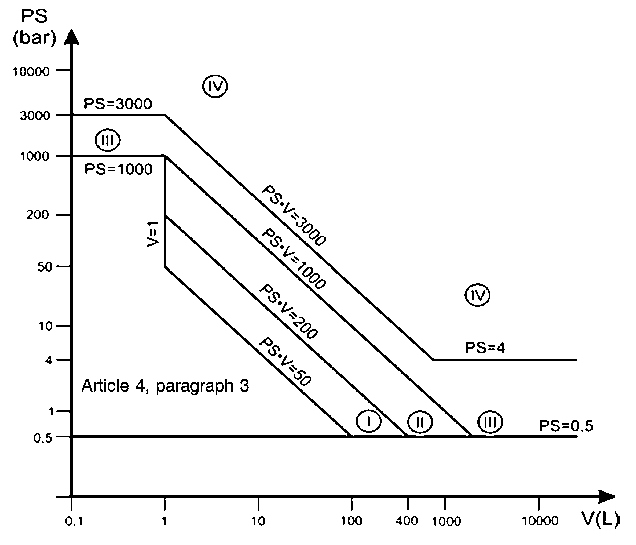
Table 2
Vessels referred to in Article 4(1)(a)(i), second indent
Exceptionally, portable extinguishers and bottles for breathing equipment shall be classified at least in category III.
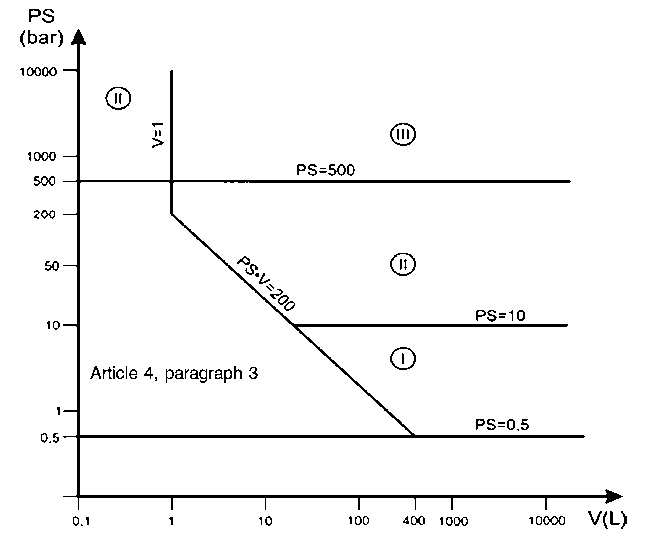
Table 3
Vessels referred to in Article 4(1)(a)(ii), first indent
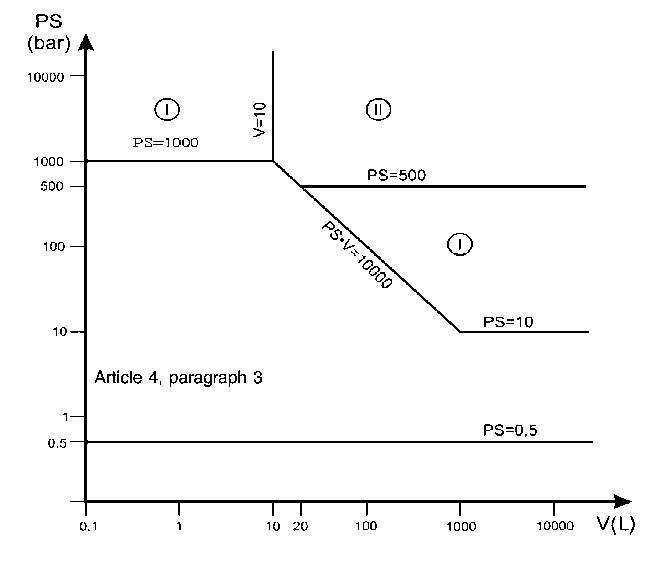
Vessels referred to in Article 4(1)(a)(ii), second indent
Exceptionally, assemblies intended for generating warm water as referred to in the second subparagraph of Article 4(2), shall be subject either to an EU-type examination (Module B - design type) with respect to their conformity with the essential requirements referred to in points 2.10, 2.11, 3.4, 5(a) and 5(d) of Annex I, or to full quality assurance (Module H).
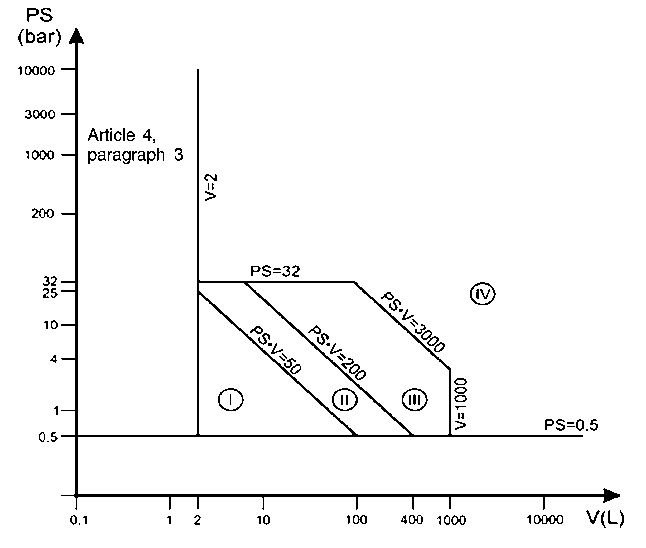
Table 5
Pressure equipment referred to in Article 4(1)(b)
Exceptionally, the design of pressure-cookers shall be subject to a conformity assessment procedure equivalent to at least one of the category III modules.
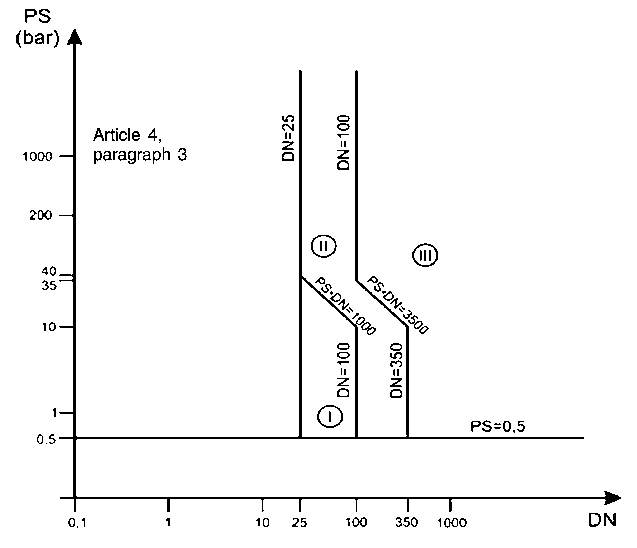
Table 6
Piping referred to in Article 4(1)(c)(i), first indent
Exceptionally, piping intended for unstable gases and falling within categories I or II on the basis of Table 6 shall be classified in category III.
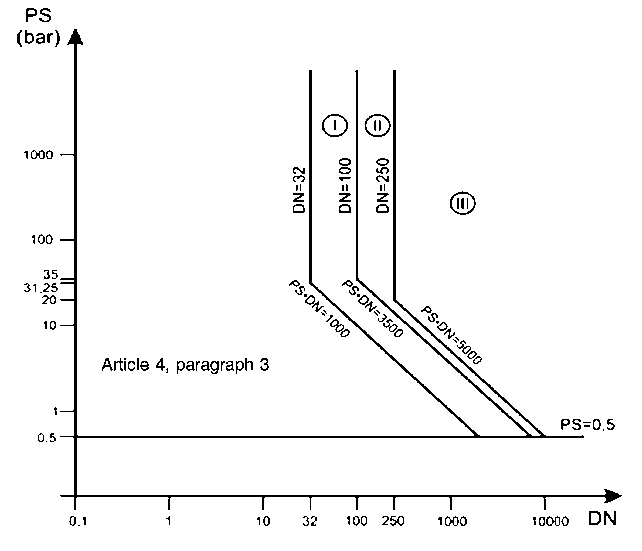
Table 7
Piping referred to in Article 4(1)(c)(i), second indent
Exceptionally, all piping containing fluids at a temperature greater than 350 °C and falling within category II on the basis of Table 7 shall be classified in category III.
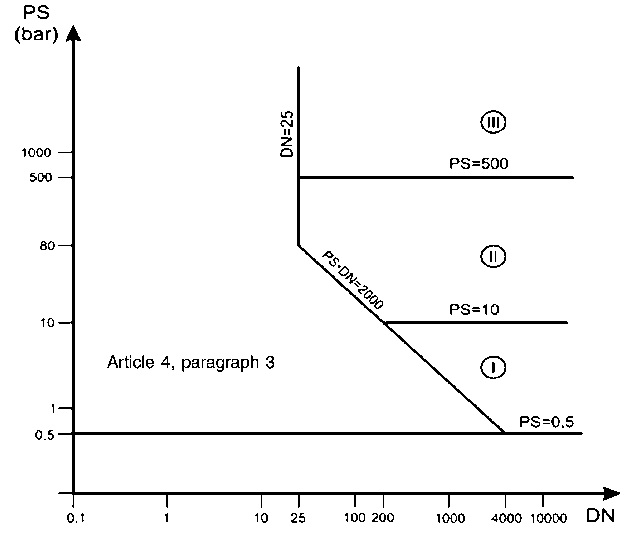
Table 8
Piping referred to in Article 4(1)(c)(ii), first indent
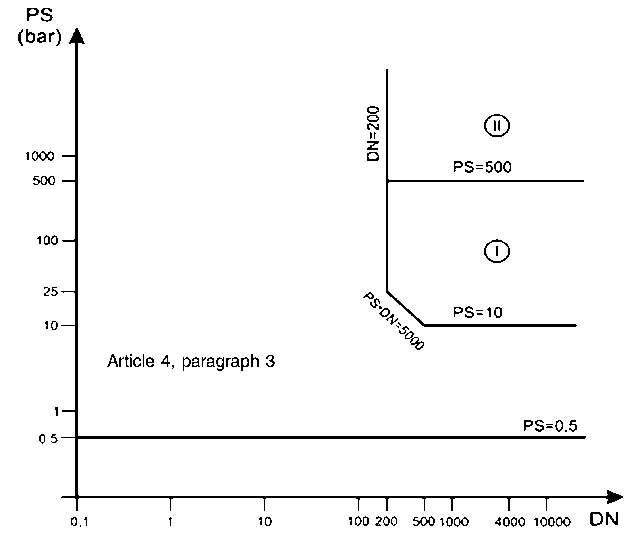
Table 9
Piping referred to in Article 4(1)(c)(ii), second indent
**CONFORMITY ASSESSMENT PROCEDURES**
The obligations arising from the provisions on pressure equipment in this Annex also apply to assemblies.
**1. MODULE A: (INTERNAL PRODUCTION CONTROL)**
1. Internal production control is the conformity assessment procedure whereby the manufacturer fulfils the obligations laid down in points 2, 3 and 4, and ensures and declares on his sole responsibility that the pressure equipment concerned satisfy the requirements of this Directive.
2. Technical documentation
The manufacturer shall establish the technical documentation.
The technical documentation shall make it possible to assess the conformity of the pressure equipment to the relevant requirements, and shall include an adequate analysis and assessment of the risk(s). The technical documentation shall specify the applicable requirements and cover, as far as relevant for the assessment, the design, manufacture and operation of the pressure equipment. The technical documentation shall, wherever applicable, contain at least the following elements:
- a general description of the pressure equipment,
- conceptual design and manufacturing drawings and diagrams of components, sub-assemblies, circuits, etc.,
- descriptions and explanations necessary for an understanding of those drawings and diagrams and the operation of the pressure equipment,
- a list of the harmonised standards the references of which have been published in the Official Journal of the European Union, applied in full or in part, and a description of the solutions adopted to meet the essential safety requirements of this Directive where those harmonised standards have not been applied. In the event of partly applied harmonised standards, the technical documentation shall specify the parts which have been applied,
- results of design calculations made, examinations carried out, etc.,
- test reports.
3. Manufacturing
The manufacturer shall take all measures necessary so that the manufacturing process and its monitoring ensure compliance of the manufactured pressure equipment with the technical documentation referred to in point 2 and with the requirements of this Directive.
4. CE marking and EU declaration of conformity
4.1. The manufacturer shall affix the CE marking to each individual pressure equipment that satisfies the applicable requirements of this Directive.
4.2. The manufacturer shall draw up a written EU declaration of conformity for the pressure equipment model and keep it together with the technical documentation at the disposal of the national authorities for 10 years after the pressure equipment has been placed on the market. The EU declaration of conformity shall identify the pressure equipment for which it has been drawn up.
A copy of the EU declaration of conformity shall be made available to the relevant authorities upon request.
5. Authorised representative
The manufacturer's obligations set out in point 4 may be fulfilled by his authorised representative, on his behalf and under his responsibility, provided that they are specified in the mandate.
**2. MODULE A2: INTERNAL PRODUCTION CONTROL PLUS SUPERVISED**
**PRESSURE EQUIPMENT CHECKS AT RANDOM INTERVALS**
1. Internal production control plus supervised pressure equipment checks at random intervals is the conformity assessment procedure whereby the manufacturer fulfils the obligations laid down in points 2, 3, 4 and 5, and ensures and declares on his sole responsibility that the pressure equipment concerned satisfy the requirements of this Directive.
2. Technical documentation
The manufacturer shall establish the technical documentation. The documentation shall make it possible to assess the conformity of the pressure equipment with the relevant requirements, and shall include an adequate analysis and assessment of the risk(s). The technical documentation shall specify the applicable requirements and cover, as far as relevant for the assessment, the design, manufacture and operation of the pressure equipment. The technical documentation shall contain, wherever applicable, at least the following elements:
- a general description of the pressure equipment,
- conceptual design and manufacturing drawings and diagrams of components, sub-assemblies, circuits, etc.,
- descriptions and explanations necessary for the understanding of those drawings and diagrams and the operation of the pressure equipment,
- a list of the harmonised standards the references of which have been published in the Official Journal of the European Union, applied in full or in part, and descriptions of the solutions adopted to meet the essential safety requirements of this Directive where those harmonised standards have not been applied. In the event of partly applied harmonised standards, the technical documentation shall specify the parts which have been applied,
- results of design calculations made, examinations carried out, etc., and
- test reports.
3. Manufacturing
The manufacturer shall take all measures necessary so that the manufacturing process and its monitoring ensure compliance of the manufactured pressure equipment with the technical documentation referred to in point 2 and with the requirements of this Directive that apply to it.
4. Final assessment and pressure equipment checks
The manufacturer shall perform a final assessment of the pressure equipment, monitored by means of unexpected visits by a notified body chosen by the manufacturer.
The notified body shall carry out product checks or have them carried out at random intervals determined by the body, in order to verify the quality of the internal checks of the pressure equipment, taking into account, inter alia, the technological complexity of the pressure equipment and the quantity of production.
During its unexpected visits, the notified body shall:
- establish that the manufacturer actually performs final assessment in accordance with point 3.2 of Annex I.
- take samples of pressure equipment at the manufacturing or storage premises in order to conduct checks. The notified body assesses the number of items of equipment to sample and whether it is necessary to perform, or have performed, all or part of the final assessment of the pressure equipment samples.
The acceptance sampling procedure to be applied is intended to determine whether the manufacturing process of the pressure equipment performs within acceptable limits, with a view to ensuring conformity of the pressure equipment.
Should one or more of the items of pressure equipment or assembly not conform, the notified body shall take appropriate measures.
The manufacturer shall, under the responsibility of the notified body, affix the notified body's identification number during the manufacturing process.
5. CE marking and EU declaration of conformity
5.1. The manufacturer shall affix the CE marking to each individual pressure equipment that satisfies the applicable requirements of this Directive.
5.2. The manufacturer shall draw up a written EU declaration of conformity for the pressure equipment model and keep it together with the technical documentation at the disposal of the national authorities for 10 years after the pressure equipment has been placed on the market. The EU declaration of conformity shall identify the pressure equipment for which it has been drawn up.
A copy of the EU declaration of conformity shall be made available to the relevant authorities upon request.
6. Authorised representative
The manufacturer's obligations set out in point 5 may be fulfilled by his authorised representative, on his behalf and under his responsibility, provided that they are specified in the mandate.
**3. MODULE B: EU-TYPE EXAMINATION**
1. EU-type examination - production type is the part of a conformity assessment procedure in which a notified body examines the technical design of the pressure equipment and verifies and attests that the technical design of the pressure equipment meets the requirements of this Directive.
2. EU-type examination - production type shall consist of an assessment of the adequacy of the technical design of the pressure equipment through examination of the technical documentation and supporting evidence referred to in point 3, plus examination of a specimen, representative of the production envisaged, of the complete pressure equipment.
3. The manufacturer shall lodge an application for EU-type examination with a single notified body of his choice.
The application shall include:
- the name and address of the manufacturer and, if the application is lodged by the authorised representative, his name and address as well,
- a written declaration that the same application has not been lodged with any other notified body,
- the technical documentation. The technical documentation shall make it possible to assess the conformity of the pressure equipment with the applicable requirements of this Directive and shall include an adequate analysis and assessment of the risk(s). The technical documentation shall specify the applicable requirements and cover, as far as relevant for the assessment, the design, manufacture and operation of the pressure equipment. The technical documentation shall contain, wherever applicable, at least the following elements:
- a general description of the pressure equipment,
- conceptual design and manufacturing drawings and diagrams of components, sub-assemblies, circuits, etc.,
- descriptions and explanations necessary for the understanding of those drawings and diagrams and the operation of the pressure equipment,
- a list of the harmonised standards the references of which have been published in the Official Journal of the European Union, applied in full or in part, and descriptions of the solutions adopted to meet the essential safety requirements of this Directive where those harmonised standards have not been applied. In the event of partly applied harmonised standards, the technical documentation shall specify the parts which have been applied,
- results of design calculations made, examinations carried out, etc.,
- test reports,
- information concerning the tests provided for in manufacture,
- information concerning the qualifications or approvals required under points 3.1.2 and 3.1.3 of Annex I,
- the specimens representative of the production envisaged.
The specimen may cover several versions of the pressure equipment provided that the differences between the versions do not affect the level of safety.
The notified body may request further specimens if needed for carrying out the test programme;
- the supporting evidence for the adequacy of the technical design solution. This supporting evidence shall mention any documents that have been used, in particular where the relevant harmonised standards have not been applied in full. The supporting evidence shall include, where necessary, the results of tests carried out by the appropriate laboratory of the manufacturer applying other relevant technical specifications, or by another testing laboratory on his behalf and under his responsibility.
4. The notified body shall:
4.1. examine the technical documentation and supporting evidence to assess the adequacy of the technical design of the pressure equipment and the manufacturing procedures.
In particular, the notified body shall:
- assess the materials where these are not in conformity with the relevant harmonised standards or with a European approval for pressure equipment materials, and check the certificate issued by the material manufacturer in accordance with point 4.3 of Annex I,
- approve the procedures for the permanent joining of pressure equipment parts, or check that they have been previously approved in accordance with point 3.1.2 of Annex I,
- verify that the personnel undertaking the permanent joining of pressure equipment parts and the non-destructive tests are qualified or approved in accordance with points 3.1.2 or 3.1.3 of Annex I.
4.2. verify that the specimen(s) have been manufactured in conformity with the technical documentation and identify the elements which have been designed in accordance with the applicable provisions of the relevant harmonised standards as well as the elements which have been designed using other relevant technical specifications without applying the relevant provisions of those standards.
4.3. carry out appropriate examinations and necessary tests to check whether when the manufacturer has chosen to apply the solutions in the relevant harmonised standards, these have been applied correctly.
4.4. carry out appropriate examinations and necessary tests to check whether, where the solutions in the relevant harmonised standards have not been applied, the solutions adopted by the manufacturer applying other relevant technical specifications meet the corresponding essential safety requirements of this Directive.
4.5. agree with the manufacturer on a location where the examinations and tests will be carried out.
5. The notified body shall draw up an evaluation report that records the activities undertaken in accordance with point 4 and their outcomes. Without prejudice to its obligations vis - à - vis the notifying authority, the notified body shall release the content of that report, in full or in part, only with the agreement of the manufacturer.
6. Where the type meets the requirements of this Directive, the notified body shall issue an EU-type examination certificate - production type to the manufacturer. Without prejudice to point 7, the certificate shall be valid for 10 years and be renewable and shall contain the name and address of the manufacturer, the conclusions of the examination, the conditions (if any) for its validity and the necessary data for identification of the approved type.
A list of the relevant parts of the technical documentation shall be annexed to the certificate and a copy kept by the notified body.
The certificate and its annexes shall contain all relevant information to allow the conformity of manufactured pressure equipment with the examined type to be evaluated and to allow for in-service control.
Where the type does not satisfy the applicable requirements of this Directive, the notified body shall refuse to issue an EU-type examination certificate - production type and shall inform the applicant accordingly, giving detailed reasons for its refusal. Provision shall be made for an appeals procedure.
7. The notified body shall keep itself apprised of any changes in the generally acknowledged state of the art which indicate that the approved type may no longer comply with the applicable requirements of this Directive, and shall determine whether such changes require further investigation. If so, the notified body shall inform the manufacturer accordingly.
The manufacturer shall inform the notified body that holds the technical documentation relating to the EU-type examination certificate - production type of all modifications to the approved type that may affect the conformity of the pressure equipment with the essential safety requirements of this Directive or the conditions for validity of the certificate. Such modifications shall require additional approval in the form of an addition to the original EU- type examination certificate - production type.
8. Each notified body shall inform its notifying authority concerning the EU-type examination certificates - production type and/or any additions thereto which it has issued or withdrawn, and shall, periodically or upon request, make available to its notifying authorities the list of certificates and/or any additions thereto refused, suspended or otherwise restricted.
Each notified body shall inform the other notified bodies concerning the EU-type examination certificates - production type and/or any additions thereto which it has refused, withdrawn, suspended or otherwise restricted, and, upon request, concerning the certificates and/or additions thereto which it has issued.
The Commission, the Member States and the other notified bodies may, on request, obtain a copy of the EU-type examination certificates - production type and/or additions thereto. On request, the Commission and the Member States may obtain a copy of the technical documentation and the results of the examinations carried out by the notified body. The notified body shall keep a copy of the EU-type examination certificate - production type, its annexes and additions, as well as the technical file including the documentation submitted by the manufacturer, until the expiry of the validity of the certificate.
9. The manufacturer shall keep a copy of the EU-type examination certificate - production type, its annexes and additions together with the technical documentation at the disposal of the national authorities for 10 years after the pressure equipment has been placed on the market.
10. The manufacturer's authorised representative may lodge the application referred to in point 3 and fulfil the obligations set out in points 7 and 9, provided that they are specified in the mandate.
1. EU-type examination - design type is the part of a conformity assessment procedure in which a notified body examines the technical design of the pressure equipment and verifies and attests that the technical design of the pressure equipment meets the requirements of this Directive.
2. The EU-type examination - design type shall consist of an assessment of the adequacy of the technical design of the pressure equipment through examination of the technical documentation and supporting evidence referred to in point 3, without examination of a specimen.
The experimental design method provided for in point 2.2.4 of Annex I shall not be used in the context of this module.
3. The manufacturer shall lodge an application for EU-type examination - design type with a single notified body of his choice.
The application shall include:
- the name and address of the manufacturer and, if the application is lodged by the authorised representative, his name and address as well,
- a written declaration that the same application has not been lodged with any other notified body,
- the technical documentation. The technical documentation shall make it possible to assess the conformity of the pressure equipment with the applicable requirements of the Directive and shall include an adequate analysis and assessment of the risk(s). The technical documentation shall specify the applicable requirements and cover, as far as relevant for the assessment, the design, manufacture and operation of the pressure equipment. The technical documentation shall contain, wherever applicable, at least the following elements:
- a general description of the pressure equipment,
- conceptual design and manufacturing drawings and diagrams of components, sub-assemblies, circuits, etc.,
- descriptions and explanations necessary for the understanding of those drawings and diagrams and the operation of the pressure equipment,
- a list of the harmonised standards the references of which have been published in the Official Journal of the European Union, applied in full or in part, and descriptions of the solutions adopted to meet the essential safety requirements of this Directive where those harmonised standards have not been applied. In the event of partly applied harmonised standards, the technical documentation shall specify the parts which have been applied,
- results of design calculations made, examinations carried out, etc.,
- information regarding the qualifications or approvals required under points 3.1.2 and 3.1.3 of Annex I,
- the supporting evidence for the adequacy of the technical design solution. This supporting evidence shall mention any documents that have been used, in particular where the relevant harmonised standards have not been applied in full. This supporting evidence shall include, where necessary, the results of tests carried out by the appropriate laboratory of the manufacturer or by another testing laboratory on his behalf and under his responsibility.
The application may cover several versions of the pressure equipment provided that the differences between the versions do not affect the level of safety.
4. The notified body shall:
4.1. examine the technical documentation and supporting evidence to assess the adequacy of the technical design of the product.
In particular, the notified body shall:
- assess the materials where these are not in conformity with the relevant harmonised standards or with a European approval for pressure equipment materials,
- approve the procedures for the permanent joining of pressure equipment parts, or check that they have been previously approved in accordance with point 3.1.2 of Annex I.
4.2. carry out appropriate examinations to check whether where the manufacturer has chosen to apply the solutions in the relevant harmonised standards these have been applied correctly.
4.3. carry out appropriate examinations to check whether, where the solutions in the relevant harmonised standards have not been applied, the solutions adopted by the manufacturer meet the corresponding essential safety requirements of this Directive.
5. The notified body shall draw up an evaluation report that records the activities undertaken in accordance with point 4 and their outcomes. Without prejudice to its obligations vis - à - vis the notifying authorities, the notified body shall release the content of that report, in full or in part, only with the agreement of the manufacturer.
6. Where the design meets the requirements of this Directive, the notified body shall issue an EU-type examination certificate - design type to the manufacturer. Without prejudice to point 7, the certificate shall be valid for 10 years and be renewable and shall contain the name and address of the manufacturer, the conclusions of the examination, the conditions (if any) for its validity and the necessary data for identification of the approved design.
A list of the relevant parts of the technical documentation shall be annexed to the certificate and a copy kept by the notified body.
The certificate and its annexes shall contain all relevant information to allow the conformity of manufactured pressure equipment with the examined design to be evaluated and to allow for in-service control.
Where the design does not satisfy the applicable requirements of this Directive, the notified body shall refuse to issue an EU-type examination certificate - design type and shall inform the applicant accordingly, giving detailed reasons for its refusal.
7. The notified body shall keep itself apprised of any changes in the generally acknowledged state of the art which indicate that the approved design may no longer comply with the applicable requirements of this Directive, and shall determine whether such changes require further investigation. If so, the notified body shall inform the manufacturer accordingly.
The manufacturer shall inform the notified body that holds the technical documentation relating to the EU-type examination certificate - design type of all modifications to the approved design that may affect the conformity of the pressure equipment with the essential safety requirements of this Directive or the conditions for validity of the certificate. Such modifications shall require additional approval in the form of an addition to the original EU-type examination certificate - design type.
8. Each notified body shall inform its notifying authorities concerning the EU-type examination certificates - design type and/or any additions thereto which it has issued or withdrawn, and shall, periodically or upon request, make available to its notifying authorities the list of certificates and/or any additions thereto refused, suspended or otherwise restricted.
Each notified body shall inform the other notified bodies concerning the EU-type examination certificates - design type and/or any additions thereto which it has refused, withdrawn, suspended or otherwise restricted, and, upon request, concerning the certificates and/or additions thereto which it has issued.
The Commission, the Member States and the other notified bodies may, on request, obtain a copy of the EU-type examination certificates - design type and/or additions thereto. On request, the Commission and the Member States may obtain a copy of the technical documentation and the results of the examinations carried out by the notified body. The notified body shall keep a copy of the EU-type examination certificate - design type, its annexes and additions, as well as the technical file including the documentation submitted by the manufacturer, until the expiry of the validity of the certificate.
9. The manufacturer shall keep a copy of the EU-type examination certificate - design type, its annexes and additions together with the technical documentation at the disposal of the national authorities for 10 years after the pressure equipment has been placed on the market.
10. The manufacturer's authorised representative may lodge the application referred to in point 3 and fulfil the obligations set out in points 7 and 9, provided that they are specified in the mandate.
**4. MODULE C2: CONFORMITY TO TYPE BASED ON INTERNAL**
**PRODUCTION CONTROL PLUS SUPERVISED PRESSURE**
**EQUIPMENT CHECKS AT RANDOM INTERVALS**
1. Conformity to type based on internal production control plus supervised pressure equipment checks at random intervals is the part of a conformity assessment procedure whereby the manufacturer fulfils the obligations laid down in points 2, 3 and 4, and ensures and declares on his sole responsibility that the pressure equipment concerned is in conformity with the type described in the EU-type examination certificate and satisfy the requirements of this Directive that apply to it.
2. Manufacturing
The manufacturer shall take all measures necessary so that the manufacturing process and its monitoring ensure conformity of the manufactured pressure equipment with the type described in the EU-type examination certificate and with the requirements of this Directive that apply to them.
3. Final assessment and pressure equipment checks
A notified body, chosen by the manufacturer, shall carry out checks or have them carried out at random intervals determined by the body, in order to verify the quality of the final assessment and of the internal checks on the pressure equipment, taking into account, inter alia, the technological complexity of the pressure equipment and the quantity of production.
The notified body shall establish that the manufacturer actually performs final assessment in accordance with point 3.2 of Annex I.
An adequate sample of the final pressure equipment, taken on site by the notified body before the placing on the market, shall be examined and appropriate tests as identified by the relevant parts of the harmonised standards, and/or equivalent tests applying other technical specifications, shall be carried out to check the conformity of the pressure equipment with the relevant requirements of this Directive.
The notified body shall assess the number of items of equipment to sample and whether it is necessary to perform, or have performed, all or part of final assessment on the pressure equipment samples.
Where a sample does not conform to the acceptable quality level, the body shall take appropriate measures.
The acceptance sampling procedure to be applied is intended to determine whether the manufacturing process of the pressure equipment performs within acceptable limits, with a view to ensuring conformity of the pressure equipment.
Where the tests are carried out by a notified body, the manufacturer shall, under the responsibility of the notified body, affix the notified body's identification number during the manufacturing process.
4. CE marking and EU declaration of conformity
4.1. The manufacturer shall affix the CE marking to each individual pressure equipment or assembly that is in conformity with the type described in the EU-type examination certificate and satisfies the applicable requirements of this Directive.
4.2. The manufacturer shall draw up a written EU declaration of conformity for a pressure equipment model and keep it at the disposal of the national authorities for 10 years after the pressure equipment has been placed on the market. The EU declaration of conformity shall identify the pressure equipment model for which it has been drawn up.
A copy of the EU declaration of conformity shall be made available to the relevant authorities upon request.
5. Authorised representative
The manufacturer's obligations set out in point 4 may be fulfilled by his authorised representative, on his behalf and under his responsibility, provided that they are specified in the mandate.
**5. MODULE D: CONFORMITY TO TYPE BASED ON QUALITY**
**ASSURANCE OF THE PRODUCTION PROCESS**
1. Conformity to type based on quality assurance of the production process is that part of a conformity assessment procedure whereby the manufacturer fulfils the obligations laid down in points 2 and 5, and ensures and declares on his sole responsibility that the pressure equipment or assembly concerned is in conformity with the type described in the EU-type examination certificate and satisfies the requirements of this Directive that apply to it.
2. Manufacturing
The manufacturer shall operate an approved quality system for production, final product inspection and testing of the pressure equipment concerned as specified in point 3 and shall be subject to surveillance as specified in point 4.
3. Quality system
3.1. The manufacturer shall lodge an application for assessment of his quality system with the notified body of his choice for the pressure equipment concerned.
The application shall include:
- the name and address of the manufacturer and, if the application is lodged by the authorised representative, his name and address as well,
- a written declaration that the same application has not been lodged with any other notified body,
- all relevant information on the pressure equipment type envisaged,
- the documentation concerning the quality system,
- the technical documentation of the approved type and a copy of the EU-type examination certificate.
3.2. The quality system shall ensure that the pressure equipment is in conformity with the type described in the EU-type examination certificate and comply with the requirements of this Directive that apply to it.
All the elements, requirements and provisions adopted by the manufacturer shall be documented in a systematic and orderly manner in the form of written policies, procedures and instructions. This quality system documentation shall permit a consistent interpretation of the quality programmes, plans, manuals and records.
It shall, in particular, contain an adequate description of:
- the quality objectives and the organisational structure, responsibilities and powers of the management with regard to the quality of the pressure equipment,
- the corresponding manufacturing, quality control and quality assurance techniques, processes and systematic actions that will be used, particularly the procedures used for the permanent joining of parts as approved in accordance with point 3.1.2 of Annex I,
- the examinations and tests that will be carried out before, during and after manufacture, and the frequency with which they will be carried out,
- the quality records, such as inspection reports and test data, calibration data, reports concerning the qualifications or approvals of the personnel concerned, particularly those of the personnel undertaking the permanent joining of parts and the non-destructive tests in accordance with points 3.1.2 and 3.1.3 of Annex I, etc., and
- the means of monitoring the achievement of the required quality and the effective operation of the quality system.
3.3. The notified body shall assess the quality system to determine whether it satisfies the requirements referred to in point 3.2.
It shall presume conformity with those requirements in respect of the elements of the quality system that comply with the corresponding specifications of the relevant harmonised standard.
In addition to experience in quality management systems, the auditing team shall have at least one member with experience of evaluation in the relevant pressure equipment field and pressure equipment technology concerned, and knowledge of the applicable requirements of this Directive. The audit shall include an inspection visit to the manufacturer's premises.
The auditing team shall review the technical documentation referred to in point 3.1, fifth indent, to verify the manufacturer's ability to identify the relevant requirements of this Directive and to carry out the necessary examinations with a view to ensuring compliance of the product with those requirements.
The decision shall be notified to the manufacturer. The notification shall contain the conclusions of the audit and the reasoned assessment decision.
3.4. The manufacturer shall undertake to fulfil the obligations arising out of the quality system as approved and to maintain it so that it remains adequate and efficient.
3.5. The manufacturer shall keep the notified body that has approved the quality system informed of any intended change to the quality system.
The notified body shall evaluate the proposed changes and decide whether the modified quality system will continue to satisfy the requirements referred to in point 3.2 or whether a reassessment is necessary.
It shall notify the manufacturer of its decision. The notification shall contain the conclusions of the examination and the reasoned assessment decision.
4. Surveillance under the responsibility of the notified body
4.1. The purpose of surveillance is to make sure that the manufacturer duly fulfils the obligations arising out of the approved quality system.
4.2. The manufacturer shall, for assessment purposes, allow the notified body access to the manufacture, inspection, testing and storage sites and shall provide it with all necessary information, in particular:
- the quality system documentation,
- the quality records, such as inspection reports and test data, calibration data, qualification reports of the personnel concerned, etc.
4.3. The notified body shall carry out periodic audits to make sure that the manufacturer maintains and applies the quality system and provide the manufacturer with an audit report. The frequency of periodic audits shall be such that a full reassessment is carried out every three years.
4.4. In addition the notified body may pay unexpected visits to the manufacturer. The need for such additional visits, and the frequency thereof, will be determined on the basis of a visit control system operated by the notified body. In particular, the following factors shall be considered in the visit control system:
- the category of the pressure equipment,
- the results of previous surveillance visits,
- the need to follow up corrective actions,
- special conditions linked to the approval of the system, where applicable,
- significant changes in manufacturing organisation, policy or techniques.
During such visits the notified body may, if necessary, carry out product tests or have them carried out in order to verify that the quality system is functioning correctly. The notified body shall provide the manufacturer with a visit report and, if tests have been carried out, with a test report.
5. CE marking and EU declaration of conformity
5.1. The manufacturer shall affix the CE marking and, under the responsibility of the notified body referred to in point 3.1, the latter's identification number to each individual pressure equipment that is in conformity with the type described in the EU-type examination certificate and satisfies the applicable requirements of this Directive.
5.2. The manufacturer shall draw up a written EU declaration of conformity for each pressure equipment model and keep it at the disposal of the national authorities for 10 years after the pressure equipment has been placed on the market. The EU declaration of conformity shall identify the pressure equipment model for which it has been drawn up.
A copy of the EU declaration of conformity shall be made available to the relevant authorities upon request.
6. The manufacturer shall, for a period ending 10 years after the pressure equipment has been placed on the market, keep at the disposal of the national authorities:
- the documentation referred to point 3.1,
- the change referred to in point 3.5, as approved,
- the decisions and reports of the notified body referred to in points 3.3, 3.5, 4.3 and 4.4.
7. Each notified body shall inform its notifying authorities of the quality system approvals issued or withdrawn, and shall, periodically or upon request, make available to its notifying authorities the list of quality system approvals refused, suspended or otherwise restricted.
Each notified body shall inform the other notified bodies of the quality system approvals which it has refused, suspended, withdrawn or otherwise restricted, and, upon request, of quality system approvals which it has issued.
8. Authorised representative
The manufacturer's obligations set out in points 3.1, 3.5, 5 and 6 may be fulfilled by his authorised representative, on his behalf and under his responsibility, provided that they are specified in the mandate.
**6. MODULE D1: QUALITY ASSURANCE OF THE PRODUCTION PROCESS**
1. Quality assurance of the production process is the conformity assessment procedure whereby the manufacturer fulfils the obligations laid down in points 2, 4 and 7, and ensures and declares on his sole responsibility that the pressure equipment concerned satisfy the requirements of this Directive that apply to it.
2. Technical documentation
The manufacturer shall establish the technical documentation. The documentation shall make it possible to assess the conformity of the pressure equipment with the relevant requirements and shall include an adequate analysis and assessment of the risk(s). The technical documentation shall specify the applicable requirements and cover, as far as relevant for the assessment, the design, manufacture and operation of the product. The technical documentation shall, wherever applicable, contain at least the following elements:
- a general description of the pressure equipment,
- conceptual design and manufacturing drawings and diagrams of components, sub-assemblies, circuits, etc.,
- descriptions and explanations necessary for an understanding of those drawings and diagrams and the operation of the pressure equipment,
- a list of the harmonised standards the references of which have been published in the Official Journal of the European Union, applied in full or in part, and descriptions of the solutions adopted to meet the essential safety requirements of this Directive where those harmonised standards have not been applied. In the event of partly applied harmonised standards, the technical documentation shall specify the parts which have been applied,
- results of design calculations made, examinations carried out, etc., and
- test reports.
3. The manufacturer shall keep the technical documentation at the disposal of the relevant national authorities for 10 years after the pressure equipment has been placed on the market.
4. Manufacturing
The manufacturer shall operate an approved quality system for production, final product inspection and testing of the pressure equipment concerned as specified in point 5, and shall be subject to surveillance as specified in point 6.
5. Quality system
5.1. The manufacturer shall lodge an application for assessment of his quality system with the notified body of his choice for the pressure equipment concerned.
The application shall include:
- the name and address of the manufacturer and, if the application is lodged by the authorised representative, his name and address as well,
- a written declaration that the same application has not been lodged with any other notified body,
- all relevant information on the pressure equipment type envisaged,
- the documentation concerning the quality system,
- the technical documentation referred to in point 2.
5.2. The quality system shall ensure compliance of the pressure equipment with the requirements of this Directive that apply to it.
All the elements, requirements and provisions adopted by the manufacturer shall be documented in a systematic and orderly manner in the form of written policies, procedures and instructions. This quality system documentation shall permit a consistent interpretation of the quality programmes, plans, manuals and records.
It shall, in particular, contain an adequate description of:
- the quality objectives and the organisational structure, responsibilities and powers of the management with regard to the quality of the pressure equipment,
- the corresponding manufacturing, quality control and quality assurance techniques, processes and systematic measures that will be used, particularly the procedures used for the permanent joining of parts as approved in accordance with point 3.1.2 of Annex I,
- the examinations and tests that will be carried out before, during and after manufacture, and the frequency with which they will be carried out,
- the quality records, such as inspection reports and test data, calibration data, reports concerning the qualifications or approvals of the personnel concerned, particularly those of the personnel undertaking the permanent joining of parts in accordance with point 3.1.2 of Annex I, etc.,
- the means of monitoring the achievement of the required product quality and the effective operation of the quality system.
5.3. The notified body shall assess the quality system to determine whether it satisfies the requirements referred to in point 5.2. The elements of the quality system which conform to the relevant harmonised standard are presumed to comply with the corresponding requirements referred to in point 5.2.
In addition to experience in quality management systems, the auditing team shall have at least one member with experience of evaluation in the pressure equipment technology concerned, and the knowledge of the applicable requirements of this Directive. The audit shall include an assessment visit to the manufacturer's premises.
The auditing team shall review the technical documentation referred to in point 2 in order to verify the manufacturer's ability to identify the relevant requirements of this Directive and to carry out the necessary examinations with a view to ensuring compliance of the pressure equipment with those requirements.
The decision shall be notified to the manufacturer. The notification shall contain the conclusions of the audit and the reasoned assessment decision.
5.4. The manufacturer shall undertake to fulfil the obligations arising out of the quality system as approved and to maintain it so that it remains adequate and efficient.
5.5. The manufacturer shall keep the notified body that has approved the quality system informed of any intended change to the quality system.
The notified body shall evaluate any proposed changes and decide whether the modified quality system will continue to satisfy the requirements referred to in point 5.2 or whether a reassessment is necessary.
It shall notify the manufacturer of its decision. The notification shall contain the conclusions of the examination and the reasoned assessment decision.
6. Surveillance under the responsibility of the notified body
6.1. The purpose of surveillance is to make sure that the manufacturer duly fulfils the obligations arising out of the approved quality system.
6.2. The manufacturer shall, for assessment purposes, allow the notified body access to the manufacture, inspection, testing and storage sites and shall provide it with all necessary information, in particular:
- the quality system documentation,
- the technical documentation referred to in point 2,
- the quality records, such as inspection reports and test data, calibration data, qualification reports of the personnel concerned, etc.
6.3. The notified body shall carry out periodic audits to make sure that the manufacturer maintains and applies the quality system and provide the manufacturer with an audit report. The frequency of periodic audits shall be such that a full reassessment is carried out every three years.
6.4. In addition the notified body may pay unexpected visits to the manufacturer. The need for such additional visits, and the frequency thereof, will be determined on the basis of a visit control system operated by the notified body. In particular, the following factors shall be considered in the visit control system:
- the category of the pressure equipment,
- the results of previous surveillance visits,
- the need to follow up corrective action(s),
- special conditions linked to the approval of the system, where applicable,
- significant changes in manufacturing organisation, policy or techniques.
During such visits the notified body may, if necessary, carry out product tests, or have them carried out, in order to verify that the quality system is functioning correctly. The notified body shall provide the manufacturer with a visit report and, if tests have been carried out, with a test report.
7. CE marking and EU declaration of conformity
7.1. The manufacturer shall affix the CE marking and, under the responsibility of the notified body referred to in point 5.1, the latter's identification number to each individual pressure equipment that satisfies the applicable requirements of this Directive.
7.2. The manufacturer shall draw up a written EU declaration of conformity for each pressure equipment model and keep it at the disposal of the national authorities for 10 years after the pressure equipment has been placed on the market. The EU declaration of conformity shall identify the product model for which it has been drawn up.
A copy of the EU declaration of conformity shall be made available to the relevant authorities upon request.
8. The manufacturer shall, for a period ending 10 years after the pressure equipment has been placed on the market, keep at the disposal of the national authorities:
- the documentation referred to in point 5.1,
- the change referred to in point 5.5,
- the decisions and reports of the notified body referred to in points 5.5, 6.3 and 6.4.
9. Each notified body shall inform its notifying authorities of the quality system approvals issued or withdrawn, and shall periodically, or upon request, make available to its notifying authorities the list of quality system approvals refused, suspended or otherwise restricted.
Each notified body shall inform the other notified bodies of quality system approvals which it has refused, suspended, or withdrawn, and upon request, of quality system approvals which it has issued.
10. Authorised representative
The manufacturer's obligations set out in points 3, 5.1, 5.5, 7 and 8 may be fulfilled by his authorised representative, on his behalf and under his responsibility, provided that they are specified in the mandate.
**7. MODULE E: CONFORMITY TO TYPE BASED ON PRESSURE**
**EQUIPMENT QUALITY ASSURANCE**
1.
Conformity to type based on pressure equipment quality assurance is that part of a conformity assessment procedure whereby the manufacturer fulfils the obligations laid down in points 2 and 5, and ensures and declares on his sole responsibility that the pressure equipment concerned is in conformity with the type described in the EU-type examination certificate and satisfies the requirements of this Directive that apply to it.
2. Manufacturing
The manufacturer shall operate an approved quality system for the final product inspection and testing of the pressure equipment concerned as specified in point 3 and shall be subject to surveillance as specified in point 4.
3. Quality system
3.1. The manufacturer shall lodge an application for assessment of his quality system with the notified body of his choice, for the pressure equipment concerned.
The application shall include:
- the name and address of the manufacturer and, if the application is lodged by the authorised representative, his name and address as well,
- a written declaration that the same application has not been lodged with any other notified body,
- all relevant information on the pressure equipment type envisaged,
- the documentation concerning the quality system,
- the technical documentation of the approved type and a copy of the EU-type examination certificate.
3.2. The quality system shall ensure compliance of the products with the type described in the EU-type examination certificate and with the applicable requirements of this Directive.
All the elements, requirements and provisions adopted by the manufacturer shall be documented in a systematic and orderly manner in the form of written policies, procedures and instructions. This quality system documentation shall permit a consistent interpretation of the quality programmes, plans, manuals and records.
It shall, in particular, contain an adequate description of:
- the quality objectives and the organisational structure, responsibilities and powers of the management with regard to product quality,
- the examinations and tests that will be carried out after manufacture,
- the quality records, such as inspection reports and test data, calibration data, reports concerning the qualifications or approvals of the personnel concerned, particularly those of the personnel undertaking the permanent joining of parts and the non-destructive tests in accordance with points 3.1.2 and 3.1.3 of Annex I,
- the means of monitoring the effective operation of the quality system.
3.3. The notified body shall assess the quality system to determine whether it satisfies the requirements referred to in point 3.2. It shall presume conformity with those requirements in respect of the elements of the quality system that comply with the corresponding specifications of the relevant harmonised standard.
In addition to experience in quality management systems, the auditing team shall have at least one member with experience of evaluation in the relevant pressure equipment field and pressure equipment technology concerned and knowledge of the applicable requirements of this Directive. The audit shall include an assessment visit to the manufacturer's premises.
The auditing team shall review the technical documentation referred to in point 3.1, fifth indent, in order to verify the manufacturer's ability to identify the relevant requirements of this Directive and to carry out the necessary examinations with a view to ensuring compliance of the pressure equipment with those requirements.
The decision shall be notified to the manufacturer. The notification shall contain the conclusions of the audit and the reasoned assessment decision.
3.4. The manufacturer shall undertake to fulfil the obligations arising out of the quality system as approved and to maintain it so that it remains adequate and efficient.
3.5. The manufacturer shall keep the notified body that has approved the quality system informed of any intended change to the quality system.
The notified body shall evaluate any proposed changes and decide whether the modified quality system will continue to satisfy the requirements referred to in point 3.2 or whether a reassessment is necessary.
It shall notify the manufacturer of its decision. The notification shall contain the conclusions of the examination and the reasoned assessment decision.
4. Surveillance under the responsibility of the notified body
4.1. The purpose of surveillance is to make sure that the manufacturer duly fulfils the obligations arising out of the approved quality system.
4.2. The manufacturer shall, for assessment purposes, allow the notified body access to the manufacture, inspection, testing and storage sites and shall provide it with all necessary information, in particular:
- the quality system documentation,
- the technical documentation,
- the quality records, such as inspection reports and test data, calibration data, reports concerning the qualifications of the personnel concerned, etc.
4.3. The notified body shall carry out periodic audits to make sure that the manufacturer maintains and applies the quality system and provide the manufacturer with an audit report. The frequency of periodic audits must be such that a full reassessment is carried out every three years.
4.4. In addition the notified body may pay unexpected visits to the manufacturer.
The need for such additional visits, and the frequency thereof, will be determined on the basis of a visit control system operated by the notified body. In particular, the following factors shall be considered in the visit control system:
- the category of the pressure equipment,
- the results of previous surveillance visits,
- the need to follow up corrective actions,
- special conditions linked to the approval of the system, where applicable,
- significant changes in manufacturing organisation, policy or techniques.
During such visits, the notified body may, if necessary, carry out product tests, or have them carried out, in order to verify that the quality system is functioning correctly. The notified body shall provide the manufacturer with a visit report and, if tests have been carried out, with a test report.
5. CE marking and EU declaration of conformity
5.1. The manufacturer shall affix the CE marking and, under the responsibility of the notified body referred to in point 3.1, the latter's identification number to each individual pressure equipment that is in conformity with the type described in the EU-type examination certificate and satisfies the applicable requirements of this Directive.
5.2. The manufacturer shall draw up a written EU declaration of conformity for each pressure equipment model and keep it at the disposal of the national authorities for 10 years after the pressure equipment has been placed on the market. The EU declaration of conformity shall identify the product model for which it has been drawn up.
A copy of the EU declaration of conformity shall be made available to the relevant authorities upon request.
6. The manufacturer shall, for a period ending 10 years after the pressure equipment has been placed on the market, keep at the disposal of the national authorities:
- the documentation referred to in point 3.1,
- the change referred to in point 3.5, as approved,
- the decisions and reports from the notified body which are referred to in points 3.3, 3.5, 4.3 and 4.4.
7. Each notified body shall inform its notifying authorities of quality system approvals issued or withdrawn and shall, periodically or upon request, make available to its notifying authorities the list of quality system approvals refused, suspended or otherwise restricted.
Each notified body shall inform the other notified bodies of quality system approvals which it has refused, suspended or withdrawn, and, upon request, of quality system approvals which it has issued.
8. Authorised representative
The manufacturer's obligations set out in points 3.1, 3.5, 5 and 6 may be fulfilled by his authorised representative, on his behalf and under his responsibility, provided that they are specified in the mandate.
**8. MODULE E1: QUALITY ASSURANCE OF FINAL PRESSURE**
**EQUIPMENT INSPECTION AND TESTING**
1.
Quality assurance of final pressure equipment inspection and testing is the conformity assessment procedure whereby the manufacturer fulfils the obligations laid down in points 2, 4 and 7, and ensures and declares on his sole responsibility that the pressure equipment concerned satisfy the requirements of this Directive that apply to it.
2.
Technical documentation
The manufacturer shall establish the technical documentation. The technical documentation shall make it possible to assess the conformity of the pressure equipment with the relevant requirements, and shall include an adequate analysis and assessment of the risk(s). The technical documentation shall specify the applicable requirements and cover, as far as relevant for the assessment, the design, manufacture and operation of the pressure equipment. The technical documentation shall, wherever applicable, contain at least the following elements:
-
a general description of the pressure equipment,
4.
Verification of conformity by examination and testing of every item of pressure equipment
4.1. All pressure equipment shall be individually examined and appropriate tests set out in the relevant harmonised standard(s) or equivalent tests shall be carried out in order to verify conformity with the approved type and described in the EU-type examination certificate and with the appropriate requirements of this Directive. In the absence of such a harmonised standard, the notified body concerned shall decide on the appropriate tests to be carried out.
In particular, the notified body shall:
-
verify that the personnel undertaking the permanent joining of parts and the non-destructive tests are qualified or approved in accordance with points 3.1.2 and 3.1.3 of Annex I,
-
results of design calculations made, examinations carried out, etc.,
-
test reports,
-
appropriate details relating to the approval of the manufacturing and test procedures and of the qualifications or approvals of the personnel concerned in accordance with points 3.1.2 and 3.1.3 of Annex I.
-
a list of the harmonised standards the references of which have been published in the Official Journal of the European Union, applied in full or in part, and descriptions of the solutions adopted to meet the essential safety requirements of this Directive where those harmonised standards have not been applied. In the event of partly applied harmonised standards, the technical documentation shall specify the parts which have been applied,
-
results of design calculations made, examinations carried out, etc.,
-
test reports,
-
results of design calculations made, examinations carried out, etc.,
-
test reports,
-
the documentation concerning the quality system,
Repealed Directive with list
of the successive amendments thereto
(referred to in Article 50)
| Directive 97/23/EC of the European Parliament and of the Council
(OJ L 181, 9.7.1997, p. 1). | | |
| --- | --- | --- |
| Regulation (EC) No 1882/2003 of the European Parliament and of the Council
(OJ L 284, 31.10.2003, p. 1). | | Only point 13 of Annex I |
| Regulation (EU) No 1025/2012 of the European Parliament and of the Council
(OJ L 316, 14.11.2012, p. 12). | | Only point (f) of Article 26(1) |
Part B
Time-limit for transposition into
national law and date of application
(referred to in Article 49)
| Directive | Time-limit for transposition | Date of application |
| 97/23/EC | 29 May 1999 | 29 November 1999 <*> |
| <*> In accordance with Article 20(3) of Directive 97/23/EC, Member States shall permit the putting into service of pressure equipment and assemblies which comply with the regulations in force in their territory at the date of application of the Directive beyond that date. |
Annex VI
**CORRELATION TABLE**
| Directive 97/23/EC | This Directive |
| --- | --- |
| Article 1(1) | Article 1(1) |
| Article 1(2) | Article 2(1) to (14) |
| Article 1(3) | Article 1(2) |
| - | Article 2(15) to (32) |
| Article 2 | Article 3 |
| Article 3 | Article 4 |
| Article 4(1) | Article 5(1) |
| Article 4(2) | Article 5(3) |
| - | Article 6 |
| - | Article 7 |
| - | Article 8 |
| - | Article 9 |
| - | Article 10 |
| - | Article 11 |
| Article 5 | - |
| Article 6 | - |
| - | Article 12(1) |
| Article 7(1) | Article 45 |
| Article 7(2) | Article 44(1) |
| Article 7(3) | - |
| Article 7(4) | Article 44(5), second subparagraph |
| Article 8 | - |
| Article 9(1) | Article 13(1), introductory sentence |
| Article 9(2) point 1 | - |
| - | Article 13(1)(a) |
| Article 9(2) point 2 | Article 13(1)(b) |
| Article 9(3) | Article 13(2) |
| Article 10 | Article 14 |
| Article 11(1) | Article 15(1) |
| Article 11(2) | Article 15(2) |
| Article 11(3) | Article 15(3) |
| Article 11(4) | Article 12(2) |
| - | Article 15(4) |
| Article 11(5) | Article 15(5) |
| - | Article 15(6) |
| Article 12 | - |
| Article 13 | - |
| Article 14(1) | Article 16(1) |
| Article 14(2) | Article 5(2) |
| Article 14(3) to (8) | Article 16(2) to (7) |
| Article 14(9) and (10) | - |
| - | Article 17 |
| - | Article 18 |
| Article 15(1) | - |
| Article 15(2) | Article 19(1) |
| Article 15(3) | Article 19(2) |
| Article 15(4) and (5) | - |
| - | Article 19(3) to (6) |
| - | Article 20 |
| - | Article 21 |
| - | Article 22 |
| - | Article 23 |
| - | Article 24 |
| - | Article 25 |
| - | Article 26 |
| - | Article 27 |
| - | Article 28 |
| - | Article 29 |
| - | Article 30 |
| - | Article 31 |
| - | Article 32 |
| - | Article 33 |
| - | Article 34 |
| - | Article 35 |
| - | Article 36 |
| - | Article 37 |
| - | Article 38 |
| Article 16 | - |
| Article 17 | - |
| Article 18 | - |
| - | Article 39 |
| - | Article 40 |
| - | Article 41 |
| - | Article 42 |
| - | Article 43 |
| - | Article 44(2) to (4) |
| - | Article 44(5), first subparagraph |
| - | Article 46 |
| - | Article 47 |
| Article 19 | - |
| Article 20(1) to (2) | - |
| Article 20(3) | Article 48(1) |
| - | Article 48(2) and (3) |
| - | Article 49 |
| - | Article 50 |
| - | Article 51 |
| Article 21 | Article 52 |
| Annex I | Annex I |
| Annex II | Annex II |
| Annex III, introductory wording | Annex III, introductory wording |
| Annex III, Module A | Annex III, point 1, Module A |
| Annex III, Module A1 | Annex III, point 2, Module A2 |
| Annex III, Module B | Annex III, point 3.1, Module B, EU-type examination - production type |
| Annex III, Module B1 | Annex III, point 3.2, Module B, EU-type examination - design type |
| Annex III, Module C1 | Annex III, point 4, Module C2 |
| Annex III, Module D | Annex III, point 5, Module D |
| Annex III, Module D1 | Annex III, point 6, Module D1 |
| Annex III, Module E | Annex III, point 7, Module E |
| Annex III, Module E1 | Annex III, point 8, Module E1 |
| Annex III, Module F | Annex III, point 9, Module F |
| Annex III, Module G | Annex III, point 10, Module G |
| Annex III, Module H | Annex III, point 11, Module H |
| Annex III, Module H1 | Annex III, point 12, Module H1 |
| Annex IV | - |
| Annex V | - |
| Annex VI | - |
| Annex VII | Annex IV |
| - | Annex V |
| - | Annex VI |
The European Parliament considers that only when and insofar as implementing acts in the sense of Regulation (EU) No 182/2011 are discussed in meetings of committees, can the latter be considered as "comitology committees" within the meaning of Annex I to the Framework Agreement on the relations between the European Parliament and the European Commission. Meetings of committees thus fall within the scope of point 15 of the Framework Agreement when and insofar as other issues are discussed.
---